


I was all set to hear the Big Mo Blues Show on KCCK 88.3 tonight starting at 6 pm and guess what? I must have fell asleep sitting up in my chair and didn’t wake up until this song “Bye Bye Blues” by Larry McCray came on a little past 6:30 pm. It makes me think of my wife, Sena-until she starts winning too many cribbage games.
Category: music
Grandma’s Hands Inspired Coffee and Slippery Playing Cards!

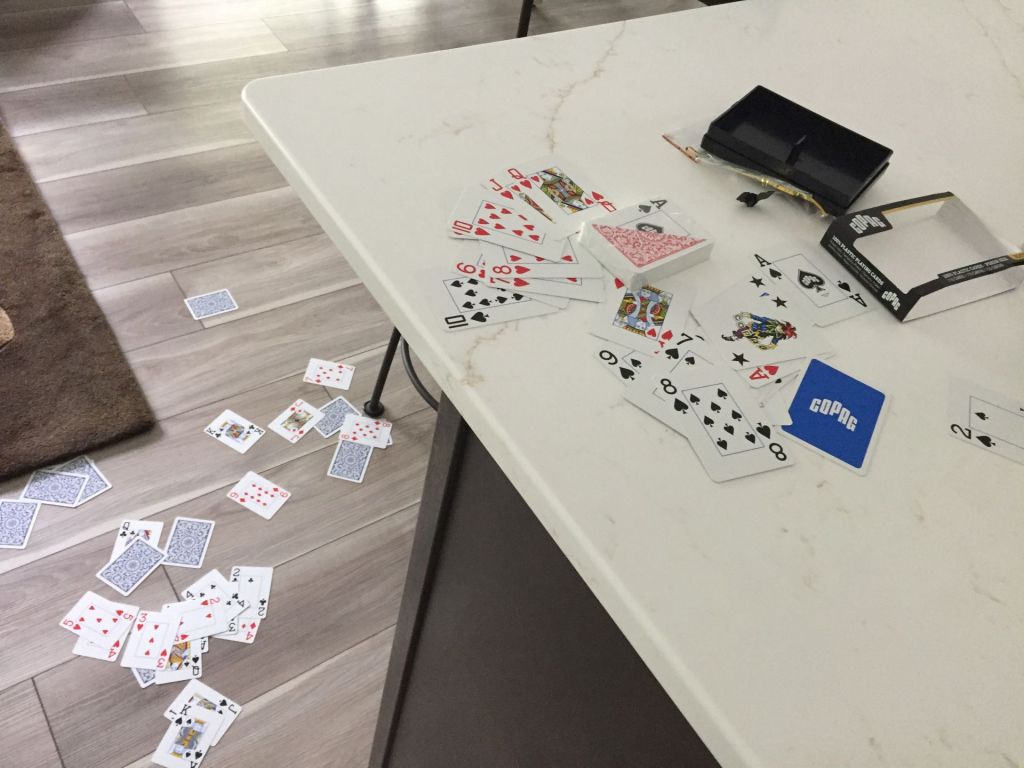
We got new stuff! We really needed new, durable playing cards and so we have a brand-new set of plastic playing cards. They’re really slippery and I dropped them on the floor right away. They float and glide on every surface. They fit in our automatic card shuffler, though. I haven’t yet tried to shuffle them manually. We played cribbage with them and I’m glad we didn’t try that tonight.
The other new thing is a new coffee: Houston White Brown Sugar Banana flavored coffee. I’m not sure about it but if I turn into an extraterrestrial, I’ll warn you.



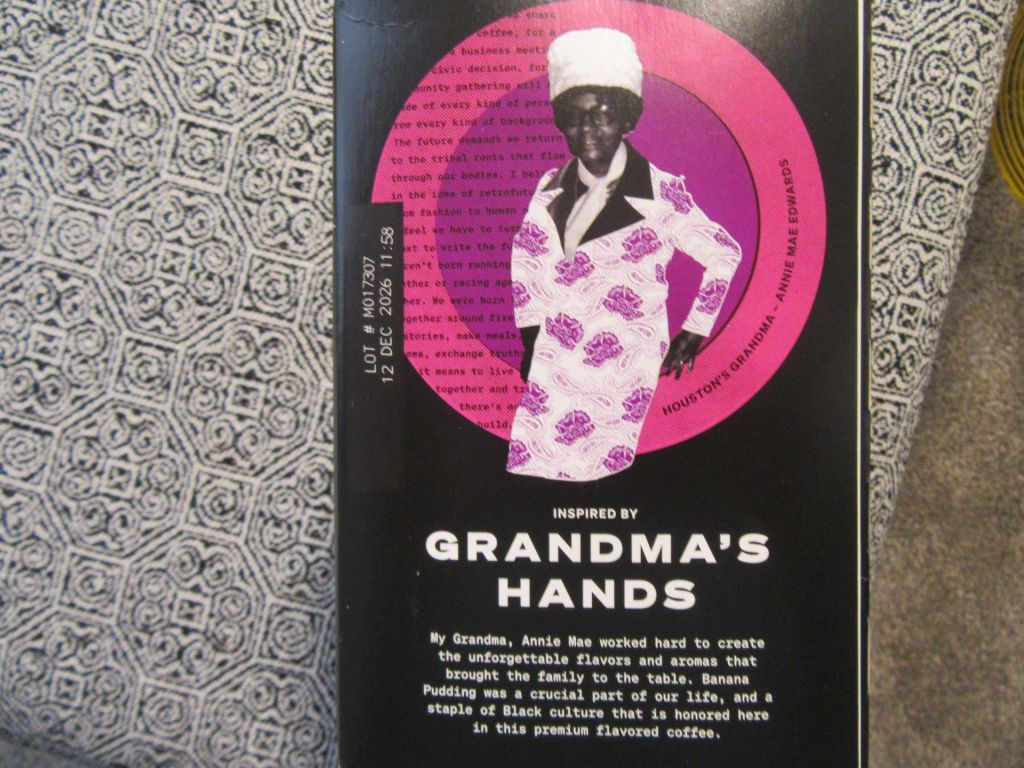
Houston White runs The Get Down Coffee Co. It’s distributed out of Minneapolis, Minnesota. They put 5% of their profits back into the community of Camdentown North Minneapolis.
It’s inspired by Grandma’s Hand, who evidently was a miraculous cook. Anybody who recognizes the words Grandma’s Hands also knows that it’s the title of a song by Bill Withers.
Hearing an Old Song

I have to admit that I’ve been mis-hearing some of the lyrics of one of my favorite songs, “Lean on Me” for the past fifty-odd years since Bill Withers wrote it. It stayed on the top of the charts for more than 3 weeks back in 1972. That was a special time in my life; and not an easy one.
Back then, you couldn’t just look up song lyrics or anything else for that matter on the world wide web. It didn’t exist yet. I’ve always been prone to mondegreens and I finally found out that I was hearing something different in the verse:
“Please swallow your pride
if I have things (faith?) you need to borrow
For no one can fill
those of your needs
That you won’t let show”
Just to let you know, I found lyrics in one YouTube that substituted the word “faith” for “things”. Think about that one. I don’t know how to settle it, so if anybody knows which word is right, please comment. Anyway, it’s a little embarrassing and revelatory that I heard “…if I have pain…” instead of “…if I have things (or faith)…” And I never really heard “…That you won’t let show.”
Yet I lived it.
Years later, after I’d finished college, medical school, residency in psychiatry, and had taught residents and medical students at the University of Iowa for a number of years, one of my colleagues, Scott, a brilliant psychologist and writer, stopped by my office one day. This was years ago.
His name is Scott and he suggested that it would be nice to get together sometime soon to catch up. I deferred and I remembered he replied while looking off down the hallway, “I’m 70.” I wonder if he meant he didn’t know how much more time he had left.
Scott and I had taken similar paths in the middle of our careers at Iowa. I wanted to try private practice and left for Madison, Wisconsin. Scott got the same idea and left for a position in Hershey, Pennsylvania. We both regretted it and soon after returned to Iowa. I swallowed my pride and came back because I loved teaching. I think he returned for the same reason. We were both grateful that the UIHC Psychiatry Dept. Chair, Bob Robinson, welcomed both us of back.


I touched base with Scott a little while ago. We’re both retired. I was trying to find out how to contact Bob about messages I was getting from the publisher of our consult psychiatry handbook. Neither Scott or I could find out what was going on with Bob, who retired several years ago and moved back East. It turned out he had died. Sometimes we all have sorrow.
Scott is my friend, and I leaned on him a long time ago. I’m unsure if I let it show. I’m 70 and I’m grateful to him.
On that note, I’m finding out that I can’t walk all the way to the mall and back anymore. On the other hand, I can walk about half that distance. It’s about a mile and a half out to the Clear Creek Trail and back. There’s a lot of uphill and downhill stretches along the way. I can manage that.
And Sena bought me a couple of pairs of new shoes that I’m breaking in that will probably be easier on my feet and my calves. They’re Skecher slip-ons, not to be confused with the no hands slip-ins. I’m used to slip-ons. I tried one pair out today, in fact. Before I left, I took a few pictures of Sena’s new garden. As usual, she’s planting new flowers. The dogwood tree looks great. She’s even excited about the wild phlox. I can’t keep track of everything else out there. She makes the beauty out there.
And I lean on her for that.


Music and Change Go Together
We listened to the Big Mo Blues Show last night on KCCK radio 88.3. It was recorded and we noticed that he sounded younger for some reason. Once he remarked that things were difficult because of having to “shelter in place.” The format of the show was different from usual.
That made me wonder if the show was recorded sometime during the Covid pandemic. I’ve been listening to Big Mo for a long time. John Heim, aka Big Mo, been doing the Friday Blues show since about 2005, according to one news story. Another KCCK legend, Bob DeForest, has been doing the Saturday night blues show for over 30 years now.
John Heim, aka Big Mo is still going strong. I think I’ve been listening to his show for about as long as he’s been doing it. He has come back strong since an accidental fall in 2018 in which he sustained a neck injury which led to a long rehab stint. But he’s back.
There have been interesting additions over time, like the Shout-Outs, the Concert Calendar, the Bodega Bay Weather Report, the Big Mo Pod Show in which he and producer Noah on Saturday discuss the music selections he made on Friday. The comedy bits have also been interesting, like MayRee’s hand-battered catfish (It’s better because it’s battered!).
Last night, we heard a couple of songs which we both liked. One of them was “She Don’t Live Around Here” by Samantha Fish. I heard it for the first time on the Big Mo Blues Show and just about every time I hear it, the hair on the back of my neck stands up. I’ve read that music will do that sometimes, although I can’t remember getting that sensation before.
We both liked Delbert McClinton’s rendition of “I’ve Got Dreams to Remember.” He’s had a huge career. Sena asked me if he’s still alive and I foolishly guessed that he died. Nope, he’s 84 years old and evidently still going strong.
I have a personal top ten songs, most of which I’ve heard on the Big Mo Blues Show. They’re not in any particular order. A few of them I like mainly because of the artist’s voice, like Samantha Fish and James Carr.
“She Don’t Live Around Here” Samantha Fish
“The Dark End of the Street” James Carr
“Everyday Will Be Like a Holiday” William Bell or Eric Clapton
“Lean On Me” Bill Withers or Keb Mo
“Mockingbird” Larkin Poe
“I’ve Got Dreams to Remember” Delbert McClinton (written by Otis Redding)
“You Were Never Mine” Delbert McClinton or Janiva Magness
“A Change is Gonna Come” Sam Cooke
“Over The Rainbow and What a Wonderful World” medley Israel Kamakawiwo’ole
“You Can’t Teach An Old Dog New Tricks” Seasick Steve
Lately, Big Mo has played Larkin Poe’s “Mockingbird” a fair number of times. I think one interpretation of it is that people’s sense of their identity tends to evolve over time. At different times in your life, you’ll take on a new voice, so to speak, which fits with the idea of the many songs the imitative Mockingbird sings.
Some songs I like because of the message, like “Lean On Me,” or “A Change is Gonna Come.” And I like the song “You Can’t Teach An Old Dog New Tricks” just because I identify with it. I realized that runs counter to the theme of many songs, which are often about change: people change, the times they are a’changing, and the like. So, my top ten song list will probably change, too.
University of Iowa Will Lead NASA Space Mission to Learn the Music of the Spheres

The big news for University of Iowa will be a NASA satellite mission to investigate how solar wind interacts with Earth’s magnetosphere. You can read the whole fascinating story in this issue of Iowa Magazine.
According to the story, “twin spacecraft known as TRACERS—Tandem Reconnection and Cusp Electrodynamics Reconnaissance Satellites—will begin their journey to study Earth’s mysterious magnetic interactions with the sun. The satellites will be packed with scientific instruments along with two small, but meaningful, tokens.”
The two small tokens happen to be purple guitar picks that belonged to University of Iowa physicist, Craig Kletzing, who died from cancer in 2023. Kletzing and colleagues got a $115 million contract from NASA for TRACERS. It’s the largest research award in University of Iowa history.
Kletzing played guitar in a few bands, and one them was named Bipolar—which is the only connection to psychiatry that I could see. He was dedicated to work in basic science, and he was often heard to ask “How can we make this simpler?” referring to chunking big scientific challenges into manageable goals. He was a rare person in that he was both a brilliant scientist and a great teacher. One example of his work ethic was that he skipped a meeting with NASA’s top brass in order to deliver a morning lecture on introductory physics to 275 students.
The members of the UI TRACERS team call the project “Craig’s mission.” I’m pretty sure he would have called it a team effort “… to help scientists better understand the powerful forces harmonizing throughout the universe—something the ancient Greeks described as the music of the spheres.”
And that’s what the purple guitar picks represent.
The Best Cribbage Song You Never Heard Of
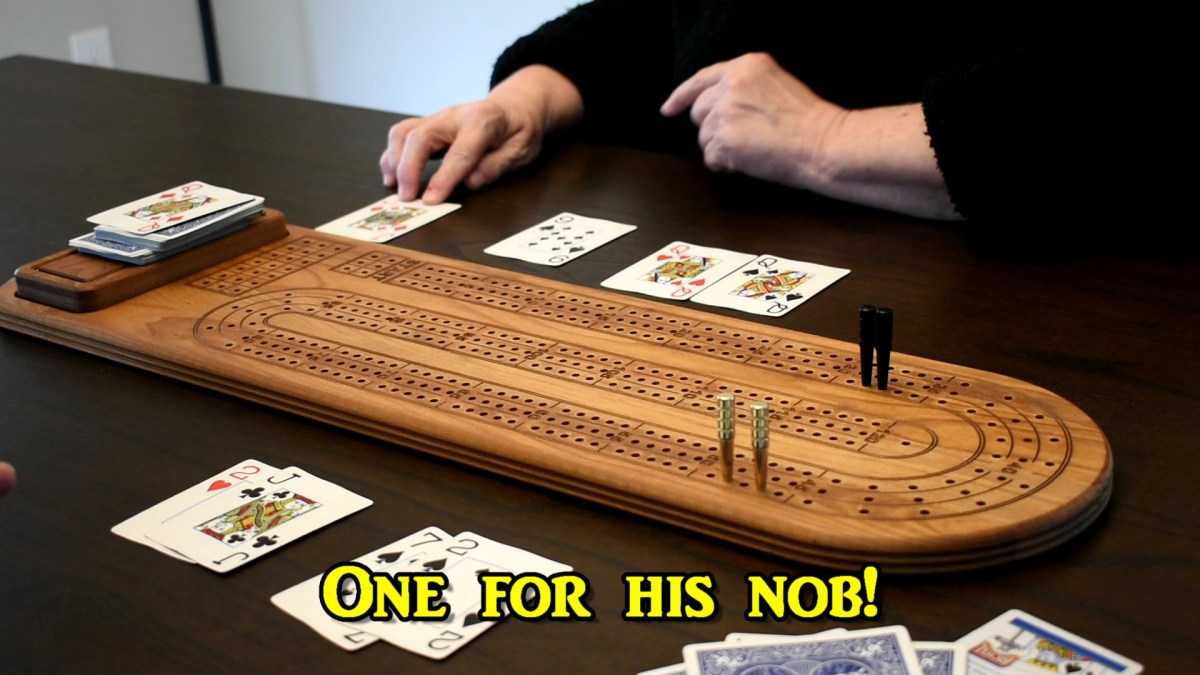
I was looking for fun cribbage facts the past few days and while I couldn’t find any good cribbage jokes, I did find an interesting song about cribbage called “One for His Nob (The Cribbage Song.” It was done by a British artist, Richard Thompson. It’s included with another song by him entitled “Meet on the Ledge.” See the credit below and in the YouTube video description.
ADDENDUM 7/16/2025: The video below for the song “One for his nob” has vanished, unfortunately. I found another one called “The Crib Song” by Brett Kessler. You can find out more on my post from 7/16/2025 “Whoops, The One for his nob Cribbage Song Vanished.”
Anyway, the song “One for his Nob” is full of references to cribbage lingo, a lot of which is hard to catch because the tune is so fast. One of the terms is “19 in the box,” which refers to a score of zero in what American cribbage players call the “crib.” A no score in cribbage is often called 19 because that score is impossible. The term “one for his nob” is also standard cribbage lingo for holding the Jack of the same suit as the cut card.
Sena and I thought it would be fun to record a video of us playing cribbage so we could play it back along with Thompson’s song. The thing is I had to speed up the video because it took us a little over 10 minutes to play a cribbage game just to 60 instead of 120. It felt frenetic, but it fits the song a little better because the song is 2 min and 44 seconds long.
If you play the YouTube vide of “One for His Nob” just right and watch our speeded-up video of us playing cribbage, it’s funny. In fact, it just so happened that Sena scored a point twice in the game because she got the nob Jack in two separate hands.
I’ve included the regular speed video of our cribbage game for comparison.
“One for His Nob” is a song about cribbage recorded by British singer-song writer Richard Thompson. It was published by Avon Records and released on July 1, 2015.



The Big Mo Pod Show: “Variety is the Spice of Life”

We heard the Big Mo Blues Show last night and heard a couple of tunes that were fun. One of them was mentioned on the Big Mo Pod Show today, “Feelin’ Alright” by Stuff. The other was a riot but was not on the podcast, and it was “I Feel So Good (I Wanna Boogie” by Magic Sam.

Big Mo Pod Show 085 – “California Bluesin” – KCCK's Big Mo Pod Show
After a short break during the Thanksgiving holiday your hosts are back at it again with another episode! This week features the usual mix of blues eras you’ve come to expect along with a few Californian artists, tune in to see which ones! Songs featured in the episode: Solomon Hicks – “Further On Up The … Continue reading
The one that brought back memories was “Feelin’ Alright” by Stuff. It sounded so familiar and we finally figured out it was a cover of song of the same title and sung by Joe Cocker (the one I remember). However, I guess it was originally written by Dave Mason of the group Traffic in 1968. And there’s even an album “Joe Cocker With Stuff Feelin’ Alright.”
The one Big Mo played last night was from the album Stuff Live at Montreux 1976. It was instrumental and hard to recognize at first. The lyrics are sad, though and it’s about unrequited love, I guess. I associated it years ago with drug and alcohol addiction after seeing the 2012 movie “Flight” on TV. Every scene in which the main character Whip Whitaker (played by Denzel Washington) got high, that song was a part of the scene.
Anyway, moving right along, the song that was not on the podcast and which was a whole lot of fun to listen to was “I Feel So Good (I Wanna Boogie) by Magic Sam. We’ve never heard of him but the way he sang the number made us laugh out loud.
The title of the podcast was right on target: “Variety is the Spice of Life.”
Big Mo Pod Show: “Blues: The Universal Mixer”
We listened to the Big Mo Pod Show (Sena stuck with it for about the first hour anyway) last night and then I got a mini-education in the forms of music, at least, as it relates to timing and rhythm. The theme was “Blues: The Universal Mixer.” Frequently, the blues show and the podcast remind me of previous eras in my life and lead to a few free associations.
Big Mo Pod Show 085 – “California Bluesin” – KCCK's Big Mo Pod Show
After a short break during the Thanksgiving holiday your hosts are back at it again with another episode! This week features the usual mix of blues eras you’ve come to expect along with a few Californian artists, tune in to see which ones! Songs featured in the episode: Solomon Hicks – “Further On Up The … Continue reading
The 5 songs reviewed by Big Mo and Noah are probably recognizable to many listeners. As usual, I have to search for the lyrics because I seem to have an inborn tendency to hearing mondegreens. And as usual, I don’t always pay the most attention to the songs chosen for the podcast.
But Big Mo did a little teaching session about rhythm forms, which he related to a couple of songs on the list. One of them was “Wait on Time” by The Fabulous Thunderbirds. I happened to notice that a couple of lines in the lyrics of “Wait on Time” reminded me of another artist who didn’t make it to the list on the podcast but was on the blues show playlist last night. That was Junior Walker and the All Stars. Their song “I’m a Road Runner” was one of my favorites because it reminded me of how I ran all over the hospital as a consult psychiatrist. But I can’t relate to the song as a whole.
The lines the two songs share are:
“Wait on Time” lyrics:
“Well, I live the life I love
And I love the life I live
The life I live baby
Is all I have to give”
“I’m a Road Runner” lyrics:
“And I live the life I love
And I’m gonna love the life I live
Yes, I’m a roadrunner, baby.”
Although the lyrics are similar, the themes are different. The guy in the song “Wait On Time” is promising he’ll get back to his lover someday. On the other hand, in the “I’m a Road Runner” lyrics, that guy is making no such promise and is actually is saying just the opposite.
Big Mo pointed out that there is a common rhythmic form in blues that easily mix with other forms of music, including Latin forms (I don’t understand that music lingo but I think I hear and feel what he means). He mentions that Bo Diddley mixed certain rhythms like that into his music, which surprised me because I didn’t know that. It may be why I like Bo Diddley.
Big Mo didn’t play “I’m a Road Runner” last night but played another hit from Junior Walker and the All Stars: “Ain’t That The Truth.” Just an aside, that tune is mostly instrumental and has a total of only 4 lines apparently, which express a common blues sentiment about relationships:
“Say man, what’s wrong with you?
Oh man, my woman done left me
Say it, man, play me some blues, jack
Get it, baby
Ain’t that the truth”
Several artists covered “I’m a Road Runner” including but not limited to the Grateful Dead and Steppenwolf. Bo Diddley did a song called “Road Runner” but it was not the Junior Walker tune. There’s a YouTube video relating it to the cartoon Roadrunner and Wile E. Coyote.
I’m not a roadrunner by any definition, but I learn a little something new just about every time I hear the Big Mo Pod Show.
Remarks on Svengoolie TV Movie Phantom of the Opera 1943 and More

We watched Phantom of the Opera (1943 version) last night. And then, just for good measure, we watched the Phantom of the Opera (1925 silent film) today. We watched the latter on the Internet Archive.
I’ll say one thing, the absence of commercials in the 1925 version is great. Even though I like cornball jokes on Svengoolie, it’s good to have a break from that too sometimes.
We’ve never read the novel by Gaston Leroux but there’s a pretty good Wikipedia article about it. We’ve never seen the Andrew Lloyd Webber stage version nor the 2004 movie.
That said, we’re struck by the differences between the 1925 and 1943 versions. It’s difficult to develop any sympathy for the Erik the phantom (played by Lon Chaney Sr. in 1925). He’s pretty much a monster from beginning to end. We tend to think that it’s easier to be sympathetic to Erique Claudin (played by Claude Rains in 1943) who has a rough path downhill after losing his job and a place to live early on, inability to sell his concerto or get a date with Christine and so on, after which he starts killing people left and right.
It’s worth pointing out that in Leroux’s book (according to the Wikipedia article), the phantom’s childhood was pretty traumatic because he was born ugly and deformed, which didn’t endear him to his mother. She was simply not good enough, which I think appeals to my training in psychiatry.
The 1943 film was pretty comical at times. For example, the two guys competing for Christine’s attention, singer Anatole (played by Nelson Eddy) and Raoul (played by Edgar Barrier) get stuck in doorways and eventually end up going to dinner together instead of one or the other going out with Christine. Their forced politeness with each other in front of Christine is priceless.
On the other hand, the 1925 version is a little more like what you’d expect from a movie on the Svengoolie show—it’s a horror flick, only classier. Lon Chaney’s makeup job makes him look like a proper monster, which made women faint according to some articles. Claude Rains’ makeup is barely suggested on part of his face.
The murders committed by the phantoms in both movies are bloodless, although the comedy in the 1943 version distracts you from what you expect; for example, after the Phantom drops the huge chandelier on the audience. No mangled bodies or gore, move along, nothing to see here. People continue to sing, dance and cavort, possibly hopping over any corpses lying about.
There was mostly dark music in the 1925 Phantom of the Opera film. However, in the 1943 version there was lullaby theme that ran throughout and was even a point of connection between Christine and the ill-fated Erique. Somebody found a full version of it years later, entitled Lullaby of the Bells. The one who posted it mentioned the composer and the performer.
 Go Retire Psychiatrist