Working on a Simple Plan to Stay Fit?

I saw a couple of web resources about staying healthy and fit that seem to make sense to me. One of them was actually a YouTube video by a personal trainer advising people to stop doing certain kinds of workouts that could be unhealthy. He recommended avoiding certain kinds of weight lifting exercises, especially for those over 40. I’m way over 40 and I agreed with him.

The video was posted about 2 months ago and there are so far 725,000 view and well over 2,000 comments, both for and against the trainer’s advice. Many of the older commenters disagreed with slowing down after the age of 40.

I’m 70 and I’m a minimalist when it comes to exercising. I’ve slowed down from daily exercise, but I still enjoy juggling, riding an exercise bicycle, limited use of dumbbells, body weight squats, a step platform routine, planks, stretching and wrestling grizzly bears. I occasionally go for walks when the weather permits.

I remember trying to lift really old barbells in the free weight room at the YMCA when I was a kid. I dropped them once and the director directed me out of the room. After they got a weight machine, a guy bet me and a friend a dollar that he could jump over a broom handle (in another variant of this stunt you try to jump over a dollar bill, I think) while bent over and grasping his toes. He did it but we couldn’t. We didn’t pay him any money. I still can’t do that trick. Nobody recommends doing this as a regular fitness exercise.

On the other hand, patient YMCA teachers taught me how to swim and helped me get over my severe headaches related to my initial fear of the water.

The other web source is an article that actually recommends we stop focusing on working out. In fact, the title is “Stop focusing on working out”—a professor says you should follow these five science-backed steps to improve your wellness instead.”

There are so far no comments on it. The authors have five suggestions:

Make movement fun

Be socially active

Use mindfulness as a stress buster

Be kind to yourself and others

Prioritize quality sleep

The last one usually is difficult for me. Ever since kindergarten, when the teacher wanted the class to take a nap, I’ve had trouble sleeping. The teacher never understood that. I also tend to be shy. I like playing cribbage, though my wife is my only partner. I still practice mindfulness meditation. Juggling is a fun movement activity and it’s also beneficial exercise.

I think it might be a little safer to try to jump over a dollar bill while squatting and grabbing your toes than squatting with barbells if you’re 70. You’re welcome. That’ll be one dollar, please.

Sit and Rise Exercise Related to Longevity?

I just read a few news articles and saw a couple of videos on something called the sit and rise or sitting rising exercise. It’s not the same as the sit to stand exercise, which is how many times you stand up from a chair without falling down after drinking several beers. The sit and rise exercise is sitting down and then standing back up in a cross-legged position.

Just to let you know, there are dozens of news stories that claim if you can’t do the sit and rise exercise without using one or both hands or a crane to get back up, you’re marked for death within hours. Make sure your last will and testament is notarized.

OK, I also saw a Snopes fact-check story about the sit and rise thing and it’s a myth that the inability to do it predicts mortality within a few years. It does indicate you have problems with mobility and that could be from a number of factors, including previous joint injuries and not having legs. Check a full-length mirror.

Apparently, there was a study done in Brazil in 2012 that got this story going about imminent mortality if you can’t do the sit and rise cross-legged routine. It looks like there have been news stories about it every year or so since then just to scare old people.

I can’t do the sit and rise cross-legged and wondered if there’s some kind of trick to it. There isn’t and the main problem according to experts are weak glutes. And I’m able to stand on one leg for 30 seconds and I can do 3-4 reps of the single sit to stand exercise on both legs. I also have no problem getting up from a chair from a sitting position without pulling myself up using grab bars or having somebody haul me up with a tow chain.

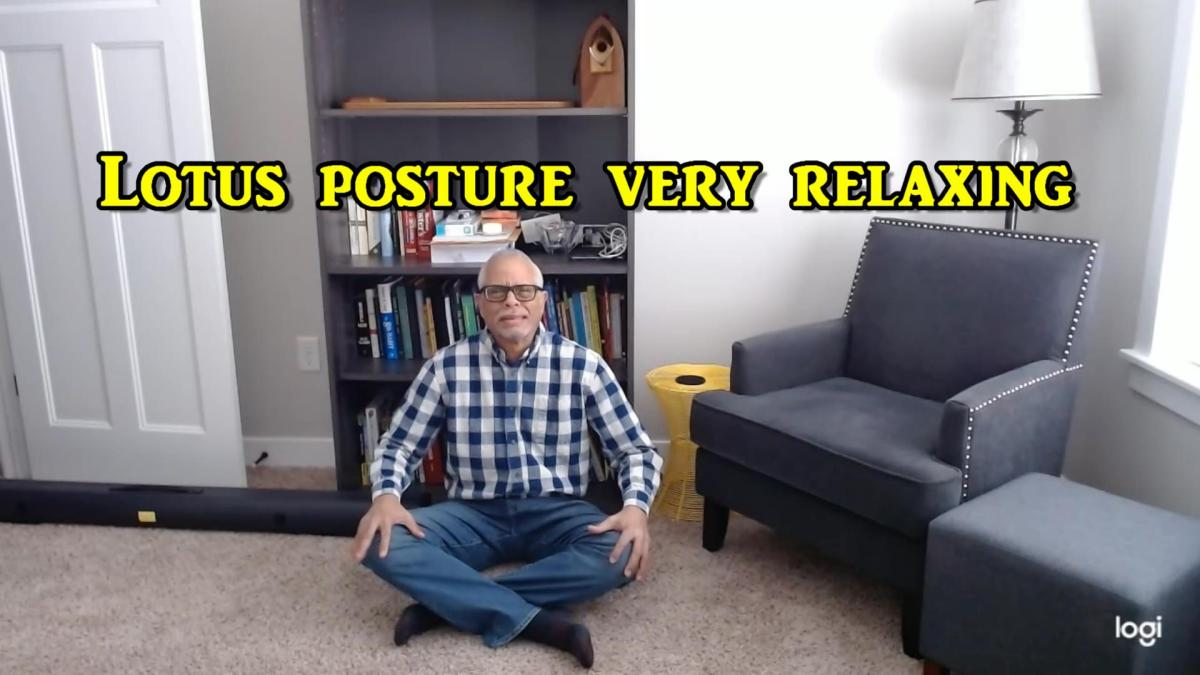
I can’t remember a time when I could even sit cross-legged, although I guess I did when I was in kindergarten. When I took a Mindfulness Based Stress Reduction (MBSR) course, I had to try to sit cross legged to meditate and I was numb in my hips and knees within a couple of minutes. When I got up, I usually fell over, sustained a minor head injury and was rushed to the ER about 1,200 times (“It’s Dr. Amos again; he’s been trying to sit in that lotus position” “OK, put him in the rack.”).

There’s a web page that gives advice on how to fix a problem with not being able to sit in a crossed leg position for longer than a minute. The author provides a short list of exercises without instructions for how to do them:

Child Pose: I imagine this resembles standing pigeon-toed, holding your crotch and dancing around a little about an hour after drinking a half-gallon of Kool-Aid.

Pigeon Pose: This is kind of like the Child Pose only it’s done while pooping on the head of a statue.

Toe Touch: Self-explanatory but apparently you can touch anything with your toe as long as it’s not something recently expelled from a pigeon.

Vajrasana: It involves contacting extraterrestrials who will assist you by inserting various probes in several orifices while you remain very still to allow the tracking device to be correctly installed.

Lung Pose: I’m not sure how this strengthens your glutes but obviously it involves surgery. Check your insurance.

Bridge Pose: This might tone your glutes if you dive off a bridge without a parachute. Make sure your life insurance policy is up-to-date.

That about does it for the sit and rise cross-legged issue. Remember, it’s only when you do it while cross-eyed that all the trouble starts. Glad I could clear that up.

This essay is satirical.

Three Photos to Share for Mental Health Awareness Month

So, I have to hurry up and get these 3 photos posted for today because it’s getting pretty late. Recall the Iowa Healthiest State Initiative calendar along with my photos to share:

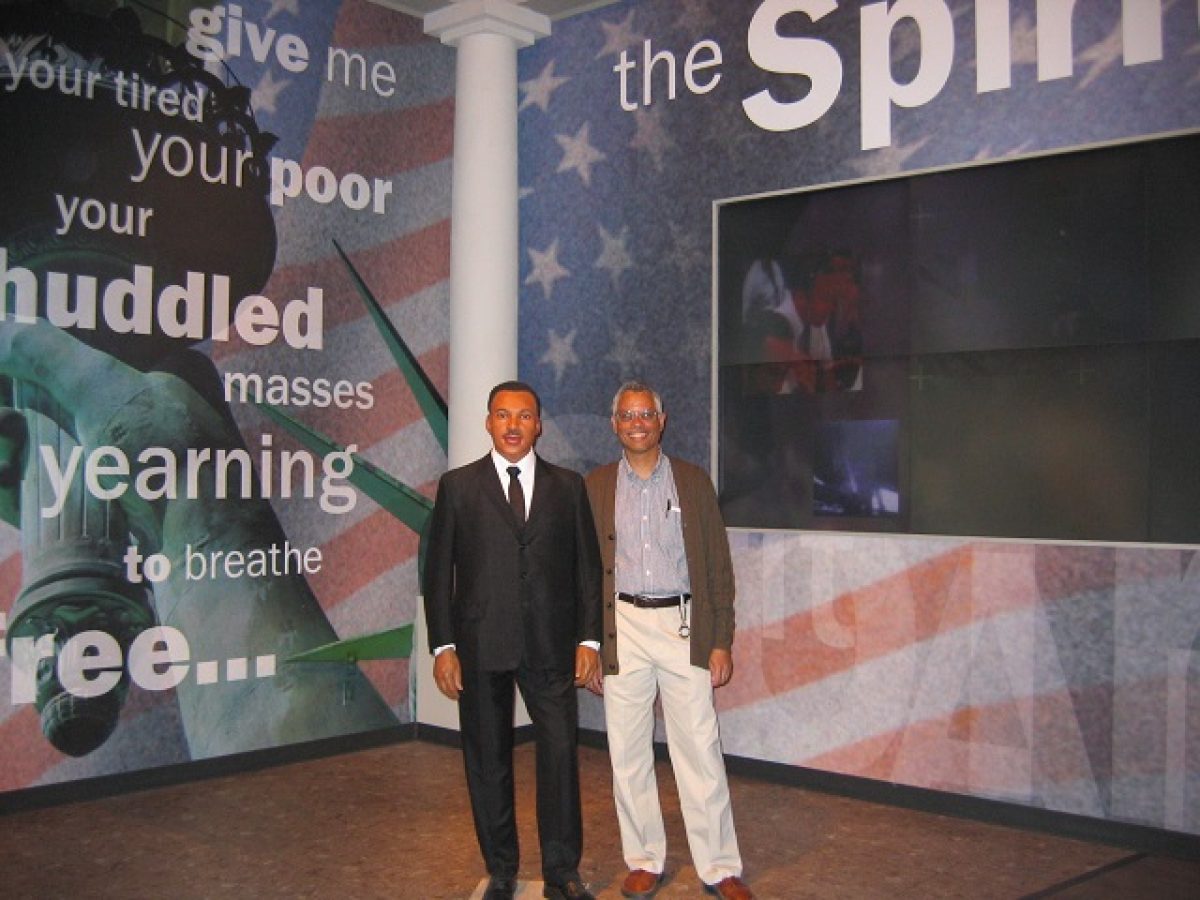
The images are important features of events in my life or my sense of humor.

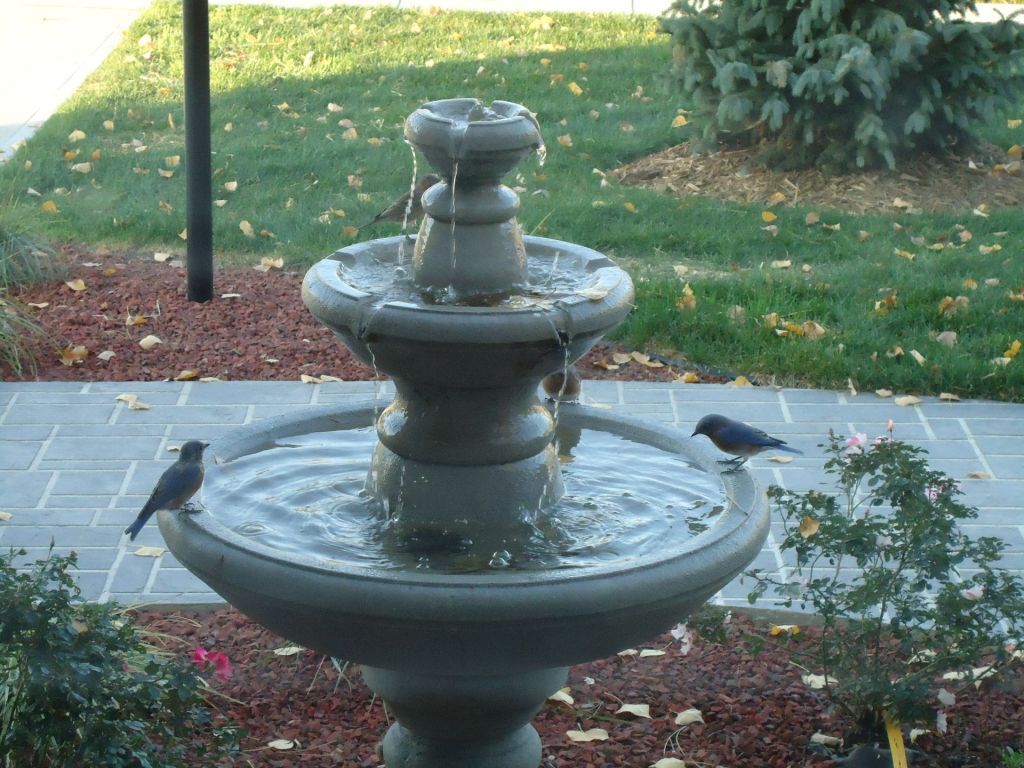
I’m a birdwatcher and many different species of birds visited the fountain. The fountain attracted bluebirds who splashed and even swam in it. That fountain was very heavy. We couldn’t leave it out all winter. In the fall I had to lift the bowls off and move them somewhere else. Moving them entailed lifting them onto bags of mulch so as to reduce the work of hefting them a small distance at a time. The birds were beautiful to watch.

The letter was a class assignment our Mindfulness Based Stress Reduction (MBSR) teacher had us write at the beginning of the class. After we graduated, she mailed us those letters shortly thereafter. We were to write something connected with what we thought we had gained or what we thought might happen after taking the MBSR class. The book might seem out of place, and while I can’t talk much about Gordon Strayer, I did meet him and read his book (which is now long gone; probably lost in a move). I admired him. I don’t think he feared death.

The Chrysler Building reminds me of the Men in Black (MIB) 3 movie, and I included it because my sense of humor is very important to me. In the movie, Agent J and Jeffrey Price have this funny conversation about time travel back to an era that was not the greatest for black people. I know because I lived through it. Agent J is about to use the time travel device which involves jumping off a tall building (it’s a “time jump!”). Agent J is preparing to travel back in time to M.I.B.’s early days in 1969 to stop an alien from assassinating his friend Agent K and changing history. They have this short conversation:

Jeffrey Price: Do not lose that time device or you will be stuck in 1969! It wasn’t the best time for your people. I’m just saying. It’s like a lot cooler now.

Agent J: How will I know if it works?

Jeffrey Price: You’ll either know…or you won’t.

Juggling Concentration Meditation

I haven’t done a juggling YouTube video in a while, and lucky you I made one. When the daily news gripes me or gets me down, juggling forces me to concentrate on just that—juggling. If I break my concentration for any reason, I literally drop the ball.

I’m limited a little in our new house because of the lower ceiling height, risking a throw into the ceiling lights. And I’m still prone to flinging and dropping balls, depending on the trick I’m practicing. So, I go downstairs to practice more difficult juggling tricks.

So, if you need a special kind of focused attention meditation, try the 100-throw cascade.

Thoughts as Train Cars Visualization in Mindfulness Meditation

The Iowa Interstate Railroad train rumbles past our hotel a few times a day and it reminds me of the Mindfulness Based Stress Reduction (MBSR) course I took 10 years ago. One of the exercises the instructor mentioned was the train visualization mindfulness exercise. I don’t know if I remember what our instructor actually said about it, probably something like what the instructor says in a mindfulness video.

One thing I do remember is that it’s OK to notice my thoughts as train cars running through my head. The other thing is the train cars can sort of hijack me and off I go on a tangent, like a hobo hopping a freight car. And, what if also I notice the spaces between the train cars? What would that be like?

The side of my nose itches.

My left eye is tearing up.

What can I do about anything?

Are we all alone in the universe?

Why is David Attenborough’s voice so calming?

Why do I joke around so much?

Even after 10 years of mindfulness practice, I still notice my thoughts jumping around. I’m still hopping from box car to box car.

Is it About the Nail or Not?

I saw this essay about getting your hamster off the treadmill and being in the moment. It’s not just for University of Iowa employees.  I do the mindfulness thing, I juggle, I make dumb YouTube videos. And for a little over a month now, I have not scrolled past the first few headlines at the top of the on-line news outlets. It’s a little easier than I thought to give up FOMO zombie-scrolling news habit, if you can even call it the news.

And the nail video is a hoot.

Jim Updates His Workout and Adds a Step Counter!

Since we added the step platform, I’ve been wondering how to count steps when I use it because for some reason my smartphone step counter won’t count steps when I try to use it on the platform.

Sena got a handy step counter and it works! It works if you have it in your pocket or wear it on neck with a lanyard.

I usually practice juggling patterns as a warm up to exercising. I’m still working on the shower pattern. Progress is slow.

My exercise routine takes a half hour. Following that I sit for mindfulness meditation for 30 minutes. We are still using our anti-Peloton exercise bike. I do one leg stands for a minute on each leg. I still do floor yoga, body weight squats, planks, and dumbbells. I still count my own steps on the platform: 50 steps alternating right and left leg four times (200 steps). The counter number varies between 170-200 or so.

As a review, a recently published study found that climbing 5 flights of stairs (approximately 50 steps) was associated with a lower risk of ASCVD types independent of disease susceptibility (Song et al, see reference below). There was a threshold effect of stair climbing in the study, meaning the benefit was lost if you went over a certain number of “floors.” Going over 15 or 20 didn’t gain much for subjects. A flight was 10 stair steps.

Step up!

Reference:

Song Z, Wan L, Wang W, Li Y, Zhao Y, Zhuang Z, Dong X, Xiao W, Huang N, Xu M, Clarke R, Qi L, Huang T, Daily stair climbing, disease susceptibility, and risk of atherosclerotic cardiovascular disease: A prospective cohort study, Atherosclerosis (2023)

A Study Shows Mindfulness Is Non-Inferior to SSRI for Anxiety Disorders And What the Heck Does That Mean?

I ran across this study showing Mindfulness Based Stress Reduction (MBSR) is “noninferior” to escitalopram in the treatment of adults with anxiety disorders.

I passed my Biostatistics course in medical school—barely. I have been practicing MBSR daily (for the most part) since 2014 when I really needed to address my struggle with burnout. I’m probably a worrier but I doubt I have a clinically significant anxiety disorder. I’m admittedly biased in favor of MBSR. Otherwise, I wouldn’t still be practicing it after about 10 years.

On the other hand, I don’t have a great handle on the statistical concept of noninferiority in clinical studies. I found a little YouTube presentation on it and I think I’m a little more comfortable with it now. I said “a little bit.” I’m not taking questions.

Reference:

Hoge EA, Bui E, Mete M, Dutton MA, Baker AW, Simon NM. Mindfulness-Based Stress Reduction vs Escitalopram for the Treatment of Adults With Anxiety Disorders: A Randomized Clinical Trial. JAMA Psychiatry. 2023;80(1):13–21. doi:10.1001/jamapsychiatry.2022.3679

How the Metta Prayer and the Shower Juggle Are Alike

I’ve been practicing mindfulness meditation since 2014, when I became uncomfortably aware of how unpleasant I was becoming on the job and elsewhere. I called this “burnout.” The word still works as an explanation although it was and is sometimes still an excuse.

I learned about the Lovingkindness meditation or the Metta Prayer during the Mindfulness Based Stress Reduction (MBSR) course I took almost a decade ago.

I used to pray when I was a child. I read the Bible and prayed. I viewed the act of prayer as a request to God back then. And I still probably regard the Metta Prayer as a kind of bargain between me and the cosmos or whatever it is I think of as a higher power.

Just because I say the Metta Prayer doesn’t mean that anybody’s going to treat each other differently. It doesn’t make people get up and square dance together. However, the caution about not expecting others to change just because you say the Metta Prayer doesn’t mean that the practice would not enhance a sense of community—if enough people did it.

There are dozens of scripts for the Metta Prayer easily accessible on the web. The part of it that is directed to those with whom I’m having a difficult time is tricky. Often enough, my goal is to use it as a way of somehow changing the person I’m having difficulty with. It’s the same way I used prayers as a child.

That’s a mistake, but at least I’m aware of it. Prayer is not a request for God or the cosmos to intercede on my behalf so that life won’t be so difficult for me sometimes.

I have trouble remembering that I’m not really a role model, especially nowadays. I’m just an old retired guy who was difficult to work with and needed to change, despite my status as a psychiatrist. I tell dad jokes and clown around but I’m still an old guy with problems—like just about every other old guy.

So, I’m still off and on practicing the Metta Prayer. I’ve noticed that practicing mindfulness is a lot like practicing juggling, which I’ve been doing for almost a year now. I still can’t do certain tricks, like the shower juggle. I can do about three or four throws and drop the balls, sometimes on my head (which is why I wear safety goggles!). And I still tend to use prayer like I’m negotiating a deal to get rid of my faults and troubles.

But I haven’t given up practicing the shower juggle. And I haven’t given up on the Metta Prayer.