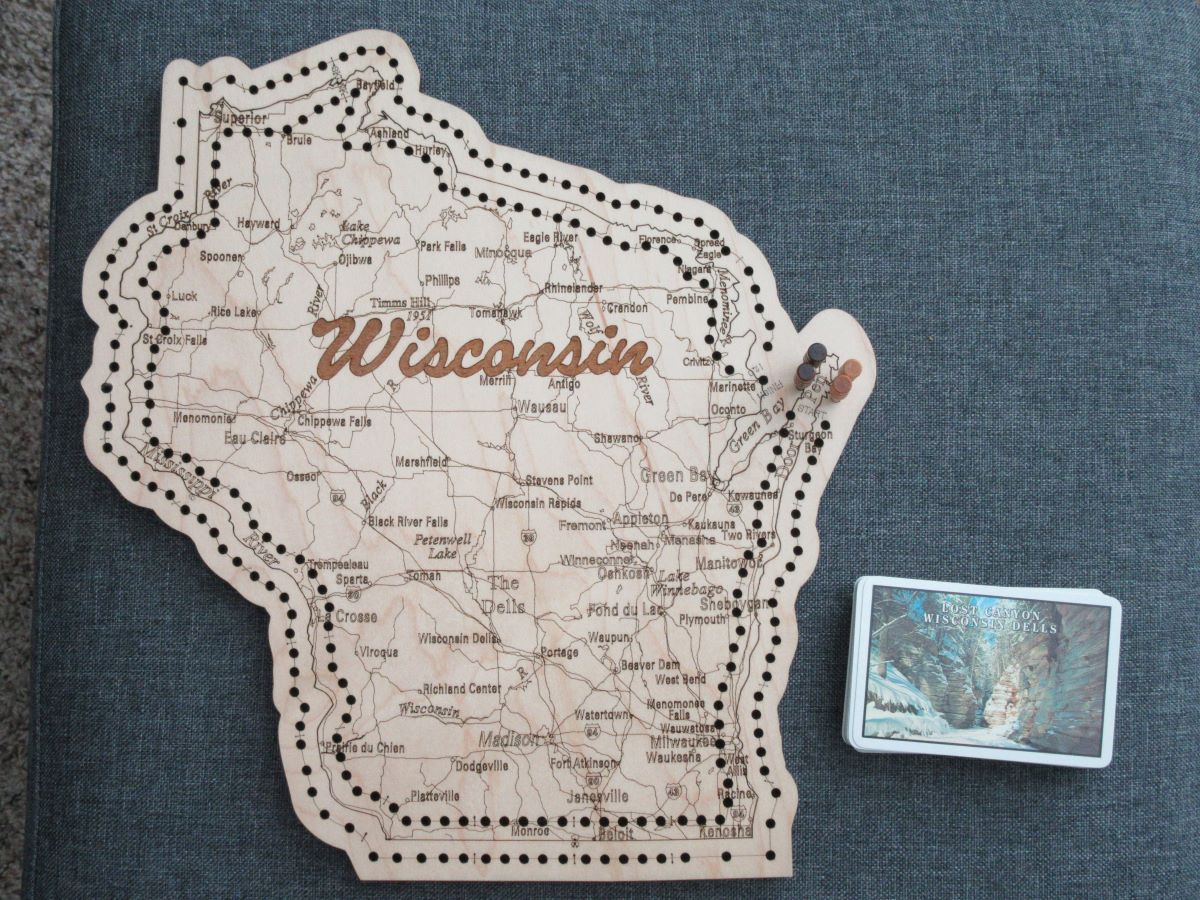
We got the Wisconsin state map cribbage board yesterday and there’s a little story behind it, right off the bat. It was delivered by the United States Postal Service (USPS) and I remember the slap as it hit our porch from the USPS worker just tossing the package.
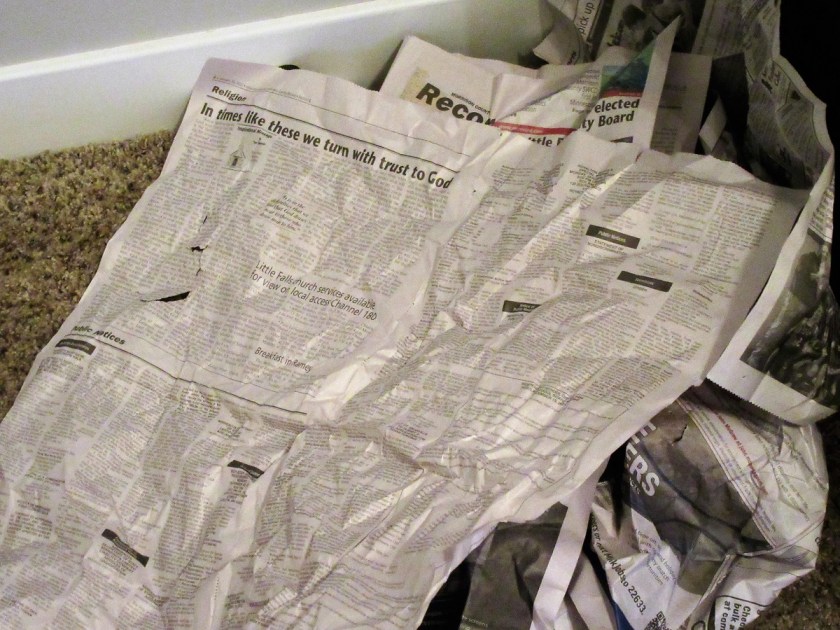
When we opened the package, it turned out to be not the board we ordered. It was not as thick as the Iowa cribbage board and it didn’t have a storage space on the back for pegs. The packing material for the Wisconsin board was not as interesting as that used for the Iowa board, which was packed using a local newspaper with a sermon on one of the pages, “In times like these we turn with trust to God.”
In contrast, the Wisconsin board was shipped from the same place in Minnesota, but this time in a plain white USPS envelope, conventionally secured with eBay tape, bubble wrap, and a plain brown shopping bag. No sermons.
Wisconsin cribbage board packing
Sena arranged to return it for a refund (which was the only choice other than having the exact same item reshipped from the seller), carefully rewrapped it and drove out to a couple of the UPS stores—both of which happened to be closed yesterday. She was late by just a couple of minutes.
This morning we noticed that the seller sent an email apologizing about shipping us the wrong board and offered us the choice of shipping it back for the full refund or keeping it at 70% off the price. We took the latter.
We’re now brushing up on our memories of Wisconsin, chuckling at our snapshots, and considering using the deck of cards we got at Lost Canyon gift shop at Wisconsin Dells, where we took the horse-drawn wagon tour 13 years ago.
Since it’s the 2nd day of spring, we went for a walk on the Clear Creek Trail in Coralville (a stone skip away from Iowa City). The trees were bare except for the buds about to burst that Sena gets so excited to see this time of year.
The birds are shy because there’s not much cover. But they’re out. A Red-Headed Woodpecker peeked out at us from the top of a dead tree. A shy pair of Canadian Geese allowed themselves to be filmed briefly before paddling away.
There was still a little snow covering the creek, despite temperatures in the mid-70s.
Another great spring day. We’re lucky—and grateful.
I’ve been looking at my About Me page and see that it needs revising. I’m way past the stage of being in phased retirement and I’m pretty sure I can’t do without this blog—or at least some way to keep writing. I notice I said that I was not sure how long I’d keep blogging.
I recently updated my YouTube trailer. It’s my first attempt at an elevator pitch in years. It’s a 48 second video, probably the shortest video I’ve ever done. According to some experts, it’s 3 seconds too long. If you want to read the long version, it’s on this blog, “Elevator Pitch for a Very Slow Elevator.”
Anyway, I’ve been retired from psychiatry since June 30, 2020 (there was a minor clerical glitch in the exact date). My wife, Sena and I have gotten all of our Covid-19 vaccines—until they come up with more. We have made Iowa City our home for over thirty years.
We play cribbage. One of the most fun cribbage games we played was the game on the Iowa state map board. That was a blast. The video of it was over 10 times longer than most YouTube videos I make. That’s because the main reason for the game was to talk up Iowa. You really ought to visit, maybe even move here. You can get used to snow. I keep reading articles on the web telling me I’ve got to stop shoveling at my age. I’ll think it over.
We also like going for walks. One of our favorite places to walk is on the Terry Trueblood Trail. Sometimes you can see Bald Eagles out there.
I have not yet mentioned Consultation-Liaison Psychiatry, even once. That’s a big difference from the old About Me page. It was the first thing I mentioned then, because it was just about the most important role I had in life.
It took a long time before I began to question that once I retired—about a year or so. It was a lot like being a firefighter. In fact, my pager was the bell, and I even had a firefighter’s helmet, a gift from a family medicine resident who rotated through the psychiatry consult service. I didn’t wear it when I interviewed patients. It would have alarmed them.
I also carried around a little camp stool. It was because there were never enough chairs in patient rooms to accommodate me, the trainees, and visiting family. Often, I sent a medical student to find me a chair from out in the hall—until I got the stool. I slung it over my shoulder and away I went. I was sort of like the guy on that old Have Gun—Will Travel (paladin) TV show (a 1950s-1960s relic with a gunslinger called Paladin). Have Stool—Will Travel. A surgeon, who also doubled as a palliative care medicine consultant, gave me the little chair as a gift. I passed it on to a resident who took it with good grace.
I miss work a lot less now than I did when I left. I think I must have loved my work. Maybe I loved it too much, because leaving it was hard. There are different kinds of love. I love writing. I love long walks and watching the birds. And most of all I love Sena.
Love
I’m gradually replacing work with something else I love, which is writing. Mindfulness meditation and exercise also help. And let’s not forget, I change electrical outlets. I think I’ve changed just about every outlet (and many toggle switches) in the house. They ought to do away with those bargain bin plugs. Just because they’re cheap doesn’t mean they’re any good.
I’m not sure yet how I’ll edit the About Me page. Maybe I’ll just call the first one Chapter One and this one Chapter Two.
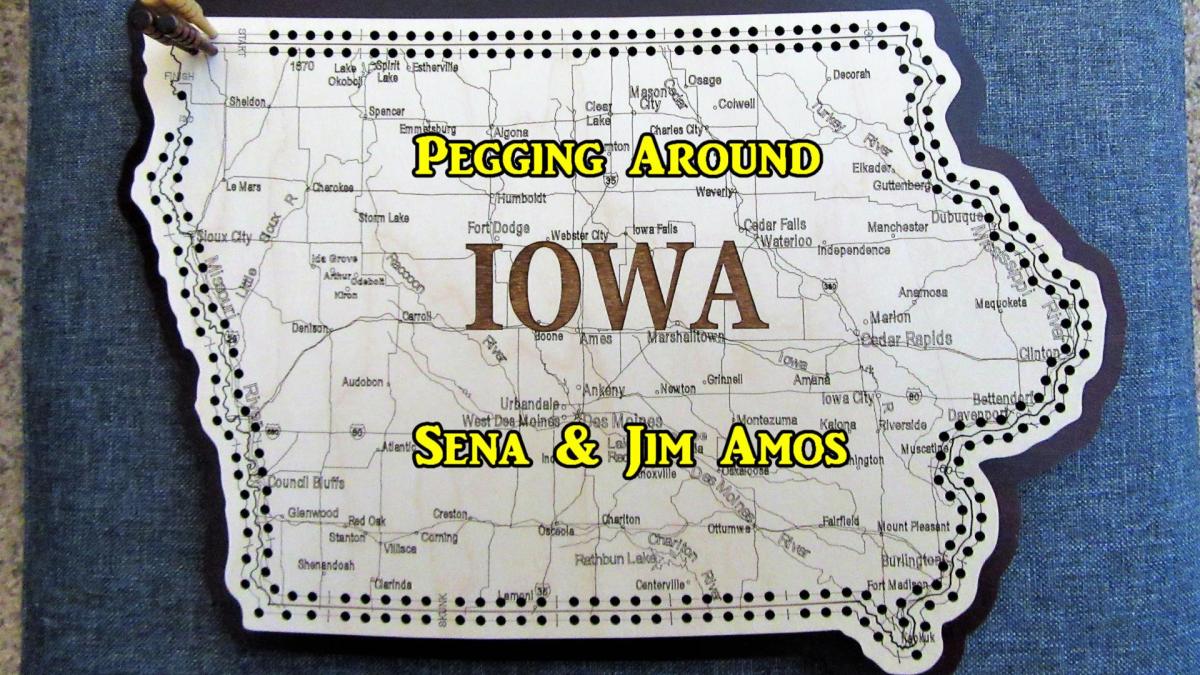
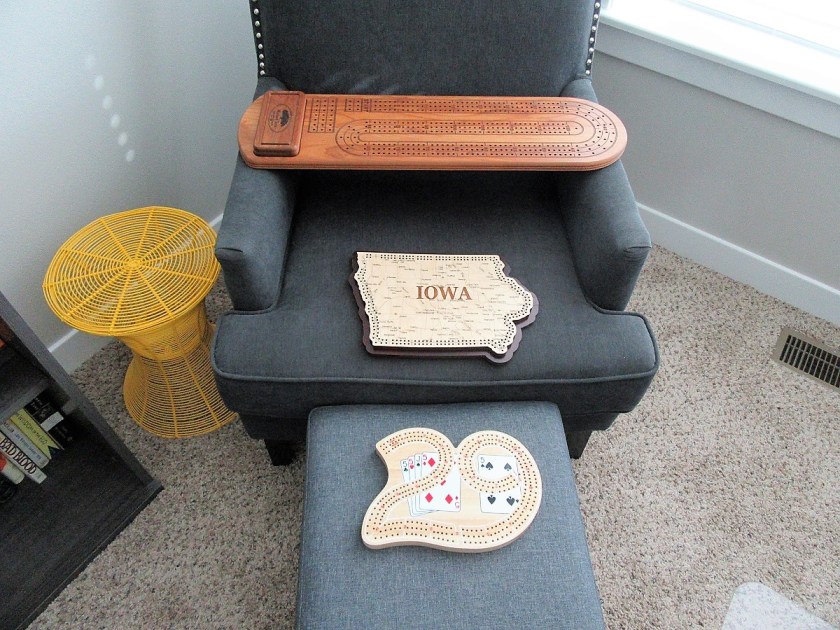
Sena and I got the Iowa map cribbage board and pegged around the state. It was a great way for us to relearn what’s great about Iowa. There is a ton of fun things to do in Iowa.
The 2022 RAGBRAI route, scheduled for July 23-30 will run from Sargeant Bluff to Lansing. It’s the oldest and largest recreational touring bicycle ride in the world, according to the RAGBRAI website. RAGBRAI stands for Register’s Annual Great Bicycle Ride Across Iowa. It’s the largest, longest, and oldest recreational bicycle touring event in the world.
It was started by Des Moines Register reporters John Karras and Donald Kaul. The 7-day trip goes from the Missouri River to the Mississippi River with many stops along the way.
One of them is Mason City, where John Dillinger robbed the First National Bank in the 1930s.
Lake Okoboji in northwestern Iowa is well known for a lot of reasons. It’s a great place to boat and fish, but if you’re an X-Files fan, you’ll recognize that it was the setting for the episode “Conduit,” in which a young woman was kidnapped by aliens although Fox Mulder was unable to prove it happened. The show misspelled the place as “Okobogee,” a mistake that was easy for any Iowan to detect. It was actually shot in British Columbia.
Of course, Iowa City is the home of the Hawkeyes, The University of Iowa, and the Iowa Writers’ Workshop. The African American Museum is in Cedar Rapids.
Clear Lake, as some of you might recall, is where the Surf Ballroom is. Buddy Holly, Ritchie Valens, and J.P. “The Big Bopper” Richardson, after performing there were killed when their plane crashed shortly after taking off from the nearby Mason City Municipal Airport in 1959.
Riverside is the site of the Star Trek Museum and the future birthplace of Captain James T. Kirk in 2233. There’s an annual Trek Fest festival. William Shatner played a hoax on Riverside in 2004 when he visited with a film crew, claiming that they were going to make a science fiction movie there.
Dubuque is the oldest city in Iowa. One of the places to see is the National Mississippi River Museum and Aquarium.
Although it’s not on the cribbage board Iowa map, about a half hour west of Dubuque is Dyersville, where the movie Field of Dreams was shot. The New York Yankees and the Chicago White Sox played there in 2021.
The Pella Tulip Time Festival runs in early May.
You can see Albert, the largest bull in the world, in Audubon. The solid concrete sculpture weighs 45 tons. That’s a lot of bull (obligatory rim shot here).
The Iowa State Fair is in Des Moines, the capital of Iowa. Iowa State University is in Ames. I’m part Cyclone and part Hawkeye because I got my bachelor’s degree at ISU and my medical degree at UI.
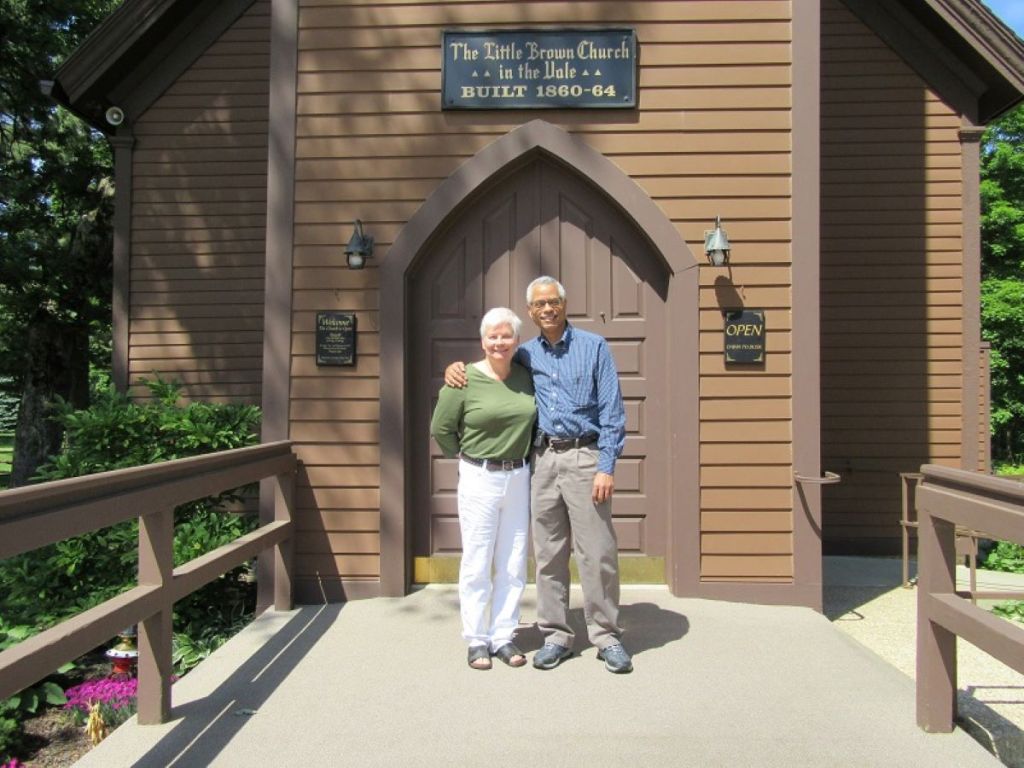
Although Nashua is not on the Iowa cribbage board, it’s in our hearts. We were reminded of our wedding at The Little Brown Church there 44 years ago. Come to Iowa and make memories of your own.
Three days and a new memory card later, Sena and I are almost done with our video of us pegging around our new Iowa map cribbage board. We’re watching the weather reports right now because rough weather is moving through the state.
The final installment of the series of Uncovering Hawkeye History, which is The Next Chapter: Blazing New Trails (1998-2047) was recorded and is now posted on the University of Iowa Center for Advancement website. You can view it below here:
Here’s the video recording of the third session in the Uncovering Hawkey History Series: Endless Innovation: An R1 Research institution (1948-1997).” Enjoy!
The final presentation of the series night before last, Uncovering Hawkeye History in honor of the 175th anniversary of the University of Iowa was a fascinating review of the changes in architecture of the campus, how local and national politics influenced the university and vice versa, as well as the expansion of the role of philanthropy to support its mission over the years. A YouTube video of the recorded presentation will be posted here at a later date.
There was not enough time to do much more than briefly mention the new trails being blazed by three leading programs. However, you can read more about them in Iowa Magazine.
Craig Kletzing is the principal investigator for NASA’s TRACERS mission. He’s a UI physics and astronomy professor who secured the largest research grant in the history of The University of Iowa in 2019 to study the interactions of the magnetic fields of the sun and the Earth.
Christopher Merrill is the director of the International Writing Program and professor of English. Merrill has made cultural diplomacy mission to over 50 countries. He once served on the U.S. National Commission for UNESCO and the National Council on the Humanities.
Dr. Patricia Winokur, the executive dean of the Roy J. and Lucille A. Carver College of Medicine, physician and professor of internal medicine—infectious diseases, and leader of Iowa’s Covid-19 vaccine clinical trials. Dr. Winokur is a nationally recognized leader in the field of infectious diseases. She created the UI Vaccine and Treatment Evaluation Unit, one of the top vaccine research programs in the country and one of only nine nationwide funded by the National Institute of Allergy and Infectious Diseases.
At the end of the presentations, university archivist David McCartney announced that he will be retiring as soon as next week. He wished everyone well and the presenters I’m sure all wish him well.
He has held the archivist position since 2001. He has led a very interesting and varied life. A story posted in The Academic Archivist on November 12, 2020 by Katie Nash, MLIS, CA reveals he got his undergraduate degree in journalism from the University of Wisconsin-Madison. He received his MA in history and MLS (master’s degree in library and information studies) in 1998, both from the University of Maryland at College Park.
He also was a reporter for radio stations in Alaska and the Midwest. I’ll bet that was interesting. He was between warehouse jobs in the summer of 1992 when he drove around the Midwest, researching Carrie Chapman Catt, the woman suffrage leader and founder of the League of Women Voters. It turns out Catt grew up near David’s hometown. That work led to publishing a collection of Catt’s papers in a catalog.
David has done a great many things. He believes that his profession’s worth and legitimacy are being challenged, and that the value of the work he and others do is often unrecognized. He firmly believes that institutions and corporations have to understand their responsibility to maintain a strong archives and records management program. He’s very motivated to advocate for his profession.
I probably would not have looked for any further information about David McCartney had he not announced his retirement at the close of the final presentation of this series. He made his point simply and humbly, saying the challenges of keeping up with the technology demands of his job were part of the reason for his retirement.
He even said he hoped he would see the presenters in the Ped Mall (officially named City Plaza), a pedestrian mall in downtown Iowa City near the UI campus, built in 1979 as the centerpiece of the city’s urban renewal project. It’s a popular gathering place for students and locals. There are concerts, jazz festivals, and art shows.
As a relatively recent retiree myself in June 2020 (19 months or 86 weeks or 606 days ago but who’s counting?), I can relate to David on this issue. Many of those I worked with were sad to see me go. I think many will be sad to see David go.
I wrote most of this post while waiting for our internet service to reconnect, which it finally did. I’m pretty sure the wintry mix ice caused the outage night before last.
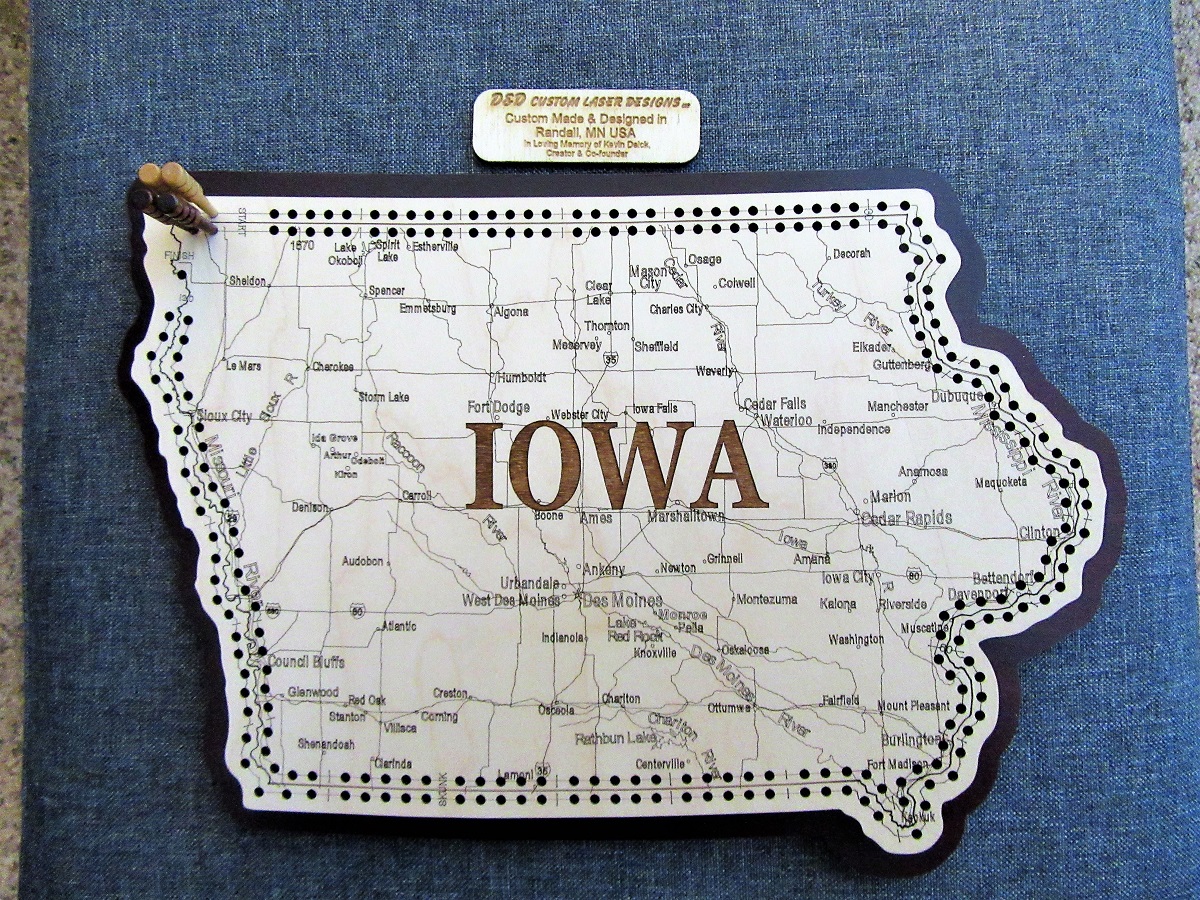
Despite the icy conditions yesterday, our Iowa State map cribbage board was delivered. One of the first things Sena said about it was, “I thought it would be bigger.”
This triggered a couple of memories. When we were on one of the tours around New York City in 2017, someone remarked on the size of the Ball in Times Square that drops on New Year’s Eve, saying it was smaller than she thought it would be. Apparently, this was the tour guide’s cue to deliver a few well-rehearsed jokes about size that all related to a man’s penis size—which I am not in the least sensitive about at all in any way, shape, form or size. Can we talk about the weather, please?
The other memory is the Men in Black II scene in which Agents K and J are grilling Frank the talking alien Pug about the whereabouts of The Galaxy (which is the best source of subatomic energy in the universe), which was small enough to fit inside a thumbnail-size jewel attached to the collar of a cat. While shaking Frank vigorously, Agent K demands that Frank tell him where The Galaxy is.
Anyway, the Iowa map cribbage board is smaller than our Jumbo board, but it’s a little bigger than the 29 board.
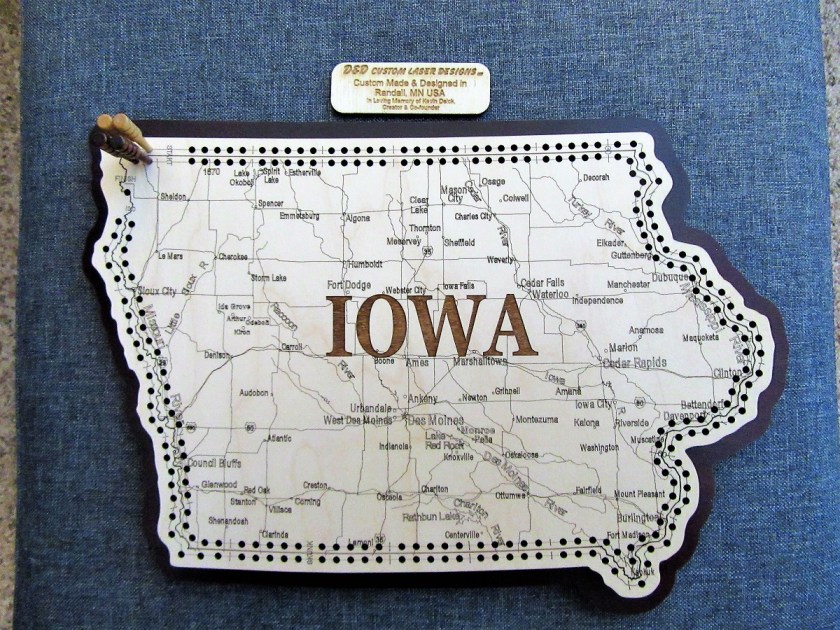
It’s made by D&D Custom Laser Designs. The name is lasered on a little cover which fits over the storage hole for the 4 wooden cribbage pegs. Below the name is “Custom Made & Designed in Randall MN, USA; In Loving Memory of Kevin Deick, Creator and Co-founder.”
I saw one review of the board on the web in which the reviewer expressed doubt that the maker knew anything about cribbage because the description indicates that it includes a pre-installed hanger so it can be used as a wall hanging. The hanger doesn’t interfere with it being used to play cribbage and the board even has small rounded feet in all four corners so you can set it on a table. And it does include pegs.
You can see the names of major and even small cities, the Mississippi and Missouri Rivers, and major highways. It reminds me of places we’ve been and what we did in those places. We haven’t played a game on it yet, but we plan to make a video of that in the near future and post it on YouTube.
The Iowa cribbage board came wrapped in something we usually don’t see. It was a crumpled-up issue of a local newspaper in Minnesota. The board itself is made in Randall, Minnesota. The newspaper is the January 30, 2022 issue of the Morrison County Record.
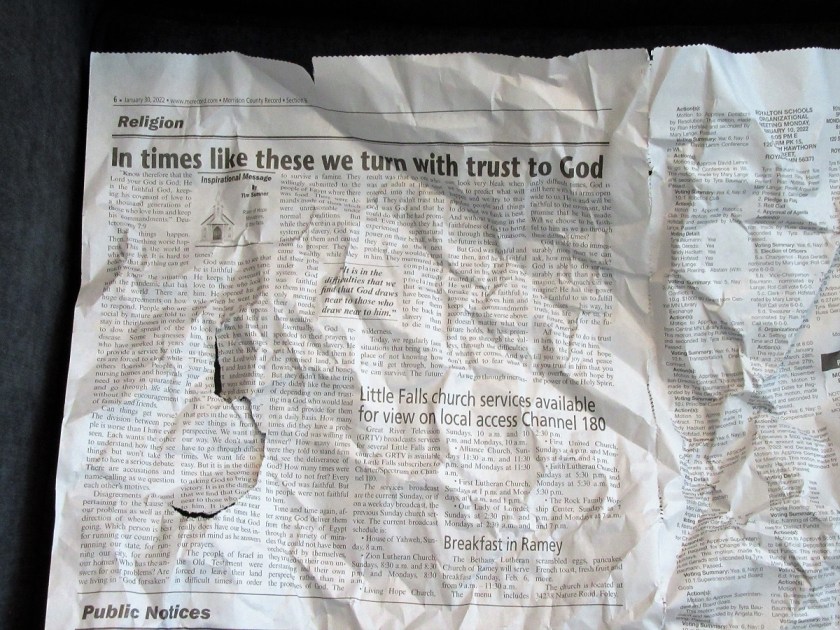
I haven’t read a regular newspaper in a long time. The Morrison County Record has a lot of the features I remember from several newspapers like the Des Moines Register and the Globe Gazette (Mason City). I noticed a large column in a section titled “Religion.” I can’t remember the last time I saw a newspaper column like that. The title of the column was “In times like these we turn with trust to God,” with the caption Inspirational Message with a small drawing of a church and the byline was Tim Sumner, evidently the pastor of River of Hope Ministries, Little Falls. So, this newspaper was published in a place called Little Falls in Minnesota.
Little Falls is about 10 miles southeast of Randall.
Anyway, Pastor Sumner (I don’t know if that’s his title, but I’m hoping it’s safe to assume that) wrote what could be given as a Sunday sermon. Because this issue of the Morrison County Record was used as wrapping paper, I had to hold the ripped pieces of it together to read it. The link to the whole sermon on the web is here.
One quote from Sumner:
Today, we regularly face situations that bring us to a place of not knowing how we will get through, how we can survive. The future can look very bleak when we try to predict what will happen and we try to manipulate people and things to do what we think is best. And without trusting in the faithfulness of God to bring us through these situations, the future is bleak.
I have not thought about God in a very long time, but when I was a child, I read the Bible a lot. And I remember the pastor of our church, Reverend Glen Bandel, who was my family’s hero when he took care of mother when she was very sick, and welcomed us in their home when times were bad. Mason City’s local newspaper, the Globe Gazette ran a brief story about his life and ministry when he turned 90 years old a few years ago. You can read it once before the web site requires you to subscribe. It won’t tell you even a tenth of what I and most people feel about his kindness, courage, and wisdom. He has a heart the size of a galaxy.
The population of Randall, Minnesota is 625, and the population of Little Falls is 8,664 (as of 2019). Just because they’re small doesn’t mean they’re not important.







 Go Retire Psychiatrist