
The Dragon Breathes Fire Again

Sena and I saw a news video about a technology called “DAX” which uses Artificial Intelligence (AI) the other day which promises to reduce or even eliminate pajama time for physicians trying to get their clinical note dictations done during the day instead of taking them home for several more hours of work.

The video was a demo of the technology, which looked like it recorded a clinical interview between the doctor and the news reporter. I didn’t see how exactly DAX was recording the interview without obvious audio equipment. Was it doing it through the smartphone speaker? This was very different from how I and many other clinicians dictated their notes using a headphone set at their desks in front of their desktop computers. It not only records but transcribes the interview.

Later, I discovered that DAX stands for Dragon Ambient Experience, made by Nuance which was acquired by Microsoft in 2022. I posted about Dragon products and their limitations last year. The product often produced hilarious mistakes during dictation which required careful editing. Sometimes more errors turned up after you completed it and these were visible in the patient’s medical record, which would then need to be corrected.

Several years ago, I remember talking to somebody from Dragon on the phone about the problems I was having. She was a little defensive when I told her I’d been having difficulty with Dragon for quite a while because it made so many mistakes.

A recent article on the web revealed that the errors continue with DAX. According to the article, “…it will make mistakes. Sometimes it might omit clinical facts; sometimes it may even hallucinate something.” I remember trying to communicate with the Google Bard AI, which seemed to do this pretty often. It made stuff up.

DAX is not cheap. The article reveals that one hospital pays $8,000-$10,000 per year per physician to use it. And skeptics worry that the system has too many bugs in it yet, which can lead to bias and inaccurate information which could negatively affect patient outcomes.

A recently published JAMA network article also urges caution in adoption of this sort of AI-assisted technology (Harris JE. An AI-Enhanced Electronic Health Record Could Boost Primary Care Productivity. JAMA. Published online August 07, 2023. doi:10.1001/jama.2023.14525).

In this case, I think it’s appropriate to say “I told you so.”
The Lesser-Known Quote by Wonko the Sane

A couple of days ago, Sena and I were playing cribbage and she thought she had a higher scoring hand than she actually did. She immediately realized it and scored it right. She commented that, at first, she thought she saw something she didn’t actually see. I quipped that “First you have to see it.” She thought that was pretty funny.

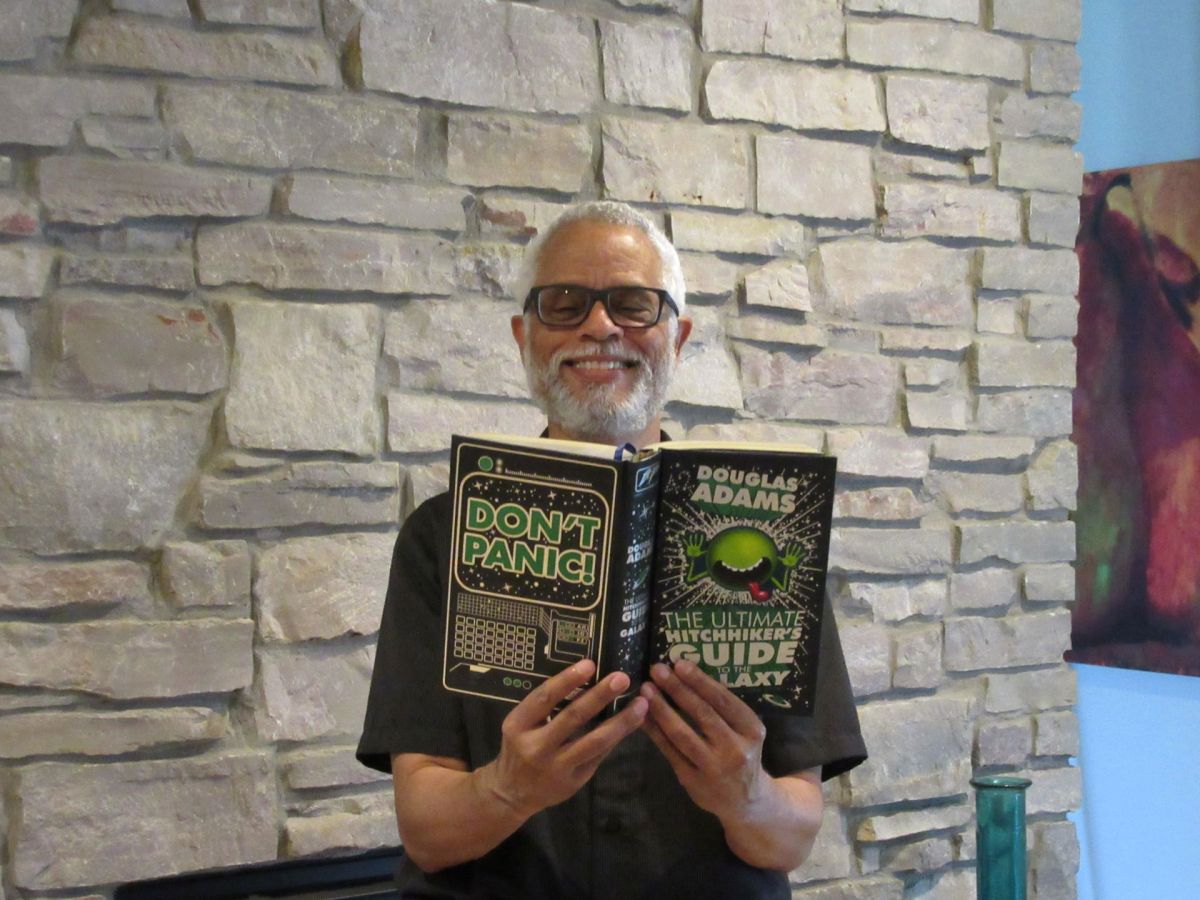
I actually said that because I remembered a quote from Wonko the Sane in Douglas Adam’s book “So Long and Thanks for All the Fish.” Wonko is a guy who lives “outside the asylum” because he saw the instructions on a box of toothpicks and thought it was so bizarre that he didn’t want to live in a society which needed that kind of instruction.

Now, you can find a lot of references on the web for the quote that arises from the toothpick instruction:

“It seemed to me, said Wonko the Sane, that any civilization that so far lost its head as to need to include a detailed set of instructions for use in a package of toothpicks, was no longer a civilization in which I could live and stay sane.” Douglas Adams, So Long, and Thanks for All the Fish.

You can even buy tee shirts printed with this quote. But that’s not the Wonko the Sane quote I was thinking of. In fact, I’m not the only one who thought of it and the first person I want to give credit to for calling attention to it is a WordPress blogger whose name seems not discoverable on his blog, but instead has the title Eppur Si Muove. It’s Latin and it means “…and yet it does move.” It’s attributed to Galileo who muttered it after being forced to recant his claim that the earth moves around the sun.

The quote is:

But the reason I call myself by my childhood name is to remind myself that a scientist must also be absolutely like a child. If he sees a thing, he must say that he sees it, whether it was what he thought he was going to see or not. See first, think later, then test. But always see first. Otherwise you will only see what you were expecting. Most scientists forget that…. So the other reason why I call myself Wonko the Sane is so that people will think that I am a fool. That allows me to say what I see when I see it. You can’t possibly be a scientist if you mind people thinking that you’re a fool. ~ Wonko the Sane, from So Long, and Thanks for All the Fish by Douglas Adams.

The blogger who wrote the post entitled it “Wonko the Sane—On Being a Scientist…”

Seeing what’s really there is very difficult to do. I’m fettered by expectations, desires, prior misinformation, and so on. Often, I see what I want to see rather than what’s there.

The toothpick quote gets more interpretations often by writers who sound like they trying to prove something. What’s even more interesting than them (and funnier) are the great number of actual instructions on how to use toothpicks, even how to do tricks with them.

What seems impossible to find are actual instructions for how to see.

New Mayos and New Braunschweiger Not Cutting the Mustard

Sena bought a new brand of Braunschweiger and a new mayo and we tried them yesterday. The new mayo was Blue Plate Mayo. Frick’s Braunschweiger was the new lunchmeat.

So far, we’ve tried Field’s, Jones Dairy Farm, and Frick’s Braunschweiger. We’ve sampled Kewpie’s, Duke’s, and Blue Plate mayo.

We both thought Blue Plate Mayo was not better than Miracle Whip and the Frick’s Braunschweiger was OK but a little short of earthshaking. Frick’s is a family business in Missouri, and their website looks similar to Jones Dairy Farm (which also makes Braunschweiger). They’re both solid family businesses.

Blue Plate Mayo (“born in New Orleans”) has been around since 1927 and make a decent mayo. We just like Miracle Whip better.

In fact, of all the mayos we’ve tried, we both like Miracle Whip the best although Sena, most of the time prefers Hellmann’s Mayo. But that’s just her.

Tickle Tickle Tickle!

I saw an interesting article about how lab rats react to researchers tickling them. I had no idea rats had a funny bone. They’ll even chase your hand to get tickled. When they’re tickled, they make laughing noises that are just under the threshold of human hearing, but the sounds can be heard when converted to our range of hearing. They like to be tickled on their bellies or backs.

What scientists have found is that an area in the brain called the periaqueductal gray (as medical students we had to learn about this area to pass anatomy class) that is associated with tickling and laughter. The upshot is that play is important for growing brains.

Many of us remember being tickled as children. We could get hysterical even if someone just approached us with hands outstretched, saying “kootchy kootchy koo.”

Something happens when we grow up and we lose that ticklish sensitivity. And you can’t tickle yourself to get that sensation.

Tickling sensitivity may go away, but a sense of humor usually doesn’t, at least for most of us. I can’t count the number of times Sena has caught me sort of stifling a chuckle over some funny thought that happens to cross my mind. I’m sure I look half-crazy. Sometimes I think I should come up with a semi-plausible explanation for this behavior (“Oh, I’m just being tickled by invisible extraterrestrials!”).

Scientists are still working on finding out why we’re ticklish. I don’t know exactly why we lose ticklishness as we grow up. But I don’t think building a tickling robot would fix it. It might be difficult to calibrate its finger strength, resulting in broken ribs and punctured lungs—at first. But those aren’t problems, just details to be worked out.

Tough TV Choices

I have a couple of choices for TV shows tonight. I could watch an X-Files rerun on the Comet network or the “season finale” of The Secret of Skinwalker Ranch.

Sena and I have been watching the X-Files reruns the last few nights. We didn’t know it was on until Sena happened to catch a couple of episodes. It comes on weeknights between 8-11 pm. They’re the early ones, which were pretty good.

We used to watch X-Files and munch popcorn a long time ago when the show was new. It was good entertainment.

On the other hand, it’s hard to know what to call The Secret of Skinwalker Ranch. Is it entertainment or investigative reporting? I don’t know how you can say it’s investigative in nature when mostly what you see are guys firing off dozens of hobby rockets to annoy the interdimensional entities who then lob UFOs back at them.

Calling a show a “season finale” doesn’t make me think about scientific TV programs.

I’m betting the skinwalker season finale will be an extravaganza of hobby rockets and dozens of Sasquatches flinging their hairy legs in the air in unison Rockette-style while munching on beef jerky.

I can’t afford to miss that. Sena will watch the X-Files on the TV downstairs.

We Are All Still Learning to Play Pong

I noticed an article the other day about Monash University in Australia getting funding for further research into growing brain cells onto silicon chips and teaching them how to play cribbage.

Just kidding, the research is for teaching the modified brain cells tasks. They succeeded in teaching them goal-directed tasks like how to play the tennis-like game Pong last year. You remember Pong from the 1970s? Shame on you if you don’t. On the other hand, that means you probably didn’t frequent any beer taverns in your hometown while you were growing up—or that you’re just too young to remember.

The new research program is called Cortical Labs and has hundreds of thousands of dollars in funding. The head of the program, Dr. Razi, says it combines Artificial Intelligence (AI) and synthetic biology to make programmable biological computing platforms which will take over the world and bring back Pong!

It’s an ambitious project. The motto of Monash University is Ancora Imparo, which is Italian for “I am still learning.” It links humility and perseverance.

There’s a lot of suspicion out there about AI and projects like the Pong initiative in Australia. It could eventually grow into a vast industry run by robots who will run on a simple fuel called vegemite.

Shame on you if you don’t know what vegemite is!

Anyway, it reminds me that I recently finished reading Isaac Asimov’s book of science fiction short stories, “I, Robot.”

The last two stories in the book are intriguing. Both “Evidence” and “The Evitable Conflict” are generally about the conflict between humans and AI, which is a big controversy currently.

The robopsychologist, Dr. Susan Calvin, is very much on the side of AI (I’m going to use the term synonymously with robot) and thinks a robot politician would be preferable to a human one because of the requirement for the AI to adhere to the 3 Laws of Robotics, especially the first one which says AI can never harm a human or allow a human or through inaction allow a human to come to harm.

In the story “Evidence,” a politician named Stephen Byerley is suspected of being a robot by his opponent. The opponent tried to legally force Byerley to eat vegemite (joke alert!) to prove the accusation. This is based on the idea that robots can’t eat. This leads to the examination of the argument about who would make better politicians: robots or humans. Byerley at one point asks Dr. Calvin whether robots are really so different from men, mentally.

Calvin retorts, “Worlds different…, Robots are essentially decent.” She and Dr. Alfred Lanning and other characters are always cranky with each other. The stare savagely at one another and yank at mustaches so hard you wonder if the mustache eventually is ripped from the face. That doesn’t happen to Calvin; she doesn’t have a mustache.

At any rate, Calvin draws parallels between robots and humans that render them almost indistinguishable from each other. Human ethics, self-preservation drive, respect for authority including law make us very much like robots such that being a robot could imply being a very good human.

Wait a minute. Most humans behave very badly, right down to exchanging savage stares at each other.

The last story, “The Evitable Conflict” was difficult to follow, but the bottom line seemed to be that the Machine, a major AI that, because it is always learning, controls not just goods and services for the world, but the social fabric as well while keeping this a secret from humans so as not to upset them.

The end result is that the economy is sound, peace reigns, the vegemite supply is secure—and humans always win the annual Pong tournaments.

Miracle Whip with Cheese Sandwiches Attracts Extraterrestrials!

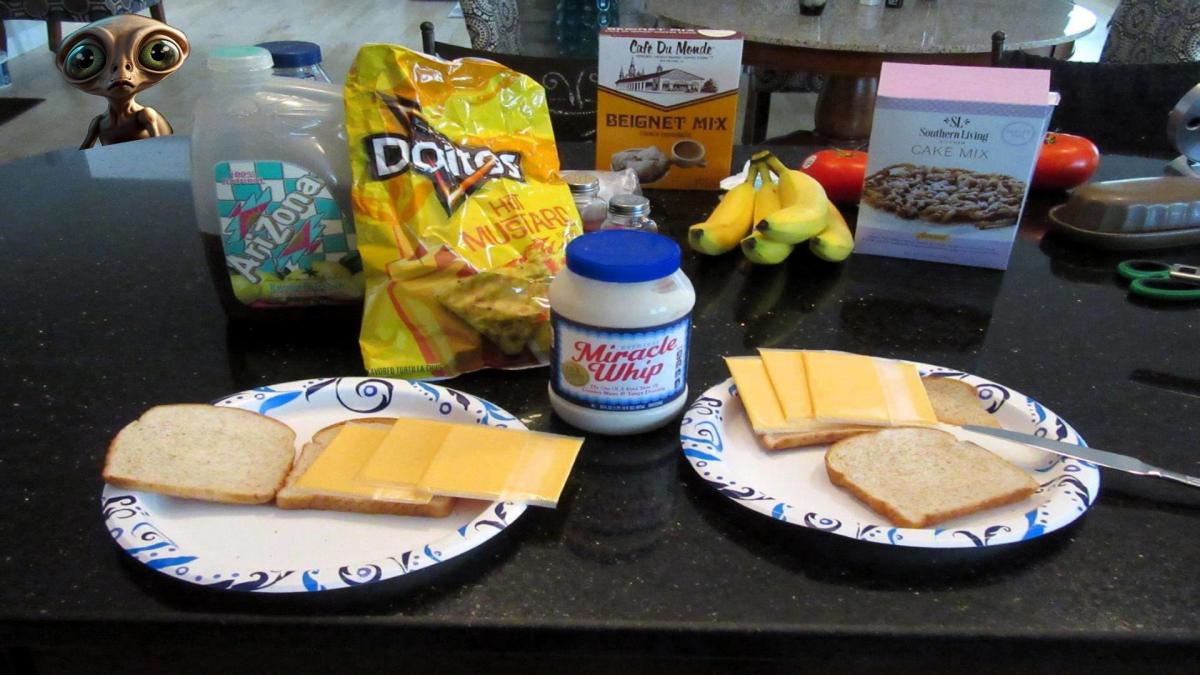
We finally had lunch with Miracle Whip and American cheese sandwiches a few days ago. They were delicious! An extraterrestrial even showed up, begging for a bite.

Miracle Whip sometimes attracts ETs. I’m surprised more people don’t try this method of getting photo evidence for the existence of these creatures.

Sena is still planning to make Beignets sometime in the near future. She did make some really tasty funnel cakes though, using that Southern Living cake mix.

Acts of Kindness Spotted in Walmart!

If you read the news, you rarely find any stories about acts of kindness. Everybody is slamming everybody else. Sena sees acts of kindness at Walmart. Not long ago, a Walmart grocery shopper went out of his way to be kind to her.

She was in the checkout lane of a cashier who greets everyone with a cheery “Did you find everything you want? Thank you for shopping at Walmart!” People actually try to get into her lane, probably to get a dose of her kindness. They will arm wrestle for the privilege, best 2 out of 3 wins.

I rarely go grocery shopping but actually recognized her from Sena’s description and scooted into her lane. She even placed the sacks of groceries up on top of the circle of bags to make it easier for me to grab them, making it less likely to forget them—which is something I would probably do. She’s easy to find; she’s the only one still wearing both a medical grade mask, face shield, and gloves.

Sena almost always encounters kindness from random shoppers and Walmart workers who see her struggling to reach an item on a high shelf. They’ll say “Let me help you with that.”

Anyway, where was I? Oh, the shopper kindness incident. She was in the kind cashier’s lane behind another couple who also prefer this cashier. She had encountered them elsewhere in the store and the guy joked with her about cottage cheese.

There were no dividers to separate Sena’s groceries on the conveyer belt from his, so she used a package of celery and announced it to the cashier—who forgot that and rung it up along with a couple of other items) for the guy and his wife in front of Sena. Sena caught the mistake and they all joked about it.

After the couple left the store with their groceries and as Sena was checking her items, she felt a tap on her shoulder. It was the guy who had been in front of her. He handed her a package of mushrooms, the one item that the cashier had charged to him by mistake and had not caught. He had probably gone all the way out to the parking lot and somehow noticed the mushrooms.

He gave Sena the mushrooms and told her that he didn’t want her to get all the way home and find out that she didn’t have them for a recipe.

Sena knew he’d been charged for them and because she didn’t carry enough cash to pay him back, advised him he could get the mistake fixed at customer service. By this time, it was too late for everyone’s favorite cashier to correct it.

The guy said the transaction was too complicated and not worth standing in the long line at customer service.

But it was worth his while to get all the way out to the parking lot and walk all the way back in to return a $2 package of mushrooms to Sena.

Sometimes, it seems to me we spend more time on the lookout for UFOs in the sky than for human acts of kindness on earth.

To Trap or Not to Trap Japanese Beetles

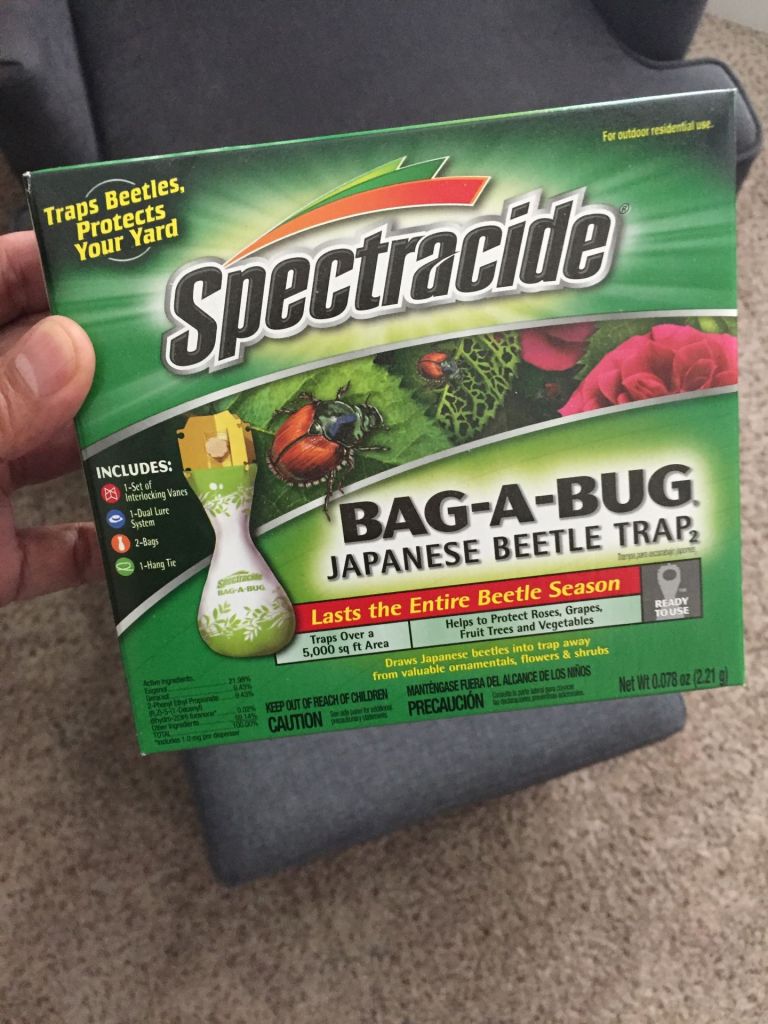
Sena has some Japanese Beetle traps she’s been thinking about using for some time now. She paid only a dollar a box because they were on sale. She’s hesitant. It’s Spectracide and uses a sex attractant and a floral lure to catch the little scarab beetles in a bag. In fact, the product is called Bag-A-Bug. The box advertises they are an “ideal method” to control Japanese Beetles and protect your yard. They cost about $8 or more a box, depending on where you buy them.

I checked the internet about controlling Japanese Beetles and I was a little surprised to learn that not everyone is in love with the bag method. Some experts say they might attract more bugs to your yard rather than rid your property of them.

The University of Minnesota Extension web article tops the list of those who caution you not to expect a miracle from the bag method. In fact, they frankly state, “While the University of Minnesota is still performing research to understand this pest, one thing we do know is Japanese beetle traps do not reduce beetle feeding.” They baldly state the traps probably won’t benefit your garden. The issue is the chemical lure itself, which might draw even more bugs to your yard. The more bugs you catch, the more stink they squirt. You can end up with thousands more of them because of the trap itself, causing more damage to your plants than if you didn’t use it at all.

What’s the answer? Toss the little buggers in a bucket of soapy water, believe it or not. And while they make holes in leaves which makes your plants look ugly, they usually don’t kill them. Beetles show up in late June and early July and mess with your yard until mid to late August.

Picking off the bugs and the damaged leaves works as good as anything else and rids the areas of the odor which attracts other insects.

What’s The University of Minnesota Extension’s bottom line on beetle traps? Don’t use them. It’s likely they attract more beetles than they catch.

I also checked the Iowa State University Extension web page on Japanese Beetles. The authors say the bugs are the “worst landscape pest in America” but they also are thumbs down on using traps, saying they attract more bugs than they catch. Here’s a funny quote from an ISU Extension article that I originally used but just found out today is not available:

“The only benefit of JB traps is the emotional satisfaction of seeing and smelling hundreds (thousands?) of dead, decaying beetles.”

The Better Homes & Gardens web page has a similar opinion. So, there you have it. During my web search, I was reminded of a neighborhood we visited several years ago where we saw a lot of back yards with these traps. The bugs were everywhere.

So much for the traps. What the heck, they were only a dollar a box.

House Oversight Committee UAP Hearing Today

We watched the House Oversight Committee UAP Hearing today and it was one of the most interesting presentations we’ve seen in a long while.

I make fun of the topic a lot but I thought all the witnesses were credible. In my opinion, the most credible witness today was retired Commander David Fravor of the U.S. Navy. His sense of humor and down-to-earth (no joke intended) demeanor lent credibility to the issue of Unidentified Anomalous Phenomena.

I especially liked Fravor’s advice for anybody reporting UAPs: “Don’t make the fish bigger than it is.

David Grusch, a former U.S. intelligence officer, often deferred answering certain questions because the answer would have meant revealing classified information. Ryan Graves, a former fighter pilot for the Navy, emphasized the need for a safe way to let military and civilian witnesses describe their encounters with UAPs.

There will likely be another meeting, one which would allow David Grusch to be more open to answering questions involving classified information.