
Stop Me If You Heard This One Before

I saw one of my favorite X-Files episodes the other night. It’s titled “Monday.” Mulder goes through the day repetitively doing the same things, including fumbling his chance to thwart a bank robber who blows up the bank and everyone in it, including Mulder. See the Wikipedia for a full spoiler alert but I’m going to spill the beans here anyway.

A lot of people think the idea was stolen from the movie “Groundhog Day,” which I’ve never seen. Actually, it was stolen from a Twilight Zone episode called “Shadow Play,” which I have seen.

“Monday” got good reviews overall, which is saying a lot. I never got the part about how a bank robber (Bernard) who can only land a job mopping floors would be smart enough to build a bomb jacket.

That said, the scenes are mostly everybody going through the day doing the same things over and over. Mulder and Scully both meet Bernard and his girlfriend Pam, who was always waiting outside in the getaway car and is the only one who remembers what has happened each and every time, which is about 50. Pam thinks Mulder is the key to disrupting the endless cycle. She has been trying to get Mulder to change what he does every time he walks in the bank just to cash a check and interrupts Bernard in the process of robbing the bank.

Mulder never gets it right away, but does wonder aloud that he’s getting a sense of déjà vu. Déjà vu is the sense that an experience is something you had before but could not have. The medial temporal cortex triggers the false memory and, normally, the frontal lobe says, “No, this is not a memory.”

Eventually, Mulder gets the idea of repeating to himself over and over that Bernard has a bomb and changes his approach by giving his gun to Bernard and telling him he knows he has a bomb. This approach is based on the assumption Bernard will walk out without setting off the bomb because Mulder will let him go without trying to arrest him.

Then, Scully brings Pam into the bank, and Bernard almost surrenders to Mulder, until he hears police sirens—and tries to shoot Mulder but instead kills Pam because she steps into the path of the bullet. He gives up and doesn’t set off the bomb. Pam changed the ending and notices just before she dies that it never happened in any of the previous enactments.

There’s the brain-based definition of déjà vu and then there’s a more mundane definition, both of which are in the Merriam-Webster dictionary on the web. The mundane definition is “something overly or unpleasantly familiar,” mainly about situations that happen repeatedly (“here we go again”).

We all recognize the second definition. We sometimes say or do something which we would not if we just recognized that it’ll trigger a pattern of events we would like to avoid. Something has to change in order to interrupt the pattern.

Psychiatrists and psychotherapists are usually experts in helping people change repetitive, maladaptive patterns of thought and behavior.

Medications can be helpful, for example in the repetitious thoughts and behaviors of obsessive-compulsive disorder (OCD). Some cases of that may respond better to a combination of psychotherapy and medication.

One of the challenges is that there are not enough helpers to help those who need it. Another challenge is that the ones who need help often don’t recognize they need it. That’s called lack of insight.

The cycle of lack of insight and unpleasantly familiar, repetitive patterns sometimes resulting in explosive consequences is ubiquitous in our society.

Can somebody please bring Pam into the consulting room?
Clumsy Juggling

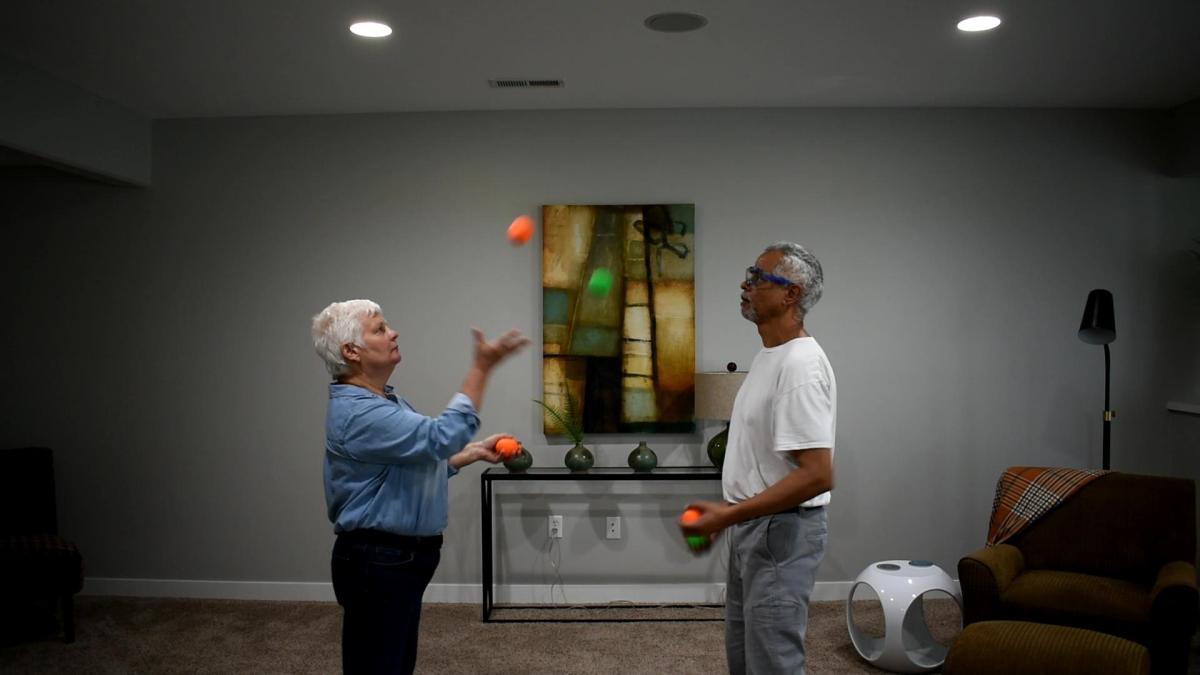
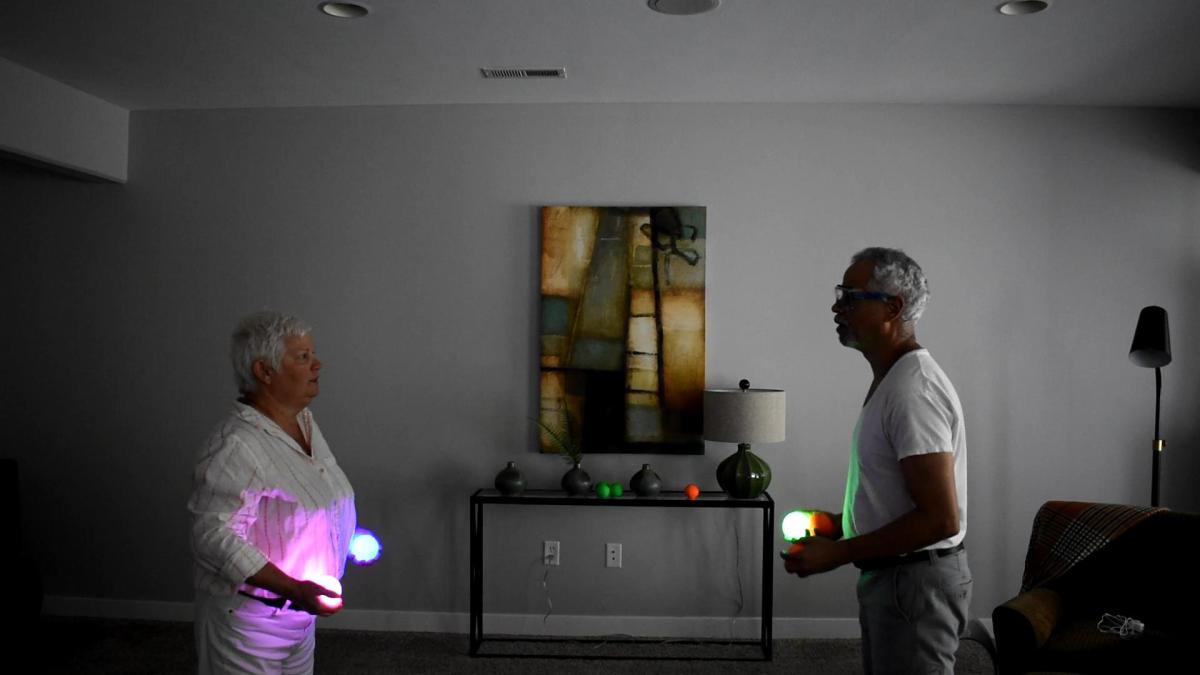
We decided to kick it up a notch with our two-person ball passing juggle routine. We switched out three of the bean bag Zeekio balls for some glowing LED juggling balls.

The LEDs are bigger and heavier than the bean bags, which led to more challenging passes. They also look better in low light, so it was a little harder to see the balls flying at us. We really didn’t know when we’d have to change our grip—so we often ended up losing our grip.

Clumsy juggling is fun juggling.

Two Person 5 Ball Passing Jitterbugging Juggling!

Sena and I are going to break the internet with another video of two person juggling! OK, so maybe we won’t exactly break the internet—but we might give it a nosebleed. We had to think of a way to top our recent side hug version of tandem juggling with 3 balls. So, we tried the 5-ball passing juggle pattern.

This one was also inspired by Niels Duinker and his sidekick Piet. On the other hand, it was difficult to get started at first. I found the video tough to follow and was dumbfounded on how to even get started.

Overthinking can put the brakes on any endeavor. Once we just got rolling and quit sweating the details, the pattern just seemed to flow. You have to give it your undivided attention. And you both have to be able to juggle the 3-ball cascade.

There are a couple of rules to remember. The jugglers face each other rather than stand side by side. One juggler tosses balls straight to the partner while the opposite partner tosses them back diagonally to the partner’s opposite hand.

In this pattern, I start with 3 balls, 2 in my right hand and one in my left. Sena starts with 2 balls, one in each hand. The person with 2 balls in the right hand starts by tossing one ball straight to the partner’s left hand. The partner must toss the ball in her left hand (to empty it so she can catch the ball flying in) across to the other’s left hand. One person always throws diagonally and the other always throws straight across.

Even saying that is confusing. You really have to see it and that’s why we included a slow-motion clip. There’s a sweet spot in the distance between jugglers. If you’re too far apart, there’s a tendency for throws to be too long and either too high or too low. There’s a juggle space between you and your partner just as there is for you alone. It’s a little wider, but not much, because lobbing it upwards more than tossing it in a shallow arc duplicates juggling by yourself.

The more we practiced, the smoother and easier the pattern felt. I tend to jitterbug around while Sena tends to stand solidly in place. Nevertheless, we both compensate for imperfections in our throws.

The result looks almost like dancing.

Morning Brew

We tried out our new double wall glass mugs yesterday and I think the coffee stays hot longer in the new cup. Sena is a little doubtful. She ordered a thermometer and we’ll test it more scientifically.

The mugs are lighter than I thought they would be. They don’t get hot on the outside so I can safely set it in my lap while we’re sitting out in the sun room in the morning.

The ceramic mug transmits a little too much heat for that, at least initially. I went through the roof once and got picked up by a passing UFO. I offered the driver a sip and it just said, “You’re not experimenting on me!” They’re a little suspicious.

Sena also got a little K-pod drawer which neatly holds most of our pods. The whole setup makes morning brew really quick and easy.

I like easy.

Our New Coffee Center!

We got our new double wall glass mugs yesterday for our Keurig coffee maker, along with more K-pods. We’ll keep the K-pods in a brand-new snazzy drawer that sits on the counter under the Black and Decker coffee maker.

Now we’ll see whether our coffee stays hot longer. Sena’s also planning to get a thermometer to check this.

Sena got a great deal on the double-wall glass mugs, at just a fraction of the list price.

I can’t remember whether the Artificial Intelligence robot came with the mugs or the coffee pot.

Discover Tandem Juggling Just for Fun!

I found out about tandem juggling yesterday and learned how to do it from a YouTube video by genius juggler Niels Duinker and his sidekick, Piet van Steen. Sena and I picked it up pretty quickly.

It’s a wide frame form of the 3-ball cascade. All we had to do was practice throwing a little wider and higher. It’s a very entertaining way to play catch.

You still have to throw the balls within the pane of glass. You also have to compensate for each other’s height. The two of you have to stand pretty close together, basically shoulder to shoulder.

This is a barrel of laughs and great exercise as well!

Should Doctors Be Funny?

I ran across an interesting Medscape article, “Should Doctors Be Funnier? These MDs Are Real Comedians.” I don’t know if they should be funny, but it probably wouldn’t hurt.

I think a sense of humor is a good thing for anyone to have and it’s probably not that hard to develop. There’s even a Wikihow article on how to develop a sense of humor.

I usually look for the funny edge in most things that happen to me. I was always very nervous about presenting Grand Rounds when I was on staff at the hospital. I would try to come up with a good case example illustrating both medical and psychiatric features. It was pretty challenging.

I often used humor to help me get through my stage fright. I didn’t tell jokes, but I did clown around a bit. One day, I arrived too early for the Psychiatry Dept. Grand Rounds and accidentally walked in on another scheduled event in the conference room that was obviously not for psychiatrists—only not immediately obvious to me. I got a few chuckles from the audience just from having to back out. Later, during the real Grand Rounds I clowned about my mistake as a sort of opener to my presentation.

Unfortunately, I then had to stumble through my PowerPoint slides (every presenter’s worst nightmare) because I evidently had not organized them correctly. I survived by joking about it. That resulted in a digital award from the residents for being “Improviser of the Year.”

Humor can get you through some pretty sticky situations.

Another Blast from the Past

Today is Labor Day, and I was looking at some of my old blog posts from my previous blog The Practical Psychosomaticist. I found one that I think I haven’t reposted on my current blog called “Going from Plan to Dirt.”

It’s a funny post, at least I think so. It draws a comparison between blue collar and white collar work, similar to what I did the other day (“Why Can’t I Wear Blue After Labor Day?”).

I wrote it in 2011, when I was on a hospital committee to improve detection and prevention of delirium in the general hospital.

“Our work on the Delirium Early Detection and Prevention Project reminds me of my early formative experiences working as a draftsman and land survey technician starting in 1971 with an engineering company, Wallace Holland Kastler Schmitz & Co. (WHKS & Co.) in Mason City, Iowa. I remember being amazed at how a drawing on paper could be turned into a city street, highway, bridge, or airport runway. They have a website now. I can now find written there what was modeled for me then:

“WHKS & Co. is committed to the continuous improvement of the quality of service provided to our clients.”

Then and now WHKS & Co. worked hard to create the infrastructure that we depend on and then put it into the world in a “safe, functional, and sustainable” way. Out in the field we sometimes joked about how a designer’s drawing was flawed if we couldn’t go from plan to dirt.

It’s common to believe that engineers and land surveyors deal with complex mathematical formulas, structural materials, things instead of people—an applied science in which the emotions and motivations of people play a small role. Nothing could be further from the truth.

I was 16 years old when WHKS & Co. hired me. I had no idea what engineers and land surveyors did, had no experience, and I was at a crossroads in my life. They didn’t hire me because I had any talent or asset they needed. They hired me because they were as committed to the people in the community, not just to things.

And if you think land surveying doesn’t have anything to do with people’s emotions, consider property line disputes. The survey crew I was attached to had been sent out to find the property corners of two neighbors. This involves locating iron pins that mark the corners of the lots that houses sit on. Little maps or “plats” are used as guides and let me tell you, often enough we found the map is not the territory.

Anyway, while we were out there in the back yard of one of the neighbors, they both came outside. One of them was a diminutive elderly lady and the other was a tall, big-boned elderly man. They started arguing about the boundaries of their lots and it got pretty heated. Pretty soon they were yelling in each other’s faces and the lady reached down in the garden in which we were all standing. She picked up the biggest, juiciest rotten tomato she could find and it was clear to us what she planned to do with it. They were both pretty old and neither one of them could move very fast. My crew chief, sensing that something violent was about to happen, moved in between them (a decision I still can’t fathom to this day).

What followed seemed to happen in slow motion, in part because the combatants were so old. The man could see the lady was about to hurl the rotten tomato at him. Ducking must have been beyond his power, probably because of a stiff back. He bent his knees and leaned forward. She cocked the tomato as far back as she could and let fly, screeching, “You’re nothing but an old Norwegian!” My crew chief probably caught a seed or two. Amazingly, the tomato only grazed the top of the man’s head.

I think the altercation took a lot of both of them. They both went back in their houses after that.

It’s not hard for me to see the connection between my past and the present. WHKS & Co. was and still is committed to continuous improvement. And they were and still are all about finding a practical way to do it. If we’re going to improve the quality of care we provide patients and we propose to do it by preventing delirium, we’re going to have to use the same principles that my first employer used. And we’re going to have to be just as practical about how to go from plan to dirt.

We’re still trying to refine the charter for our delirium detection and prevention project, which is a kind of map, really. And even though the map is not the territory, it’s still a necessary guide to remind us of the goal.”

Men in Black Movies on Cable TV This Month!

I’m pretty excited because all of the Men in Black movies are going to be on cable September 9, 2023, which is a Saturday.  It’s on Paramount HD and several other streaming services. They start with the original Men in Black at 10:30 a.m. (Central Time), which I don’t care for. The other three sequels run right behind it in sequence. But then they restart at 5:30 PM—which means I would need to stay up way past my bedtime.

The one movie in the series you can see almost every night is the 4th sequel, Men in Black International. The other 3: Men in Black, Men in Black 2, and Men in Black 3 all seem to run every couple of months on cable or streaming services.

Anyway, I almost never miss an opportunity to watch the first 3 whenever I find out they’re on. I watched the 4th one a couple of times and that was enough.  I like the chemistry Will Smith and Tommy Lee Jones had.

There’s an article on the web you can read to get up to speed on the movies. I disagree with the author on one point. Technically speaking, it was not Agent J who neuralyzed Beatrice. It was Agent K who zapped her with his neuralyzer. Agent J just refined Agent K’s memory adjustment script, which made it a team effort.

The AARO Finally Has a Website And is it Part of a Zero-Sum Game?

The All-Domain Anomaly Resolution Office (AARO) finally has a website—more than a year after it was formed.

It looks like there’s an intriguing message in the section “Coming Soon: US Government UAP-Related Program/Activity Reporting.” It says AARO will accept reports of UAP from current government employees who know of any programs or activities related to UAPs dating back to 1945.

One sentence tells you “This form is intended as an initial point of contact with AARO; it is not intended for conveying potentially sensitive or classified information.  Following the submission of your report, AARO staff may reach out to request additional detail or arrange for an informational interview.”

Several other sections provide further information and pictures and videos on UAP.

I wonder if all this is a reaction to the House Oversight Committee Hearing on UAP on July 26, 2023. Either the website has been under construction for all of last year and was just finished a couple days ago or it was just thrown together recently.

This makes me think of a couple of things, one is Dr. George Dawson’s blog post “Is This An Episode of the X-Files?” The other is an X-Files episode itself, “Zero Sum” which Sena and I just saw a couple of nights ago. We don’t remember seeing it when it first aired in 1997. You can read the Wikipedia article about the episode.

The gist of it is that Assistant Director Skinner makes a deal with the Smoking Man in which the latter will save Agent Scully’s life (she’s dying of cancer related to alien experiments) if Skinner hides the death of a postal worker who was killed by a swarm of bees carrying smallpox. This is part of a complex plot by a group called the Syndicate which is either trying to work with extraterrestrials to either exterminate the human race or save it (depending on which episode you watch) by using bees as a vehicle to transmit either smallpox or a vaccine to cure the Black Oil, which screws you up pretty bad. Part of this is my interpretation because the storyline sometimes is not clear about this to me.

Anyway, the back-and-forth actions and reactions of the characters, especially Skinner and the Smoking Man, are pretty good examples of a Zero-Sum game, loosely defined in that neither gets much of an edge on the other as they both try to counter each other’s efforts in what is probably just a power struggle from the Smoking Man’s perspective and a desperate effort to save Scully’s life from Skinner’s perspective.

Anyway, I wonder if the UAP reporters and the government (including the AARO) might be in some kind of zero-sum game. UAP reporters try to get the government to admit that Extraterrestrial Biological Entities (EABs) and Extraterrestrial spacecraft exist. But the government denies it. Neither side ever seems to get much further ahead of the other.