
Darned Rhinorrhea Interrupting People

I’ve been having a runny nose recently that is intermittent and often related to eating hot foods. I have to get up from the dinner table and blow my nose, especially if we’re having hot soups or chili. I’ve been making fun of it, saying it’s caused by the nasal hair condensation index. You could also refer to it as Darned Rhinorrhea Interrupting People (DRIP). I looked it up on the internet and getting a runny nose is pretty common when eating and after other activities. It can happen just from getting older.

It turns out that there is a connection to eating certain kinds of hot and spicy foods called gustatory rhinitis. I never had this problem until the past month or so.

Recently, I get this even while juggling. And there is something called exercise induced rhinitis. It’s been known for over a hundred years.

I always notice I have a drippy nose when I come in the house after shoveling snow. It’s just snow melting from my nose hairs.

But I never got a runny nose from eating chili until a month or so ago.

And I found out there’s this thing called geriatric rhinitis. It can be caused by a number of things like (hold on to your tissue!) gustatory rhinitis. There are a number of other common causes including allergies, certain medications, and extraterrestrial abduction. Those darned ETs are forever sticking implants in peoples’ noses. There is a tendency to believe geriatric rhinitis needs some kind of specific treatment, such as anticholinergic sprays, immunotherapy, and a nasal cork stopper implantation procedure under general anesthesia in the outpatient Ear, Nose, and Throat surgery center. It costs only $50,000 per nostril (not covered by most insurance). ENT surgeons use a device with an Artificial Intelligence module, which can detect the difference between your nose and your eye with 50% accuracy.

Jokes aside (for a fraction of a second), I’ll admit a thought crossed my mind (an infrequent event) that I might have a cerebrospinal fluid leak, which is caused by a tear in the meninges into the sinuses and nasal passages. The fluid is thin and clear. Nasal sprays don’t stop it and you should seek medical attention if you can’t remember your name or find chunks of cerebral cortex in your Kleenex.

This blog post does not constitute medical advice and if you have DRIP, you should contact your nearest Voodoo practitioner.

Rube Goldberg Contraptions and Other Updates

Just random updates for now. That 2-person 6 ball pass juggle Sena and I made a YouTube about? We could barely complete a couple of volleys, and we didn’t think we’d ever make much more progress. However, yesterday, we were starting to make 3, even 4 passes and cascades. Just when you think it’s hopeless….

What about me and the shower juggle pattern? I have not stopped trying—but I’m really no further ahead than I was 6 months ago. It wouldn’t feel right to quit. Success could happen tomorrow.

I remember watching an X-Files episode a while ago, “The Goldberg Variation.” A Rube Goldberg Contraption is a machine that is built of a lot of complex parts that in sequence result in solving a simple task. The main character in the episode is Henry Weems, who is incredibly lucky. His life is a series of improbable, complicated sequences of events that either make him rich or foil his enemies.

Unlike most people, Henry wants to use his incredible power for good, specifically to help a kid get a special treatment for liver disease which is killing him. The results he gets are wacky and complicated and result in good things happening to others.

I wonder what makes Rube Goldberg Contraptions so focused on trivial results? I think it would be nice to build one that—write your wish here.

Note: Rube Goldberg cartoon in public domain (source Wikipedia article, “Rube Goldberg machine”).

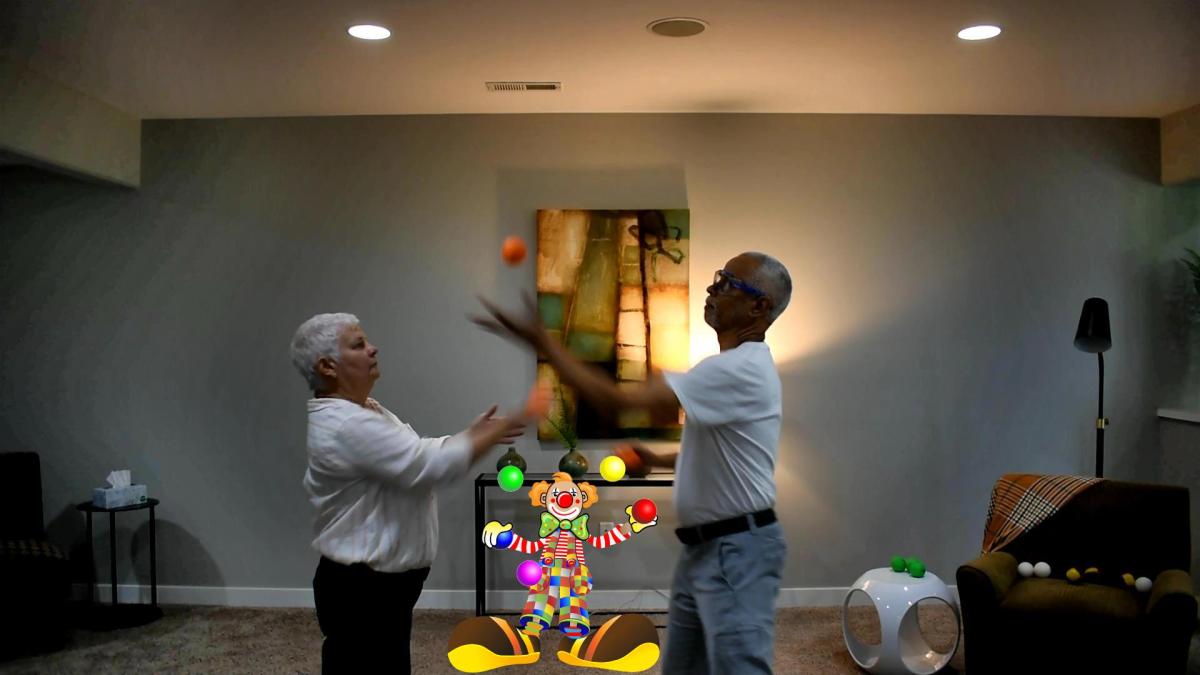
2 Person 6 Ball Pass Juggle

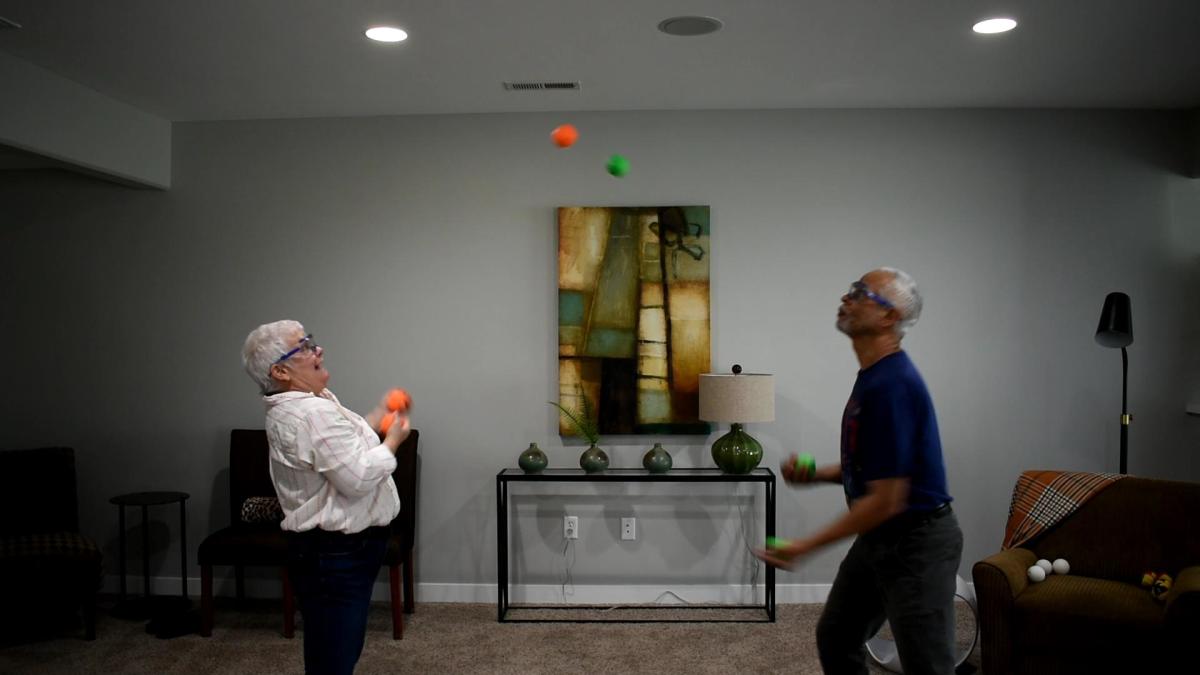
Sena and I reached for the sky and tried another two-person juggle pattern with 6 balls. It’s supposedly one of the easier tricks, but we are ordinary jugglers and beg to differ. One YouTube expert juggler says you should be able to stand in one place and juggle 100 cascade throws to do this trick.

Sena finally wore her safety goggles, probably because she got knocked on the head once while we practiced.

The idea is for both partners to do a solid 3 ball cascade pattern and pass one of the balls at regular intervals. Believe it or not, the slowest pace is to count “1, 2, pass” so that you throw the pass after two right hand tosses in your cascade. Both partners pass with the right hand to each other’s left hand.

That was difficult for both of use because we’re used to counting every throw, including the left-hand throws. You have to skip counting the left-hand throw and starting counting with only the right-hand throws. There are faster variations of this trick, including passing every throw!

We drop a lot of balls, needless to say. But we have a lot of fun!

Food for Thought

I’m giving a shout-out to a couple of child psychiatrists, one I know only from a blog, The Good Enough Psychiatrist. The other is an assistant professor in the University of Iowa Child Psychiatry Dept. I’ve never met her.

Since Jenna gives her name in the About Me section of her blog, I’m going to call her that because it’s easier. Jenna writes many thought-provoking posts, but I really admire the one titled “Amae.”

Dr. Ashmita Banerjee, MD wrote an essay titled “The Power of Reflection and Self-Awareness.” It’s published on line in the Mental Health at Iowa section of The University of Iowa web site.

As a relatively recently retired consultation-liaison psychiatrist who is also a writer, I feel a strong connection to them. In addition to being very glad that extremely talented persons are filling the ranks of a specialty which suffers from a serious manpower shortage, I get a big kick out of reading what really smart people write.

Here’s where a geezer retired psychiatrist starts kidding around. Jenna, a fellow blogger, is used to my habit of deploying humor, admittedly often as a defense. Dr. Banerjee doesn’t know me.

What is it about these essays that reminds me of the X-Files episode “Hungry”? It’s a Monster of the Week episode from the monster’s perspective. This monster looks like a human but sucks brains out of people’s skulls. He’s conflicted about it and even sees a therapist. But in the end his dying words were, as Agent Mulder shoots him down, “I can’t be something I’m not.”

If you read Dr. Banerjee’s essay and followed one of the links, you would have caught the clue that I actually read it because I consciously substituted the word “What” for “Why” in the previous paragraph. I could have as easily asked why instead of what—but it’s less helpful in gaining self-awareness.

And I haven’t sucked anybody’s brains out of their skulls in, what, over two weeks now! Upon reflection, I’m very aware of being incorrigible. Food for thought.

Jenna’s description of the Japanese concept of the word “amae” and Dr. Banerjee’s examination of the Japanese word “kintsukuroi” fascinated me. What made both writers consider human emotions using a language which captures the nuances so deftly?

I was a first-generation college student. There was a time in my life that a path to medical school seemed impossible. At times I probably thought I was trying to be something I’m not.

I’m just grateful for the new generation.

Chair Leg Cups for Floor Protection–Hah!

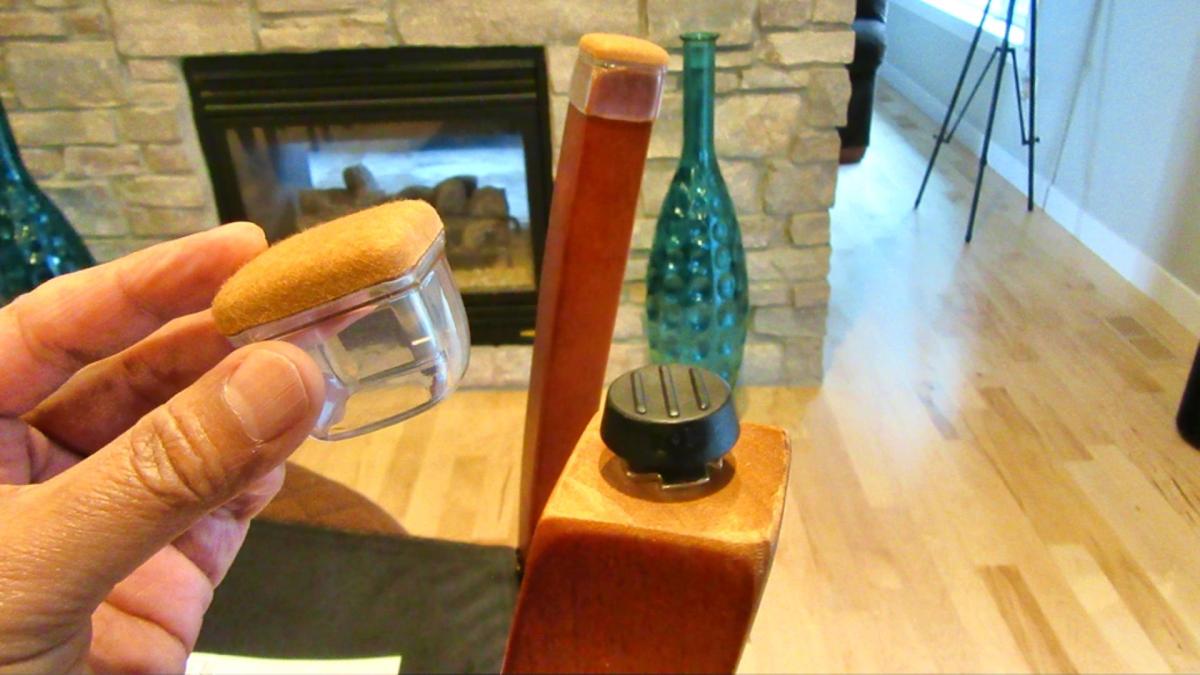
Okay, Sena ordered some chair leg cups to protect our wood floors. These are for the new Parsons chairs we got recently.

The cups and how to install them over the chair legs are enough to remind some people of condoms for extraterrestrials. These people have no morals and have not developed the maturity needed to listen to Rossini’s William Tell Overture without yelling at the top of their immature lungs, “Hi Yo, Silver!”

Anyway, we struggled with these condoms, I mean these chair leg prophylactics, I mean Hi Yo, Silver!”

Where was I? Oh, the cups came with no instructions. They are made of tough silicone and one end has a soft covering to enable sliding over carpet or wood floors. The manufacturers give you extra cups because they probably know you’re going to cut them up on your table saw when you figure out it will take approximately 5 hours to install one, just one, on any dining room chair without sustaining serious injury to your fingernails or getting one on just enough only to see it snap off and ricochet off your ceiling into the kitchen garbage disposal where you can gleefully grind it up into tiny condom particles.

Sena tells me the reviews are generally positive. Apparently, people writing these reviews either have no problems installing them on their furniture legs or they are pathological liars.

It really takes two persons to get these on a chair leg, one to hold down the chair, which for reasons known only to chairs, try to run away as soon as you try to put chair leg cups on them. While one person has to press down on specific corners of the cup to press them down, the other has to pull down on the sides.

If by some miracle you get all of the cups installed on the chair legs, you then turn the chair right side up, set it on your carpet or wood floor—and immediately notice that it won’t sit level. You then wonder if the problem was that you removed all the chair leg levelers (those little screw things on the bottom of the legs). Maybe you should not have removed them. Then you try putting the leveler back on, which of course means you have to remove the cup you labored to install, and then reinstall it.

After you do that—voila! The chair still sits cockeyed with one leg shorter than all the rest. Isn’t that clever? Actually, they worked out okay after the first couple and we did have to work as a team.

I think your best bet is to buy a house with dirt floors. You’re welcome.

AARO Wants UFO Info

The All-Domain Anomaly Resolution Office (AARO) is now accepting information about U.S. government programs or activities related to UFOs from “…current or former U.S. Government employees, service members, or contractor personnel with direct knowledge of U.S. Government programs or activities related to UAP dating back to 1945.   These reports will be used to inform AARO’s congressionally directed Historical Record Report.”

You know who you are.

Speaking of Spanish

Every once in a while, I get an urge to try to learn to speak, or at least read Spanish. Recently, Men in Black was on the Telemundo broadcasting network. I tried to watch it but gave up after a few minutes. The dubbing was disappointing because the actors don’t speak Spanish and the dialogue sounds weird.

I enjoyed my basic Spanish courses in my freshman year of college at Huston-Tillotson University (then Huston-Tillotson College). I think I impressed my teachers simply because I could mimic the sound of Spanish. That’s only because our family lived next door to a Spanish-speaking family. As a child, I got so used to hearing it that I must have absorbed the sounds and cadence.

That didn’t help me in actually learning to speak Spanish in college, though. My teacher, Dr. Whitby, gave me a book of jokes and funny stories titled “Risas Y Sonrisas.” I think he gave it to me because I did my homework and, at least on paper, did well on written exams. I found a book with the same name on Amazon that was originally published in the late 1940s. The title can be translated as “Smiles and Laughter.” My teacher translated it more loosely as “Giggles and Grins.” I kept the book for many years, but it got lost in a move. Toward the latter part of the first semester, Dr. Whitby invited a native Spanish-speaker who was a senior to class one day. The idea was for us to use what language skills we had tried to learn to communicate with her. None of us could even bring ourselves to say Como Esta used! I was extremely shy and embarrassed.

When I was working as a consulting psychiatrist, I always used a translator service that health professionals could access by telephone. It was a little awkward, but handy when a Spanish-speaking translator was not available in person.

There are free Spanish lessons on the web and other ways to learn that cost money. I’m leery of both. If I could find a course in Spanish that didn’t cost an arm and a leg, I would consider trying it.

Then I could say some of my favorite Men in Black quotes in Spanish. I found out Tommy Lee Jones (who plays Agent K) actually can speak Spanish. I have to use the Google Translate application:

Men in Black quote:

Edwards: Why the big secret? People are smart. They can handle it.

Agent K: A person is smart. People are dumb, panicky dangerous animals and you know it. Fifteen hundred years ago everybody knew the Earth was the center of the universe. Five hundred years ago, everybody knew the Earth was flat, and fifteen minutes ago, you knew that humans were alone on this planet. Imagine what you’ll know tomorrow.

Men in Black quote in Spanish:

Edwards: ¿Por qué el gran secreto? La gente es inteligente. Pueden manejarlo.

Agent K: Una persona es inteligente. Las personas son animales peligrosos, tontos y asustados, y tú lo sabes. Hace mil quinientos años todo el mundo sabía que la Tierra era el centro del universo. Hace quinientos años todo el mundo sabía que la Tierra era plana y hace quince minutos sabíamos que los humanos estábamos solos en este planeta. Imagínate lo que sabrás mañana.

Parsons Chairs Our Latest Knockdown Furniture

Our old Parsons chairs are getting pretty lumpy, so we ordered some new ones. We generally buy and put together knockdown furniture to save money, although squatting on my haunches and sitting on the floor while cranking a hex head wrench makes my joints sore.

Sena was having a little anxiety about the chairs. Ordering knockdown furniture can be a daunting experience, especially because I’m one of the least handy persons on the planet.

I looked up Parsons chairs on the internet. It’s named for the Parsons School of Design in Paris, France. They were first created in the 1930s in reaction against very ornamental designs of that era. They’re plain and simple, often used as dining chairs.

When I was a skinny kid, I used to lift our dining chairs for exercise. We couldn’t afford barbells. I think of Parsons chairs as being pretty light weight, so I don’t know if the chair I used for bench pressing were Parsons—although I was definitely a lightweight.

On the other hand, these chairs are definitely heavier than the ones they’re replacing. The tough part was getting the screws lined up when fixing the seat to the chair back. I had to tip the seat slightly either to me or away from me to get the screws in. When I can screw them down easily with my fingers, I’m usually OK. Occasionally, it takes a quick crank with the wrench to get it going.

When I wasn’t interrupting myself taking pictures of my assembly of the chairs, I put one of the chairs together in about 25 minutes. For me, that’s not the record. I assembled a typical knockdown Parsons chair in 15 minutes back in March.

Sena was had high anxiety about the chairs-nervous about possibly having to return them if they were damaged or parts missing and so on. She read some of the reviews by people who got them and had bad experiences. She had high anxiety about me, in case I broke something. But things turned out OK.

Side By Side Steal Juggle

We took a couple days to get the hang of the side steal juggle. It’s not easy and a lot of the throws look more like sneaky passes than steals. But it’s a lot of fun!

Sena juggles with her arms really reaching for the sky, like she’s getting robbed—which actually fits this complicated crime of a juggling trick.

You have to get a feel for whether you feel more skilled by reaching with your left or right hand when trying to steal your partner’s juggling balls. That dictates on which side you stand. One of the key points is to stand fairly close together.

It helps to toss the balls a little high and close to the juggling pane of glass so that you don’t have to reach too far out in front or you or too far behind you.

We counted the initial throws just to get started. After the first steal, it got too difficult for us to keep track of the count and a free style pattern began to emerge. We traded balls 4 times and Sena was gunning for 5. We almost got there.

Because we were so close together, ball collisions were common, making it important to time throws.

Side by side, shoulder to shoulder, this is a juggling trick in which teamwork is the key. It really helps you develop more skill with the 3-ball cascade.

Juggling Updates

Well, I’ve been juggling for a year now. I have been trying to learn the shower juggling pattern for 6 months. I can still do only about 3-4 throws. I think it’ll happen eventually.

All of the juggling balls are downstairs on the lower level since all the upstairs doors were repainted. We can’t scuff them up by dropping juggling balls anymore.

We’re working on a new two person juggling trick. It’s a variation on the steal. It’s a side-by-side steal pattern and it’s more difficult to do than the front steal. We have to orchestrate it a little, sort of like the ever-popular Wolfgang Amadeus (“Bud”) Mozart’s Symphony No. 573.8 in J Minor, Op 74: II. Andante Pizzacata Beef Jerky de Bigfoot. I bet you’re wondering how I got to know so much about classical music. Anyway, we’re getting there.

We’re both working so hard on juggling that our shoulders are sore. I do a total of 200 throws of the cascade every day in addition to other tricks. Sena does air juggling at the dinner table. Maybe we should be doing some shoulder mobility exercises.

I’m pretty consistent about wearing safety goggles. Sena won’t wear them. You should comment that she ought to start right now. Thank you.