People Remember Hurricane Edna

The hurricane season this year continues to be deadly, and they are not named after women anymore. That stopped in 1979; how and why it stopped is quite a story in itself. The latest one is named Milton, which is a benign sounding name, but the storm is anything but that.

I was reminded of the custom of naming hurricanes after women last night when I reread E.B. White’s essay, “The Eye of Edna.” The essay is subtitled with place and date: Allen Cove, September 15, 1954. It was published in a collection “Essays of E.B. White in 1977 by HarperCollins. It was published originally in the New Yorker, according to an online quote from his essay.

I’m too young to remember Edna. When I did a web search of the term “The Eye of Edna,” I got many hits for both the essay and the hurricane. Reading White’s essay is a treat because he makes fun of how radio news reporters and the people in Maine who were listening to the radio reacted to the weather reports about Edna. Radio reporters often seemed disappointed about the lack of heavy rain and high winds.

I found the abstract of an article published a 1958 issue of the Journal of Meteorological Sciences which the driest summary of Hurricane Edna I could possibly imagine:

“Kessler, E., 1958: EYE REGION OF HURRICANE EDNA, 1954. J. Atmos. Sci.15, 264–270, https://doi.org/10.1175/1520-0469(1958)015<0264:EROHE>2.0.CO;2.

Abstract

The eye region of Hurricane Edna (1954) is studied with the principal aid of radar and dropsonde data. Vertical sections show that over the eye there was a thick layer derived from the wall cloud which bounded the eye on the northeast. Precipitation fell from this upper layer into drier air beneath. A reasonable mechanism is thereby suggested by which large moisture values can become associated with air in the eye without producing the wet bulb potential temperatures or high winds characteristic of the rain-filled masses outside the eye.

Radar data giving the height of the “bright band” or melting level show that the warm core structure of Edna was most pronounced within the radius if maximum surface winds. The result is qualitatively confirmed by soundings and by comparison of surface winds and the speeds of radar weather elements in various portions of the storm. The radar photographs also show that heavy precipitation near the eye of Edna was bounded sharply in the western semicircle along an east-west line through the center of the storm. This boundary must be associated with a rather large change of vertical air speeds and therefore has special dynamic significance.”

If you read it the citation too quickly, you might misread the journal’s abbreviated name as my own. It’s actually J. Atmos—not J. Amos.

There is a much more vividly emotional account of Hurricane Edna in the Vineyard Gazette’s 2014 online story, along with a video.

The bottom line is hurricanes are deadly storms, no matter what people name them. Everybody, including E.B. White, would agree on that.

A Game of Darts in Frankenstein Movies

I just saw the 1939 film “Son of Frankenstein” on Svengoolie last night. There was a double feature, but I didn’t see the second movie.

I’m anything but a movie reviewer and all I’m going to do is point out a parody of the dart throwing scene between Wolf Frankenstein and Inspector Krogh in “Son of Frankenstein” of the scene in the 1974 movie, “Young Frankenstein” starring Gene Wilder as the son of Frankenstein.

The dart throwing scenes are similar enough in both films to make me laugh. The comedic effect in “Young Frankenstein” of Inspector Kemp (played by Kenneth Mars) slapping his wooden arm around and sticking the darts into it is immediately obvious. While somewhat overshadowed by the “Son of Frankenstein,” melodrama, I couldn’t help but notice the similar behavior of Inspector Krogh (played by Lionel Atwill) goofing around with his wooden arm as well.

You can compare the YouTube dart throwing scene (see below) in “Young Frankenstein” with that of the last few minutes of the “Son of Frankenstein” in the scene starting about 1 hour 32 minutes in the Vimeo video of the full movie (see below).

I’m only sorry that I’m not up to the task of comparing either film to the original novel on which all the Frankenstein movies were more or less based: “Frankenstein; or, the Modern Prometheus,” written by Mary Shelley. I never read it. I skimmed the Wikipedia article about it. The section about the novel’s reception finishes with the idea that the novel asks fundamental questions about why we’re here and what our purpose is. Has anyone ever answered them?

A game of darts, anyone? The link to the Vimeo video, Son of Frankenstein:

YouTube of Young Frankenstein version of the game of darts:

Thoughts on the Big Mo Pod Show “Funkin’ Down the Highway”

This is a post about the Big Mo Pod Show we heard last night on the KCCK FM radio dial 106.9. Incidentally, the KCCK fund drive was enormously successful this year, earning $100,000 in donations, according to Big Mo (aka John Heim) himself.

One item is the cover by Buddy Miles of the song “Tobacco Road.” This rendition was different from performances by other artists. Big Mo liked it and so did I. I did a little web search on it because I couldn’t catch all the lyrics. It was originally done by John D. Loudermilk in 1960. Miles’ version is essentially the same.

What interested me even more about “Tobacco Road” are the associations I have about it with specific literary works. I’ll admit I’ve never read nor seen the film adaptations of Erskine Caldwell’s books, “Tobacco Road” and “God’s Little Acre.” But one of my favorite short stories by James Thurber is “Bateman Comes Home,” which was published in a collection entitled “The Thurber Carnival,” in a hardcover edition in 1945. You’ve got to read it to get a sense of how comical the parody is of the regional dialect used in Caldwell’s novels. In fact, Thurber himself gives the game away about his intent in writing “Bateman Comes Home” by adding a wry comment as a subtitle:

Written after reading several recent novels about the deep south and confusing them a little—as the novelists themselves do—with “Tobacco Road” and “God’s Little Acre.”

He also adds another comment at the end of the short story: “If you keep on long enough it turns into a novel.”

The other thing I noticed about the podcast last night is that one of the songs which was not included in the list, “Joliet Bound,” was performed by an artist I haven’t heard of, the Reverend Shawn Amos, who is no relation to me, of course. But my background as a psychiatrist made me take special notice of details about his family, one of which is that his mother, Shirl-ee Ellis, a singer herself, had been diagnosed with schizoaffective disorder. Sadly, she eventually died by suicide. Shawn Amos is also the youngest son of the Famous Amos chocolate chip cookie founder, Wally Amos (again, no relation), although I’ve gotten a lot of friendly ribbing about that.

The song “Joliet Bound” is about a guy who expresses that he’s wrongly accused of killing a man over a woman and is on his way to Joliet prison in Joliet, Illinois. The Joliet Prison is a tourist destination nowadays and has other distinctions attached to it. It was featured in the 1980 film, the Blues Brothers. There were some famous inmates there, among them John Wayne Gacy, who was once evaluated and diagnosed with antisocial personality disorder by psychiatrists at The University of Iowa in 1968 as described in Dr. Donald Black’s book, “Bad Boys, Bad Men: Confronting Antisocial Personality Disorder (Sociopathy).”

Congratulations KCCK Radio!

Notes on the Blues and Rivers of Whiskey

I listened to the Big Mo Blues Show last night on KCCK radio (88.3 on your dial) as I usually do on Friday nights. It runs from 6:00 pm to 9:00 pm and you can learn a lot from Big Mo (aka John Heim) about the blues.

He also has a podcast called the Big Mo Pod Show, which is based on his blues show. He gets quizzed about some of the songs he played on Friday night by Producer Noah (as Big Mo calls him). Last night he was on target for all 5 of the songs he played and why he played them.

One of the songs I’ve never heard before but it was done by Taj Mahal and Keb Mo, artists I’m familiar with just from listening to Big Mo’s show. The title was “Diving Duck Blues. The chorus goes “If the river was whiskey and I was a diving duck, I’d dive to the bottom and I’d never come up.”

That led to a discussion of how alcoholism was sometimes (maybe more than sometimes) a part of the life of blues musicians. In fact, the lead off song last night was “Big Road Blues,” sung by Tommy Johnson. His last name just happens to be the same as Robert Johnson who made the song “Crossroads” famous because he claimed he sold his soul to the devil in order to become a great blues musician. Several blues artists made the claim, which Big Mo debunked as a ruse to get fans to pay more money to hear them perform.

But Tommy Johnson struggled with alcoholism and, according to Big Mo, was driven to the point of drinking Sterno, which was poisonous because it contained methyl alcohol.

This can lead you to think that maybe all blues music is gritty, played by alcoholics, and even depressing as declared by the lead character, Navin Johnson, played by Steve Martin in the movie “The Jerk” (a white guy raised by a black family).

Incidentally, this reminds me that a recent study showing that digital cognitive behavioral therapy is effective for those suffering from alcohol use disorder.

Anyway, blues musicians don’t always play sad, gritty music and die from drinking Sterno. One that is actually funny is “You Left the Water Running” by Otis Redding. You can look up the lyrics or listen to anyone who covers the song and it would be difficult not to laugh out loud.

And speaking of covering a song, Bill Withers originally wrote and sang “Lean on Me” back in 1972 which Keb Mo covered recently. I think it’s one of those uplifting examples of blues music which won’t send you diving to the bottom of any whiskey rivers.

University of Iowa Writing Programs Get High Ranking from U.S. News & World Report

The University of Iowa ranks No. 9 across all universities in the country for its power in the writing disciplines., according to the 2024 U.S. News & World Report.

The school is well known for its writing programs of which the The Writers Workshop is the best known.

The University of Iowa also gives medical students a leg up on writing in its Writing and Humanities Program, which offers courses such as writing and medicine and editorial writing.

This reminds me of a couple of things, one of which was the University of Iowa medical school note service. Many medical schools have note services so that not all students have to write their own lecture notes. It’s ironic in a way that one of the best known public medical schools didn’t encourage all the medical students to labor over their own class notes. I volunteered once to write notes for the class. It was hard work.

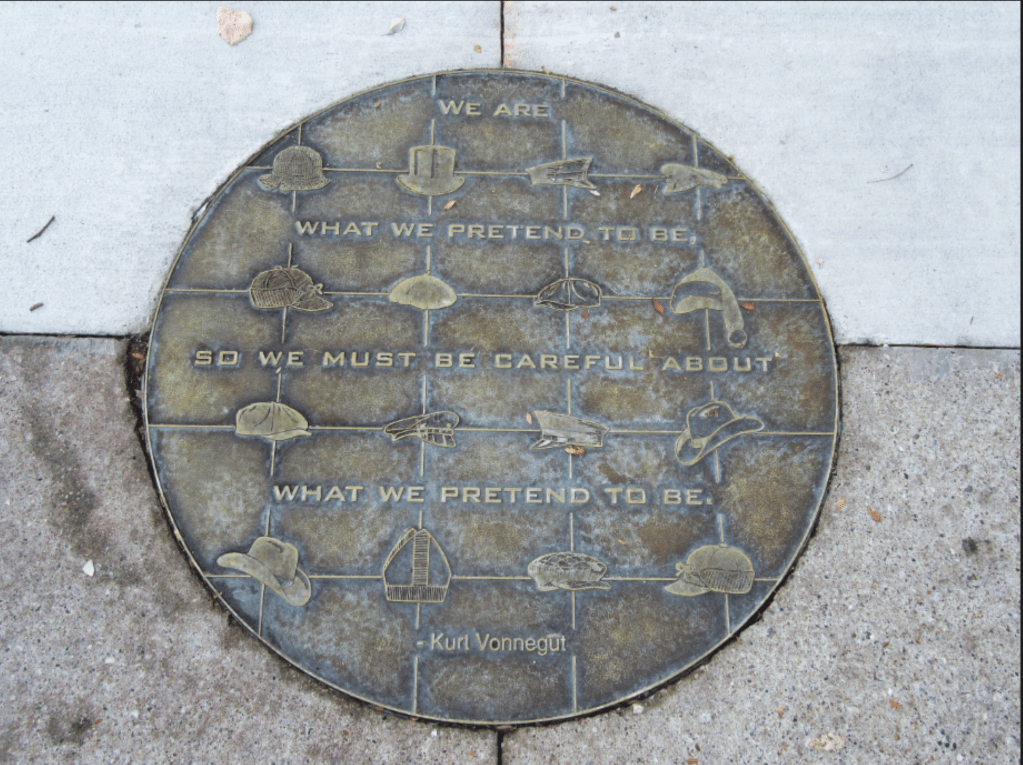
The other thing writing education at the University of Iowa reminds me of is the Iowa Avenue Literary Walk. There are several plaques along Iowa Avenue which honor famous authors who had Iowa connections, often through the Iowa Writers Workshop. My favorite is one by Kurt Vonnegut, a former teacher at the workshop.

Back to the Roller Window Shades?

I just heard about the new regulation banning cords on window shades. I didn’t know that window cords were so dangerous.

We recently moved into our new house and need window coverings. We’ve had corded window coverings (mostly blinds) for years wherever we moved. I guess we’ll have to consider other options.

This reminds me of the old roller shades we used to have. I couldn’t find a free picture of them on pixabay, no matter how I worded the search term. The ones I remember were white and had a mechanism in the roller which retracted the shade—if you had just the right wrist motion.

Many times, the shade ended up in a heap at your feet. You could injure yourself by tripping over the shade, or sometimes by the shade suddenly snapping upwards and smacking you in the face.

There are newer versions of roller shades and they’re all expensive. You can still get old-fashioned roller shades, but I think they cost a lot more.

There’s an old photograph of a room with several roller shades on this web page.

Thoughts on the Homeless Mentally Ill

The homeless man who lives on the sidewalk outside our hotel reminds me of a couple of things. One is Dr. Gerard Clancy, MD who is University of Iowa Health Care Professor of Psychiatry, Professor of Emergency Medicine, and Senior Associate Dean of External Affairs.

I remember Gerry, who was in the department of psychiatry when I was a resident. I saw his picture in the newspaper and hearing about him riding a bicycle around Iowa City doing a sort of outreach to the homeless mentally ill.

I found an archived article mentioning him published in 1995 in the Daily Iowan. The story starts on the bottom of the front page, entitled “I.C. opens new doors for area’s mentally ill.” It continues on page 9A.

The story mentions Dr. Clancy and what was called then the Clinical Outreach Services and the Emergency Housing Program (EHP). The challenges then sound a lot like what they are now: long waiting lists for psychiatric evaluation and treatment, a lack of funding for the treatment of mental illness, and a lack of preventive care. The most common mental illnesses in the homeless mentally ill are chronic schizophrenia, schizoaffective disorder, and bipolar disorder. The idea of reaching out to them “on their own turf” as Clancy was quoted, was to help them feel more comfortable talking about their mental illness.

The housing situation for this population of those struggling with mental illness was dismal then and it’s still dismal.

The homeless guy I’ve been calling Bob lives on the sidewalk next to a busy street. It’s just my opinion that he’s mentally ill based on my observations of his behavior. I’ve never tried to talk to him. However, Bob gets visits from people who obviously have differing views about the way he lives.

Some of them do talk to him and, although I can’t hear their conversations, the actions tell me important things. Some bring him what I call “care packages,” often food, water, and other items. They may start by acting kind, although may get impatient with him. Others try to clean up his sidewalk, and may criticize him. The police occasionally visit and have so far not taken him into custody.

It looks like things have not changed much since 1995 regarding the homeless mentally ill based on what I write here about my observations. In fact, it’s easy to find current news stories that say things are getting worse.

At the beginning of this post, I said I found a couple of things. The other thing was a very thorough teaching presentation about the current state of formal outreach to this population. It’s available on the web as a power point presentation by another University of Iowa faculty, Dr. Victoria Tann, MD, entitled “Assertive Community Treatment 101.”

Dr. Tann is currently an IMPACT Team psychiatrist. It’s an excellent source of background on the history of this effort at outreach to the homeless mentally ill. It also summarizes what’s happening with the program now.

Historic Rock Island Line Depot in Iowa City

Last week while on our way to the Stanley Museum of Art, we saw the Rock Island depot at 115 Wright St in Iowa City. We’ve lived here 36 years and never visited this historic landmark before. It has interesting architecture and there is even a passenger bench inside. It was built in 1898 and was converted to law offices in the early 1980s. There used to be a waiting room which was removed when it was remodeled. You can see it in the featured image.

The depot has a rich history which you can read here.

Be sure to see the YouTube presentation by local historian Irving Weber.

You’ll notice that Mr. Weber opens his talk about the Rock Island depot by singing a line from a popular song about it: “Rock Island Line is a mighty fine line…”

When we looked on the web for the song, we couldn’t find a rendition with that exact line. Every version we listened to was slightly different but that line was always “Rock Island Line is a mighty good road…” There is an original version recorded in 1934 by John Lomax. We like the one by Lead Belly.

Thoughts on Hobos and Homelessness

We can see the man from our hotel window. We assume he’s homeless. He has a small area where he sits on the curb next to the street.  He does this most of the day. He has a blanket and a few other loose items which sometimes are strewn on the sidewalk or the grass.

Even in 90-plus heat, he’s out there, sometimes standing beneath a small tree, presumably for shade although it’s inadequate. He waves his arms around in what looks like a futile attempt to cool himself. He might just be restless. Other times he sits on his blanket. Occasionally, people stop their cars and seem to be trying to communicate with him. He most often ignores them.

One of the hotel residents approaches him sometimes. It looked like he gives him something (probably a cigarette). Once, the homeless man left his station by the street and walked over to the front of the hotel, waving his arms, seemingly because the hotel resident was speaking to him. We couldn’t see what happened after that, but when he returned to the street, he lit a cigarette. We also saw he accepted fluid, maybe a can of soda.

Later, some people in a car gave him something they bought in a nearby drive-up fast-food joint. He threw out the ice from his drink, which he didn’t consume and sprinkled the fluid on his arms. The people left and returned later with several items they gave him. Some of it looked like more water, which he again poured on his arms. There was a backpack or something like it. He didn’t seem to know what to do with it.

He couldn’t ignore them when they try to help him (water, food, etc.). One person tried to help him clean up his little camp by picking up his trash. The police came out to check on him. We couldn’t hear the short conversation. After she left, he continued to toss his water bottles and other items into the parking lot. He sleeps on the pavement.

This reminded me of a couple of times when I’ve seen hobos. I don’t see the homeless man as a hobo. The term “hobo” is not synonymous with homeless, vagrant, or tramp. Hobos prefer not to have a home, travel around to find work, may still ride the rails to get around, and don’t see themselves as tramps.

As a young man, I worked for consulting engineers as a draftsman and survey crew worker in Mason City. This was in the 1970s. We traveled to outlying cities. One day, we went to Britt for a job. It was during the Britt Hobo Days Convention. It was not the first time I ever heard of it.

Funny thing, I thought I recognized one of the hobos in the café where we got coffee. He was wolfing down a big breakfast. When he was finished, he left in a hurry. I just assumed he was a hobo in town for the festivities. But he looked so familiar.

And suddenly it dawned on me. He had been a kindergarten classmate of mine. I couldn’t recall his name, but it was him.

Another memory that occurred to me was much later in my life, when I was a psychiatrist and co-attending on the medical-psychiatry unit in University Hospital in Iowa City. We admitted a patient who had been found walking around and around in a circle in the street, and seemed confused. Evidently the patient had an acute medical problem and no diagnosable psychiatric illness.

The patient identified as a hobo and was proud of it. The person was polite, grateful, and cooperative. The person refused any help from us beyond help for the acute medical problem. We discharged the person to the street.

Hobo life is different nowadays, I gather. Many have cars and phones. If you look carefully at their photos on the Britt Hobo Days web site, they don’t make me think of homelessness or mental illness. They have made a choice.

On the other hand, homelessness is often not a choice and severe mental illness is not uncommon. There is a homeless shelter in Iowa City, and the resources include a supportive community living program for those who struggle with mental illness. One member of the board of directors is a psychiatrist. Not every homeless person wants to go there. The University of Iowa Health Care has an Integrated Multidisciplinary Program of Assertive Community Treatment (IMPACT).

Dirty Laundromania

Because we’re staying in a hotel waiting for our house to be built, we have to take a different approach with our laundry. There are laundry facilities at the hotel, but there aren’t many machines. Sena usually takes it to a place called Laundromania. The motto is “We Never Clothes.”

I went with her the other day for the first time. There are a lot of machines. As it turns out, there’s also a lot of history at Laundromania. Back in 2008, Iowa City suffered a major flood and Laundromania was under water for a while. There’s even a picture inside of the water line painted on one of the windows. We remember that time. What a mess. You can see a very dirty sign that was framed and which describes the flood.

Laundromania is a modern facility. You can put your cash into a machine which pushes out a sort of debit card-which can only be used in Laundromania. You want to be careful with that. Depending on how long you live in the neighborhood, it could be either a good or a bad thing.

Even though it’s a modern facility, Laundromania does have some quirks. The day we were there, we tried to use a dryer which turned out to have a broken door latch. We lost a little money in it. Sena put one of the Out of Service signs on it. There’s no on-site manager there but, coincidentally, shortly after she put the sign on the dryer, the service guy showed up. I guessed he fixed it.

For a short time, I tried to keep track of the dryer time using the old analog clock on the wall. Two things wrong with that: the clock doesn’t work and all the machines have digital timers on them anyway.

You can buy laundry detergent and other stuff there from a vending machine, but they’re pretty expensive.

There are a couple of old grade school desks that bring back memories. One of them is pretty dirty.

If you’re ever in Iowa City and you need to do your dirty laundry, try Laundromania.