FDA Removes N95 Respirators from Shortage List

I think it’s ironic that about the same time a PLOs One study and news articles came out announcing a new method using 8-inch rubber bands for improving the fit of the surgical mask to approximate that of the N95 respirator, the FDA removed the N95 respirator from the medical device shortage list. This is relevant to help protect people from infection with Covid-19 because even vaccinated older people are getting hospitalized with the Omicron variant of the virus.

I’m not saying that the new rubber band method to tighten the fit of the surgical mask is not an improvement. It might come in handy when there is another shortage of N95 respirators.

The method mainly targets health care professionals. It would be difficult to persuade everyone in the community to adopt the technique. It’s tough enough to get people to wear masks even in crowded buildings in high transmission areas.

This is despite the CDC study showing that the elderly population continue to be at high risk for hospitalization from Covid-19 despite being vaccinated with the initial series and one or more boosters.

I think it’s hard to achieve a good fit even with the N95 respirators. The free ones distributed by the Federal government early this year were not widely available and fit poorly because the straps were elastic (similar to rubber bands, only flimsier) and loosened quickly, even after using only 2 or 3 times. At least the ones I got did. Prior to retiring, I was never able to pass a Fit test at the hospital using that type of mask.

I think my surgical masks fit better than the N95 respirators, especially after using the knot and tuck method to get a tighter seal.

Now the newer rubber band method to get a better seal uses two large 8-inch rubber bands to make the mid-face portion of the mask fit closer to your face. It looks a little easier to do than the earlier 3 rubber band technique developed a couple of years ago. That one was even tested at the University of Iowa Hospitals and Clinics by emergency room health care professionals, resulting in a small published study (the “double eights mask brace”).

All of the rubber band mask braces techniques were a response to the shortage of N95 respirators. What’s interesting to me is that, as the authors of the PLOs One study point out, there is a fair amount of variability in how well the N95 mask fits. Differences in the shape of a person’s face can account for some of this.

And there’s no shortage of N95 respirators—for now, at least according to the FDA.

If a non-health care professional wanted to use a rubber band brace, it would take some practice to get a good seal. There’s a bit of a learning curve even for a pro.

I think it would be difficult to persuade the average person to get the rubber bands and the surgical mask out of a pocket or a purse and fiddle around to achieve a good fit if you’re just going to run into Wal Mart—where I could not find that the big 8-inch rubber bands are even in stock. They’re pretty much a “3-day shipping” kind of item and could cost as much as $20 a bag.

Iowa State Fair Musings

We’ve never actually been to the Iowa State Fair, but we really like listening to the Iowa Public Broadcasting TV shows about it.

The first show covered a lot of activities. Food at the Fair is always intriguing.  We know there are a lot of foods on a stick, but we didn’t know you could get a rattlesnake corn dog—with venom sauce! It’s pretty good according to the food guy, Travis Graven. You probably won’t find it in your local grocery store.

The big animals are impressive. I always wonder why the handlers sort of guide some of the animals (like that huge boar) using those little boards.

The lemonade stand was a little thought provoking. Dad’s Old-Fashioned Lemonade stand sellers aren’t out there to make money. They do it for the nostalgia. I’m sure they do it for the tradition as well.

That’s a nod to keeping tradition alive. One of those is the 4-H program. According to the Iowa State University 4-H Youth Development web page, the 4 H’s stand for:

Head for thinking, planning, and reasoning

Heart for being kind, true, and sympathetic

Hands for being useful, helpful, and skillful

Health for taking care of yourself and your community

The Iowa State Fair is a longstanding tradition. It started way back in 1854. It was on hold in 2020 because of the Covid-19 pandemic and that was the first time since World War II it was cancelled and only the sixth time in the Fair’s 166-year history.

A tradition is defined as the transmission of a culture’s customs, beliefs, knowledge, skills and more from generation to generation. In order to do that somebody has to do the passing down of all of that. And somebody has to pick it up.

You can store some of it in electronic archives, but a critically important part of it relies on institutional knowledge in the hearts and minds of the culture’s older people. It’s a two-way street; the young listen, accept some, and improve more if we’re lucky. It’s more than facts and figures—it’s the wisdom we want to preserve.

And we want to keep the rattlesnake corn dogs, with venom sauce.

What About the Deer?

I saw a very thoroughly researched article the other day about the issue of deer population management in Little Village, a monthly news and culture magazine. You get an idea of the conflict between deer and people when you read the title of the article, which contains the gentle term, “Rats with hooves.”

I was reminded of it when Sena yanked the tall grasses out of her garden recently. Later, I could hear her tapping on the windows and yelling at the deer who could now see the garden is actually a salad bar.

I have lost count of the number of deer who ask me to light their cigarettes for them after they breed on our front lawn.

And I made a video in which they cavort and chew their way across our back yard on their way to parties. For some reason, it’s gotten over 1,280 views as of this writing (8/11/2022), and got about a 1,000 in one day.

I’m not clear on exactly why deer management by bow-hunting is such a failure. Iowa City has contracted with an outside company which can cull the population by the hundreds using sharp shooters who apparently do this for a living. I guess bow hunters see this as a form of recreation.

I’m ambivalent about people killing deer. On the other hand, a deer did run into Sena while she was driving the car a few years ago. They can leave a pretty good dent and can even kill motorists.

The Little Village article quotes somebody who said that neighbors call deer “1,200-pound rats with hooves.”

That sounded pretty heavy to me. I looked it up on the web and the average deer weighs a little over 100 pounds. If they’re seeing something that big in their yards, they might be confusing a moose for a deer. And that means we’ve got an even bigger problem.

There are other ways to control the population besides shooting them. I learned that you can surgically sterilize them. It costs about $1,000 per animal. Would these be veterinarians who might call their clinic, Pay to Spay?

The other way might be to introduce natural predators, such as wolves, into the areas where deer are making themselves a nuisance. Collateral damage could become an issue during backyard cookouts. And has anybody considered the risk of werewolf contamination?

Mmmm, venison!

Could we round up the deer and relocate them to a wilderness where wolves and other natural predators could control their population? I won’t mention the name of such a place, but it starts with the letter A-L-A-S-K-A.

Could Bigfoot get involved somehow? Maybe, if scientists could come up with a way to alter the deer genetic code to make them smell like beef jerky.

According to the article, the application for participating in the bow-hunt season runs through October 21, 2022. Property owners can fill out an application to allow them on their land. Anybody up for shish kabob at their cookout?

Holes in Our Heads

I remember getting a trephination of my fingernail a long time ago when I was working as a surveyor’s assistant. We were out taking elevation shots with a level and a rod measuring the depth of sewer pipes.

This required us to remove the manhole covers, which are very heavy. I got one of my fingers pinched and man that hurt. My crew drove me to the emergency room where an ER doctor drilled a tiny hole in my fingernail. The immediate pain relief resulting from the release of the subungual hematoma pressure felt miraculous.

That was trephination of the fingernail. I’ll bet some of you thought of my skull when you read the word in my first sentence, though.

Trephination is just the word for the medical procedure of making a hole in the body for some reason. In order to relieve pressure and severe pain from getting your finger mashed, a doctor can make a hole in your fingernail.

Trephination can also mean making a hole in your skull to treat brain injuries or to let the evil spirits out. That was done thousands of years ago, but making burr holes in the skull for other medical reasons is still being performed, including to relieve pressure.

It’s the origin of the old saying, “Well, I’ll be bored for the simples,” where the term “simples” means feeble-mindedness and “bored” refers to the obvious treatment.

Anyway, boring holes in either your mashed finger or your head can relieve certain kinds of pressure and pain.

Figuratively speaking, we can feel under pressure in our heads for all kinds of reasons. In fact, we’re born with several kinds of holes in our heads that can lead to the pressures of anger, anxiety, sorrow and fear.

Our eyes can fool us, even to the point of making us believe we see Bigfoot when all we’re really seeing are pictures or videos that are very blurred and pixelated. I didn’t say nobody ever sees Bigfoot. I’m saying that there’s a term for some forms of visual misperception, one of them being pareidolia—the tendency to perceive meaningful images in random or ambiguous visual patterns.

Our ears can also fool us. Mondegreens are misperceived song lyrics. One of the most common mondegreens is a line I was very embarrassed by for years, “Wrapped up like a douche, another runner in the night” from the song Blinded by the Light by Manfred Mann’s Earth Band. It’s actually “Revved up like a deuce, another runner in the night.” A deuce is a kind of automobile that was often converted into a hotrod in the 1930s, usually a Ford.

Those are just a couple of examples of how holes in our heads can sometimes lead to trouble getting along with each other. All you have to do to prove this is to look at news headlines. Everybody’s slamming each other.

There’s no magic cure for interpersonal conflict, although there have been plenty of efforts to help us understand how it may arise from misperceptions and misunderstandings, often arising from missteps in communication. I doubt making more holes in our heads would be helpful.

For example, I could have chosen to show you a picture of which one of my fingers got pinched in a manhole cover. How I might have done that could have been unnecessarily provocative and even offensive—even if I only meant it as a joke. A prominent scientist recently published a picture on social media of what he called a new star he said was taken by the Webb telescope. It later came out it was actually a picture of a slice of chorizo, which is a sausage. Many people didn’t think it was funny, but that was his explanation for the post.

I don’t have to say anything more to convey the message that being mindful of what and how we are communicating is vital to making ourselves understood while remaining respectful and kind.

Practicing mindfulness is one way to facilitate clear communication that can help solve problems without hurting the feelings of others and triggering vengeful counterattacks. We’ve all been there.

Not everybody gets the idea about mindfulness. I think the blogger thegoodenoughpsychiatrist does a great job discussing it in the post “Reflecting on DBT and Mindfulness.”

As the blogger says, “Sometimes, you just need to be brought back down to earth.”

And if that doesn’t work, we can always try trephination.

Novavax Covid-19 Vaccine Gets CDC Green Light

The Novavax Covid-19 vaccine was approved by the CDC a few days ago. University of Iowa Health Care was one of the sites in the multi-site Phase 3 trial.

The vaccine is not based on mRNA technology; it uses a more traditional method similar to the flu vaccine, which is familiar to more people.

Paying Attention to What Matters

This is just a quick shout-out to the Iowa City Fire Department (Iowa City Fire Engine 4 and Engine 1) and the Johnson County ambulance service for their outstanding rescue of a person who suffered a cardiac arrest recently. It was reported in the news and the city of Iowa City wrote a great story about it as well.

We visited with a firefighter at Fire Engine 4 when we were out for a walk a while back.

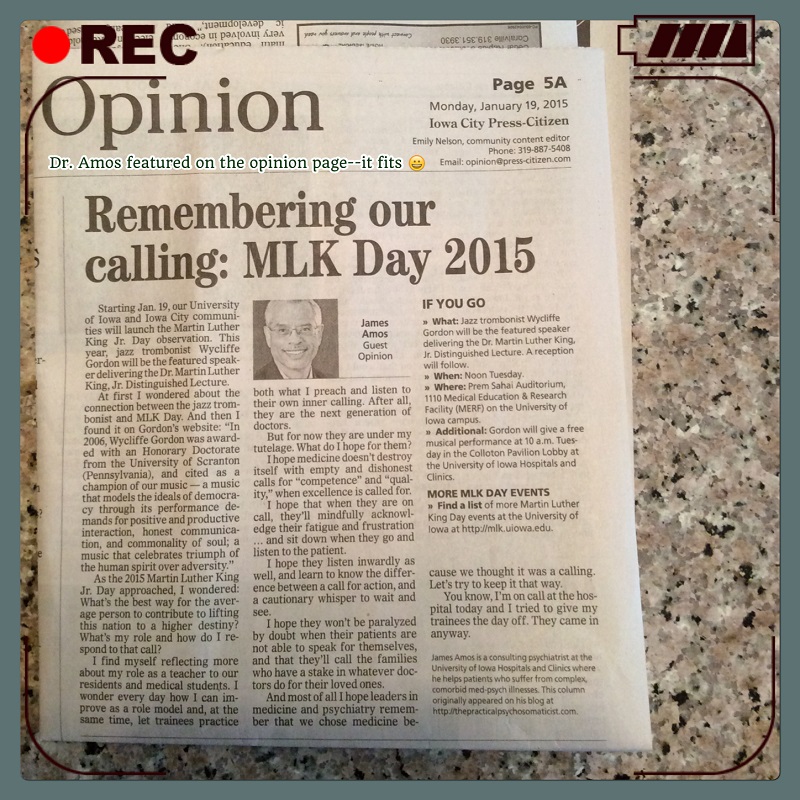
Every day I see news stories about people acting up just to get attention. I pay attention to the stories about people who exemplify courage and kindness.