I'm a retired consult-liaison psychiatrist. I navigated the path in a phased retirement program through the hospital where I was employed. I was fully retired as of June 30, 2020. This blog chronicles my journey.
I was picking up our mail at the mailbox pod this morning around 5:45 a.m. and noticed what looked like a faint circle of color around the nearly full moon in the western sky. There were streaky white clouds. Not far from it and to the left was something that looked like a big star-which I guessed was Venus. It didn’t twinkle like stars do.
I’ve never seen anything like it before. It reminded me of a rainbow and I thought I’d heard something about moonbows (probably on the Weather Channel). By the time Sena got up and I told her about it, she suggested I get a video. By that time, it was pretty much gone, though.
According to one article, this might have been a moon halo, which differs from a moonbow. Moon halos can form from ice crystals. It was about 25 degrees outside.
So, according to some cultures, moon halos might herald bad weather, maybe in a couple of days. On the other hand, it’s going to be pretty quiet around here for next several days.
possible moon halo apossible moon halo bpossible moon halo c
I was just musing on Philip Rivers. You know about him. I blogged recently about his coming out of retirement to play quarterback for the Indianapolis Colts. I guess you already know this, but he retired again.
Unlike Philip Rivers, I’ve not even considered coming out of retirement since I left my position at The University of Iowa Health Care (UIHC) over 5 years ago. I never looked back.
But that doesn’t mean I never think about looking back. I look back a lot and that’s mostly because I’m an old guy. I was a consulting psychiatrist in the general hospital.
Anyway, occasionally I search my name on the web and laugh at what comes up. I never went to Baylor College of Medicine, much less graduated from there.
I did a few things when I was a doctor. Not all of them were about work, but most of them were.
Those who know me know that I always hated Maintenance of Certification (MOC). I checked the American Board of Psychiatry & Neurology website and my MOC contribution to continuing education is still there. It’s a clinical module on Delirium, which a lot of doctors and other health care practitioners see every day in the hospital. Dr. Emily Morse worked on it as well. She’s still working at UIHC.
I co-edited a book about consultation-liaison psychiatry with my former chair of the Psychiatry Dept, Dr. Robert G. Robinson, may he rest in peace. It’s “Psychosomatic Medicine: An Introduction to Consultation-Liaison Psychiatry.” You can buy it on Amazon—please.
I wrote a case report on catatonia caused by withdrawal from lorazepam (a benzodiazepine), and it’s still available. It was first published in Annals of Psychiatry.
But one of the things I’m proudest of doing was writing a short article for the University of Iowa Library for Open Access Week.
In it, I tell a short anecdote about my lofty (OK, a better word is “greedy”) thoughts about how much money I could make shoveling snow. I was just a kid and I never made it outside to shovel anybody’s walk because I was too busy calculating my income. I wrote that way back when I had another blog, The Practical Psychosomaticist. The photo of me shows my Leonard Tow Humanism in Medicine pin fixed to my lapel—another thing I’m proud of. By the way “Tow” rhymes with “Wow.”
Libraries have always been my one of my favorite places to hang out. Anyway, I’ve got more time to do things like hang out in general. I think Philip Rivers will adjust.
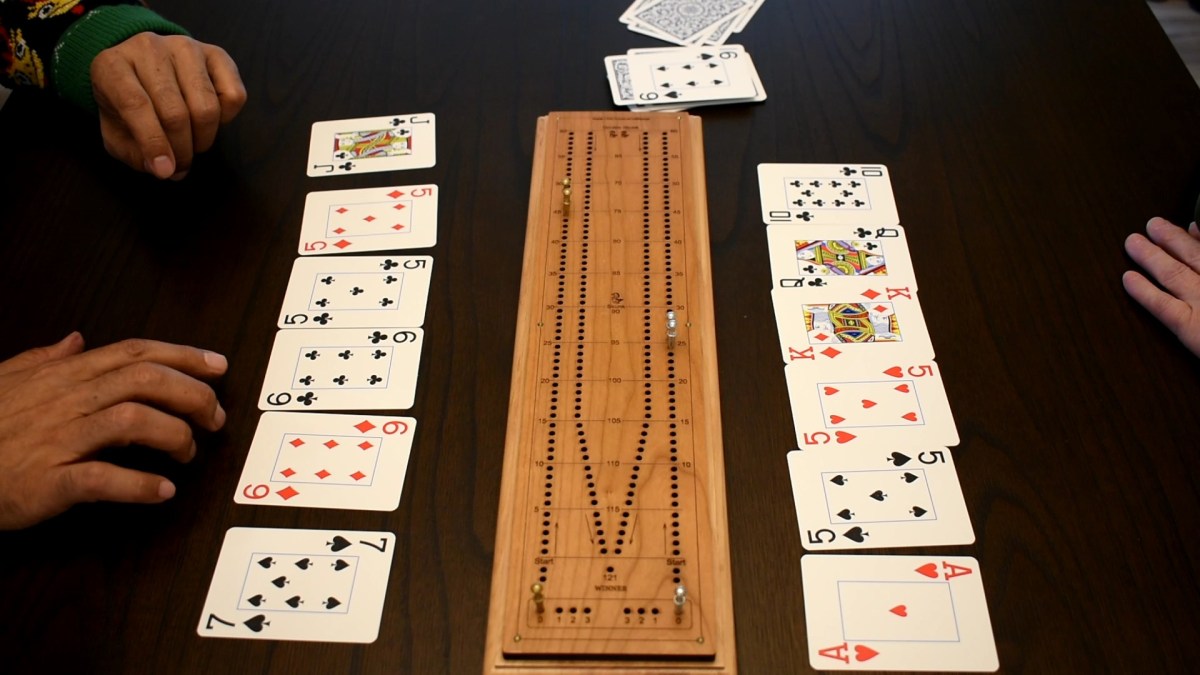
Well, we played the 13-card cribbage game today and we survived it! I got to tell you; I don’t know how anyone would invent such a hairy cribbage variant. I got so mixed-up Sena had to bail me out on counting a complicated run.
What is ironic, if I had not had a problem with one of the counts, the game would have lasted about 20 minutes, give or take—just like the last few Calvinball Crib variants we’ve played. We’ve been through 6-card through 13-card versions and those are just the ones we’ve heard about.
It still makes me wonder whether there should be a new organization, the Calvinball Cribbage Congress (CCC), analogous to the American Cribbage Congress (ACC). The CCC could have their big annual tournament in Reno, Nevada (I think it’s at the J Resort (Casino/Sands). And we’d have to have special tee shirts with a distinctive logo.
Certain requirements would have to change, like the amount of time you have to finish a cribbage game at the CCC. In the time it takes to play 13-card cribbage, Santa Claus could shave his beard and grow it back. Of course, as you know, you have to be able to play a 6-card cribbage game in 15 minutes.
We’d need a special cribbage board and the likely candidate would be the Calvinball Cribbage board made in Canada.
Based on the currency exchange rate, the board would cost a little over $100 in U.S. dollars. The board is on the small side (11in x14in), so it would be easy to provide them for the thousands who would flock to Reno for the big CCC tournament—as long as you charge for them. The going rate for a tournament board the size and brand (CreativeCrafthouse, made in the good old USA) of the one we use is about $75.
You should write to the CCC President about it—except there isn’t one yet.
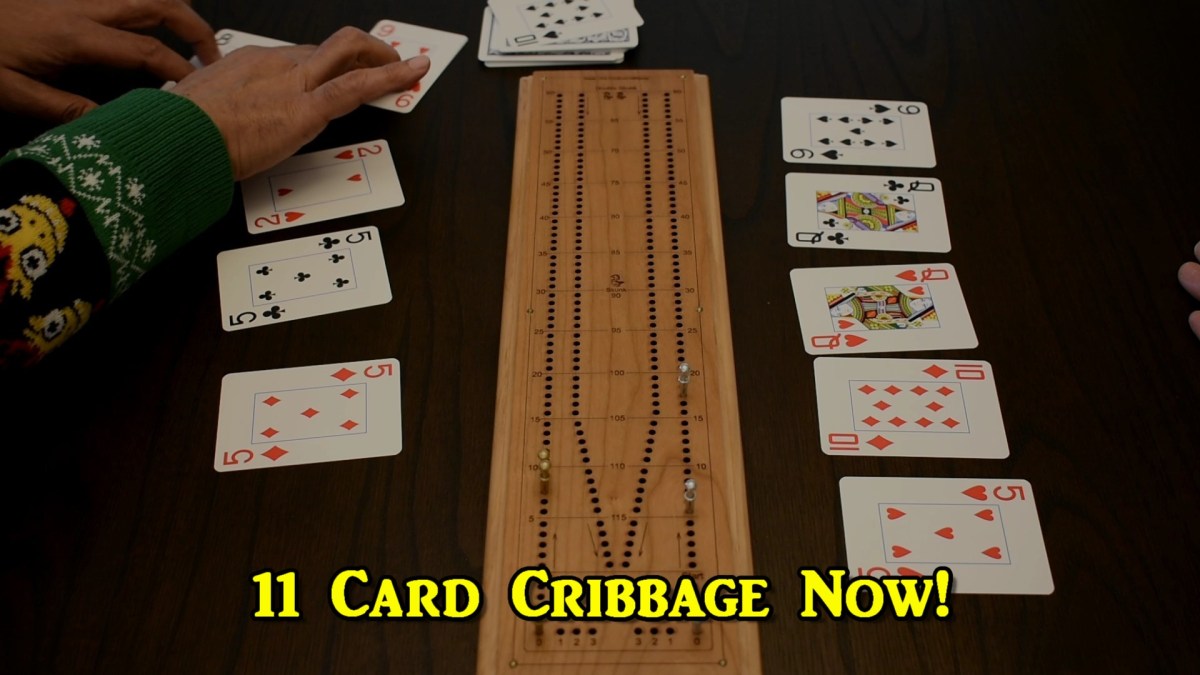
Hey, it’s New Year’s Eve and it’s time for 11-card cribbage! Recall, the American Cribbage Congress (ACC) website has a cribbage variations page in which the unknown author reports there being many cribbage variants, including 11 and 13 card cribbage.
So, yesterday we played 12-card cribbage and we decided to address the 11-card variant today. We intend to tackle the 13-card variant “next year.”
We did OK, although I had a miscount (counted 31 in the play instead of 30 near the end of the game). Again, it took us about 20 minutes to play it.
Scores can be difficult to count so you might want to check on this link for the calculator.
We made up the rules because, of course, there are no rules. This puts any of these game variants into the Calvinball Crib category. This is because there are no established rules and the name just has a little fun with that name because of the definition of the name Calvinball:
“Activity reminiscent of the imaginary game of Calvinball (see etymology), in not following any 1994- discernible rules, or in which individuals act in a self-servingly inconsistent manner. Also (and in earliest use) as a modifier.”
Did you know there’s a place in Canada that makes a Calvinball Cribbage board? It’ll set you back $140. We can’t tell if there’s a tariff on it.
Did you know that Artificial Intelligence (AI) has confabulated a description of Calvinball Cribbage? I copied it for you:
“Calvinball Cribbage is a humorous mashup of the chaotic, rule-free game from Calvin & Hobbes with traditional Cribbage, often involving themed boards or rule modifications, where the core idea is applying Calvinball’s fluid, make-it-up-as-you-go spirit to Cribbage’s scoring and play, adding wild, non-sensical rules like using mallets, changing hand values, or scoring points for silly actions, making each round unique and unpredictable, not a single defined game but a creative approach to Cribbage.
What it is (The Calvinball Aspect):
No Fixed Rules: Just like original Calvinball, there’s no single set of rules; the players invent them as they go.
Rule Changes: A key rule is that rules can’t be repeated, and players constantly invent new scoring, actions, or penalties.
Props & Actions: You might use mallets, balls, trees, or make up actions like “scoring three points for pointing at a cloud” or “losing a turn for looking left”.
How it Applies to Cribbage:
Themed Boards: You can find or make custom cribbage boards featuring Calvin & Hobbes, adding visual flair.
Modified Scoring: Instead of just points for pairs and runs, you might add a “Hobbes Bonus” for a specific card or penalize for “too much logic”.
Strategic Chaos: Players still play cribbage (cards, pegs, crib), but the gameplay is constantly disrupted by invented rules, turning strategic plays into potential jokes or absurd victories.
Example Calvinball Cribbage “Rules”:
“If you play a 7, you must hop on one foot until your next turn”.
“The crib gets 5 points if it contains a card with a face on it” (referencing Calvin’s drawings).
“A ‘skunk’ is achieved by making your opponent laugh out loud”.
In essence, Calvinball Cribbage is about injecting unpredictable fun and silliness into the structured world of cribbage, making it a game of spontaneous creativity rather than strict strategy. “
How do you feel about AI now? You know, I wonder why somebody hasn’t yet come up with a new club: Calvinball Cribbage Congress (CCC). Somebody could make a cool tee shirt for the club.
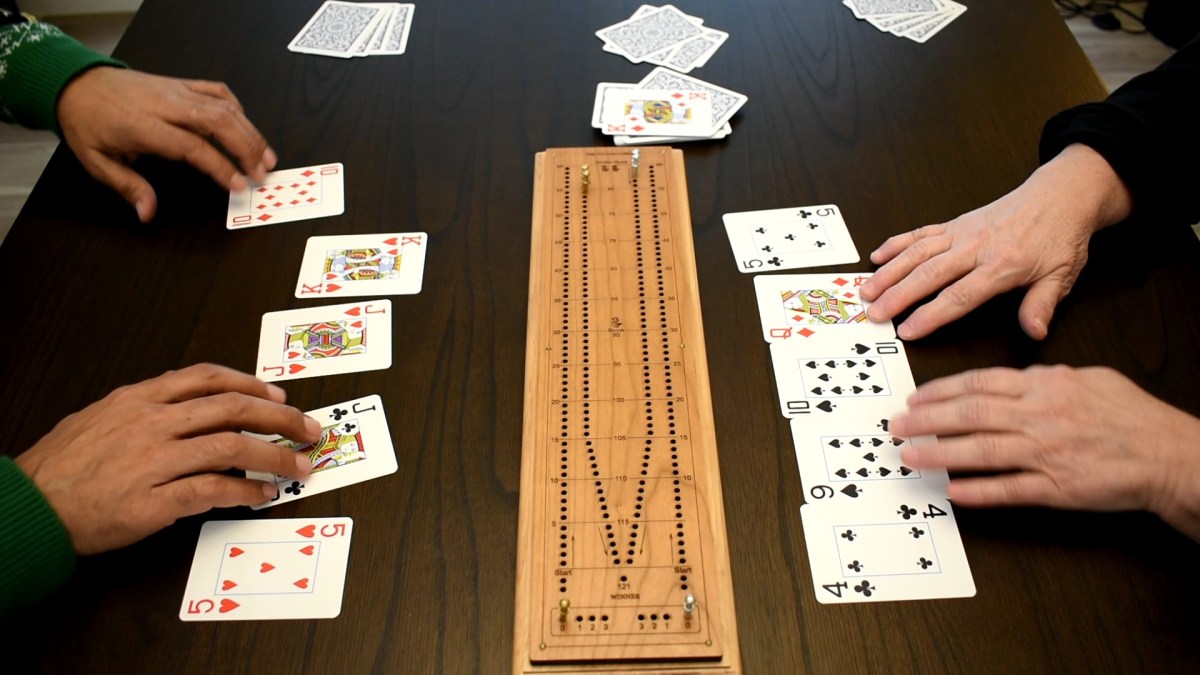
As promised, we played a game of 12-card cribbage on the tournament board today. What an adventure! We both missed pairs in counting high scores on one round (that we noticed after viewing the video)—but we got through it.
I don’t know of anyone else who’s made a video of this wacky variant, but let me know if you do. You know, it’s remarkable, we practiced it all morning and kerfuffles were the rule when it came to counting hands. You’ll see them. Yet we still finished the game in about 20 minutes because the scores were so high!
This is Calvinball Crib for sure. We don’t know where this tangent will go next.
We saw a really pretty sunrise this morning. Sunrises always make feel expectant, hopeful, and a little excited. It reminded me of that show “Sunrise Earth,” anyone remember those? They didn’t even have music, just the sounds of nature and the scene of dawn slowly giving its own introduction.
You know the winter is getting long when Sena and I talk about trying to play 12-card cribbage. We’ve come up with a way to manage the deal and the crib and we’ll try to play it tomorrow.
Sena’s been bugging me for a while now to try playing both 11-card and 12-card cribbage—despite the fact that no rules exist for them. There is the mystery of the American Cribbage Congress (ACC) having a section in their cribbage history which clearly claims that:
“Did you know that there are at least 18 variations to the BASIC game of cribbage? There is the basic 2 or 4 handed game, and then there are the 5 card, 7 card, 11 card and 13 card cribbage games. “
Notice that the author (who doesn’t have a byline) says there are both 11-card and 13-card variations. On the other hand, I’ve spoken with someone else at the ACC who knows everything there is to know about tournament cribbage and he and everyone else he asked at a recent tournament never heard of these variants. And you can’t find them anywhere on the web.
This whole Calvinball Crib thing comes from our having tried 7-card, 8-card, 9-card, and 10-card cribbage. Sena wore me down. So, we cobbled together some rules for 12-card cribbage. We’ll let you know what happens. If anybody out there has suggestions and comments, let us know!
Svengoolie Intro: “Calling all stations! Clear the air lanes! Clear all air lanes for the big broadcast!”
Last night, I watched the Svengoolie movie, “The Creation of the Humanoids,” and I don’t mind telling you, I was reminded of Isaac Asimov’s book, “I, Robot.” Believe it or not, I purposedly avoided reading any other reviews of this movie to see if they mention the possible connection of Asimov’s book with this movie. It preceded the film by 12 years, and it’s at least conceivable that producers and writers might have been inspired by the plot, took the idea of the robot laws from the book and dressed it up in at least some of the dialogue. I think there’s also a connection to Artificial Intelligence (AI) in our own time.
The last two stories in Asimov’s book are “Evidence” and “The Evitable Conflict,” both of which seem to be exemplified in “The Creation of the Humanoids.” They’re both about the conflict between robots and humans and how difficult it is to apply the Laws of Robotics, the first of which is that “a robot not injure a human being or, through inaction, allow a human being to come to harm.”
The robots in the film actually create the humanoids with the overall goal of saving the human race from extinction. And they’re programmed to obey the “Prime Law” which prevents them from killing humans. The psychological conflict of Captain Kenneth Cragis (Don Megowan) and Maxine Megan (Erica Elliot) and the rationale the robots supply for what they did both to and for humans echo the Laws of Robotics.
In the movie, the politics of the racist conflict between the robots and the group calling themselves the members of the Order of Flesh and Blood remind me of the Civil War—right down to the uniforms of the latter and their slur for the robots, which is “Clickers” (substitute another two-syllable slur and you get the idea).
In Asimov’s story “The Evitable Conflict,” something called the Machine takes control of a variety of factors manipulating natural resources, goods, services, and even the social fabric on the planet to protect humans, who have a penchant for overusing and destroying resources and each other. The robots in “The Creation of the Humanoids” do something similar and break the fourth wall to tell you about it.
Anyway, Captain Kenneth Cragis is a member of the Order of Flesh and Blood and reminds me of a character in the 2004 movie “I, Robot,” which is Sonny. An important part of Cragis is hidden from the audience as well as himself.
The dialogue is heavily intellectualized and the robots, which are supposed to be blue, wind up showing up in different colors and those eyes! Cragis and his sister, Esme Cragis Milos (Frances McCann) have a protracted and almost poetic discussion about their differences of opinion about the robots. I wonder if McCann’s revealing dress was intended to distract the audience from the dry declamations.
The scene in which Cragis confronts the robot Pax who has somehow chosen Esme to be his main squeeze is puzzling. Cragis sort of breaks Pax (David Cross) and converts him into a ’57 Chevy, which barely upsets Esme. The scene in which Dr. Raven (Don Doolittle), a robotic scientist, makes some adjustments on a disembodied arm is one example of many which proves why even Svengoolie calls this movie “a low budget” production. The furniture pieces look like they’re made for children; both Cragis and Esme might as well have sat on the floor.
Ok, so this sounds more like a review than my usual fibs and jokes, but I think it’s because the movie reminds me of something that is on a grander scale. Speaking of scales, except for the low production value, I thought movie was pretty good and I would give it a 4/5 Shrilling Chicken Rating. Sena, who watched it this morning, thought it was really good and would give it a 5/5 rating despite “the glassy eyeballs.” So, I’ll give it a 4.5/5.












 Go Retire Psychiatrist