Since we’ve gotten new smartphones, we’ve been working on getting up to speed on how to use them. More often they seem to be using us.
In fact, Sena is pretty bummed about how much fiddling around with a smartphone you have to do. She used a little flip phone for years and this is a big upgrade (she would say “downgrade”) for her.
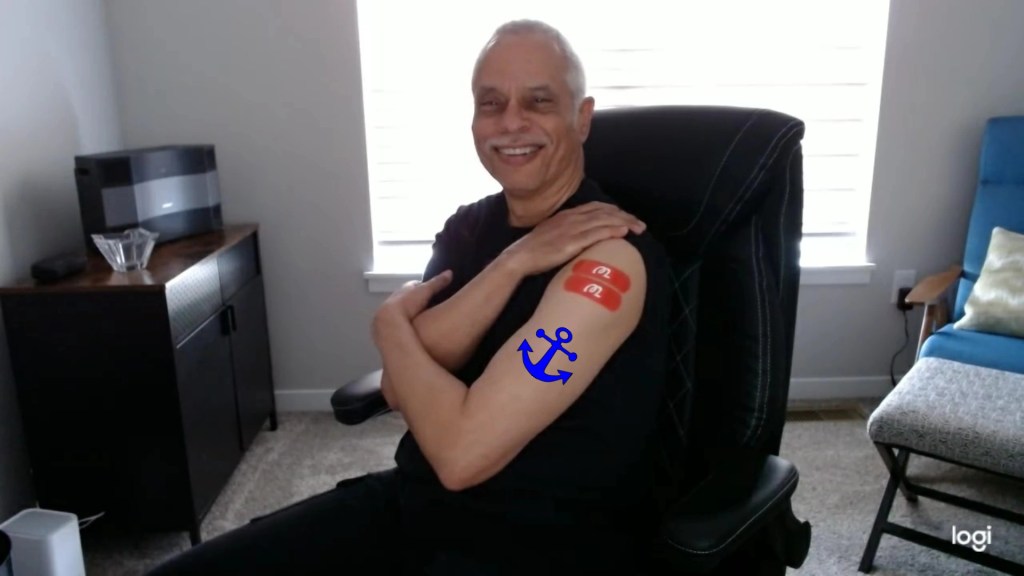
Zuckerberg wants to replace smartphones with Artificial Intelligence (AI) glasses. Sena tells me Bill Gates has been talking about replacing them with electronic tattoos.
That reminds me of a 1997 X-Files episode I don’t remember seeing called “Never Again.” Some guy gets a tattoo on his arm of a girl with the words “Never Again” under it. It starts talking to him and making him do crazy things, like buying mobile phones priced around $1,000, which is about what they cost back in 1997. Smartphones cost about the same these days.
Is that how electronic tattoos would work? Or would they just send mind control messages telling you to buy more of the same stocks in Bill Gates’ portfolio?
There are a plethora of new ads and promotional messages that we’ve never seen before:
Buy new armpit removal tool for half-price!
Upgrade to AI-assisted fruitcake recipe idea generating protocol!
Install planet construction and combustion instructions now!
I’m thinking we’ll Never Again purchase new smartphones.
I feel like I should put on my Huston-Tillotson College (H-TC) news reporter press tag for this brief announcement, which you can get pretty much anywhere on the web anyway. Just a reminder, I was a reporter for the Ramshead Journal back in the 1970s for H-TC (now H-T University).
The breaking news is that the Moody Foundation recently gave H-TU a large gift of $150 million. It’s the largest gift to a single Historically Black College and University (HBCU) in history. Furthermore, the philanthropist MacKenzie Scott gave a $70 million gift to the United Negro College Fund recently to be divided among the 37 HBCUs. H-TU will also get a piece of that.
For more details about these donations, see the pbs story.
As an aside, the Jackson-Moody Humanities building on campus was named after the Moody Foundation, which covered the financial cost of construction. E.W. Jackson was a former trustee and donor. I took my English, Literature, and Spanish classes there.
picture is in the public domain
The other news is that H-TU rose in the National rankings and is now the #1 private HBCU in Texas for 2026.
A big congratulations to Huston-Tillotson University!
I saw the 1973 made for TV movie “The Night Strangler” directed by Dan Curtis and starring Darrin McGavin as the investigative reporter Carl Kolchak. I’ve never seen the first Kolchak movie, “The Night Stalker.”
The gist of The Night Strangler plot is that some guy in Seattle is strangling women and getting a little blood from them. People are scared; Kolchak is putting clues together with a lot of help from a local newspaper archivist researcher Titus Berry (Wally Cox) while local police as well as Kolchak’s editor, Tony Vincenzo (Simon Oakland) spend a lot of time yelling at Kolchak—which just provokes him to yell back. Eventually Kolchak irritates everybody so much they all just haul him up to the top of the Space Needle and toss him through a window. He happens to land on top of the first of 6 belly dancers killed by the strangler.
She’s as white as a sheet, dead as a doornail and has decayed flesh around her neck. She’s so anemic as to be white as a fish belly though the coroner finds that only a few drops of blood were drained from her neck.
And that really gets Kolchak started. He’s an extremely annoying reporter who doesn’t take “no” for an answer from anybody, even the owner of the Pink Elephant car wash who refuses to let him run his old jalopy through it for free.
Kolchak always wears the same dingy suit no matter how many times he gets thrown from the Space Needle and ignores everybody who insists he have the suit dry-cleaned.
He takes pictures of cops being thrown around like rag dolls in an alley (not Post Alley where the Gum Wall is) by a bull strong man who apparently can also dodge speeding police cruisers like a running back.
However, the police confiscate Kolchak’s camera and put enough obstacles in his way to make me wonder if they’re in cahoots with the strangler who it turns out is also leading tours of the legendary Seattle underground and would give free tours to the cops who can get free box lunches from an old diner where human skeletons throw fish around just like they do at Pike’s Place Fish Market while letting rats crawl through their eye sockets.
Kolchak gets valuable insights from an old crone named Professor Crabwell (Margaret Hamilton, who also played the wicked witch in the Wizard of Oz) about a youth preserving potion that the strangler might be making—and just when she gets to the good part, a house drops on top of her.
When Kolchak and a brave belly dancer (who is beginning to dislike him as much as everyone else does) get to the underground, he tells her to give him about 30 minutes before she calls the cops to come and rescue him. How does he know he can hold off the strangler for longer than 30 seconds?
The ending is pretty good, mainly because you know you won’t have to listen to Kolchak anymore. I’ll give it a 3 shrilling chicken rating.
I caught the Big Mo Pod Show last night and listened to the podcast this afternoon. That’s later than I usually do because we were running around today learning how to use our new smartphones. You know, the makers don’t send the phones with even basic instructions. I guess they just expect you to guess right.
It’s like passing the torch (the title of the pod show) with the burning end towards your face. The phones are really slippery because they wash them with triple muddifying brahma bull body wash and add a 3-inch charging cable.
Anyway, I think the passing the torch title really comes from the Morganfield family. One of Muddy Water’s sons named Mud did a number called “She’s Getting her Groove On.” Mckinley is another son of Muddy and he’s also a blues musician.
Big Mo called one of the numbers on the blues show last night a novelty song: “Willie Dixon’s Gone,” by Tom Hambridge. Producer Noah asked him point blank, “What makes a song a novelty song?” to which Big Mo replies, “Ohhh, that is so hard!” He named a few like “Alley Oop.” And in general, his answer was that novelty songs are “overdone” and “over-shticked.” So, the novelty songs are comical.
But for comical, I don’t think you can beat one of my favorite songs that Big Mo played last night but didn’t make today’s list: “Can’t Even Do Wrong Right,” by Elvin Bishop. He grew up on a farm in Iowa. He even did a song titled “Calling All Cows.” I’ll let you look that one up.
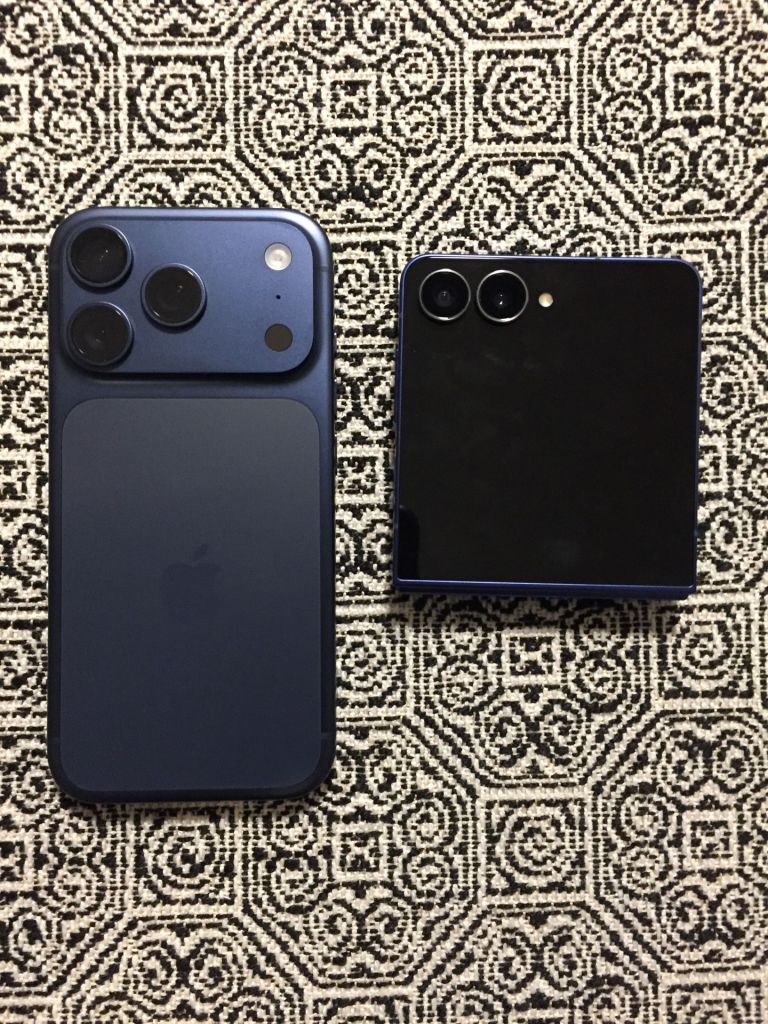
Well, we finally got new phones after several years. I think we bought the old ones from Fred Flintstone. I probably should have got a new phone after the battery swelled up in it so big it was starting to split the case. That was over 5 years ago. I have an iPhone 17 Pro now.
Sena’s always had a flip phone. She got one that still folds up, but it’s a lot nicer. It’s a Galaxy Z Flip7.
I think these phones have a feature that allows you to call extraterrestrials to order pizza. Don’t ask for extra cheese.
I remember we got along OK without portable phones at all for years until a big snowstorm made the streets impassable and I decided I had to sleep in my chair in my office at the hospital. We had only one car. I tried to call Sena to warn her not to drive in the snowstorm, but she’d already left to come pick me up. She got stuck on the way but managed to get unstuck and drove back home. I had no way to get a hold of her while she was out on the road.
We both got flip phones after that. I later got an iPhone triple zero, which ran OK most of the time on diesel. One of the residents talked me into buying one. It was a lesson in evolution. I guess we’re still evolving.
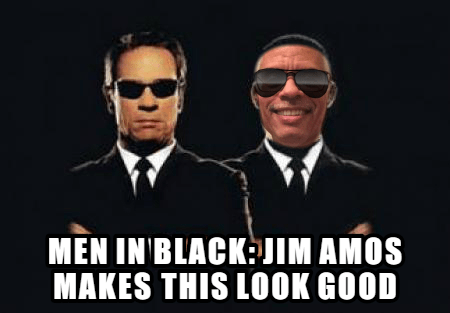
As a big fan of the Men in Black (MIB) movies, my burning question is: Will there be an MIB 5 or not?
Probably not in my lifetime, which is sad. I’m not really as big a fan of any other films, despite what you might think of my Svengoolie movie reviews—which are always tongue in cheek.
I didn’t see the first MIB film when it came out in 1997 because I was too busy starting my career as a psychiatrist. It’s my favorite, but I can’t remember the first time I saw it. I’ve always thought the chemistry between Will Smith and Tommy Lee Jones was priceless. One of my favorite quotes from that was:
Edwards: Why the big secret? People are smart. They can handle it. (this relates to why the subject of extraterrestrials on the planet is kept a big secret).
Kay: A person is smart. People are dumb, panicky dangerous animals and you know it. Fifteen hundred years ago everybody knew the Earth was the center of the universe. Five hundred years ago, everybody knew the Earth was flat, and fifteen minutes ago, you knew that humans were alone on this planet. Imagine what you’ll know tomorrow.
I Iiked the first sequel, MIB II (2002), although not as much as the first movie. And I just found out what Frank the pug meant by his question to Agent J about missing Laura. I always thought I heard Frank ask him: “What? Still sit and shiver?” That doesn’t make sense, of course. What Frank actually asked is “What? Still in shiva?” I finally just looked up the word “shiva.” Turns out it’s a Jewish term, loosely translated meaning a period of mourning, in this context of losing his girl.
I thought the third sequel, MIB 3 (2012) was really funny (all of them are funny). I always thought this one about time travel and getting trapped in the year 1969 was on target, partly because it was historically accurate. I lived through that era. Somehow, being able to laugh about it might be healing, in a way.
Jeffrey Price: Do not lose that time device or you will be stuck in 1969! It wasn’t the best time for your people. I’m just saying; it’s like a lot cooler now.
Agent J: How will I know if it works?
Jeffrey Price: You’ll either know…or you won’t.
I never watch MIB International (2019). Nothing against the actors; it just doesn’t do for me what Agents J and K do.
Anyhow, I doubt there’s ever going to be an MIB 5. I just wish the cable networks had not recently stopped showing reruns of the movies. Now it looks like the only way to see them is to subscribe to a streaming service, which is way too expensive just to feed nostalgia. I checked the Internet Archive. Comments on the videos mention their low quality. I know they’re available on DVD, but we don’t have a player anymore. I know I could play them on my computer, but I’m too lazy to sit at my desk. It’s just not the same as watching them while sitting in the living room in a really comfortable chair.
I’ve seen them so many times, I’ve practically memorized them anyway.
Svengoolie Intro: “Calling all stations, clear the air lanes, clear all air lanes for the big broadcast!”
This coming Saturday, the Svengoolie show movie will be the 1973 horror flick, “The Night Strangler” starring Darrin McGavin who plays an investigative reporter/detective named Carl Kolchak, which I’ve never seen. Neither did I see the first movie, “The Night Stalker.”
The setting is in Seattle. Apparently, there’s some monster serial killer who’s really, really mad about getting chewing gum stuck all over him whenever he goes hunting for victims on Post Alley. He’s written dozens of letters to the city about cleaning up the Gum Wall, which they actually do periodically, but hey, sticking chewing gum wads on the wall is a time-honored tradition, which Sena and I noticed when we were visiting Seattle on vacation about 9 years ago. Don’t lean up against the Gum Wall.
Anyway, the killer has come up with a plan to blow up the Gum Wall with dynamite to spite the Seattle city council, which Kolchak can’t figure out without consulting Artificial Intelligence (AI) until late in the movie. AI instructs Kolchak to build a rudimentary time machine which is this really souped-up car which, when it reaches warp speed, can send Kolchak back in time to the scene of the crimes and with the assistance of a kid named McFly, he can…no wait, that’s a different movie.
I watched the Svengoolie show movie “Tarantula” last night, although I fell asleep for what turns out to have been about 20 minutes or so during the second half hour of this 1955 film about radioactive nutrient producing a giant tarantula. I had to catch up on what I missed on the Internet Archive.
Don’t get me wrong, the movie didn’t put me to sleep; in fact, there were various segments that reminded me of various tangents I’m about to go off on.
Anyway, the film was directed by Jack Arnold and starred John Agar (Dr. Mass Hastings), Mara Corday (Stephanie ‘Steve’ Clayton), and Leo G. Carroll (Prof Gerald Deemer, who I guess was in a lot of Hitchcock films including North by Northwest, which Sena has seen). Raymond Bailey (Townsend, Arizona dept of agriculture scientist) had an interesting line I’ll mention later. Bailey also played the banker Milburn Drysdale in the Beverly Hillbillies TV show in the early ‘60s-early ‘70s.
The short summary of this film is that it’s one of several related to the fear of radioactivity-linked science gone bad leading to the creation of really big bugs running amok in tiny towns in the desert southwest. The main angle here is Prof Deemer’s scientific work on preventing world starvation from overpopulation by creating a nutrient that would, if mixed with the evil radioactive isotope, cause hungry tarantulas to grow to enormous size, in turn leading to cattle mutilations that would prevent long wait times for motorists waiting for cows to cross Route 66, consequently unblocking the path to McDonald’s restaurants, although the food chain interruption from the beef shortage caused by tarantula predation would eventually result in the loss of big macs leading to cannibalism, thereby cancelling world hunger by population reduction.
Scientists never think this one through.
But there are other things to talk about with respect to this movie. One of them is the word “acromegalia.” I know about acromegaly, but the term “acromegalia” was a new one to me, although it turns out to be an old term. Acromegaly is the usual name for the medical condition. Why the writers chose this word is a mystery. Both mean a rare pituitary gland problem which produces too much growth hormone leading to gigantism in which the hands, feet, and face grow bigger.
Another fascinating thing about the film is that I think I can hear Dr. Deemer call the radioisotope a specific name, something that sounds sort of like “ammoniac.” In the internet archive version, see if you can hear it at about 27:47.
Sena can hear it too. But I can’t find any reviewers who mention it and even AI denies that the radioisotope is given a name in the movie. Also, if it was made just for the movie, it doesn’t make sense because most isotopes’ names end in “-ium,” so no made-up word for it should sound like “ammoniac” which makes you think of ammonia, something somebody would wave under your nose to smell if you fainted from the sight of the giant tarantula.
Another interesting thing is the dialogue between Dr. Hastings and an Arizona Agricultural Institute scientist, Dr. Townsend (played by Raymond Bailey). The gist of the interaction is that Dr. Hastings brought a specimen of giant tarantula venom for Dr. Townsend to analyze, but when he says he found giant pools of it, Townsend is incredulous and accuses Hastings of either having a nightmare or being the biggest liar since Baron Munchausen. On the internet archive this exchange happens at about 59:07.
This is priceless. I know about Baron Munchausen because, as a consulting psychiatrist for many years I saw patients who had the syndrome which used to be called Munchausen’s Syndrome (now called Factitious Disorder) which is essentially a mental disorder in which patients claim to have diseases which they don’t actually have but fake them and lie to doctors about it. I gave lectures about the syndrome. There’s a fascinating literature about it and, the odd thing is that the real Baron von Munchhausen was a famous adventurer and raconteur—but he was not a liar.
What many people don’t know is that it was actually a fellow named Rudolf Erich Raspe, a German scientist and scholar who wrote a book about the baron which was mostly made up. Raspe was the liar, not Baron Munchhausen.
A person with Factitious Disorder was hospitalized at University of Iowa Health Care back in the 1950s and a long case report about it was published in the Journal of the American Medical Association (JAMA). Further, a physician named William Bennett Bean, MD in the Department of Medicine at the University of Iowa wrote a very long poem about this which you can access. There was also a fascinating case report published in 1980 in the New England Journal of Medicine (NEJM) by medicine residents claiming they had seen a patient who lied about having Factitious Disorder (Factitious Munchausen’s Syndrome). The residents later admitted that they made up the story. I summarized most of this in a blog post a few years ago.
Finally, there is a line by Dr. Hastings at about 1:04:45 which reminded me of a Verizon commercial years ago: “Can you hear me now?”
I think that’s more than enough about this movie, which I would give a rating of 4/5 mainly because it evoked so much from the deep recesses of my memory.
Shrilling Chicken Rating 4/5
Addendum: I couldn’t shake an urge to comment on a gesture of earlobe tugging that Dr. Matt Hastings engaged in while asking Prof Deemer about how quickly Jacobs developed his physical malformations. You can find this on the Internet Archive at time 28:36. Deemer dismisses it as acromegalia and nothing more but finally suggests Hastings could see that an autopsy be performed on Jacobs. I suspect Hasting’s earlobe tug might be dismissed as simple overacting, but there could be other interpretations.
Here’s another video on head stall juggling, this time using glow in the dark juggling balls. They’re heavier and I drop more often. On the other hand, when one hit the glass top coffee table, it didn’t leave a scratch! It did make a heck of a racket, though.
I did switch off between left and right for the off the head trick. It’s a lot harder using larger, hard plastic balls.
There was a lot to digest in today’s CDC ACIP meeting on Covid-19 vaccines. I missed the morning sessions but managed to see a few of the afternoon presentations.
The presentation by Dr. Retsef Levi, PhD, MIT, ACIP Work Group Chair, the Covid -19 Vaccine Discussion Framing Work Group (WG) was basically pretty critical of the Covid-19 vaccines in general.
The opposing reply to this (favorable to vaccines) was put together by University of Iowa’s Dr. Stanley Perlman, Dr. H. Bernstein, and Dr. M. Miglis, Additional Workgroup Considerations in Covid-19 Vaccination Policy and Practice.
For a change, I listened to the Public Comment section. I usually have not paid attention to them because most of the speakers were opposed to vaccines. Today was different. All of them were strongly supportive of vaccines.
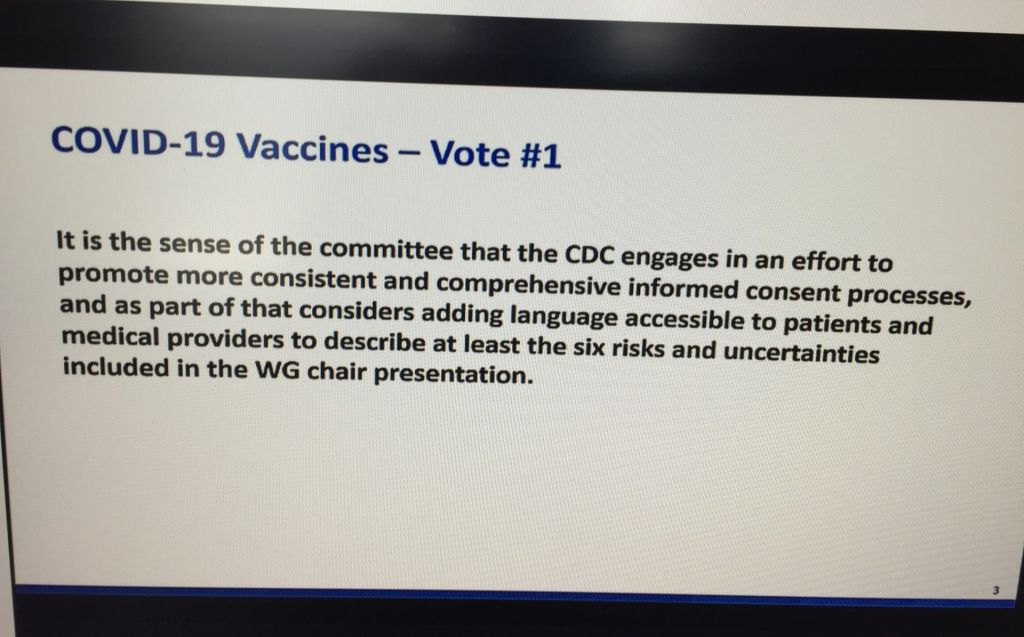
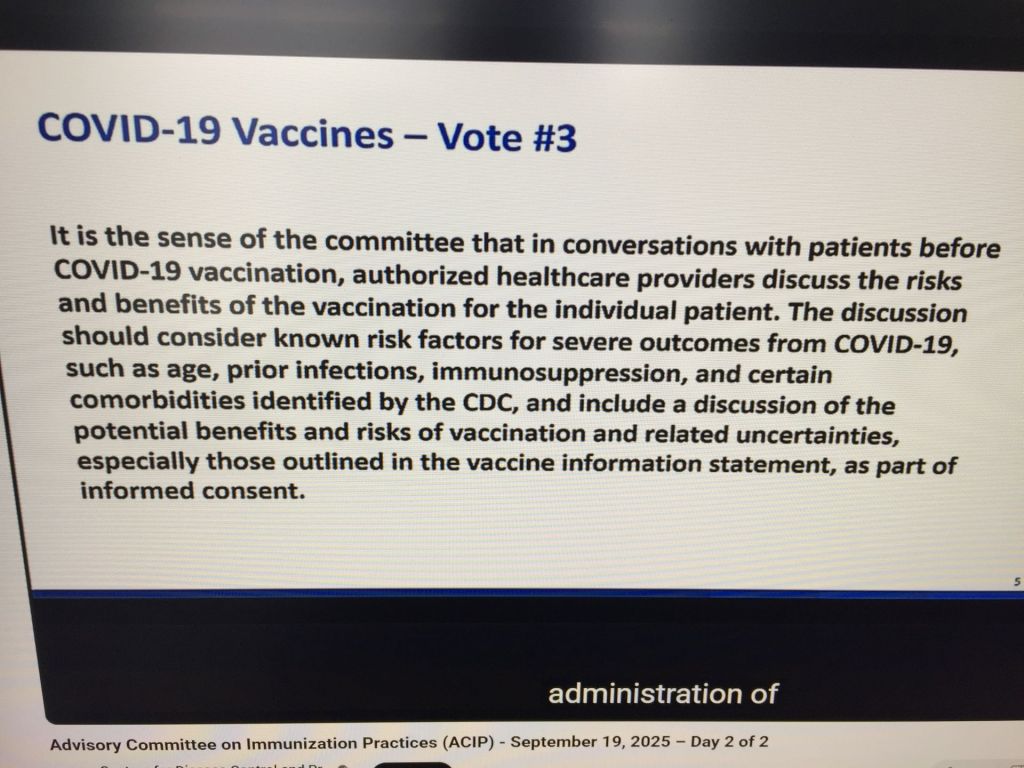
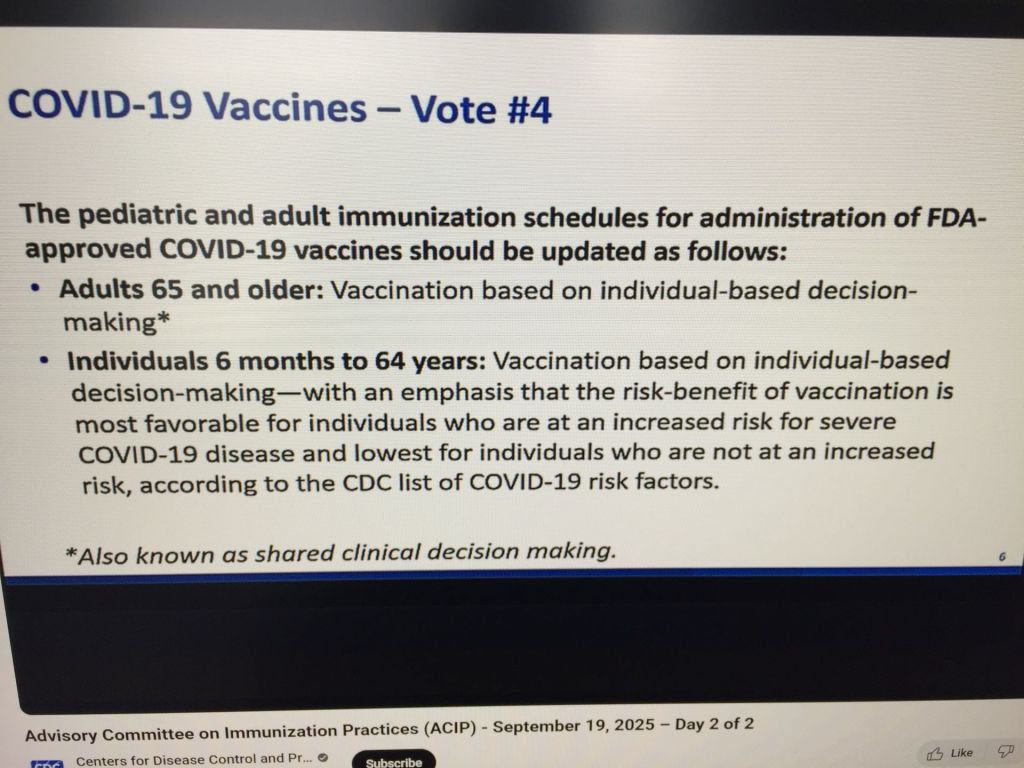
There is a bottom line to this. I watched the voting session, which was very interesting. There were 4 voting questions. I had to take pictures of them because they were not included in the on-line schedule. It was easily the most interesting session of the afternoon, at least for me.
Voting question 1: all but one member voted “yes,” the committee chair Kulldorff voted “no.”
Voting question 2: one member suggested striking this one, but they voted anyway. What’s worrisome is that it was split between the yes and no votes; only the chair, Kulldorff, could break it and he voted “no.” Looks like common sense won; otherwise it would have made access very difficult.
Voting question 3: The video lost audio for a long time, but eventually it turned out that the votes were “yes” unanimously on the assumption that pharmacists counted as “health care providers.”
Voting question 4: The votes were all “yes,” mainly because they decided that pharmacists could make this work. One member questioned the wording which suggested that you needed to talk to your doctor about getting the vaccine because of the wording “shared clinical decision-making.” They glossed over it.
It looks like access to the Covid-19 vaccine will remain mostly open for now.














 Go Retire Psychiatrist