We’re both pretty excited today because we found a tagged monarch butterfly with a guy’s help out on the Terry Trueblood Trail. We saw quite a few monarch butterflies around the flowers and saw a man spending a lot of time getting a video of one of them with his smartphone. Sena remarked about how nice all the flowers were and he pointed to the butterfly and said it was tagged.
We had no idea what he meant until after we filmed the butterfly and saw this tag with numbers and letters printed on its wing. Sena got a really good shot of it and we were able to read the code.
Then we discovered the website for tracking monarch butterflies.
You can actually report the tagged butterfly to MonarchWatch.Org. We had never heard of the Monarch Watch Tagging Program, which got started in 1992 to track the monarch’s migration pattern.
We’re not certain of the sex of the monarch we saw today (which is part of the reporting process), but that’s OK. We can just enter “Unknown.” On the other hand, you can find instructions on line. We plan to make a video of our walk tomorrow with the monarch as the star, but I wanted to give you a heads up about the most exciting part of it today.
I’ve been checking the Centers for Advisory Committee schedule on their website for weeks and the only way I found out there is an upcoming meeting is on the Federal Register schedule. Sena found it in a news outlet story. As of this morning around 9 a.m., there was no announcement on the CDC website yet. That may change later today.
According to the Federal Register, the CDC ACIP will hold a meeting on September 18, 2025, from 10 a.m. to 5 p.m., EDT, and September 19, 2025, from 8 a.m. to 4 p.m., EDT.
Under Supplementary Information:
“The agenda will include discussions on COVID-19 vaccines; Hepatitis B vaccine; measles, mumps, rubella, varicella (MMRV) vaccine; and Respiratory Syncytial Virus (RSV). The agenda will include updates on ACIP Workgroups. Recommendation votes may be scheduled for COVID-19 vaccines, Hepatitis B vaccine, MMRV vaccine, and RSV. Vaccines for Children (VFC) may be scheduled for COVID-19 vaccines, Hepatitis B vaccine, MMRV vaccine, and RSV. Agenda items are subject to change as priorities dictate. For more information on the meeting agenda, visit https://www.cdc.gov/acip/meetings/index.html.”
However, I also noticed a news article posted by the Center for Infectious Disease Research and Policy (CIDRAP) indicating that the meeting might be postponed because of the recent upheaval around vaccine policy and personnel.
This meeting’s actual timing and schedule items could be moving targets.
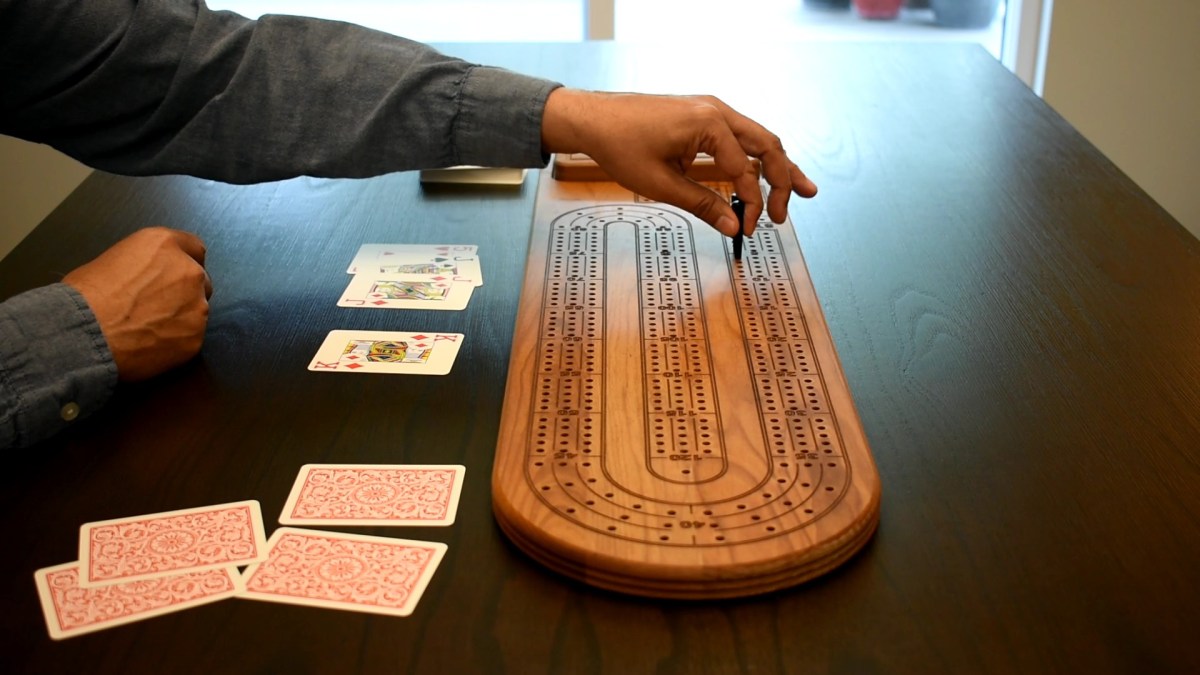
I just played 3 games of cribbage solitaire that I posted about in the last couple of days. I got to 4th street in 2 of them and got to 115 in one. I think getting to 121 is at least possible. You have 6 deals to get there and you need over 20 points per deal to make it. Each game takes me about 10 minutes.
I haven’t seen any rules for this cribbage solitaire variation about looking at your cards or not as you deal them. I deal the hand cards face down as well as the first two crib cards face down. I look at the six cards in my hand from which I select the other two cards to throw to the crib. I only look at all four crib cards when I’m ready to count the crib points. I don’t know if anybody else does it differently. See my YouTube video demo for how I interpret the game play.
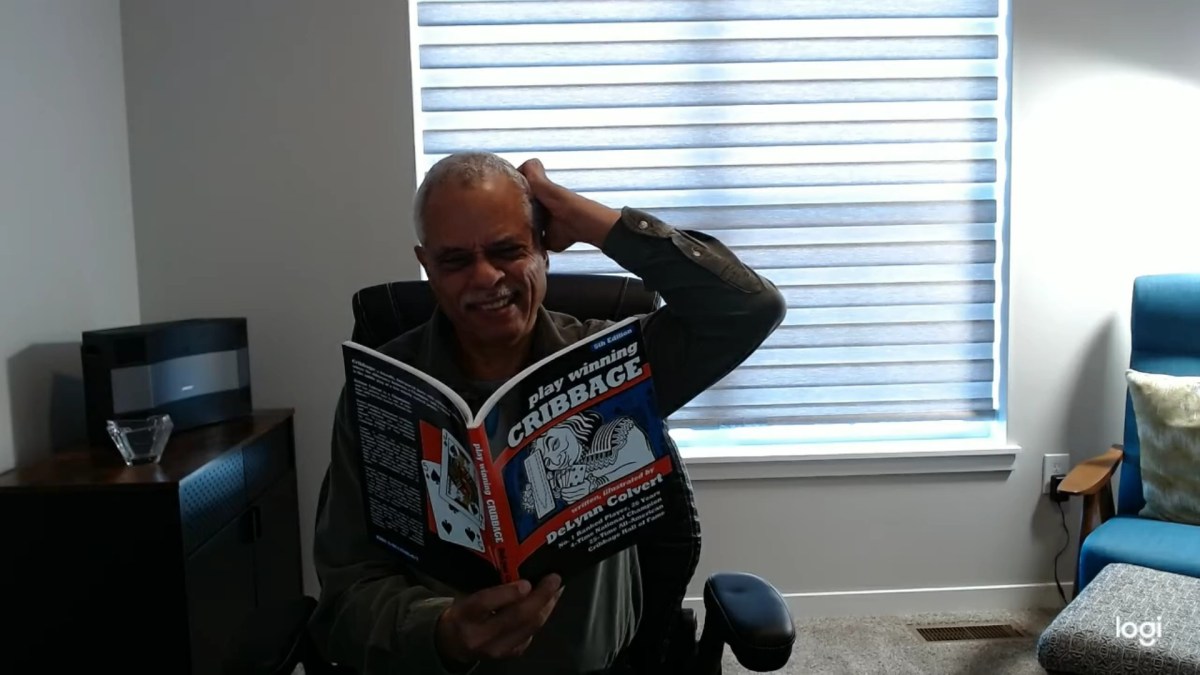
The only rules I’ve seen for this cribbage solitaire version are in DeLynn Colvert’s book (“Play Winning Cribbage, 5th edition, published in 2015) or were cited by someone on the boardgamegeekdotcom thread which dates to 2008 and they are virtually identical. Neither source identifies the inventor of the rules. I wonder if they would be in the original edition of Colvert’s book, which was first published in 1980. You can find a 1993 edition on eBay going for $150. There’s a 1985 edition advertised for $113. I can’t find anything on the Internet Archive about it.
I thought I would try to learn how to play cribbage solitaire as described by DeLynn Colvert in his book Play Winning Cribbage, 5th edition published in June 2015.
There are several versions of the variation of the game often called cribbage solitaire, but I think this one teaches the most about the important phases of the game of cribbage.
I don’t know who originally created this variation of cribbage solitaire, but I found the same description on the website boardgamegeekdotcom.
If anyone else knows more about this variation, please let me know!
I was leafing through Delynn Colvert’s book “Play Winning Cribbage” and found a section on how to play cribbage solitaire. I’ve never considered it, but I tried it tonight just for laughs. It’s easier to understand than his 26 Theory, which I never got. I looked for the rules as Colvert described them and was lucky to find them in the forum on the boardgamegeek website.
Just read Jesse Hickle’s description. If you look at stuff on the web about cribbage solitaire too long, you’ll find dozens of variations. I’d stick with Colvert’s version (or Hickle’s version, whatever). I don’t know where the rules originated.
Colvert says it’s not impossible to beat—but I didn’t win tonight after a few tries. It’s good practice.
The Svengoolie show last night was the 1957 Hammer production “The Curse of Frankenstein” starring the 3 stooges. Actually, this film was no laughing matter and this was my first time (and last time) seeing it.
That’s not saying it’s a “bad” movie. It’s just tough to come up with anything comical to say about a gothic horror flick that was inspired by Mary Shelley’s novel, “Frankenstein; or, The Modern Prometheus.”
I’ve not read Mary Shelley’s novel and I only skimmed the Encyclopedia Britannica entry. That’s good enough for an old guy pretending to be a movie reviewer.
What hooked me, though, early on the film was a short dialogue between Paul Krempe (Robert Urquhart) and Elizabeth Lavensa (Hazel Court). Paul describes Victor Frankenstein (Peter Cushing) in contemptible and scary terms, to which Elizabeth reacts by saying that Victor is either “wicked or insane.” Paul answers that Victor is neither—which struck me as odd.
I would have no trouble saying Victor is evil, but what do I know? On the other hand, I ran across a couple of web articles that mentioned “psychopath” as a suitable label for someone who thinks nothing of pushing an old man like the scientific scholar Professor Bernstein (Paul Hardtmuth) over a banister to kill him in order to dig his brain out of his skull to insert into a do-it-yourself hodgepodge of spare body parts in an experiment to create a living being.
Victor, from the time he first meets Paul, presents as an insufferable, entitled brat lacking a conscience and by the time he reaches adulthood he’s the perfect example of someone with the most creepily severe case of antisocial personality disorder (ASPD) imaginable.
He gets the housekeeper Justine (Valerie Gaunt) pregnant, tricks her into entering the laboratory where the monster (Christopher Lee) kills her, marries Elizabeth and then abandons her on their wedding night in order to cheat in a cribbage game with the monster.
He pretends to bury the monster in the woods after Paul kills it by shooting it in the eye with an AK-47—then sneaks back to dig it up, carry it back to the lab and reanimates the wreck. He proudly shows it off to Paul, who throws up on him. This makes no difference to Victor who is always smeared with dirt anyway because he hangs out in morgues, graveyards, and golf courses (“as he approaches this critical putt, somebody leaps out and cuts off his feet”), filching eyes, hands, Adams apples and what have you to assemble and repair the monster.
There are big differences between Shelley’s monster and Hammer’s creature—the latter doesn’t speak at all while the former is eloquent. Hammer’s creature can barely stand up or sit down on command while Shelley’s monster can do triple axels skating across the Arctic ice as Victor pursues him.
During the movie, my mind often wandered off to memories of Mel Brooks’ “Young Frankenstein.”
I just discovered this Community Psychiatry Podcast site today. A couple of days ago Dr. Emily Morse, DO, of The University of Iowa Health Care gave a 20-minute interview that outlines how the psychiatry department leverages community psychiatry outreach to address the challenges those experiencing homelessness face.
Introduction: “Emily Morse, DO, is a Clinical Associate Professor of Psychiatry at the University of Iowa where she was first drawn to community-based care during her residency training. Her current clinical work spans a variety of settings which include outreach clinics embedded within local permanent supportive housing programs in partnership with Shelter House in Iowa City—an organization that provides comprehensive support services to help individuals move beyond homelessness. She also works as part of interdisciplinary teams that reach patients across Iowa, including one focused on individuals with intellectual and developmental disabilities, and another providing reproductive and perinatal mental health care. Along with her clinical work, she is active in medical education as a psychiatry clerkship co-director, and she enjoys working alongside residents and fellows while aiming to provide accessible, collaborative, and relationship-centered care.”
Dr. Morse provides a view of psychiatry that goes beyond the idea of scheduled appointments in the psychiatry clinic.
This is also a great way to get beyond the politicization of this issue we typically hear about in the national and local news almost every day.
The title of this post is inspired by a short comment I got today from an Iowa City musician named Ed English. It’s on my blog post from April 14, 2024 entitled “KCCK Big Mo News and More.” I blog a fair amount about the Big Mo (John Heim) Blues Show and the Big Mo Pod Show.
Ed says “Always available on the web and the KCCK App, too… ;0)”
I’m not up to speed on emoticons, but I wonder if it means amazement, although about exactly what I’m not sure. I really appreciate hearing from him.
Anyway, it turns out that Ed English is a long time Iowa City blues music scene guy and he’s part of The Beaker Brothers Band.
Ed (informally known as Uncle Ed) also started the Tanya English Band. Ed and Tanya are married.
I listen to the Big Mo Blues Show every Friday night. When he does the part of his show called The Shout Outs, he mentions Dr. Tanya, healing with the blues. I suspect a lot of the Shout Outs are to local blues musicians, many of them known by nicknames—I think.
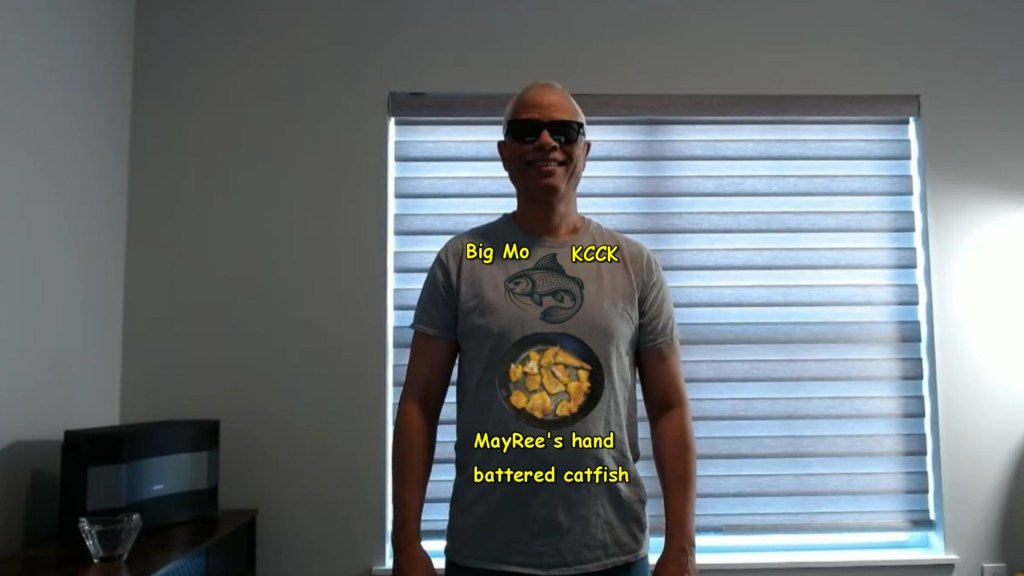
I’m honored to get a nod and a wink from Uncle Ed. Now, can we talk about my MayRee’s Hand Battered Catfish tee shirt design?
After more than a decade of not experiencing the pleasure of gravity draining a water heater, we drained our water heater today. It’s only a year old because the house is new. We did it just because most plumbers recommend you drain your water heater annually and sometimes twice a year.
I had to search the web for instructions, some of which conflicted with each other. One source that was almost comical was on a web site made possible by PlumbingSupplydotcom. There’s no date on it, but it’s for anybody who wants to ask a plumber questions about anything to do with plumbing.
I found a YouTube that made the job fairly simple even for guys like me.
The last time we drained a water heater (in a different house a long time ago), I opened the Temperature and Pressure Relief (TPR) valve as part of the process. The guys who filmed the YouTube didn’t touch it or even mention the TPR valve.
It turns out that opening the TPR valve whenever you drain the water heater might be a matter of opinion. Another way to expedite the emptying process is to just open all the faucets (hot side) in the house. I guess you could do both according to one guy.
One thing I can tell you, opening just one or two faucets might not be enough to get the draining process going fast enough. As one of the plumbers on Plumbing Supply put it, it might be best to open them all. Water drained pretty slowly until I did that.
Although Artificial Intelligence (AI) will tell you it takes about 15-20 minutes, it can take more time for many reasons, so beware of AI guidance because it lies.
I followed the steps outlined in the YouTube video I mentioned above, “2 Easy Ways to flush/drain Water Heaters” posted by The Honest Carpenter. It was only 3 years old and had 2.3 million views and 867 comments when I found it today.
The only tools needed are a flat head screw to open and close the drain valve and a garden hose with a coupling to screw on to the drain valve opening. Watching it drain doesn’t help; it’s too much like watching paint dry.
It’s really not that complicated, at least not as complicated as the back and forth on the Plumbing Supply web site made it sound. There was a suspicion by plumbers that the guy asking how to drain his water heater was making stuff up. One suggested shooting the water heater with a 30:06.
If you’re going to do that, consider first releasing the TPR valve. Just kidding; guns won’t solve this or any other problem!
Addendum: We used a long garden hose, but Sena got a shorter one-for next time!












 Go Retire Psychiatrist