Writing is Dope

I learned a new slang word from Houston White, the guy who makes that specialty coffee in Minneapolis I blogged about yesterday: Brown Sugar Banana (I’m not a fan, but I admire him just the same). The word is “dope.” That used to be an insult or an illicit drug when I was growing up. Now it means “very good.”

I guess writing, at least for me, is dope.

The further I get in time away from the day I retired from practicing consultation psychiatry, the more I reflect about how I became a psychiatrist. I’m a first-generation doctor in my family, so what follows is one way to write about it.

What has helped me get through life was this writing habit along with a sense of humor. When I was little, I wrote short stories for my mother. I was the “number one son” in the words of my father, which meant only that I was the first born. My younger brother came second only in order of birth. He was the track star. I was the paperboy. Our parents separated early on. Sena and I have been married for 47 years.

I have been writing my whole life. I used a very old typewriter. I wrote poetry for a while, eons ago. Like many aspiring writers, I tried to sell them to publishers. The only publisher I remember ever responding sent me a hand-scrawled note on a small sheet of paper. He told this really short, nearly incoherent story about his son, who had apparently died shortly before. His son had a “tough road.” It wasn’t clear exactly how he died, but I remember wondering whether it was suicide. It was very sad.

In the 1970s, while I was a student at one of the Historically Black Colleges and Universities (Huston-Tillotson College, now a university) in Austin, Texas, I submitted a poem to the school’s annual contest and for entry into the college’s collection, called Habari Gabani (which means “what’s going on” in Swahili). It was rejected. Years later, I finally was able to track down a digital copy of Habari Gani.

Habari Gani from Huston-Tillotson College

Eventually, thank goodness for everyone’s sake, I gave up writing poetry. It was as bad as Vogon poetry. You’ll have to read Douglas Adam’s book “A Hitchhiker’s Guide to the Galaxy,” for background on that. The Vogons were extraterrestrials who destroyed Earth in order to build an intergalactic bypass for a hyperspace expressway. Vogon poetry is frightfully bad; it’s the waterboarding torture of literature.

I wrote a short Halloween story for my hometown newspaper contest once. It got honorable mention, but I can’t recall what it was about, thank goodness.

I wrote a feature story in a journalism class taught by a nice old guy who made a long speech to the class about the unfortunate tendency for young writers to use flowery, polysyllabic words in their prose. He made it clear that journalists shouldn’t write like that. Although I didn’t consciously do the opposite to annoy him, I did it anyway. I even tossed the word “Brobdingnagian” in it, which might have referred to some high bluffs somewhere in Iowa. Despite being infested with Vogonisms, my teacher tolerated it, sparing my feelings. I must have passed the course although how I did it remains a mystery. 

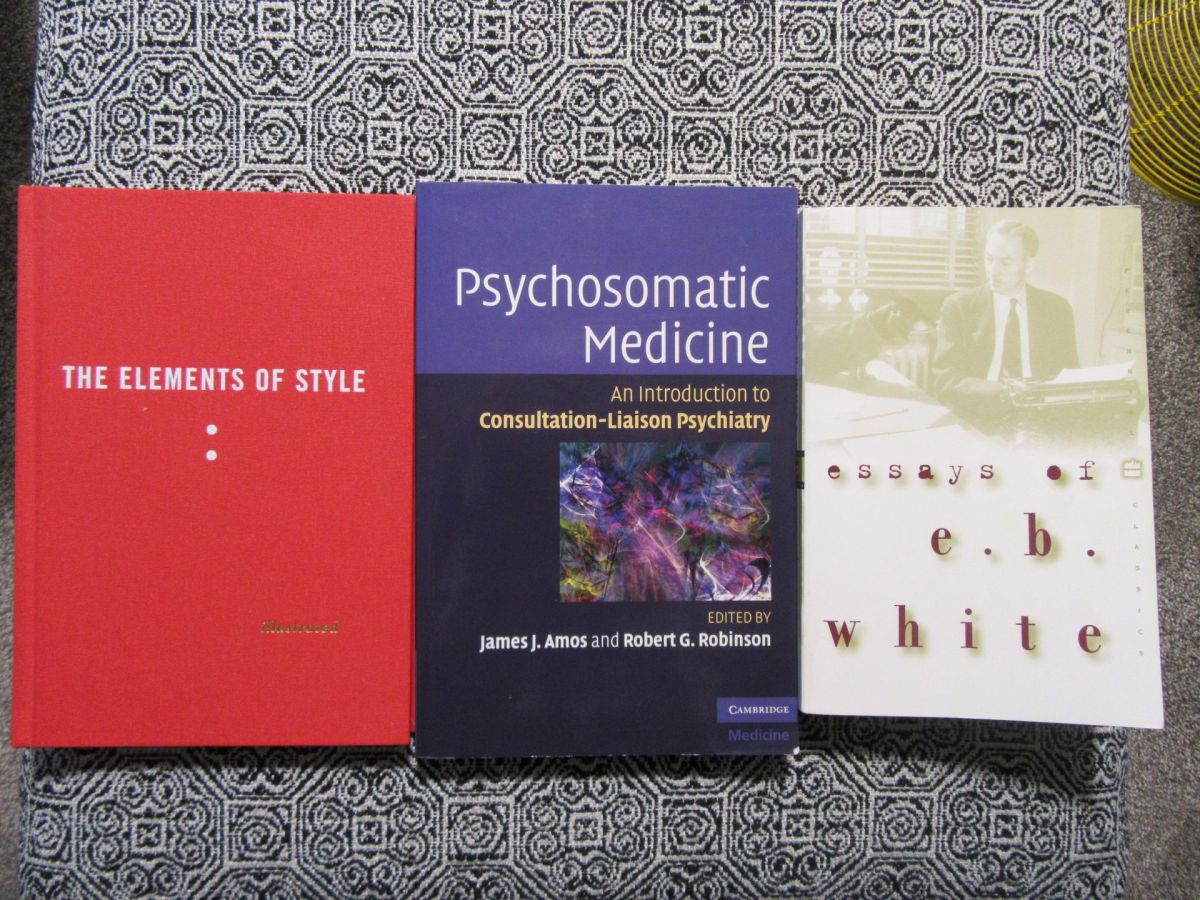
I wrote and co-edited a book with the chairman of the University of Iowa Healthcare Dept of Psychiatry, Dr. Robert G. Robinson, MD. It was “Psychosomatic Medicine: An Introduction to Consultation-Liaison Psychiatry”. There were several contributors. Many of them were my colleagues. It was published in 2010, and prior to that, I’d written an unpublished manual that I wrote for the residents.

There wasn’t any humor in either book, because they were supposed to be evidence of scholarly productivity from a clinical track academic psychiatrist. But I used humor and non-scientific verbiage in my lectures, albeit sparingly. I remember one visiting scientist remarked after one of my Grand Rounds presentations, “You are so—poetic” and I detected a faint disparaging note in his tone…probably a reaction to a latent Vogonism. It’s not impossible to monkey-wrench those into a PowerPoint slide or two.

I used to write a former blog called The Practical Psychosomaticist, later changed to The Practical CL Psychiatrist when The Academy of Psychosomatic Medicine changed their name back to The Academy of Consult-Liaison Psychiatry back in 2017. I wrote The Practical CL Psychiatrist for a little over 7 years. I stopped, but then missed blogging so much I went back to it in 2019 after only 8 months. I guess I was in withdrawal from writing.

That’s because writing is dope.

Food for Thought

I’m giving a shout-out to a couple of child psychiatrists, one I know only from a blog, The Good Enough Psychiatrist. The other is an assistant professor in the University of Iowa Child Psychiatry Dept. I’ve never met her.

Since Jenna gives her name in the About Me section of her blog, I’m going to call her that because it’s easier. Jenna writes many thought-provoking posts, but I really admire the one titled “Amae.”

Dr. Ashmita Banerjee, MD wrote an essay titled “The Power of Reflection and Self-Awareness.” It’s published on line in the Mental Health at Iowa section of The University of Iowa web site.

As a relatively recently retired consultation-liaison psychiatrist who is also a writer, I feel a strong connection to them. In addition to being very glad that extremely talented persons are filling the ranks of a specialty which suffers from a serious manpower shortage, I get a big kick out of reading what really smart people write.

Here’s where a geezer retired psychiatrist starts kidding around. Jenna, a fellow blogger, is used to my habit of deploying humor, admittedly often as a defense. Dr. Banerjee doesn’t know me.

What is it about these essays that reminds me of the X-Files episode “Hungry”? It’s a Monster of the Week episode from the monster’s perspective. This monster looks like a human but sucks brains out of people’s skulls. He’s conflicted about it and even sees a therapist. But in the end his dying words were, as Agent Mulder shoots him down, “I can’t be something I’m not.”

If you read Dr. Banerjee’s essay and followed one of the links, you would have caught the clue that I actually read it because I consciously substituted the word “What” for “Why” in the previous paragraph. I could have as easily asked why instead of what—but it’s less helpful in gaining self-awareness.

And I haven’t sucked anybody’s brains out of their skulls in, what, over two weeks now! Upon reflection, I’m very aware of being incorrigible. Food for thought.

Jenna’s description of the Japanese concept of the word “amae” and Dr. Banerjee’s examination of the Japanese word “kintsukuroi” fascinated me. What made both writers consider human emotions using a language which captures the nuances so deftly?

I was a first-generation college student. There was a time in my life that a path to medical school seemed impossible. At times I probably thought I was trying to be something I’m not.

I’m just grateful for the new generation.

The Secret of Patience

The secret of patience is to do something else in the meantime.

Croft M. Pentz

A few days ago, Sena noticed a noise in one of the sunroom window shade wand controls. She can hear noises I can’t hear, which is a good thing. She wondered if the wand battery needed recharging. We have 3 window shades like this and they came with a recharger that works the same way a cell phone recharger does. You plug the small end into the back of the wand which has control buttons for raising and lowering the shade. You plug the two-prong end into a regular electrical outlet.

We had never recharged them. The instructions said that when plugged into the charger the wand indicator light would shine red. When fully recharged, the light should turn green.

I waited one hour, then two hours. I checked the red light every few minutes or so. Finally, I quit looking and did other things. I replaced the refrigerator water filter. I purged the system. I emptied the ice bucket. I did a load of laundry. I vacuumed the carpet in the house. I exercised. I sat in mindfulness meditation. The light was still red. I checked it after 5 hours—still red. I finally just forgot about it.

About 6 hours later, I passed by the sunroom, glanced at the window and didn’t see the red light. I looked at the wand and couldn’t see the indicator light very well. I got the magnifying glass out and caught the light just right. It was green! Sena said the noise was gone.

I plugged in another window shade wand. The red light didn’t turn green until 8 hours later. I checked it several times. There was nothing to do but be patient.

I finally just did something else. I checked my blog site and was amazed to find a comment from a colleague, Dr. Ronald W. Pies, MD. He is according to a brief bio: professor emeritus of psychiatry and a lecturer on bioethics and humanities at SUNY Upstate Medical University in Syracuse, New York; a clinical professor of psychiatry at Tufts University School of Medicine in Boston, Massachusetts; and editor in chief emeritus of Psychiatric Times™ (2007-2010). He is the author of several books. A collection of his works can be found on Amazon.

I had written a short shout-out blog post about the article he and Dr. George Dawson, MD had written and published on September 26, 2022 in Psychiatric Times, “Antidepressants Do Not Work by Numbing Emotions.”

What was unusual about Dr. Pies’ comment was that it actually turned up in my spam box! If I had not patiently waited a second to read it carefully, I would have automatically trashed it. That was close.

And I would have missed the golden opportunity to tell him that I consider both him and George my friends.

About a half hour before the wand control light turned the green, our cable TV and internet went out. Wow. I had been watching a TV show rerun, probably for the 100th time, so it was no great loss. There was the usual message you get when the service is out: Please wait while this channel is being restored kind of thing. You can’t do anything but just be patient. It was getting late in the evening and I usually don’t do much on the computer then.

A little later, after Sena had gone to bed, I thought of writing this post. I didn’t want to clack on the keyboard and wake her up, so I did something I haven’t done in years. I got pen and paper out and did some long-hand writing. I had skimmed some articles on the internet before it crashed about how reading and writing on paper were better for your brain than doing those on a computer.

It felt good to write. As I did in the distant past, I scribbled in the margins, drew arrows above lines and carets to corrections and notes. It was a mess—a partly satisfying mess.

I say “partly” because it was also not quite right. I didn’t try to type it that night or even the next day. In fact, I couldn’t post anything the following morning to my blog because the internet was still out. The cable TV came back sometime during the night. Obviously, there had been a service outage.

But because the internet was still out, I called the cable company. This was another exercise in patience. I don’t know if every other cable company puts those automated telephone recordings in front of you before you can reach an actual person. They are nuts.

Cable Company Voice (CCV): Hello, please hold on while I check your account. OK, there, I found it. Am I speaking with the owner of the account or Bozo the Clown?

Me: Nobody here but us bozos.

CCV: Great, how can I help you, Bozo?

Me: Was there a power outage in my area?

CCV: OK, I see you’re having a problem with your internet connection. I can help you with that. Are you in front of your computer now or on the roof of your house dancing the merengue?

Me: In front of my computer.

CCV: Great! Please unplug your modem and wait 3 millenia; then plug it into your toaster. This will reset the incoming signal. When you have completed this step, say “Continue.”

Me: Continue.

CCV: That was a rather quick 3 millenia. Which would you prefer: Going through another dozen more trouble-shooting steps with me or speak to an agent?

Me: Speak to an agent.

I finally got to an agent whose mere presence on the line seemed to lead to an immediate, magical restoration of our internet connection. When I specifically asked her if there had been a service outage, she said that, indeed, an outage in our area had occurred. She then arranged for an account credit to ensure we would not be charged for service during the time of the outage. Patience.

This post does not look much like the hand-written one. But waiting a while to let the thing simmer probably didn’t hurt.

Be Quiet and Pay Attention!

I think it was last week that I got this thought about getting attention compared to paying attention. At first, I thought it was original. Hey, did I really just come up with that idea? The see-saw nature of it appealed to me. I write this blog partly to get attention. But I notice that when I pay attention and focus on what I’m writing, it’s more fun.

I quickly gave up the thought that I came up with the idea. I think the context was a little discouragement about the really low traffic to my blog. Now, I’m not just saying that to get more attention—although it does sound like that. And I really appreciate the visits I get from readers!

I searched the web for more about the get attention vs pay attention thing because I was pretty sure I didn’t come up with it but just forgot where I first heard about it.

The funny thing is that what first came to mind was the Men in Black (MIB) scene in which Agent J’s elementary schoolteacher Mrs. Edelson is displayed on the big monitor at MIB headquarters. It turns out she’s actually an alien and she’s crabbing at the class, “…Be quiet and pay attention!” I’ve searched for the YouTube clip but all I found were two: one deleted scene in which her rage at the class went up like a bomb and was way overdone and the other which was blurry and the audio was terrible.

Anyway, you get the idea. Of course, I also found the TED Talk by actor Joseph Gordon-Levitt about paying attention vs getting attention, “How craving attention makes you less creative.”

I think his point is spot on about social media being a big part of the push for many of us to crave attention. I used to have accounts on Twitter, Facebook, and LinkedIn but dropped them years ago because I got almost no traffic. I’m still on YouTube, which has low traffic but which I have fun with because I like making funny little videos. I also made teaching videos back when I was a consulting psychiatrist at University of Iowa Hospitals & Clinics.

I get hardly any traffic on my current blog (which I’ve had for about 3 years) and I get a little frustrated with that. However, I like to write so I’m probably going to hang on to it for a while. I had a previous blog that lasted for about 7 years. It also never got more than a modest number of followers.

When I’m paying attention to what I’m writing about, it may not get any views but I get more satisfaction from writing them. I do my best writing when I’m just having fun doing it. I get a kick out of writing. But then I wonder why I’m not getting any views.

I think the see-saw aspect of paying vs getting attention is normal. So, I should pay more attention to Mrs. Edelson.

Elevator Pitch for a Very Slow Elevator

This is a follow up to yesterday’s post about elevator pitches. I’m using one of the standard formats below. The first step is to find a really slow elevator.

Who am I?

I’m a retired consultation psychiatrist, slowly evolving beyond that backwards in time to something else I’ve always been. I’ve been a writer since I was a child. My favorite place was the public library. I walked there from my house. I stayed there as long as I could. It was place of tall windows where I could look out and see trees which swayed like peaceful giants. I borrowed as many books as I could carry in my skinny arms and walked all the way back home. Then I picked up a pencil. I wrote short stories which I bound in construction paper. I read them to my mother, who always praised them and called me gifted whether I deserved it or not. I lived inside my head. My inner world was my whole world.

What problem am I trying to solve?

The problem was that I forgot who I was as I got older. I forgot for a long time about being a writer. I evolved into the outer world, adopting other forms. I put down the pencil, but never for very long. I changed what I did and made, but I always lived in my head. People told me “Get out of your head.” I tried, but didn’t know how. I wrote less and less. When I did write, I realized that I was no genius, not gifted—but still driven to write. I was so busy in college, medical school, residency, and in the practice of consultation psychiatry, I didn’t write for a long time. But later I returned to it as the main way to teach students. I even co-edited and published a book, Psychosomatic Medicine: An Introduction to Consultation-Liaison Psychiatry, with my former department chair, Dr. Robert G. Robinson. On the Psychiatry Department web page, in the Books by Faculty section, the book is in the subsection “Classic.” Inside the cover of my personal copy is a loose page with the quote:

A classic is something that everybody wants to have read and nobody wants to read.

Mark Twain

I’m pretty sure I put it there. Part of the preface was my idea because of my admiration for Will Strunk, who I learned about in an essay by E.B. White (“Will Strunk,” Essays of E.B White, New York, Harper Row, 1977). We informally called the work The Little Book of Psychosomatic Psychiatry:

The name comes from Will Strunk’s book, The Elements of Style, which was, as White says, “Will Strunk’s parvum opus, his attempt to cut the vast tangle of English rhetoric down to size and write its rules and principles on the head of a pin. Will himself hung the title “little” on his book and referred to it sardonically and with secret pride as “the little book,” always giving the word “little” a special twist, as though he were putting a spin on a ball.”

I guess our little book was, in a way, my own parvum opus.

Obviously, I don’t write the way Strunk would have wanted. But it’s my way, and I’m finding my way back to it, back to the path I was on in the beginning of my life, back to who I am.

What solution do I propose?

Almost two years ago, my solution to the challenge of rediscovering who I am, I suppose, was interrupting my medical career, but that would be dishonest. I did it because of my chronological age or least that was what I told myself. Burnout was the other reason. That said, despite my love of teaching students, I missed something else. And I knew if I kept working as a firefighter, which is what a general hospital consultation psychiatrist really is, I might lose what I loved best, which was writing for its own sake and for sharing it with others. It sounds so simple when I say it. Why has this been so hard, then? Obviously, I’m not going to recommend to those who are writers at heart lock themselves in a garret and do nothing but write. We would starve.

I think this is where mindfulness helped me. I couldn’t ignore my love of writing. I was better off just accepting it. But until I learned mindfulness in 2014 as a part of a Mindfulness Based Stress Reduction (MBSR), which I took mainly because I was struggling with burnout, I would either just ruminate or act on autopilot. I still do those things, just less often. Mindfulness is not miraculous. It’s not for everyone. It can be a part of transitioning to a healthier life. I exercise too. I don’t rigidly always without fail adhere to my schedule. I miss some days. I accept that and just go back and try again.

What is the benefit of my solution?

I think the benefit of adopting mindfulness and other healthy practices, at least for me, is that sooner or later (in my case much later), I made a sort of uneven peace with the loss of my professional routines, my professional identity, my work, as the single most important way to live. I still have a lot to learn, including how to be more patient, how to listen to others, how to get out of my head for what I know will be only a short time. Most of all, I’ve reintegrated writing into my life and it brings me joy. If you’re going through anything like that, then maybe seeing my struggle, my wins and losses, will help you keep going. It gets better.

This elevator pitch is way longer than 45 seconds.

Featured image picture credit Pixydotorg.