


When I was a consultation-liaison psychiatrist I taught trainees in different ways. One of them was what I called the Dirty Dozen slide sets. They were on various basic topics that are important for psychistrists to know. I tried to put the most important points on only a dozen powerpoint slides.
After I started blogging about C-L Psychiatry around 13 years ago, the WordPress blogging platform started offering a way to post slide presentations using what is called shortcode. Presumably, you didn’t really have to know anything about coding language but the instructions weren’t very helpful.
I think I started trying to make slides using shortcode shortly after it was first introduced around 2013. I had to contact WordPress support because I couldn’t learn shortcode. A lot of bloggers had the same problem.
I think my main reason for getting interested in shortcode was so I could cut down on how many powerpoint slides I had to convert to images, which can take up a lot of space on a blog site after a while.
Anyway, in the past few days I tried to pick up the shortcode but couldn’t get the hang of it again. I finally found a WordPress help forum in which I found a blogger’s solution. She made it so clear.
Anyway, the Dirty Dozen on Delirium is below. A few pointers: click in the lower right hand corner of the slide if you want to view the slides full size. Use the directional arrows on your keyboard to click through the slides. You can also just use the arrow handles on the slides if you don’t want to see them full size. . When you click the URLs on the delirium websites, right click and open them in a new tab.
This slideshow could not be started. Try refreshing the page or viewing it in another browser.
Why You Might Have Noticed My Blog Was Missing in Action Recently

A couple of days ago, I tried switching my blog to a new theme. A theme is a kind of digital uniform for the blog. It’s a set of files and pictures that work together to display your blog content.
Every once in a while, I get an urge to change the theme. WordPress has a lot of themes, some free, some for a price.Usually, I can just put on a new theme like a new suit of clothes, pinch it a little and I’m done.
Not this time. I struggled with the new theme for hours. I thought it had features it didn’t have, partly because the initial description was a little misleading. I finally just went back to the old one, which was a lucky break.
While the theme construction was going on, some of you might have dropped by and noticed that my blog was either missing in action or severely crippled, with many essential parts missing. Sorry about that.
While the theme was out, some links evidently changed, mainly because certain web sites either dropped out or were modified. The changes were in the main menu at the top of the page (just to let you know, the new theme really didn’t have a menu per se). The menu looks like it lost weight. The blogs by Drs. Moffic and Pies got included in the main link for Psychiatric Times, which makes sense. One web site evidently no longer exists.
It’ll be a while before I mess around with my blog theme again, maybe until WordPress again tells me that I have to change it if they decide to discontinue it.
Anecdotal Garrulity

I’ve noticed that I’m getting more garrulous as I age. In fact, I call this anecdotal garrulity and I always warn my trainees that I’m about to tell them yet another war story which usually involves some activities or processes in my job as a Consultation-Liaison (C-L) Psychiatrist that nobody knows about anymore–but should.
My anecdotes tend to grow longer and more woolly as the years pass. I add a detail or nuance to the story that adds extra angles, twists and turns, and bits of hair-raising action. Some of them never happened. No, I ‘m just kidding. I don’t actually lie; I just polish the history a little bit.
One example of anecdotal garrulity in which the tales get hairier with each performance, I mean embellishment, no I mean repetition–involve people I’ve encountered while blogging on WordPress.
One of them is Dr. Igor Galynker, a brilliant psychiatrist at Beth Israel in New York who has done very important research in suicide risk assessment. He has recently published a book about the suicide crisis syndrome, The Suicidal Crisis: Clinical Guide to the Assessment of Imminent Suicide Risk. I purchased a copy and am reading it whenever I get a chance. I wrote a post about a paper he published regarding his suicide risk assessment research in my previous blog, The Practical C-L Psychiatrist, which started off with the name The Practical Psychosomaticist for goodness sakes, what a name! The name Psychosomatic Medicine (PM), by the way, was chosen by the American Board of Psychiatry and Neurology (ABPN) and the American Board of Medical Specialties (ABMS) about 2,000 years ago when this subspecialty got approved by the Accreditation Council on Graduate Medical Education (ACGME).
Come to think of it, I probably ought to call it a supraspecialty instead of a subspecialty and that name originated with another grand beacon of academic C-L Psychiatry (I mean besides me), Dr. Theodore Stern, at an annual meeting of the Academy of Psychosomatic Medicine (that’s what it was called then, if you can believe it; but now, because the members of the academy (including me) howled about it and voted to change it to something that made some darn sense, it is now rightly called the Academy of C-L Psychiatry; we’re finally correctly identified, good gahd’amighty) and you will not find “supraspecialty in Webster’s Dictionary although “supra” comes from the Latin for “above, beyond, earlier”. One of the definitions is “transcending”. I tried to Google “supraspecialty” and came up empty, so it’s a bona fide neologism. Dr. Stern coined the term while talking about the scope of practice of PM. As he went through the long list, it gradually dawned on me why “supraspecialty” as a title probably fits our profession. It’s mainly because it makes us, as psychiatrists, accountable for aspects of general and specialty medical and surgical care above and beyond that of Psychiatry alone. That doesn’t make us deities; just better than most doctors on the planet. Of course not; I’m only kidding. Can’t you take a joke?
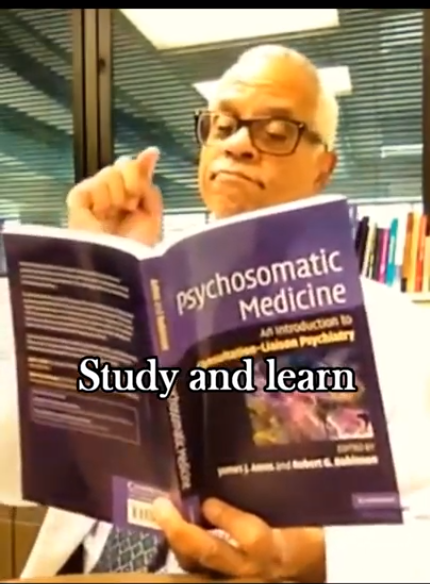
Where was I ? Oh, getting back to Igor Galynker, I wrote a post about one of his papers on the assessment of imminent suicide risk, published in about 2014 I believe, a few years after the book Robert G. Robinson and I edited was published, Psychosomatic Medicine: An Introduction to Consultation-Liaison Psychiatry, a block bluster that you cannot put down and will read cover to cover; the level of interest just climbs, almost the effect you get from my award-winning and wildly popular video on pseudobulbar palsy.
Anyway, shortly after I posted that, I got a box in the mail with a very strange-looking address for me:

Even more astonishing was what was in the box. It was Bumpy the Bipolar Bear, an item that evidently was a part of his Mood Disorder Division at Beth Israel.

I have never really figured out whether he did this tongue-in-cheek or what. We’ve never met and we don’t correspond. It doesn’t look like Bumpy is a thing anymore at Beth Israel.
I’m not a research scientist, but I wonder if anyone would fund a center for the study of Anecdotal Garrulity? More importantly, would a statue of me, sculpted from Play-Doh (originally wallpaper cleaner, something you’d know if you watched the Travel Channel as much as I do now that I’m retiring), be erected in the rotunda?
 Go Retire Psychiatrist