Black History Month 2025 ASALH Theme

This is Black History Month and the Association for the Study of African American Life and History (ASALH) theme this year is African Americans & Labor.

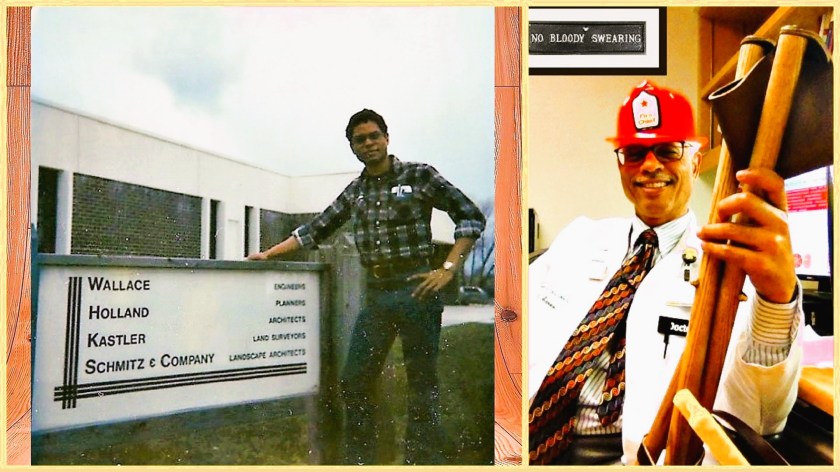
When I look back on my youth, I think of my time learning on the job to be a survey crew technician and drafter for a consulting engineer company in Mason City, Iowa, Wallace Holland Kastler Schmitz & Co. (WHKS & Co.).

I was probably not the first black person to work for WHKS & Co. One other black person who was one of very few role models for African Americans was a guy named Al Martin, who I’ve posted about before.

My time there was in the 1970s and there were not many job opportunities open to minorities. I learned more than just the skills specific to the job. I learned that I could succeed in life, which was valuable later on. I developed the confidence to seek other opportunities which included going to medical school and becoming a physician.

Although racism was not absent at WHKS & Co., there was just enough open-mindedness to support my ambition to move forward in life despite the barriers to success in society that existed.

I think the ASALH theme for Black History Month in 2025 is vital to reflect on in the present day. People from all walks of life can relate to this.

Carter G. Woodson is considered the father of Black history and was the founder of Black History Month.

Reminiscence of My Younger Days

The other day we had some stormy weather roll across central Iowa, although it was not as bad as the tornado that swept through Greenfield. We hope the best for them. We didn’t actually get a tornado, but I remember wondering why the siren went off about 6:00 a.m. It woke me up and I wondered what was the matter. Turns out it was a tornado warning and we had to sit in the basement for a little while. It was a little scary, but the storm moved east pretty quickly northeast out of our area.

For whatever reason, this eventually led to my reminiscing about my younger days. Maybe it was because of a temporary scare and increased awareness of our mortality.

I used to work for a consulting engineers company called WHKS & Co. in Mason City, Iowa. This was back in the days of the dinosaurs when it was challenging to set stakes for rerouting highways around grazing diplodocus herds.

I was young and stupid (compared to being old and stupid now by way of comparison). I lived at the YMCA and took the city bus to the Willowbrook Plaza where the WHKS & Co. office was located on the west side of town.

I usually got there too early and stopped for breakfast at the Country Kitchen. The waitress would make many trips to my table to top off my coffee while I sat there waiting for the office to open. That was fine because I had a strong bladder in those days. I left tips (“Don’t cross the street when the light is red”).

My duties at WHKS & Co. included being rear chain man and rod man, at least when I first started. A “chain” was the word still being used for a steel tape for measuring distances. It was well past the days when land surveyors used actual chains for that purpose. You had to use a plumb bob with the chain to make sure you were straight above the point (usually marked by a nail or an iron property corner pin) you measuring to and from.

You and the lead chain man had to pull hard on each end of the chain to make sure it was straight. It was challenging, especially on hot days when my hands were sweaty and the chain was dirty. Callouses helped.

The rod was for measuring vertical distances and an instrument called a level was used with that. One guy held up the rod which was marked with numbers and the guy using the level read the elevation. Another way to measure both horizontal and vertical angles used a rod and a different instrument that we called a theodolite (older instrument name was “transit”).

We worked in all kinds of weather, although not during thunderstorms. In fact, when it was looking like rain out in the field, a standard joke for us sitting in the truck waiting for rain was to draw a circle on the windshield (imaginary, you just used your finger although if your finger was dirty which it always was, you left a mark) and if a certain number of drops fell in the circle, you could sit in the truck and play cards.

When we played cards, it was always the game Hearts, which I could not play skillfully at all. I always lost. But it kept us out of the rain. If a big thunderstorm blew in, we just headed back home.

We never got caught in a tornado.

Another Blast from the Past

Today is Labor Day, and I was looking at some of my old blog posts from my previous blog The Practical Psychosomaticist. I found one that I think I haven’t reposted on my current blog called “Going from Plan to Dirt.”

It’s a funny post, at least I think so. It draws a comparison between blue collar and white collar work, similar to what I did the other day (“Why Can’t I Wear Blue After Labor Day?”).

I wrote it in 2011, when I was on a hospital committee to improve detection and prevention of delirium in the general hospital.

“Our work on the Delirium Early Detection and Prevention Project reminds me of my early formative experiences working as a draftsman and land survey technician starting in 1971 with an engineering company, Wallace Holland Kastler Schmitz & Co. (WHKS & Co.) in Mason City, Iowa. I remember being amazed at how a drawing on paper could be turned into a city street, highway, bridge, or airport runway. They have a website now. I can now find written there what was modeled for me then:

“WHKS & Co. is committed to the continuous improvement of the quality of service provided to our clients.”

Then and now WHKS & Co. worked hard to create the infrastructure that we depend on and then put it into the world in a “safe, functional, and sustainable” way. Out in the field we sometimes joked about how a designer’s drawing was flawed if we couldn’t go from plan to dirt.

It’s common to believe that engineers and land surveyors deal with complex mathematical formulas, structural materials, things instead of people—an applied science in which the emotions and motivations of people play a small role. Nothing could be further from the truth.

I was 16 years old when WHKS & Co. hired me. I had no idea what engineers and land surveyors did, had no experience, and I was at a crossroads in my life. They didn’t hire me because I had any talent or asset they needed. They hired me because they were as committed to the people in the community, not just to things.

And if you think land surveying doesn’t have anything to do with people’s emotions, consider property line disputes. The survey crew I was attached to had been sent out to find the property corners of two neighbors. This involves locating iron pins that mark the corners of the lots that houses sit on. Little maps or “plats” are used as guides and let me tell you, often enough we found the map is not the territory.

Anyway, while we were out there in the back yard of one of the neighbors, they both came outside. One of them was a diminutive elderly lady and the other was a tall, big-boned elderly man. They started arguing about the boundaries of their lots and it got pretty heated. Pretty soon they were yelling in each other’s faces and the lady reached down in the garden in which we were all standing. She picked up the biggest, juiciest rotten tomato she could find and it was clear to us what she planned to do with it. They were both pretty old and neither one of them could move very fast. My crew chief, sensing that something violent was about to happen, moved in between them (a decision I still can’t fathom to this day).

What followed seemed to happen in slow motion, in part because the combatants were so old. The man could see the lady was about to hurl the rotten tomato at him. Ducking must have been beyond his power, probably because of a stiff back. He bent his knees and leaned forward. She cocked the tomato as far back as she could and let fly, screeching, “You’re nothing but an old Norwegian!” My crew chief probably caught a seed or two. Amazingly, the tomato only grazed the top of the man’s head.

I think the altercation took a lot of both of them. They both went back in their houses after that.

It’s not hard for me to see the connection between my past and the present. WHKS & Co. was and still is committed to continuous improvement. And they were and still are all about finding a practical way to do it. If we’re going to improve the quality of care we provide patients and we propose to do it by preventing delirium, we’re going to have to use the same principles that my first employer used. And we’re going to have to be just as practical about how to go from plan to dirt.

We’re still trying to refine the charter for our delirium detection and prevention project, which is a kind of map, really. And even though the map is not the territory, it’s still a necessary guide to remind us of the goal.”

Why Can’t I Wear Blue After Labor Day?

I have a few thoughts on the upcoming Labor Day weekend. It occurs to me that Labor Day often evokes images of blue-collar workers. On the other hand, I think in a broader view of the holiday, most of us can think of ourselves as working toward improving our society no matter whether our jobs are in the white-collar or blue-collar sector.

Many eons ago, I was a blue-collar worker. I was a surveyor’s assistant and drafter for a consulting engineers’ company in Mason City, Wallace Holland Kastler Schmitz & Co. (WHKS & Co.). I got attached to my job because it was the first real job I ever had.

I was proud of what I did, even though I didn’t make much money. I had to travel around the state a lot. I lived at the YMCA and ate all my meals in cafes because I was often out of town on jobs and when I was not, there was no kitchen in my tiny sleeping room at the Y.

I wore blue jeans and tee shirts, flannel shirts when I wasn’t out in the hot sun. I liked being outside except when the ragweed was out in the late summer. I had bad hay fever. I tried desensitization shots, but all they did was make my arm swell up. Winters were cold, especially if I had to stand in one place for a long time, either holding up the rod or running the gun.

I was mostly a rear chain man and rod man early on, but moved up to “running the gun” which meant operating the level and theodolite, the former for measuring elevations and the latter for measuring angles. I was proud of my job.

It took me a while to transition from blue-collar to white-collar mindset. In college, I often returned to work for WHKS during the summer breaks. That was where I formed my identity.

Some aspects of the job were simple. You hammered a stake, an iron property marker, or a frost pin if the ground was frozen. Measuring distances, angles, and elevations were often repetitive tasks, yet satisfying because they marked progress toward a concrete goal, like building an airport runway, establishing the outline of a tract of farmland, or raising a bridge. As one of my bosses on the survey crew put it, the work helped you see “the lay of the land.”

Land surveying, mapping, and drawing up plans set my perspective on life when I was a young man. At one time, that perspective made me think I wanted to be an engineer. I respected engineers because they built the subdivisions, highways, dams, and other real things from ideas.

I respected my teachers at WHKS, but couldn’t do the math. And they respected my change of heart.

I eventually became a doctor, after a short stint as a medical technologist in clinical laboratory medicine. You’d think, given my hands-on background, I would have become a surgeon, but I wasn’t made for that either.

I learned basic things at WHKS like being steady, reliable, and focused. I had to learn other things to be a doctor, especially a psychiatrist. On the other hand, in this white-collar environment, especially in a research-oriented academic medical center, I often looked and acted more like a blue-collar worker.

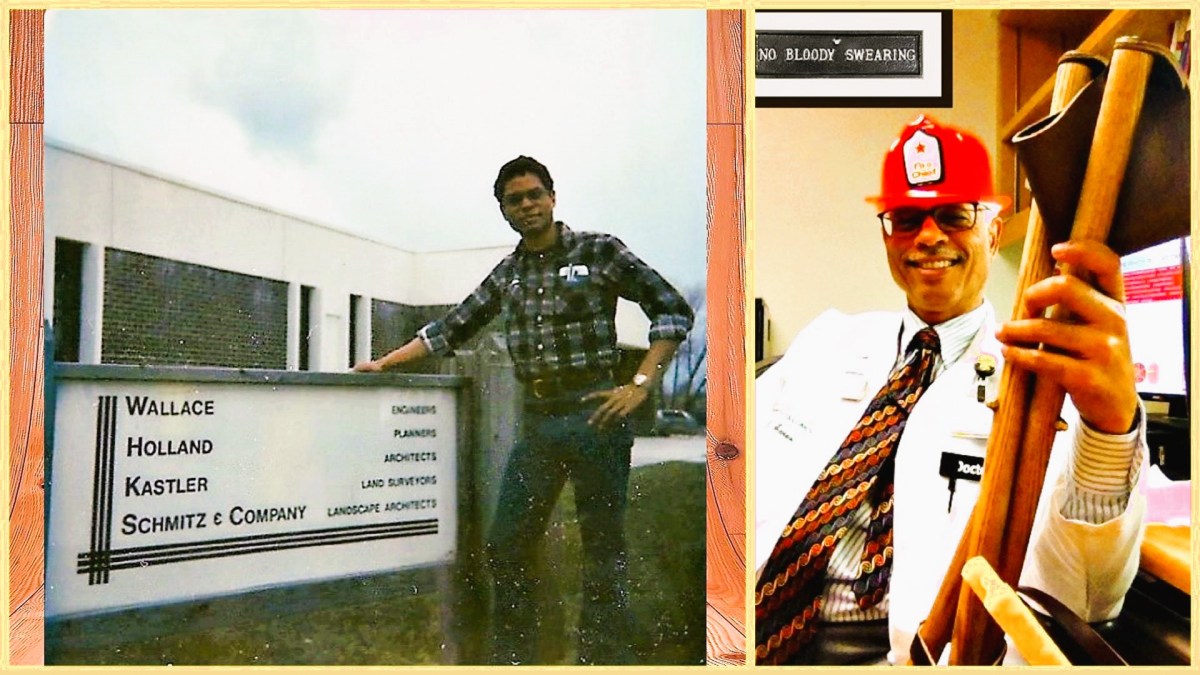
One of the Family Medicine residents who rotated on the psychiatry consultation-liaison service left me a gift of a fireman’s helmet. It fit my head and my approach to psychiatry in the general hospital. What I did mostly was put out the fires, metaphorically speaking, of behavioral eruptions related to delirium which were caused by medical problems. Often, I had to apply blue-collar approaches in a white-collar world. So, can I wear blue after Labor Day?

Happy Labor Day.