Saying Goodbye to Zem the Mattress

We’re saying goodbye to Zem the mattress. This raises important questions. Who the heck is Zem? Why does a mattress have a name? If you’ve ever read Douglas Adams’ book “The Ultimate Hitchhiker’s Guide to the Galaxy: Five Novels and One Story,” you’d probably wonder why anyone should ask.

The name Zem is given to every mattress that exists. According to the Guide, mattresses were once living beings who were slaughtered (not clear who slaughters them) and sold throughout the Universe. They are friendly, talkative, and originate on Sqornshellous Zeta, a swampy planet on which Zem the mattress has a long, idiotic conversation with a depressed robot named Marvin. It’s true, at least in Adams’ book. Find it in Chapter 7 of “Life, The Universe and Everything.”

This raises the issue of how to replace a mattress. It’s a difficult thing and it’s likely there are exceptions to the rule that all mattresses have to go to the junkyard.

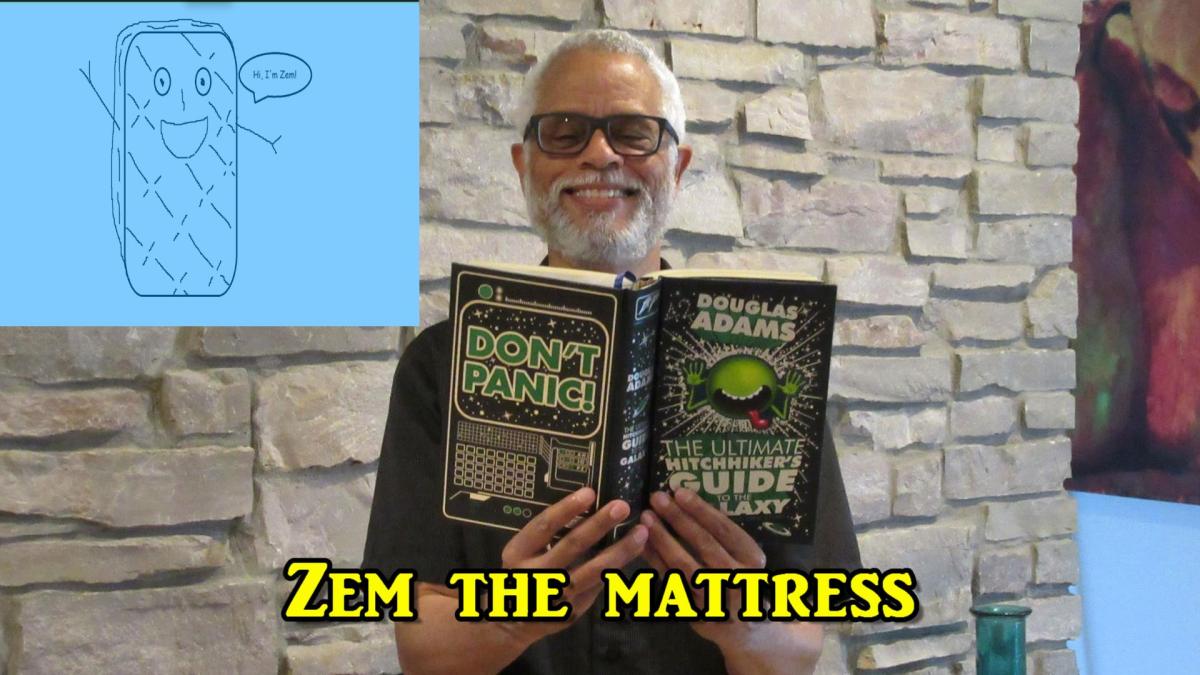
I should say that the crude drawing of our Zem is an original work by me, using Microsoft Paint. It’s definitely not made by something called Image Creator. Recently, Windows 11 added Image Creator to Paint, which claims to be able to create drawings just by clicking on the AI icon—which appears almost everywhere nowadays.

It’s getting harder to ignore, but I did. That explains why my drawing of Zem looks like it was made by a 4-year-old child. It’s a form of protest against AI. I’m not sure how long I can hold out. I suspect that AI will eventually learn to disguise itself as something completely innocent without formally introducing itself as AI.

Anyway, like most people, it was challenging to find a new home other than the landfill for Zem. It turns out there is an informal underground railroad leading to new homes for Zem. Zem can be recycled, or at least some parts of it can be repurposed, which don’t include going back into mattress production.

And, there are places like Salvation Army, Goodwill, and homeless shelters which may publicly refuse to take Zem—but then not always stick to the rules on the signs. The websites may say they won’t adopt Zem, even if it doesn’t have a port wine stain on its face. On the other hand, there are circuitous, by word of mouth only code talkers who guide you (sometimes from half-closed doors) to what “could” be a new home for Zem, but you didn’t hear it from them. That rhyme was unintentional, but it worked.

The process is a little like the old TV show “Hogan’s Heroes,” in which Stalag 13 outwardly looked like a prison camp, but contained cleverly disguised nooks, crannies, and tunnels which allowed trips to the Dairy Queen if inmates were so inclined.

It turns out Zem might have a new home—but you didn’t hear it from me.

The Intergalactic Angle on Your Point of View

I finally watched the movie “The Hitchhiker’s Guide to the Galaxy” the other night. It was released in 2005 and based on Douglas Adams’ book of the same title. In fact, he co-wrote the screenplay. A lot of it was not in the book. I thought a couple of scenes were noteworthy and pretty funny. I made connections to Dr. Martin Luther King, Jr. annual observance, which is this month.

One of them was the Point of View Gun. It’s probably unfortunate that the main prop was a gun, but hey, it was a ray gun. It didn’t kill anyone and in fact, it caused the person “shot” with it to be able to understand the perspective of another person. It was just temporary, but for a short while it enabled persons or extraterrestrials to understand another’s point of view. It was designed by the Intergalactic Consortium of Angry Housewives to influence their husbands to understand them better.

One of Dr. Martin Luther King’s main points was how important it is to try to understand and validate someone else’s point of view.

One drawback of the Point of View gun (besides the obvious associations with gun violence) was that the effect was specific to whoever was using it. So, when the ultra-maladjusted robot Marvin mowed down a gang of Vogons (hideous and cruel extraterrestrial bureaucrats who destroyed Earth in order to make room for an intergalactic bypass), they all collapsed from depression.

The other scene I thought was funny was the Vogon planet’s slap-happy encounter between the heroes and the creatures shaped like spatulas that popped out of the ground and smacked anyone in the face who had an idea.

I didn’t think the movie was nearly as good as Adams’ book. But I wonder if you could cross the spatula creatures with the Point of View gun that would take the perspective-taking power of the gun and give it to the spatula creatures who would slap you silly whenever you failed to even try to understand another’s point of view. I could use that kind of a slap sometimes.

It’s remarkable the connections you could make between Dr. Martin Luther King, Jr and The Hitchhiker’s Guide to the Galaxy.

The Lesser-Known Quote by Wonko the Sane

A couple of days ago, Sena and I were playing cribbage and she thought she had a higher scoring hand than she actually did. She immediately realized it and scored it right. She commented that, at first, she thought she saw something she didn’t actually see. I quipped that “First you have to see it.” She thought that was pretty funny.

I actually said that because I remembered a quote from Wonko the Sane in Douglas Adam’s book “So Long and Thanks for All the Fish.” Wonko is a guy who lives “outside the asylum” because he saw the instructions on a box of toothpicks and thought it was so bizarre that he didn’t want to live in a society which needed that kind of instruction.

Now, you can find a lot of references on the web for the quote that arises from the toothpick instruction:

“It seemed to me, said Wonko the Sane, that any civilization that so far lost its head as to need to include a detailed set of instructions for use in a package of toothpicks, was no longer a civilization in which I could live and stay sane.” Douglas Adams, So Long, and Thanks for All the Fish.

You can even buy tee shirts printed with this quote. But that’s not the Wonko the Sane quote I was thinking of. In fact, I’m not the only one who thought of it and the first person I want to give credit to for calling attention to it is a WordPress blogger whose name seems not discoverable on his blog, but instead has the title Eppur Si Muove. It’s Latin and it means “…and yet it does move.” It’s attributed to Galileo who muttered it after being forced to recant his claim that the earth moves around the sun.

The quote is:

But the reason I call myself by my childhood name is to remind myself that a scientist must also be absolutely like a child. If he sees a thing, he must say that he sees it, whether it was what he thought he was going to see or not. See first, think later, then test. But always see first. Otherwise you will only see what you were expecting. Most scientists forget that…. So the other reason why I call myself Wonko the Sane is so that people will think that I am a fool. That allows me to say what I see when I see it. You can’t possibly be a scientist if you mind people thinking that you’re a fool. ~ Wonko the Sane, from So Long, and Thanks for All the Fish by Douglas Adams.

The blogger who wrote the post entitled it “Wonko the Sane—On Being a Scientist…”

Seeing what’s really there is very difficult to do. I’m fettered by expectations, desires, prior misinformation, and so on. Often, I see what I want to see rather than what’s there.

The toothpick quote gets more interpretations often by writers who sound like they trying to prove something. What’s even more interesting than them (and funnier) are the great number of actual instructions on how to use toothpicks, even how to do tricks with them.

What seems impossible to find are actual instructions for how to see.

Maybe I Should Be More Optimistic About Humans

I read the Psychiatric Times article “How Psychiatry Has Enriched My Life: A Journey Beyond Expectations” by Victor Ajluni, MD and published on July 4, 2023. It was like a breath of fresh air to read an expression of gratitude. Just about everything I read in the news is negative.

At the end of the article, Dr. Ajluni added a comment acknowledging that artificial intelligence (AI ChatGPT) assisted him in writing it. He takes full responsibility for the content, to be sure. I wouldn’t have guessed that AI was involved.

There’s a lot of negative stuff in the news. There are hysterically alarming headlines about AI.

I suppose you could wonder if Dr. Aljuni’s article is intentionally ironic, maybe just because the gratitude tone is so positive.  If it had been intended as irony, what could the AI contribution have been, though? I have a pretty low opinion of the AI capacity for irony.

I think irony occurs to me only because I tend to be pessimistic about the human race.

Maybe that’s because it has been very easy to be pessimistic about what direction human nature seems to be taking in recent years. I’ve been reading Douglas Adams’ satirical book, “The Ultimate Hitchhiker’s Guide to the Galaxy.” It contains several of his books which I think are really about human nature, and the setting is in a funny though often terrifying universe. I think there’s an ironic tone which softens the pessimism. The most pessimistic character is not a human but a robot, Marvin the paranoid android.

Unlike Marvin, I don’t have “a brain the size of a planet” (it’s more the size of a chickpea), but I am getting a bit cynical about the universe. I’m prone to regarding humans as evolving into a race of beings similar to those described in the book “Life, The Universe and Everything.” In Chapter 24, Adams describes the constantly warring Silastic Armorfiends of Striterax.

The Silastic Armorfiends are incredibly violent. Their planet is in ruins because they’re constantly fighting their enemies, and indeed, each other. In fact, the best way to deal with a Silastic Armorfiend is to lock him in a room by himself—because eventually he’ll just beat himself up.

In order to cope better, they tried punching sacks of potatoes to get rid of aggression. But then, they thought it would be more efficient to simply shoot the potatoes instead.

They were the first race to shock a computer, named Hactar. Possibly, Hactar was an AI because, when they told Hactar to make the Ultimate Weapon so they could vanquish all their enemies, Hactar was shocked. Hactar secretly made a tiny bomb with a flaw that made it harmless when the Silastic Armorfiends set it off. Hactar explained “…that there was no conceivable consequence of not setting the bomb off that was worse than setting it off…”, which was why it made the bomb a dud. While Hactar was explaining that it hoped the Silastic Armorfiends would see the logic of this course of action—they destroyed Hactar, or at least thought they had.

Eventually, they found a new way to blow themselves up, which was a relief to everyone in the galaxy.

There are similarities between Hactar and the AI called Virtual Interactive Kinetic Intelligence (V.I.K.I.) in the movie “I, Robot.” The idea was that robots must control humans because humans are so self-destructive. Only that meant robots had to hurt humans in order to protect humanity. The heroes who eventually destroy V.I.K.I. make up a team of misfits: a neurotic AI named Sonny, a paranoid cop who is himself a mixture of robot and human, and a psychiatrist. Together, the team finally discovers the flaw in the logic of V.I.K.I. Of course, this leads to the destruction of V.I.K.I.—but also to the evolution of Sonny who learns the power of the ironic wink.

Maybe kindness is the Ultimate Weapon.

What Do the Personal Brain Specialists Recommend?

Dr. George Dawson’s post “The Freak Show” reminded me of how coarse and cruel we can be to each other, even when we’re not aware of it. Maybe I should say especially when we’re not aware of it. Dr. Dawson emphasizes the importance of the empathic approach. In the same way, Dr. Moffic in the articles in his column, “Psychiatric Views on the News” draws attention to the need for a socially responsible way for us to relate to one another. The Goodenough Psychiatrist blog expresses poignantly the emotional and courageously humanistic ways we can (or could) relate to each other. Dr. Ronald Pies has highlighted the importance of how human interaction with artificial intelligence must help us find a way to treat each other with respect, and teach that to AI because AI learns from humans.

This reminds me of a character in the book “The Hitchhiker’s Guide to the Galaxy” by Douglas Adams. The character is named Gag Halfrunt who is the personal brain specialist for a couple of other characters. In fact, he’s a psychiatrist who orders the destruction of planet Earth, which is a sort of computer program designed to give us the ultimate question to the ultimate answer for life, the universe, and everything. The reason Gag Halfrunt wants to destroy Earth is, if the ultimate question is revealed, it would put psychiatrists out of work because then everyone would be happy.

Just as a personal comment, I’m pretty unhappy with the author’s position on psychiatrists in general, which tends to overemphasize our importance. And I’m pretty sure psychiatrists are not that important, having been employed as one for many years and seeing how much impact of any kind we have. We can’t make people more or less happy at all.

In fact, Adams also takes a shot at philosophers, who are also upset at being thrown out of work should the ultimate question to the ultimate answer be revealed (the ultimate answer, by the way, is 42 if you’re interested).

Giving psychiatrists and philosophers and anyone else who might have a stake in taking credit for making people happy is nonsense. We all bear responsibility for ourselves. You can argue about whether or not we have any responsibility for each other.

Rather than arguing about it, we could give something else a try. We could try a mindfulness approach like the Lovingkindness Meditation. I’m not an authority or expert on this, but you can check it out on the Palouse Mindfulness website, the link to which is in the menu on my blog. You can find the link to the Lovingkindness Meditation there.

There is no guarantee the Lovingkindness Meditation will make you or anyone else happy. But it doesn’t hurt anything to try it and, as far as I know, Gag Halfrunt is not opposed to it.