Going Down Blogging Memory Lane

I’ve been going down the blogging memory lane lately and thought I’d repost what was probably the very first post I published on my first blog, The Practical Psychosomaticist. The title was “Letter from a Pragmatic Idealist.”

While a lot of water has gone under the bridge since mid-December of 2010, some principles remain the same. Some problems still remain, such as the under-recognition of delirium.

Just a few thoughts about words, just because I’m a writer and words are interesting. The word “Psychosomaticist” is clunky and I’ve joked about it. I tried to think of another name for the blog.  I thought “Pragmatic Idealist” was original until I googled it—someone already had coined it. Then I considered “The Practical Idealist”, with the same result. The same thing happened with “The Practical Psychiatrist.” All of the terms had been used and the associations didn’t fit me. I couldn’t find anyone or any group using the term “The Practical Psychosomaticist.” 

Finally, after the Academy of Psychosomatic Medicine (APM) changed its name to the Academy of Consultation-Liaison Psychiatry (ACLP) in 2016, I changed the name of the blog to The Practical C-L Psychiatrist, finally dropping the name “psychosomatic” along with its problematic associations.

I guess the chronicle would be incomplete without an explanation of what happened to that blog. Around 2016, the General Data Protection Regulation (GDPR) was adopted by the European Parliament. WordPress, a popular blogging platform which I use, eventually decided that even hobby bloggers had to come up with a quasi-legal policy document to post on their websites to ensure they were complying with the GDPR regulation and not misusing anyone’s personal data.

I didn’t think that applied to hobby bloggers like me yet it was required. I wasn’t collecting anyone’s personal data and not trying to sell anything. I deleted my blog in July of 2018.  Because I loved to write, I eventually started a new blog around the last year of my phased retirement contract with my hospital in 2019.

Anyway, here’s the December 15, 2010 post, “Letter from a Pragmatic Idealist.”

“I read with interest an article from The Hospitalist, August 2008 discussing the Center for Medicare and Medicaid Services (CMS) requirement for hospitals to submit information on Medicare claims regarding whether a list of specific diagnoses were present on admission (POA)[1]. The topic of the article was whether or not delirium would eventually make the list of diagnoses that CMS will pay hospitals as though that complication did not occur, i.e., not pay for the additional costs associated with managing these complications. At the time this article was published, CMS was seeking public comments on the degree to which the conditions would be reasonably preventable through application of evidence-based guidelines.

I have no idea whether delirium due to any general medical condition made the list or not. But I have a suggestion for a delirium subtype that probably should make the list, and that would be intoxication delirium associated with using beverage alcohol in an effort to treat presumed alcohol withdrawal. There is a disturbing tendency for physicians (primarily surgeons) at academic medical centers to try to manage alcohol withdrawal with beverage alcohol, despite the lack of medical literature evidence to support the practice [2, 3]. At times, in my opinion, the practice has led to intoxication delirium in certain patients who receive both benzodiazepines (a medication that has evidence-based support for treating alcohol withdrawal) combined with beer—which generally does not.

I’ve co-authored a couple of articles for our institution’s pharmacy newsletter and several of my colleagues and pharmacists petitioned the pharmacy subcommittee to remove beverage alcohol from the formulary at our institution, where beer and whiskey have been used by some of our surgeons to manage withdrawal. Although our understanding was that beverage alcohol had been removed last year, it is evidently still available through some sort of palliative care exception. This exception has been misused, as evidenced by cans of Old Style Beer with straws in them on bedside tables of patients who are already stuporous from opioid and benzodiazepine. A surgical co-management team was developed, in my opinion, in part to address the issue by providing expert consultation from surgeons to surgeons about how to apply evidence-based practices to alcohol withdrawal treatment. This has also been a failure.

I think it’s ironic that some professionals feared being sanctioned by CMS for using Haloperidol to manage suffering and dangerous behavior by delirious people as reported by Stoddard in the winter 2009 article in the American Academy of Hospice and Palliative Medicine (AAHPM) Bulletin[4]. Apparently, CMS in fact did have a problem with using PRN Haloperidol (not FDA approved of course, but commonly used for decades and recommended in American Psychiatric Association practice guidelines for management of delirium), calling it a chemical restraint while having no objection to PRN Lorazepam, which has been identified as an independent predictor of delirium in ICU patients[5]. Would the CMS approve of using beer to treat alcohol withdrawal, which can cause delirium?

As a clinician-educator and Psychosomatic Medicine “supraspecialist” (term coined by Dr. Theodore Stern, MD from Massachusetts General Hospital), I’ve long cherished the notion that we, as physicians, advance our profession and serve our patients best by trying to do the right thing as well as do the thing right. But I wonder if what some of my colleagues and trainees say may be true—that when educational efforts to improve the way we provide humanistic and preventive medical care for certain conditions don’t succeed, not paying physicians and hospitals for them will. I still hold out for a less cynical view of human nature. But if it will improve patient care, then add this letter to the CMS suggestion box, if there is one.”

1.        Hospitalist, D. (2008) Delirium Dilemma. The Hospitalist.

2.        Sarff, M. and J.A. Gold, Alcohol withdrawal syndromes in the intensive care unit. Crit Care Med, 2010. 38(9 Suppl): p. S494-501.

3.        Rosenbaum, M. and T. McCarty, Alcohol prescription by surgeons in the prevention and treatment of delirium tremens: historic and current practice. General Hospital Psychiatry. 24(4): p. 257-259.

4.        Stoddard, J., D.O. (2009) Treating Delirium with Haloperidol: Our Experience with the Center for Medicare and Medicaid Services. Academy of Hospice and Palliative Medicine Bulletin.

5.        Pandharipande, P., et al., Lorazepam is an independent risk factor for transitioning to delirium in intensive care unit patients. Anesthesiology, 2006. 104(1): p. 21-6.

About Me Page Revisited

I’ve been looking at my About Me page and see that it needs revising. I’m way past the stage of being in phased retirement and I’m pretty sure I can’t do without this blog—or at least some way to keep writing. I notice I said that I was not sure how long I’d keep blogging.

I recently updated my YouTube trailer. It’s my first attempt at an elevator pitch in years. It’s a 48 second video, probably the shortest video I’ve ever done. According to some experts, it’s 3 seconds too long. If you want to read the long version, it’s on this blog, “Elevator Pitch for a Very Slow Elevator.”

Anyway, I’ve been retired from psychiatry since June 30, 2020 (there was a minor clerical glitch in the exact date). My wife, Sena and I have gotten all of our Covid-19 vaccines—until they come up with more. We have made Iowa City our home for over thirty years.

We play cribbage. One of the most fun cribbage games we played was the game on the Iowa state map board. That was a blast. The video of it was over 10 times longer than most YouTube videos I make. That’s because the main reason for the game was to talk up Iowa. You really ought to visit, maybe even move here. You can get used to snow. I keep reading articles on the web telling me I’ve got to stop shoveling at my age. I’ll think it over.

We also like going for walks. One of our favorite places to walk is on the Terry Trueblood Trail. Sometimes you can see Bald Eagles out there.

I have not yet mentioned Consultation-Liaison Psychiatry, even once. That’s a big difference from the old About Me page. It was the first thing I mentioned then, because it was just about the most important role I had in life.

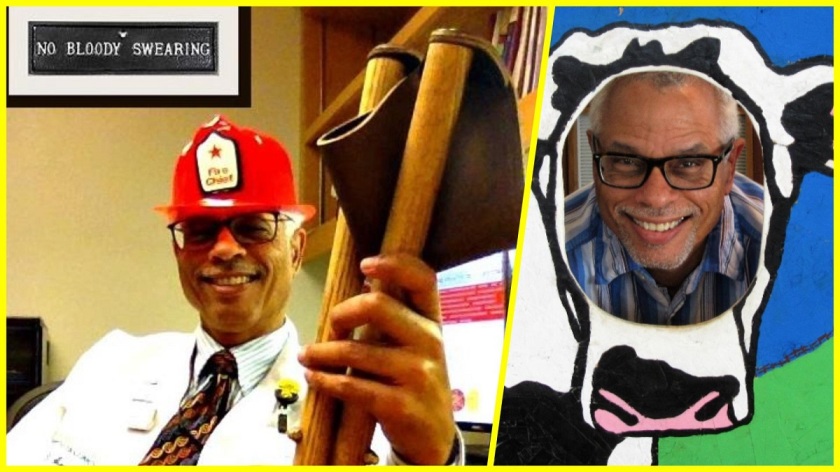
It took a long time before I began to question that once I retired—about a year or so. It was a lot like being a firefighter. In fact, my pager was the bell, and I even had a firefighter’s helmet, a gift from a family medicine resident who rotated through the psychiatry consult service. I didn’t wear it when I interviewed patients. It would have alarmed them.

I also carried around a little camp stool. It was because there were never enough chairs in patient rooms to accommodate me, the trainees, and visiting family. Often, I sent a medical student to find me a chair from out in the hall—until I got the stool. I slung it over my shoulder and away I went. I was sort of like the guy on that old Have Gun—Will Travel (paladin) TV show (a 1950s-1960s relic with a gunslinger called Paladin). Have Stool—Will Travel. A surgeon, who also doubled as a palliative care medicine consultant, gave me the little chair as a gift. I passed it on to a resident who took it with good grace.

I miss work a lot less now than I did when I left. I think I must have loved my work. Maybe I loved it too much, because leaving it was hard. There are different kinds of love. I love writing. I love long walks and watching the birds. And most of all I love Sena.

Love

I’m gradually replacing work with something else I love, which is writing. Mindfulness meditation and exercise also help. And let’s not forget, I change electrical outlets. I think I’ve changed just about every outlet (and many toggle switches) in the house. They ought to do away with those bargain bin plugs. Just because they’re cheap doesn’t mean they’re any good.

I’m not sure yet how I’ll edit the About Me page. Maybe I’ll just call the first one Chapter One and this one Chapter Two.

Elevator Pitch for a Very Slow Elevator

This is a follow up to yesterday’s post about elevator pitches. I’m using one of the standard formats below. The first step is to find a really slow elevator.

Who am I?

I’m a retired consultation psychiatrist, slowly evolving beyond that backwards in time to something else I’ve always been. I’ve been a writer since I was a child. My favorite place was the public library. I walked there from my house. I stayed there as long as I could. It was place of tall windows where I could look out and see trees which swayed like peaceful giants. I borrowed as many books as I could carry in my skinny arms and walked all the way back home. Then I picked up a pencil. I wrote short stories which I bound in construction paper. I read them to my mother, who always praised them and called me gifted whether I deserved it or not. I lived inside my head. My inner world was my whole world.

What problem am I trying to solve?

The problem was that I forgot who I was as I got older. I forgot for a long time about being a writer. I evolved into the outer world, adopting other forms. I put down the pencil, but never for very long. I changed what I did and made, but I always lived in my head. People told me “Get out of your head.” I tried, but didn’t know how. I wrote less and less. When I did write, I realized that I was no genius, not gifted—but still driven to write. I was so busy in college, medical school, residency, and in the practice of consultation psychiatry, I didn’t write for a long time. But later I returned to it as the main way to teach students. I even co-edited and published a book, Psychosomatic Medicine: An Introduction to Consultation-Liaison Psychiatry, with my former department chair, Dr. Robert G. Robinson. On the Psychiatry Department web page, in the Books by Faculty section, the book is in the subsection “Classic.” Inside the cover of my personal copy is a loose page with the quote:

A classic is something that everybody wants to have read and nobody wants to read.

Mark Twain

I’m pretty sure I put it there. Part of the preface was my idea because of my admiration for Will Strunk, who I learned about in an essay by E.B. White (“Will Strunk,” Essays of E.B White, New York, Harper Row, 1977). We informally called the work The Little Book of Psychosomatic Psychiatry:

The name comes from Will Strunk’s book, The Elements of Style, which was, as White says, “Will Strunk’s parvum opus, his attempt to cut the vast tangle of English rhetoric down to size and write its rules and principles on the head of a pin. Will himself hung the title “little” on his book and referred to it sardonically and with secret pride as “the little book,” always giving the word “little” a special twist, as though he were putting a spin on a ball.”

I guess our little book was, in a way, my own parvum opus.

Obviously, I don’t write the way Strunk would have wanted. But it’s my way, and I’m finding my way back to it, back to the path I was on in the beginning of my life, back to who I am.

What solution do I propose?

Almost two years ago, my solution to the challenge of rediscovering who I am, I suppose, was interrupting my medical career, but that would be dishonest. I did it because of my chronological age or least that was what I told myself. Burnout was the other reason. That said, despite my love of teaching students, I missed something else. And I knew if I kept working as a firefighter, which is what a general hospital consultation psychiatrist really is, I might lose what I loved best, which was writing for its own sake and for sharing it with others. It sounds so simple when I say it. Why has this been so hard, then? Obviously, I’m not going to recommend to those who are writers at heart lock themselves in a garret and do nothing but write. We would starve.

I think this is where mindfulness helped me. I couldn’t ignore my love of writing. I was better off just accepting it. But until I learned mindfulness in 2014 as a part of a Mindfulness Based Stress Reduction (MBSR), which I took mainly because I was struggling with burnout, I would either just ruminate or act on autopilot. I still do those things, just less often. Mindfulness is not miraculous. It’s not for everyone. It can be a part of transitioning to a healthier life. I exercise too. I don’t rigidly always without fail adhere to my schedule. I miss some days. I accept that and just go back and try again.

What is the benefit of my solution?

I think the benefit of adopting mindfulness and other healthy practices, at least for me, is that sooner or later (in my case much later), I made a sort of uneven peace with the loss of my professional routines, my professional identity, my work, as the single most important way to live. I still have a lot to learn, including how to be more patient, how to listen to others, how to get out of my head for what I know will be only a short time. Most of all, I’ve reintegrated writing into my life and it brings me joy. If you’re going through anything like that, then maybe seeing my struggle, my wins and losses, will help you keep going. It gets better.

This elevator pitch is way longer than 45 seconds.

Featured image picture credit Pixydotorg.

Snow Day Reflections on Elevator Pitches

I got up early this morning, partly because I knew I wanted to shovel the snowdrifts from last night, and partly because I heard my neighbor’s snowblower, shortly after 5:00 a.m.

I don’t have a snowblower. I’d rather shovel. It was the wet, heavy stuff. It was still coming down when I charged outside without breakfast, not even coffee.

While I was slogging away at the snow, I kept thinking about how to update my YouTube trailer. It’s been about a couple of years since I made the last trailer. I’m evolving since my retirement from the hospital where I worked as a consulting psychiatrist. I guess it’s time to update my About page on this blog as well.

The further I get in time away from work, the more I wonder what I’m evolving into. Work is not my focus. Sena and I got a big kick out of doing the Iowa cribbage board video. It brought back memories of our travels in Iowa.

I noticed my YouTube trailer is long by usual standards. It’s about 2 minutes. I found instructions for making it on YouTube. It’s supposed to be no longer than 30-45 seconds. Technically it’s supposed to be sort of like an elevator pitch.

I tried to develop elevator pitches back when I was working. There’s all kind of guidance for them on the web.

The framework is designed for those who are job seekers and students and salesmen. I tried googling “elevator pitches for retirees” and didn’t get any real hits.

I’m not trying to sell anything. I’m not competing for a job. The basic format for an elevator pitch could include:

  • Who are you?
  • What problem are you trying to solve?
  • What’s your proposed solution?
  • What’s the benefit of your solution?

I guess the answer to the first one is that I’m a retired psychiatric consultant. I’m not sure who in his right mind would be interested in that. If I shorten it to just “retiree,” that doesn’t seem to gain much traction.

The second one is even harder. Frankly, the problem I’m trying to solve is deeply personal although arguably could be applied to any retiree. I’ve been trying to adjust to no longer having a professional identity. I know George Dawson, MD remarked that he had little trouble with the meaningfulness issues with which one could wrestle after retiring from one’s profession, some after several decades of work.

I’m actually still wrestling with it and I would say it’s normal, at least for me. The loss of my professional identity was a real struggle for at least a year after my last day of work on June 30, 2020. I often failed to cover it up with a sense of humor, although I never fully lost that trait.

I don’t have a solution, and therefore can’t propose one. I have discovered other interests, which have gradually overtaken the one which kept my mind on the hospital most of the time, even when I was not at the hospital. I know I never really seriously considered the solution of going back to work in my former role. Some of my colleagues did, though. I hope they were happier when they did.

Since I don’t have a solution to the problem of adapting to retirement, I can’t really talk about the benefit. On the other hand, I notice I’m changing very slowly from being the firefighter psychiatric consultant to whatever I am now.

I think mindfulness meditation has been helpful, which I started in 2014 mainly as a way to cope with burnout. I was in a class with several others who had various reasons for being in the Mindfulness Based Stress Reduction (MBSR) class at the hospital. The class is no longer given there, and my teacher, Bev Klug, retired. However, resources for it are available elsewhere on the University of Iowa campus.

Maybe I have the beginnings for an elevator pitch after all.

The Fourth in the Series Uncovering Hawkeye History: The Next Chapter: Blazing New Trails (1998-2047)

The final installment of the series of Uncovering Hawkeye History, which is The Next Chapter: Blazing New Trails (1998-2047) was recorded and is now posted on the University of Iowa Center for Advancement website. You can view it below here:

My Definitive Journey Revisited

A couple of days ago, I got my retirement gift from The University of Iowa. It’s a about a year and a half late because of the Covid-19 pandemic, but it’s welcome nonetheless. Normally there is an Annual Faculty Retirement Dinner, but it had to be cancelled. It’s a stunningly beautiful engraved crystal bowl with the University logo on it. It came with a wonderful letter of appreciation. It reminded me of my blog post in 2019, “My Definitive Journey.”

It’s a definitive symbol of the next part of my journey in life. For years I’d been a fireman of sorts, which is what a general hospital psychiatric consultant really is. The other symbols have been the fireman’s helmet and the little chair I carried around so that I could sit with my patients. I have changed a little.

I still have my work email access, which I’m ambivalent about, naturally. I check it every day, partly because of Fear of Missing Out (FOMO), but also to delete the junk mail. I still get a lot of it. I get a rare message from former trainees, one of whom said it “pained” her to learn I’m now Professor Emeritus.

I have not seriously considered returning to work. That doesn’t mean I have not been occasionally nostalgic for some aspects of my former life.

The poem, “El Viaje Definitivo” by Juan Ramon Jimenez evokes mixed feelings and thoughts now. I have gone away. But in looking back at the past, I now see now that the birds didn’t always sing. The tree was not always green.

I don’t miss my former home, the hospital, as keenly now, which is now a much harder place to work since the Covid-19 pandemic began.

And there is little that is definitive about my journey forward from where I now stand. I’m a little less afraid than I was over a year and a half ago. And the birds sing where I am now, sometimes more clearly than before.

El Viaje Definitivo (The Final Journey)

… and I will go away.

And the birds will stay, singing

And my garden will stay

With its green tree

And white water well.

And every afternoon the sky will be blue and peaceful

And the pealing of bells will be like this afternoon’s

Peal of the bell of the high campanile.

They will die, all those who loved me

And every year the town will be revived, again

And in my circle of green white-limed flowering garden

My spirit will dwell nostalgic from tree to well.

And I will go away

And I will be lonely without my home

And without my tree with its green foliage

Without my white water well

Without the blue peaceful sky

And the birds will stay

Singing

                                –Juan Ramon Jimenez

Reminisce Once in a While

Occasionally I’ll reminisce, an activity which recently got triggered when I realized why I tend to like watching TV shows like Highway Thru Hell and Heavy Rescue 401, which are heading into the 10th and 6th seasons, respectively. Despite that, last year I didn’t see any episodes in which the COVID-19 pandemic was even mentioned. Nobody wears masks. They’re hard-working people in Canada who basically drag semi-trucks out of various ditches. It’s hard work, they’re down-to-earth and they’re not acting.

I marvel at what they do. It’s brutal, real, and no-nonsense. While I watch them, I tend to forget about the pandemic, and the social and economic upheaval everywhere on the planet. For a little while, I almost stop thinking about bored I am and without a purpose or meaning sometimes in retirement. I just find myself being glad I don’t have their job.

Sometimes I think about how I got my start as a working stiff, starting out as a teenager doing practical work like the heavy tow truck drivers. Now, don’t get me wrong. I’m not trying to sell you the idea that land surveying is really hard work. I was outside most of the time, although in the winter when highway, street, and other construction was down, I would do some drafting. I worked for WHKS & Co. If you click the link to their website, scroll all the way down on the About Us section. There’s a black and white picture with four frowning men sitting at a heavy desk in front of a bookcase with many large books in it. They are from left to right, Richard “Dick” Kastler, Francis Holland, Ralph Wallace, and Frank Schmitz. I didn’t know Richard but his brother, Carol Kastler, was my boss along with the other three. Carol Kastler was the head of the land surveying department.

This is not going to be a history of surveying, which I’m not qualified to do; just my impressions of it as a young man. I can flesh it out a little with a video about how to throw a chain, and an extremely detailed reminiscence written by a real old-timer about surveying that was a lot like the way I remember it. Try to read all of Knud E. Hermansen’s first essay about measuring with a steel tape, “Reminisce Of An Old Surveyor, Part I: Measuring a Distance by Taping.” You can skip Part II, which even I couldn’t relate to because the stuff was way before my time.

Hermansen’s description of measuring distance using a steel tape and plumb bob is spot on, though. The other thing I would do in the winter down time was tie up red heads—which is not what you’re thinking. You tied red flagging around nails which were used to mark distances measured.

We often did work out in the field through the winter, though. When we set survey corners using what were called survey pins. Sometimes we had to break through the frozen ground first by pounding a frost pin with a sledge hammer. I remember WHKS & Co. made their own cornerstones using a wood frame box and cement. They were several feet long and they were heavy and surveyors carried them slung to their backs through the timber.

We spent a lot of cold days on straightening out a lot of the curves in Highway 13 between Strawberry Point and Elkader in eastern Iowa. We had expense accounts and were often away from our homes a week at a time for most of the winter. We ate a lot of restaurant food. Carol Kastler was partial to pea salad.

Guys told colorful stories out in the field, some of them pretty sobering. We were out setting stakes for widening a drainage ditch and talking with an old timer running a piece of heavy equipment called a dragline excavator. It has a long boom and a bucket pulled by a cable. The old timer told a harrowing study about his son, a dragline operator himself, who suffered a terrible accident. Somehow the boom broke off and fell on him. It didn’t outright kill him and workers frantically called his father (the old timer). They told him to come quick to see his son before he died because they knew they couldn’t get him to a hospital quick enough from way out in the field. The old timer just said, “I don’t want to see him.” It was just like that, a simple statement. It sounded cold but he somehow conveyed that he just didn’t want his last encounter with his son to be under a horrifying circumstance like that.

The company had Christmas parties which almost everybody enjoyed a lot. There were some guys who had a hard time relaxing. I remember a driven, work-devoted surveyor, who was thinking about work. I could tell because there was some kind of game we were playing which involved writing something like a question on a piece of paper and giving it to someone else, some inane thing like that, I can’t remember the details. I gave him my slip, and he took it. While he scribbled something on it without looking at it, he looked away and mumbled, “I really don’t have a whole lot of time.” He was at the party but his mind was out in the field.

It’s hard not to absorb experiences like that early in your life when you’re still young and impressionable. Work can become a way of life. It doesn’t seem to make a difference what kind of work it is. Even Agent J in Men In Black 2 gets a short lecture from Zed after Agent J returns from a mission and seems like he’s on autopilot, asking Zed for yet another mission, “What do you got for me?” Zed says, “Dedication’s one thing, but this job will eat you up and spit you out.”

It’s even hard for some of the guys in Highway Thru Hell and Heavy Rescue 410 to relax; even after a heart attack, one older guy can’t wait to get back in the tow truck. But even he knows that it’s a young man’s job.

Anyway, I promised I would show a video about how to throw a chain, which I learned how to do back in the day. I’m pretty sure I couldn’t do it today.

Just Because it’s Vintage Doesn’t Mean it’s Wreckage

I still have a vintage calculator. It’s a Sharp ELSI MATE EL-505. You can buy one on eBay for $30. I bought this dinosaur back in the early 1980s just before heading to college at Iowa State University. It’s still usable, so just because it is vintage doesn’t mean it is wreckage. The original batteries last for over a decade at least, and probably longer.

My original major was engineering but I quickly changed my mind and eventually ended up in medical school at The University of Iowa. I’ve been retired from being a consultation-liaison psychiatrist now for a year. A couple of days ago, I ran into someone I know from the hospital and she asked me how retirement was going. She was on her way into and I was on my way out of Best Buy (nothing big, just a toner cartridge). I mumbled something quickly about having ups and downs but in general doing OK. The automatic door kept opening and closing. It was distracting so we said quick goodbyes.

We’ve got a couple of computers at home that are probably quickly becoming vintage, especially now that Microsoft is pushing the next iteration of the operating system (OS), Windows 11. The introduction is having a rough start, beginning with the puzzling PC readiness checker. You got a message that your PC would either be good to go with Windows 11—or not. That was pretty much it until the complaints started cropping up, generally starting with “What the heck do you mean it won’t run on my machine; why not?” They finally dropped the PC checker routine.

We’ve been through pretty much every Windows OS since Windows 95. If you’re wondering why go through all that, let me say that I actually started with a Mac at the hospital in my first year on the job at the hospital, on the advice of my mentor and first supervisor on the psychiatry consult service. He had a Mac and liked it a lot. On the other hand, even though I liked it too, it soon became clear that it was often impossible to interface with the PC-based office support staff network. I ended up going with a PC and have been dealing with Windows ever since.

Actually, my very first computer was given to me by an endocrine staff physician who co-attended with me in the medical-psychiatry unit. I didn’t pay a dollar for it and it was obviously vintage, in the negative connotation as I soon discovered after trundling it out to the parking lot in a cart and getting it home. When I pressed the power button—nothing happened. I returned it the very next day. My colleague could not explain it.

I could not get Windows 95 to run basic computer games at first. Even Myst, a simple point and click game that probably nobody remembers, would freeze and lock up the machine. I spent hours on the phone with tech support. You could do that then. It was not fun. Windows 98 was only slightly better. I’m still trying to forget Windows Me (Windows Millennium Edition or Mistake Edition). Windows XP had some longevity and ran OK. Windows Vista was another dud. I can’t remember much about Windows 7. I hated Windows 8 Live Tiles nonsense. We’ve been coping with Windows 10 and the updates to the present day.

Now here comes Windows 11 and seems like the most I can recall from articles about it is that it will have a Mac-like graphic interface. Then why shouldn’t I just go back to the Mac?

In some ways, my vintage calculator has done better over time than Windows. I can even spell “hello” on it.

Hey, How About Them Nielsen Surveys?

Hey, how ‘bout them Nielsen’s surveys? I can’t remember getting any Nielsen media rating surveys before I retired and I’ve gotten two of them since then. They send you a crisp, new dollar bill in the mail to entice participation. More likely, it elicits guilt. You’d return the dollar bill but not in the mail, would you? Is this some kind of rite of passage or what?

Technically, you’re not supposed to talk about whether or not you participated in the survey, but I saw one blogger’s post about his radio diary survey. Is there a penalty for admitting you’re a part of “Nielsen Family”? Are there Nielsen Enforcers who come to your house and break your kneecaps while listening to the Godfather soundtrack through their earbuds if you don’t obey the rule?

One white commenter thought Nielsen just targets old white guys for some reason. Then a black commenter pointed out that Nielsen mails the surveys to old black guys too, so it didn’t have anything to do with skin color—and he did it with a sense of humor. He speculated that Nielsen might just target grouchy old retired guys with strong opinions because we remember what the value of a dollar bill was back in the day.

It reminded me of what I used to listen to on the radio in my younger days. Back then, the radio was what you had to use to listen to music. Well, there was a TV music show called American Bandstand, hosted by Dick Clark. The format was pretty much young couples dancing to the latest tunes while the camera panned over the dancers randomly. I remember watching it one day and noticing the camera was moving a lot less randomly and kept focusing on a young blonde woman in the crowd in the middle of the dance floor. That is, it did until she made a very lewd gesture which immediately led to a return to very random camera meandering—and possibly higher Nielsen ratings.

 I listened to the radio a lot when I was a kid. One of the local radio stations was KRIB, which the announcer always pronounced “K-OW-I-B because he talked so fast. Many of the songs were bad, so bad that a humorist named Dave Barry published a book about it in 1997, Dave Barry’s Book of Bad Songs. He’s a Miami Herald newspaper columnist who has written a lot of funny books. I had nearly all of them at one time, including the bad songs book. I have only a few now, including an autographed copy of one about getting older, Lessons from Lucy (2019).

One of the worst songs in my opinion was a 1976 tune “Blinded by the Light” by Manfred Mann’s Earth Band. It’s actually a cover of a song by Bruce Springsteen. I kept hearing a lyric I definitely thought was “wrapped up like a douche,” which I swear I never shared with anybody nor looked up on the web (or as Dave Barry would say, “I swear I am not making this up.”) until just today to discover I’m far from the only person to hear that. I also found out that kind of error is called a “mondegreen” (a mishearing of a phrase in a way that gives it a new meaning). The actual lyric was “revved up like a deuce.” That was the kind of bad song Dave Barry wrote about—although I don’t remember that specific song being in his book.

Nowadays I listen to KCCK (88.3 FM) for blues and jazz. Years ago, I used to listen to Da Friday Blues show starting at 6:00 p.m. every Friday. It was hosted by John Heim, who is still doing the show, even after a devastating accidental neck injury which left him paralyzed from the neck down a few years ago. He was hospitalized at The University of Iowa and his family and friends donated a lot of money to help him get to a rehab center in Omaha, Nebraska. John actually retired from teaching in 2004, but has been a DJ at KCCK for years because music means so much to him. He’s a brilliant example to retirees everywhere.

There’s a lot more to radio than Nielsen ratings, no disrespect to Nielsen Families everywhere—and just a reminder, I have no kneecaps worth breaking.

Reflection on James Alan McPherson’s “A Solo Song: For Doc”

I’ve been reading the short story collection Hue and Cry by James Alan McPherson with the idea that the entire book was new to me. So, I was stunned when I remembered the story, “A Solo Song: For Doc.” It has more than one layer of meaning, but on one level it’s about a Black railroad train waiter named Doc Craft who is forced into retirement. The narrator tries to teach a young waiter he calls youngblood learning the ropes about how the old school waiters made their work not just a job but a way of life.  I was surprised to learn there was a television adaptation of the story made in 1982.

I must have read it in an anthology when I was a youngblood myself. It’s about racism but it’s also about aging, retirement, and change itself. It makes sense that I would feel differently about the story now that I’m older and retired.

I’m about a year into my retirement now and it has not been easy to adjust. Boredom and the search for a new meaning and purpose in my life still challenge me. While racism did not play a part in my decision to leave my profession, there is no doubt that things changed over my three-year phased retirement starting in 2017, dramatically so since the COVID-19 pandemic in 2020.

I thought I was still maintaining my skills as a psychiatric consultant in the general hospital. I was physically fit, in many cases better able to run up and down the stairs for 8 flights than the youngbloods. When they asked me why I became a consulting psychiatrist, I often told them that I “did it for the juice.” I guess that’s why Doc Craft did it.

Maybe I retired because I didn’t want to be pushed out. Doc Craft didn’t retire because he just wasn’t made for it. Sometimes this doc wonders….