The weather was pretty good for a walk on Scot Blvd the other day. Right away I got a video clip of an Indigo Bunting, a bird I haven’t seen in over 20 years! It was sitting on a thin grass stem which couldn’t hold its weight. It looked like it was sinking lower and lower on a slow elevator.
The people we passed along the way were friendly. Just looking at the landscape while sitting next to the Sitting Man was relaxing.
The video of the song “Then You Look At Me” by Celine Dion also fits, depending on your mood. Looking at nature puts you in the mood. Try not to think of robots.
Sena said I should use the short video of that big raccoon I filmed in lumbering around and eating breakfast in our mulberry tree the other day. I didn’t include it in the original post, but when Sena and I looked at it together, she persuaded me that it was worth posting.
I was not sure what exactly I saw this between 6:30 and 7:00 this morning shaking the mulberry tree branches in our backyard. It seemed too big to be a squirrel and I dismissed the thought, telling myself that it was most likely the usual squirrel getting its mulberry breakfast.
Just prior to this incident, I had seen and heard what I thought was a blue jay in the mulberry tree. It gave a series of short whistles while bobbing up and down on the branch. I had never heard a blue jay make whistle notes, just the usual screeches. I doubted what I saw and heard. I checked my bird book, “Birds of Iowa: Field Guide” by Stan Tekiela. It didn’t mention anything about blue jays making short whistling notes and bobbing up and down as they did so. I didn’t bother to get up and try to get a video of it. It would have been through the window of our sun room and the jay didn’t sit for more than a few seconds.
So, I looked it up on the web. It turns out blue jays make a variety of noises besides the jeer. They bob up and down as a part of a courtship ritual. They make what is termed a “pump handle call” and I found a video which duplicates what I saw and heard.
Anyhow, getting back to the critter in the mulberry tree, it turned out to be a large raccoon. It was eating mulberries and I tried to take video of it as it was climbing down the tree. This reminded me of an essay by E.B. White entitled “Coon Tree.” If you’ve ever read essays by E.B. White, you probably know already that this one is about a lot more than raccoons.
It’s basically about the conflict between nature and technology. The main essay was published in 1956 and a post script was added in 1962. The coon represents nature which White idealizes and contrasts with references to new inventions, including nuclear devices which represent the destructive side of technology.
I guess we can forget for the moment that raccoons can carry diseases like rabies and roundworm. I’m also reminded of an old TV commercial in the 1970s about margarine (an alternative to butter) in which an actor says angrily, “It’s not nice to fool Mother Nature!” The idea was that margarine (which was a new invention in the late 19th century) was healthier than the natural spread, butter—although the trans fat in it makes the comparison a bit more complicated.
White also says something interesting about unsanitary homes, claiming that children who live in them become more resistant to certain diseases like polio than the kids who grow up in clean homes. The polio scourge raised its ugly head recently in New York, which renewed the recommendation by the Centers for Disease Control recently that people who didn’t get vaccinated against polio should get vaccinated—regardless of how dirty your home was.
And then there is the artificial intelligence (AI) technology. I wonder what E.B. White would say about that? AI can improve detection of some diseases and assist in medical research. On the other hand, AI can still make mistakes and it needs human surveillance.
I read you can sometimes use loud noises to keep raccoons out of your yard. For example, you could try recordings of blue jays.
Just about any time of year is a great opportunity to walk the Terry Trueblood Recreation Area. The birds are busy competing for mates and nesting spaces.
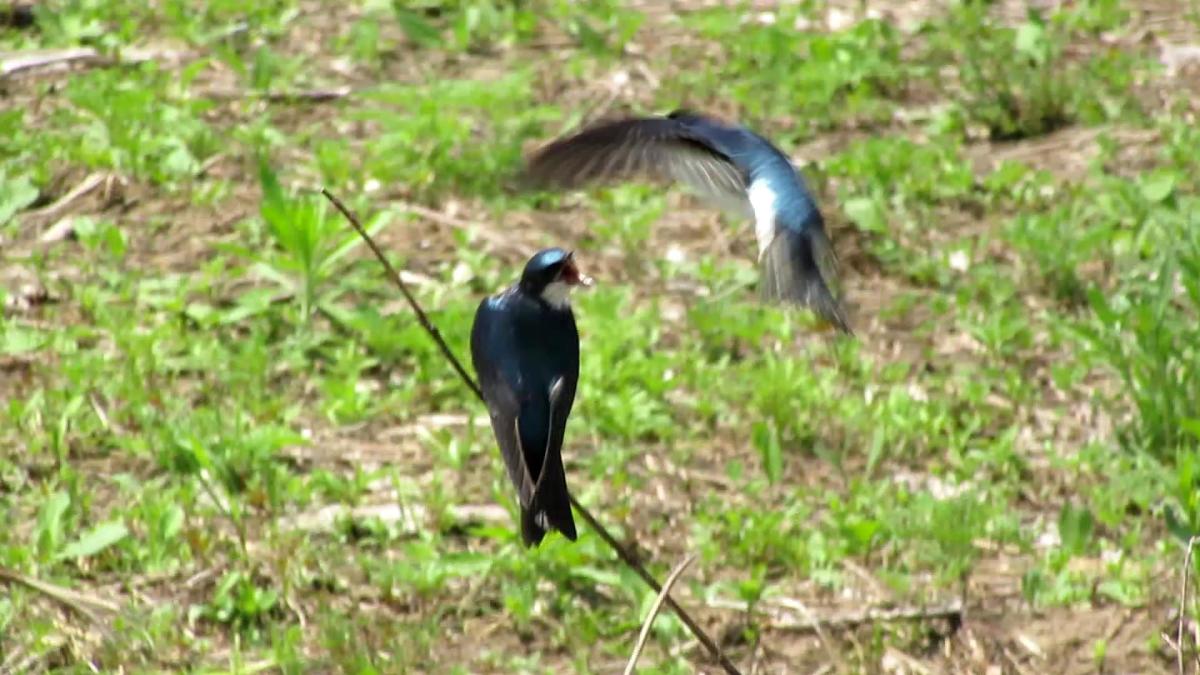
The nest boxes for the tree swallows are up. Already, vacancies are few. Their iridescent feathers are dazzling.
The music in the first part of the video is a piece called “There Are Chirping Birdies In My Soul” by Reed Mathis.
In the second part of the video, we let the birds themselves make the music. The birds don’t just show off; they sound off. All the birds are singing—except for the one killdeer for some reason. I managed to save a few clips of them singing their songs. They are in the last minute or so of the YouTube video. The first is the tree swallow. The next is the red-wing blackbird. Last is the song sparrow.
You’ll need to crank the volume to hear them. The tree swallows have a subtle trilling chirp. The male red-winged blackbirds have a distinctive call that probably sounds very familiar to most of us. We also saw and heard a song sparrow, a first for us.
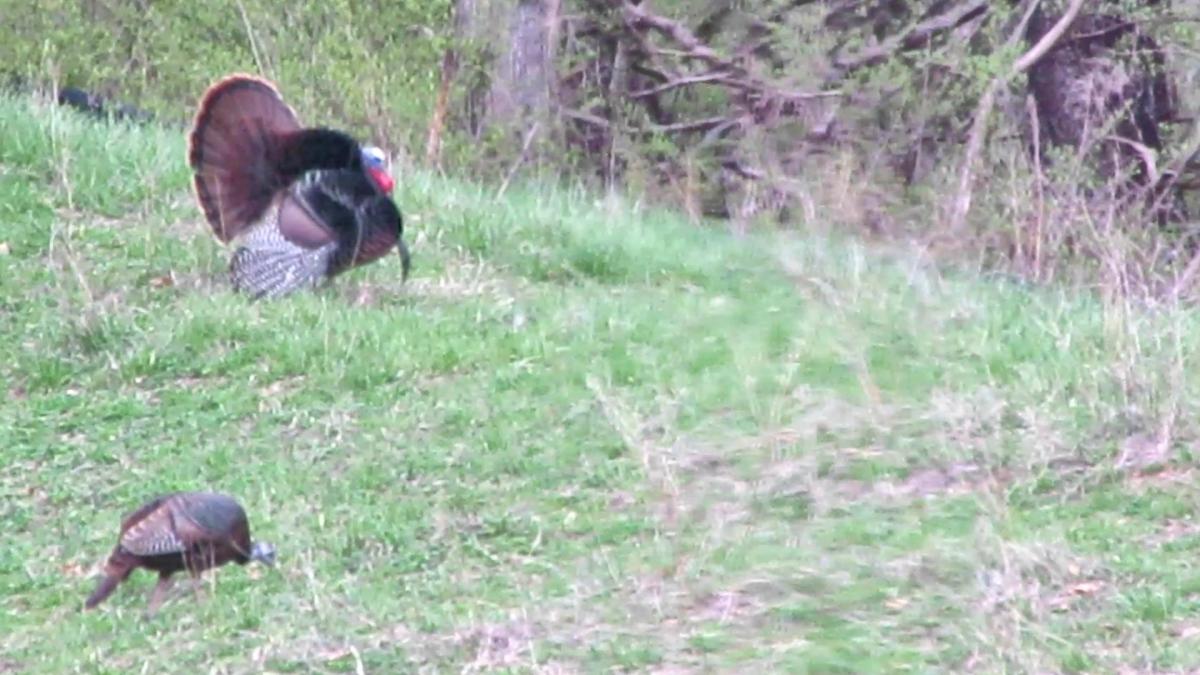
Yesterday morning we saw a big wild tom turkey decked out in all his feathered glory strut his stuff in front of a likely hen. He was regal. He was graceful. He was proud.
He was rejected.
I read a little bit on the web about what happens when the tom scores. The tom and the hen sort of dance around each other in a circle. That would have been dandy.
Once in a while when I’m filming wildlife, I get an odd feeling that the animal somehow knows it’s being watched. It looks up and seemingly right at the camera.
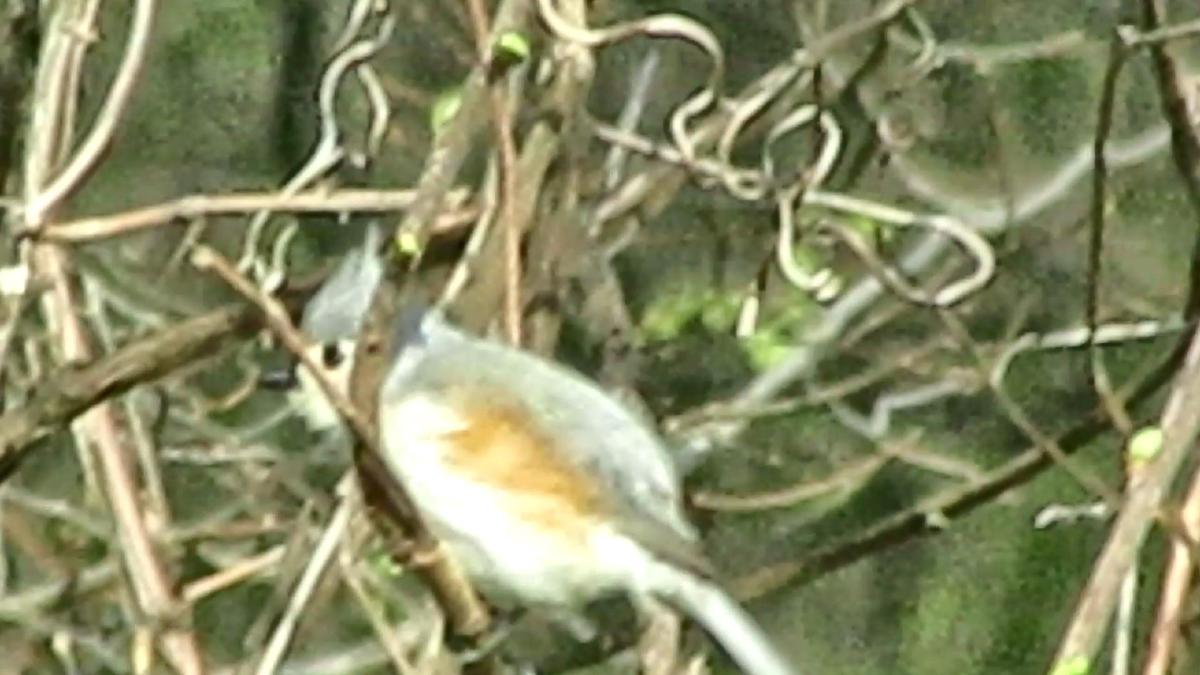
I got that feeling while making a short video of a Tufted Titmouse the other day. It seemed to stare at me while I filmed it through the window. A tree branch was in front of it and it was really tough to get a clear shot of its face. It looked like it was playing a peekaboo.
Some people say the bird has a friendly face. It also appears to be coy. The name titmouse just means “a small bird.” They’ll pull hairs from sleeping dogs, cats, and squirrels to line their nests.
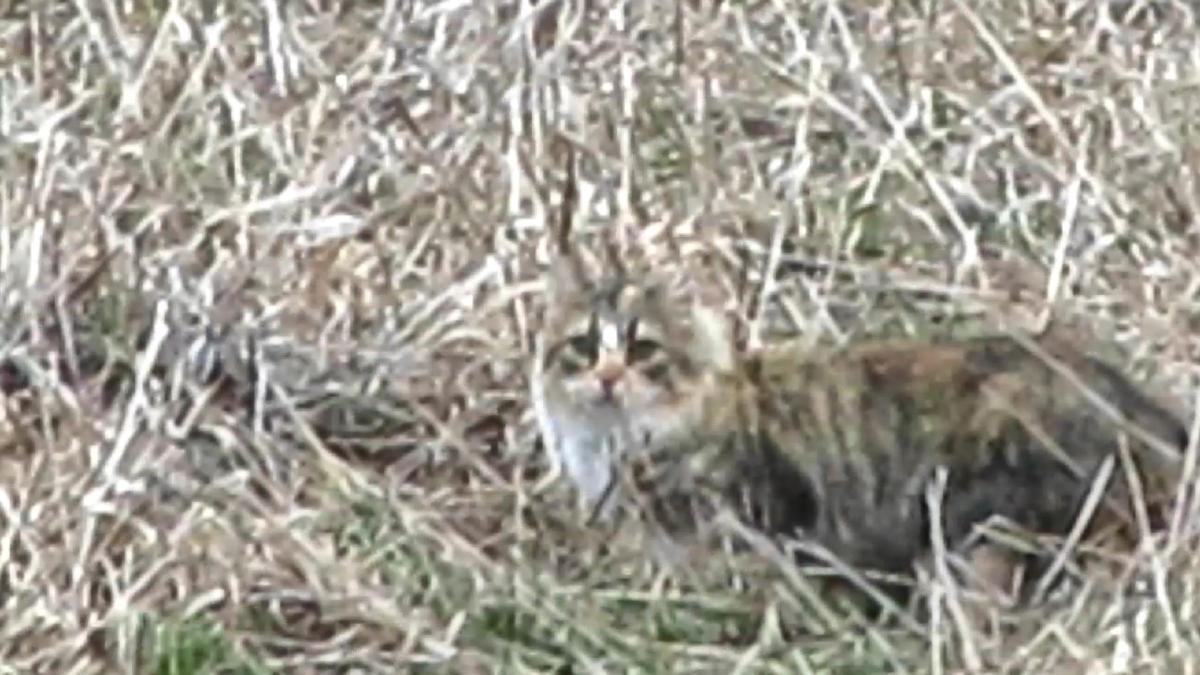
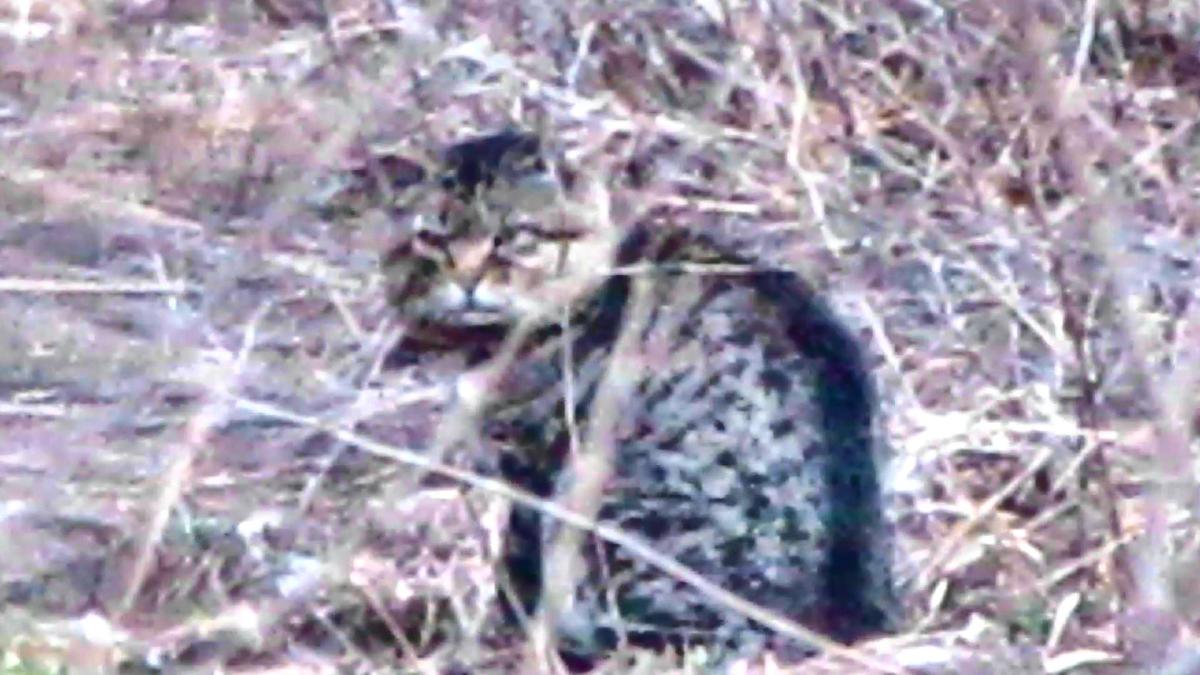
Yesterday, we saw a gray cat with black stripes (one broad black stripe down its back) in the outlet in back of our house. It was about the size of a large housecat. It definitely was not big enough to be one of the large cats which can be seen in Iowa. It wasn’t a lynx, bobcat, or mountain lion. I think it was hunting for rodents.
And today, believe it or not Sena alerted me to another cat in the same location, only it was brown and white. It looked identical otherwise.
I was stumped until I thought of tabby cats. I’m not a cat person so the only way I would know this is because I’ve heard the term before. I found out the tabby cat has a marking on its forehead that looks like the letter “M.” The markings are often striped or swirled. The term “tabby’ doesn’t refer to any particular breed of cat; it just refers to the markings. I think both cats have an “M” marking on their foreheads.
I think Sena saw a cat like this not that far from our back yard last year. It was surrounded by kittens.
I wonder if they’re feral. That led me to the internet. According to one web site, both stray and feral cats are called “community cats.” Strays usually are accustomed to being around humans and can be lost or abandoned. Feral cats are not used to being around humans and live wild.
So, I think these cats are feral tabbies and maybe they’re litter mates. Some say that a large percentage of feral cats are tabbies. I don’t know if they’re male or female—and you can’t pay me enough to check. I gather it’s tough to tell a cat’s gender just by looking at it. Males tend to have wider jowls, and tend to be bigger.
If you think I’m mistaken about what kind of cats these are based on the video, please let me know.
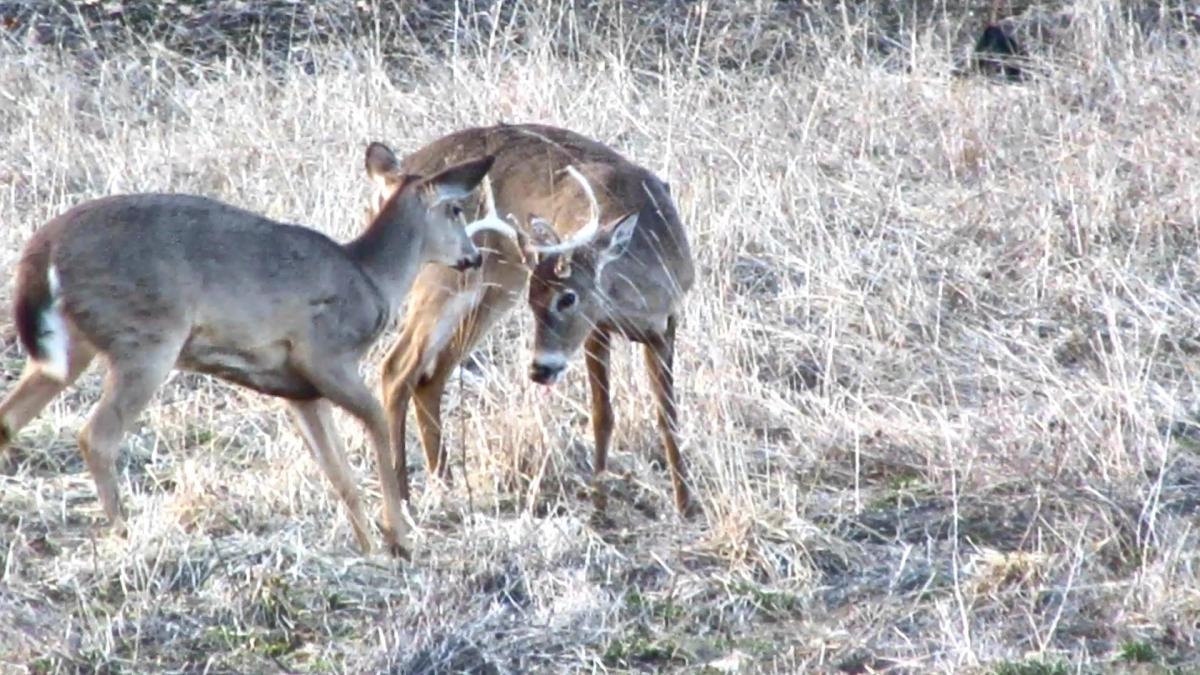
The other interesting thing about the gray feral tabby sighting was how whitetail deer reacted to the cat’s presence. We watched as a deer seemed to approach it warily, staring at it while stamping its hooves. We got the impression that the deer did not want the cat in what looks like its territory, judging from how often deer graze there—which is daily.
I found information on the internet suggesting that deer don’t get along with feral and stray cats. One YouTube video showed deer being aggressive to a stray cat. It makes sense that deer would hate cats. Deer are prey for large cats like mountain lions.
In general, all cats including feral cats can transmit a parasite, Toxoplasma gondii (T. gondii), to both deer and humans. Infection with T. gondii is usually asymptomatic. You get it from eating undercooked meat or contact with cat feces. There are a few studies suggesting that there is a relationship between toxoplasmosis and schizophrenia, although it’s not clear what that connection is yet (Osman E, Mohammad Zahariluddin AS, Sharip S, Md Idris Z, Tan JK. Metabolomic Profiling Reveals Common Metabolic Alterations in Plasma of Patients with Toxoplasma Infection and Schizophrenia. Genes (Basel). 2022 Aug 19;13(8):1482. doi: 10.3390/genes13081482. PMID: 36011393; PMCID: PMC9408728.)
The gray cat left the area, although I’m not sure it was because it felt threatened by the deer or because it just wasn’t having any luck finding food.
Today, the sighting of the brown and white feral tabby was exciting because I caught video of it catching a mouse!
We have a small herd of whitetail deer who regularly visit our lawn because they think it’s a salad bar. They’re all over the neighborhood because the city apparently doesn’t have a consistent deer population management plan. I don’t know anything about the animals, other than what I care to look up on the internet.
We saw several bucks the yesterday. One of them was missing an antler. It might have been lost in a fight with another buck.
As far as we could tell, most of the deer seemed pretty healthy, although I guess you can’t really tell which ones might have chronic wasting disease just by looking at them.
One animal looked like it might have suffered an injury, possibly from a buck. The lesions looked like they might be healing.
I guess this time of year, they would be molting. That probably explains why some of them look scraggly.
Sena taps on the windows and orders them off the property. That doesn’t work. Sometimes they look up at you like they know you’re staring at them—but they usually ignore you and go back to munching on your lawn.
I wonder if I’d feel differently about culling the whitetail deer if I watched hunters actually cull them—or kill them. The word “culling” actually sounds like a nicer version of “killing.” The definition of culling is the reduction in the population of wild animals by “selective slaughtering.”
The origin of the word “cull” is interesting. It comes from the Latin verb colligere, meaning “to gather.” In general, it means to collect a group of animals into separate groups: one to keep and one to kill. Usually, it’s about killing the weak and sick ones.
On the other hand, the origin of the word “kill” seems to be obscure. Of course, it means to strike, hit, put to death. It might derive from an Old English word, “cwellan,” which means to murder, or execute.
Cwellan, cull, kill. I think it’s a coincidence they sound similar. None of them sound like “Bambi.” When me and my brother were little, we had a toy record player that played a simplified version of the Disney classic movie, Bambi. It had either a little storybook that came with it or a little slide show. It got a lot of use. One slide showed a shadowy image of a big stag. Eventually the record got stuck on a place that cried over and over, “Man!”
Maybe that’s why the city doesn’t have a whitetail deer culling plan.
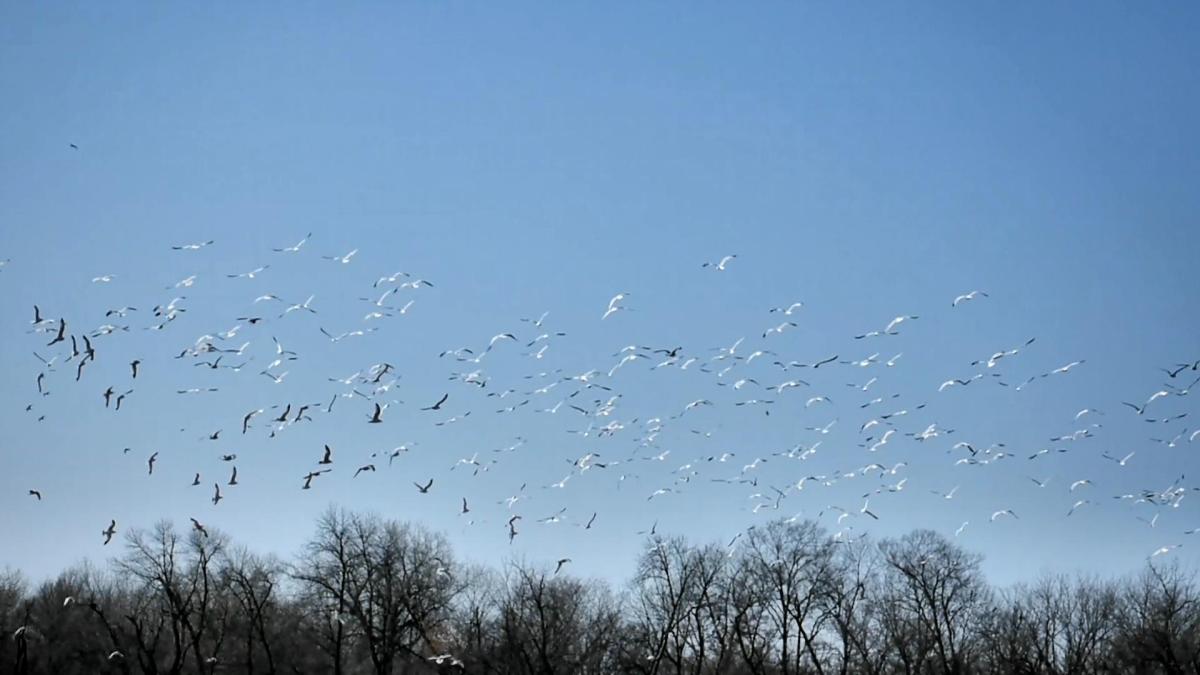
Yesterday was the one of those days where everything seemed to happen for a reason. If we had arrived at Terry Trueblood Recreation Area a few minutes too early or too late, we would not have seen the mesmerizing rise and fall of the shore birds on Sand Lake.
I thought of the word “murmuration,” which refers to starlings flying in tight, swirling patterns. I checked the dictionary and discovered that the word “murmuration” refers to the murmuring sound similar to low-pitched noises starlings make as they fly in flocks, swirling this way and that, presumably to avoid predatory birds.
This led to my wondering if starlings were the only birds that form a murmuration.
I wonder of shore birds also do it because we saw them flying in a sort of swirling pattern when there were no visible predators.
We might have missed the light shining just right on a majestic American Sycamore in all its glory, festooned like a Christmas tree with its seed balls hanging from almost every limb. In fact, some people do make Christmas tree ornaments out of them.
We might also have missed the squirrel munching on his lunch in a tree. It was not eating American Sycamore seed balls, probably only because it was not sitting in an American Sycamore tree.
We have walked the Terry Trueblood trail often, in every season, including autumn. We’ve never seen the seed balls before.
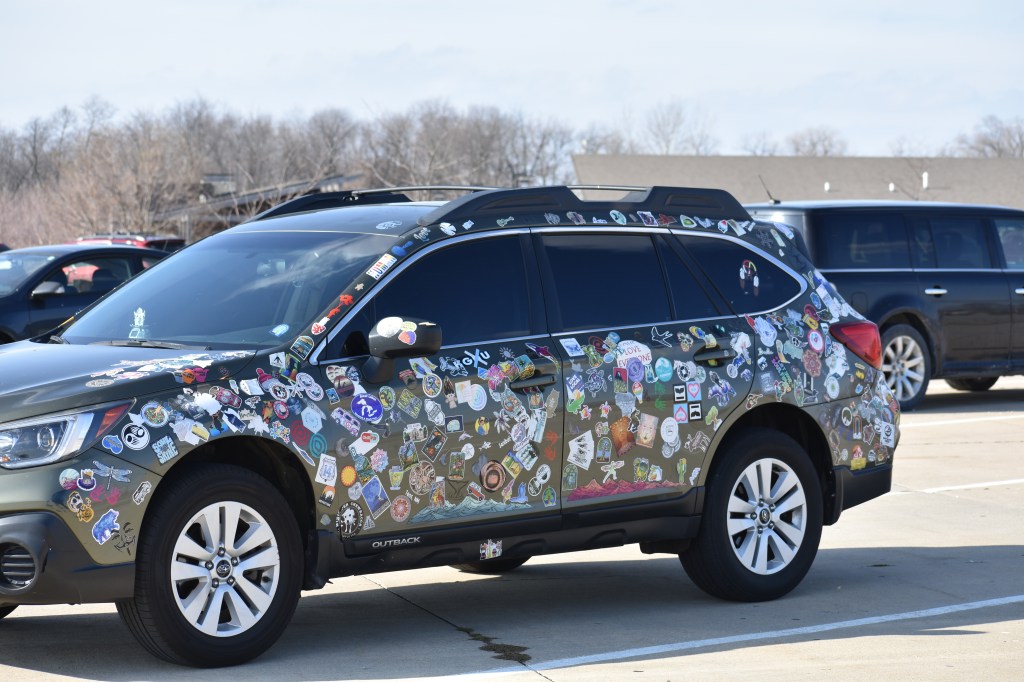
And we might have also missed the Subaru Outback with Wisconsin license plates in the parking lot. It was covered with decals. And later I discovered that the word “decal” is short for “decalcomania,” which is exactly how I would describe how the car came to be so heavily decorated—from an episode of decal-co-mania.
A lot happened yesterday which seemed somehow just right. Some people see so-called “glitches in the matrix,” which are events that seem out of place and ill-timed, leading to the idea we’re living in a poorly run computer simulation.
What about the times we see and feel everything occurring so smoothly that we’re surprised by the flow? Maybe we don’t call attention to it so as to avoid interrupting the miracle.



 Go Retire Psychiatrist