We heard the Big Mo Blues Show last night and heard a couple of tunes that were fun. One of them was mentioned on the Big Mo Pod Show today, “Feelin’ Alright” by Stuff. The other was a riot but was not on the podcast, and it was “I Feel So Good (I Wanna Boogie” by Magic Sam.
After a short break during the Thanksgiving holiday your hosts are back at it again with another episode! This week features the usual mix of blues eras you’ve come to expect along with a few Californian artists, tune in to see which ones! Songs featured in the episode: Solomon Hicks – “Further On Up The … Continue reading
The one that brought back memories was “Feelin’ Alright” by Stuff. It sounded so familiar and we finally figured out it was a cover of song of the same title and sung by Joe Cocker (the one I remember). However, I guess it was originally written by Dave Mason of the group Traffic in 1968. And there’s even an album “Joe Cocker With Stuff Feelin’ Alright.”
The one Big Mo played last night was from the album Stuff Live at Montreux 1976. It was instrumental and hard to recognize at first. The lyrics are sad, though and it’s about unrequited love, I guess. I associated it years ago with drug and alcohol addiction after seeing the 2012 movie “Flight” on TV. Every scene in which the main character Whip Whitaker (played by Denzel Washington) got high, that song was a part of the scene.
Anyway, moving right along, the song that was not on the podcast and which was a whole lot of fun to listen to was “I Feel So Good (I Wanna Boogie) by Magic Sam. We’ve never heard of him but the way he sang the number made us laugh out loud.
The title of the podcast was right on target: “Variety is the Spice of Life.”
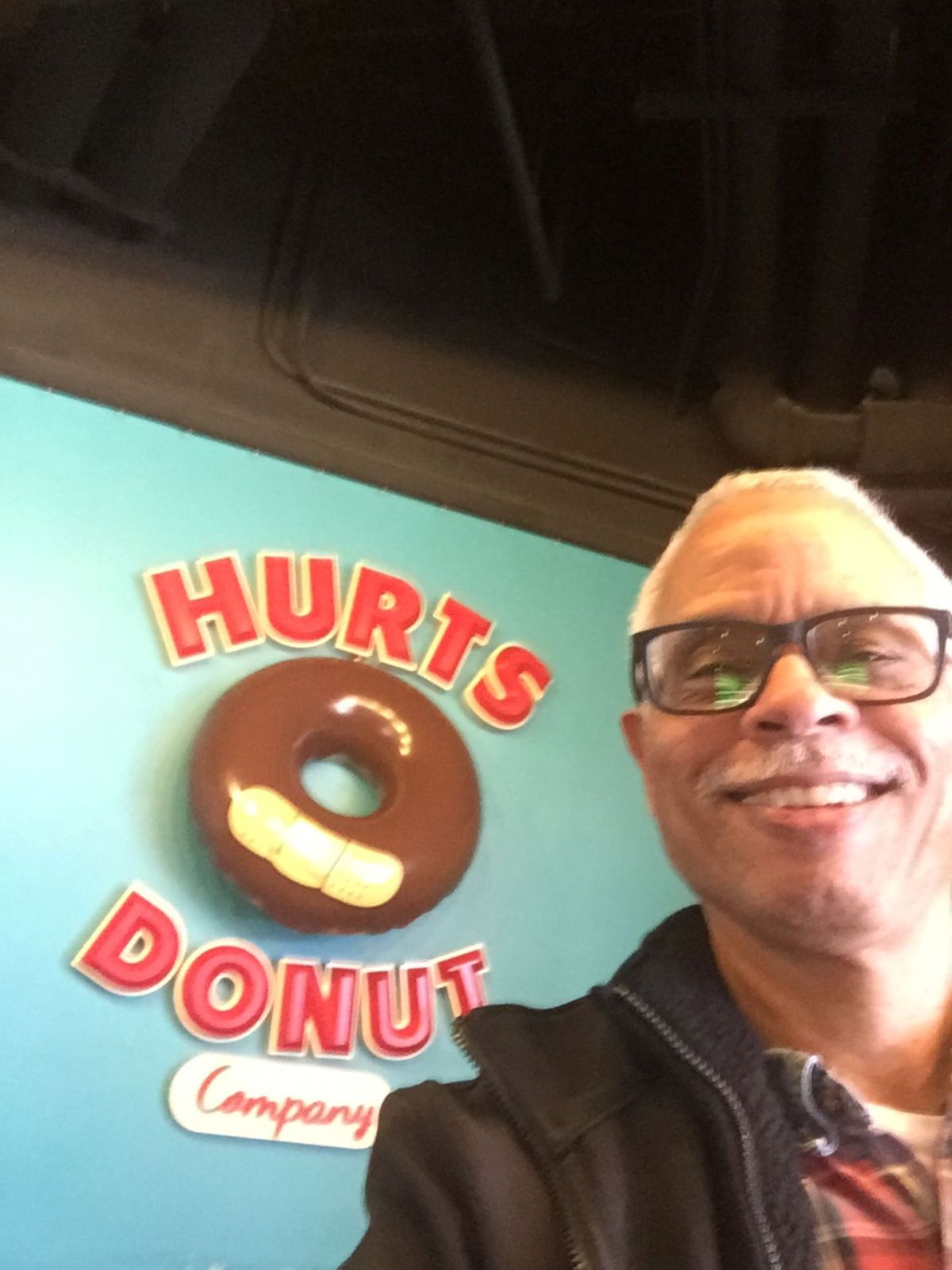
I got an urge for a Hurts Donut so I walked on the Clear Creek Trail to Coralville get to the little hole in the wall shop. You can easily walk to several places in Coralville on the trail. Actually, I wanted to also check out the Coralville Public Library and see S.T. Morrison Park. I’ve never been to that park so it was a novelty all by itself.
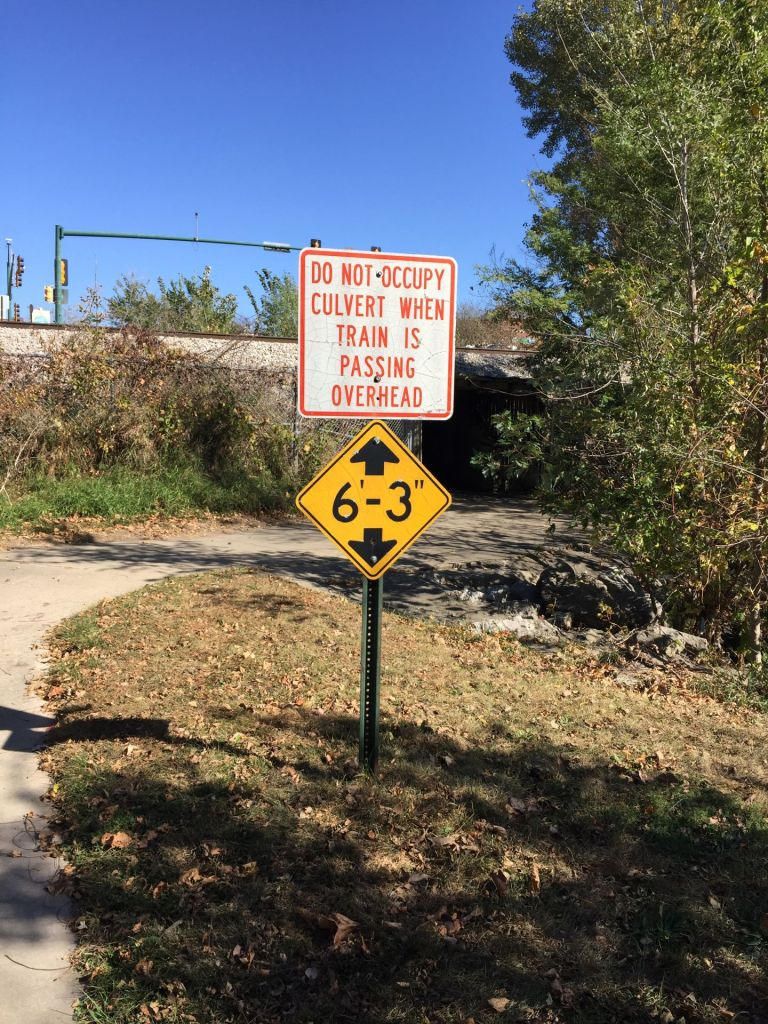
It took about 45 minutes to walk to that part of town. It’s great exercise and beats the traffic. You have to walk under some railroad tracks and there’s a sign warning you not to stand in the culvert below while the train is passing over the top. I can see why.
There are funny signs in the rustic Hurts Donut shop. You can see the corny “Wanna hurts donut?” jokes on the walls. There’s another sign saying “School is important but donuts are importanter,” which reminds me of my coffee mug which says sort of the same thing about cribbage: “Education is important but cribbage is importanter.”
The Old-Fashioned donuts there are so good, but so bad for you. I had two.
The Coralville Public Library has a beautiful skylight. I haven’t been in a public library for ages and so it was fascinating to see that libraries haven’t changed much.
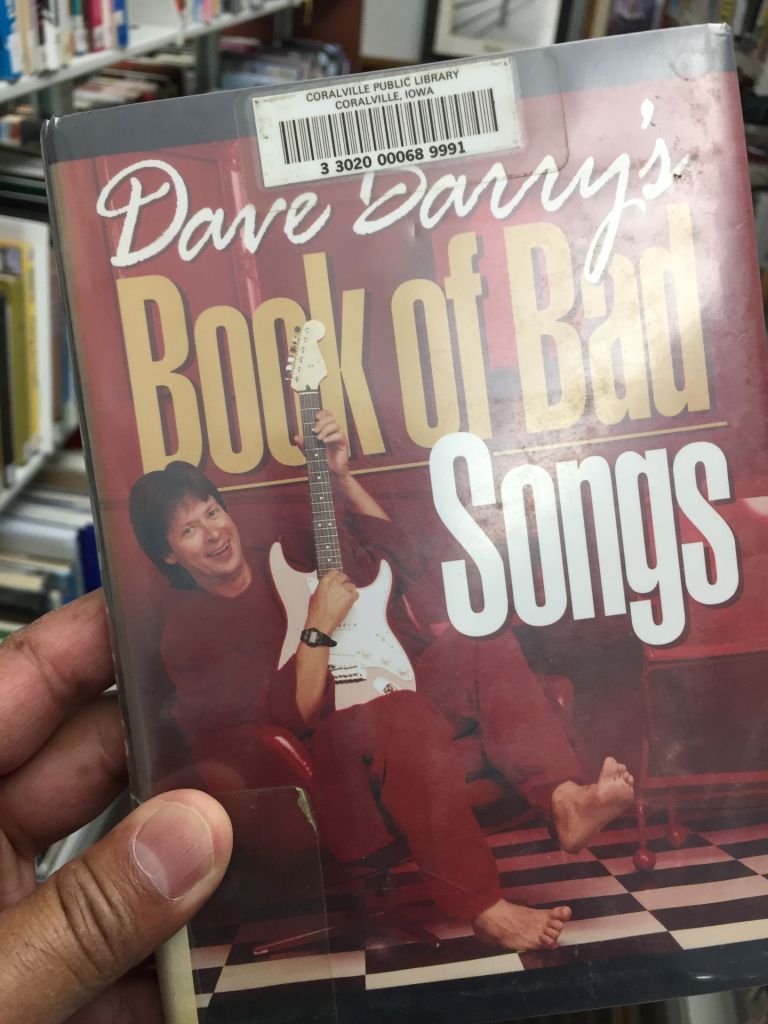
In fact, after I found one of Dave Barry’s books, “Dave Barry Book of Bad Songs,” (published in 1997; I had a copy but it got lost in a move) I asked one of the librarians about the old rule I learned as a kid. You might remember it too if you’re old enough. When you pick a book off the shelf and go to a reading room to look it over—can you just put it back on the shelf where you found it or do you have to give it the librarian who will reshelve it?
If you guessed that you have to give it to a librarian, you’re right and you’ve probably dated yourself. The librarian joked that some things never change. Sometimes that’s a good thing.
Among the things that never change are the difficult to understand lyrics in some songs. Dave Barry wrote a whole chapter about it in the Book of Bad Songs, “Songs People Get Wrong.” He mentions one of them, which I always got wrong but never told anyone about it because it was embarrassing. It’s a lyric in the song “Blinded by the Light” that Barry said was done by Bruce Springsteen, but which I didn’t hear until Manfred Mann’s Earth Band covered it.
So, here’s my deal with that lyric. I always heard “wrapped up like a douche” instead of “revved up like a deuce.” Barry notes that many people made the same mistake. Funny thing, Barry never mentions what that common mistake is called and it’s a mondegreen (a misunderstood or misinterpreted word or phrase resulting from mishearing the lyrics of a song). Music is important but mondegreens are importanter.
I finally saw Morrison Park and it’s a very restful place. You can contemplate the sculpture which is placed in the center of a pond. Ducks paddle around it. It’s called “Silver Lilly” and it was made by Professor Hu Hung-shu. Art is important.
I didn’t get to listen to the Friday blues with Big Mo last Friday because my little Sony Dream Machine radio audio kept cutting out.
But on the Friday blues of August 9, 2024, I heard a tune I liked. It was “Hit ‘Em Back” by Kenny Wayne Shepherd and Shemekia Copeland.
Some blues songs can be gritty and dark, but the title “Hit ‘Em Back” isn’t what it makes you think. The song is really about turning the other cheek, emphasizing the growing importance of getting along with each other.
Getting along with each other is hard to do. I know to most old people (including me) that used to be a lot easier. Old people say that, like saying “What happened to the good old days?”
Well, when I reflect on the past just from my perspective, I have trouble remembering the so-called good old days. In general, we all struggle to get along with each other.
I think the song “Hit ‘Em Back” is a novel way of expressing how relationships between people and nations usually go, but also suggest we “hit” them with love. We mostly hit each other back-in a bad way. The lyrics send an apparently paradoxical message which gets your attention.
And then you get it. Let’s not hit each other. Let’s listen to each other instead.
I’m out of sync with the Big Mo Blues Show and his podcast, mostly because we’re in the middle of this big move and we’re staying in a hotel waiting for this house to be built. I missed his most recent show, but caught the one before that.
The podcast title was “Goodness is a Practice.” Big Mo mentioned that moving (among a lot of other sorrows and hardships) could cause the blues-and he’s right.
But some perspective on it shows that a lot of other troubles take priority over moving (even though boxes are bad, admit it). Troubles that call for a little human decency are just one variety. Practicing goodness would come in handy right about now, in a lot of places.
I got an update to the Big Mo Pod Show on Iowa’s only jazz and blues radio station KCCK 88.3 in Cedar Rapids (translator 106.9 in Iowa City). Last Friday on the Big Mo Blues Show, host John Heim (aka Big Mo) played a lot of tunes, which he gets quizzed about a day or so later on the Big Mo Pod Show.
He gets quizzed about the name of that tune, the artist, and why he picked that tune for the show. He got them all except for one; he said “East Coast Blues” instead of “West Coast Blues” as the song by Blind Blake. He was almost perfect.
I was listening that night, but the Seasick Steve number I missed. It’s misspelled on the KCCK website on May 5, 2024 as “Internet Coyboys,” but it’s “Internet Cowboys.” Maybe by the time you read this, it’ll be corrected. It’s all about spending too much time on the internet. We need to disconnect. I’m sort of a fan of Seasick Steve, ever since I heard him do “You Can’t Teach an Old Dog New Tricks.” It means something special to old dogs like me.
I was thinking about my time as a student at Huston-Tillotson University in the 1970s (then Huston-Tillotson College) and remembered somebody who was a student there. His name is James Spaights. In honor of his stature in music as it connects to the Black History Month theme of African Americans and the Arts, I just want to make special mention that Mr. Spaights is a concert pianist. I have not found his obituary (you know already about my habit of checking the obituaries) so I’m not going to talk about him in the past tense.
When I met him, Mr. Spaights was straightforward about his life goal, which was to be a concert pianist. Little did I know that he had already achieved that by the time I met him at H-TU.
He gave a fantastic performance for the faculty and students. I’m pretty sure we gave him a standing ovation.
I found some news clippings and other items about his career (unfortunately I couldn’t find recordings of his performances), which deserves to be better known. He was a member of the Alpha Phi Alpha Fraternity and a fraternity news letter shows his photo and bio in the 1977 issue of the SPHINX:
“Brother James Spaights, pianist, whom New York critics acclaimed “a virtuoso pianist and technician of the first rank” after his New York debut at Town Hall in 1965, was presented in concert on March 20, 1977 in Carnegie Hall, New York City, by the Behre Piano Associates of New York. Spaights is a former student of Madam Edwine Behre in New York City, also Freda Rosenblatt, Bronx, N.Y. and Emma Slutsky, Brooklyn, N.Y.
For three years Spaights served as Ambassador of Goodwill for the United States’ State Department as a concert pianist touring throughout Europe, parts of Canada, and the United States.
On his most recent United States tour, Spaights was presented by the Music Department at Morgan State College in Baltimore, Maryland, and Goddard College in Montpellian, Vermont.
Spaights holds his B.A. Degree in Music from Howard University and a Master of Arts Degree in Music from Columbia University. He is a member of the Lechetisky Association of America, The Behre Piano Association of New York, and a member of Gamma Eta Lambda Chapter of Alpha Phi Alpha Fraternity in Austin, Texas.
He is presently serving a post in the Music Department of Huston-Tillotson College of Austin, Texas.” (The SPHINX, Fall 1977, Volume 63, Number 3 197706303).
I guess I misunderstood what Mr. Spaights was doing at H-TU when I was an undergraduate there. I thought he was a student! He never mentioned his career or accomplishments (at least to me) and he had a great sense of humor. I was in the presence of a music luminary and never knew it.
Ref: The SPHINX Volume 63, Number 3, October 1977.
We have noticed that the AARP is sponsoring the Rolling Stones Hackney Diamonds Tour 2024. I don’t think it’s necessary to point out that, with all due respect, the Rolling Stones have long ago passed fossil status.
I guess that means it’s fitting that the AARP sponsor a rock music group the members of which are eligible to join the organization formerly known as Prince. Sorry, I meant to say formerly known as the American Association of Retired Persons.
Obviously, the Rolling Stones are not thinking about retirement. But unless they can come up with a plausible explanation for the name of the tour, Hackney Diamonds, they should probably not be eligible for the free tote bag the AARP offers to those who become members.
A hackney is a horse drawn carriage. A diamond is a precious stone. The Rolling Stones have thankfully clarified that, obviously, the Hackney Diamonds tour name comes from the well-known legend of the hackney cab driver who drove through the streets of a town called Hackney in London in the 17th century, tossing out diamonds to passersby if they could guess how many angels could dance on the head of a pin during a snowstorm in the Sahara Desert.
That’s about as clear as the explanation given by Keth Richards and Mick Jagger in an interview with Jimmy Fallon as reported in an article written by Tom Skinner in NME on September 7, 2023.
Anyway, the Rolling Stones have been a big deal for decades, of course and they get mentioned in a lot of different ways. For example, in the movie Men in Black 3, there’s a conversation between Agent J and young Agent K in a café which is prompted by the need to eat pie in order to clear their minds of the case they’re working on which is trying to stop the murderous bad guy, Boris the animal, from destroying Earth. Young Agent K stipulates the rule is to talk about anything about the case and to let the pie do its magic. You’ll never guess what they talk about but it goes like this:
“Young Agent K: You said we don’t talk, right? Go ahead, ask me any question. Anything you want, just as long as it doesn’t have to do with the case… just let her rip.
Agent J: What’s up with you and O?
Young Agent K: Me and O?
Agent J: Yeah, you and O.
Young Agent K: All right, all right… all right, this is it. A while back, I was assigned to keep tabs on a musician, Mick Jagger. He was in this British group, Rolling Stones…
Agent J: Rings a bell.
Young Agent K: We believed he’s on the planet to breed with Earth women, so I was in London and that’s when I met O. She’s smart, funny… great smile and we find ourselves in this pub, Whistler’s Bar, warm beer and the worst food you ever ate. We just played darts till the sun came up, neither of us wanted to leave…”
And I can remember that Microsoft used the Rolling Stones 1981 song, “Start Me Up” in their promotion of Windows 95 computer operating system. You remember that; it was a total loser which led to the evolutionary creation of a dozen operating systems, all of them laughably dysfunctional. I should know—I bought all of them.
So, the Rolling Stones turn up a lot in pop culture. Everybody knows that. That’s in part because of their stamina—and maybe doggedly persistent denial of aging leading to a refusal to ever retire, just drop on stage because their bones finally disintegrate.
So, returning to the question of why AARP (pronounced arf only with a p on the end) is sponsoring the Rolling Stones tour. I have no clear idea except that I think the organization wants to broaden appeal for the organization so that more dues paying young people join, adding money to help support those over 50 to maintain financial stability and security.
What I don’t understand is that, in part, this implies trying to work as advocates (read “lobby”) in Congress. All those old farts in Congress can do is argue and a some of them should seriously think about retiring. If they can’t command respect, they could at least get a free tote bag by joining AARP.
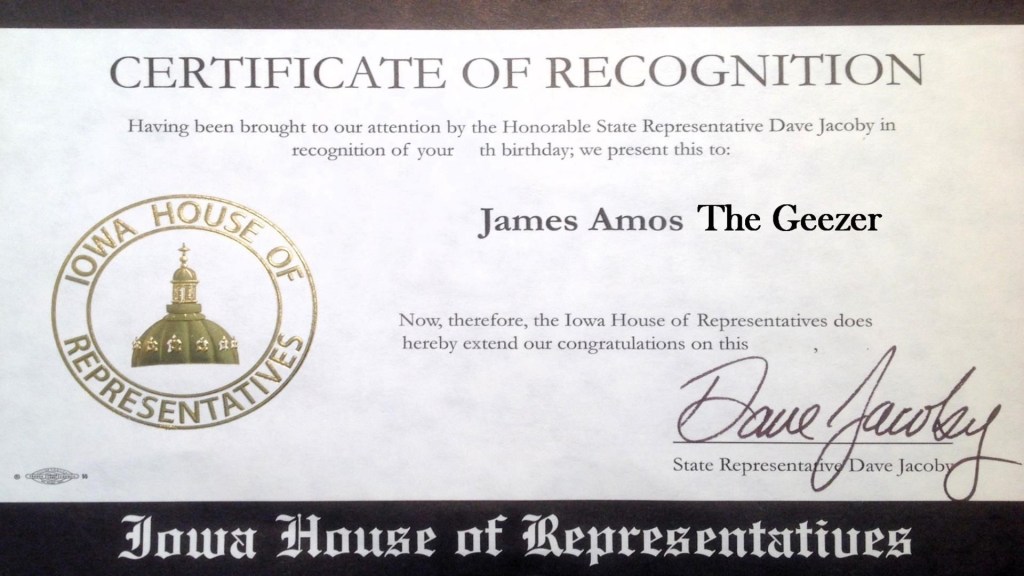
But the Rolling Stones don’t need free tote bags. They’ve earned their fossil status many times over. On the other hand, I have earned my certificate from the state legislature.
The other night I heard something pretty interesting on the Music Choice channel. I was listening to the Light Classical stuff because, let’s face it, I’m a real lightweight when it comes to knowing anything about music, much less the classical genre.
It reminded me of a time long ago when my mother tried to teach me how to play our old upright piano. She always complained that it was out of tune, always promised that she would get it tuned and never did. It didn’t matter. I never learned a thing but the middle C note, which I poked with my right thumb.
And then I heard a selection that sounded like the composer was poking fun at classical music. The piece was titled “A Symphonic Nightmare: Desecration Rag No. 2.” Somebody said it was actually “An Operatic Nightmare: Desecration Rag No. 2.” I don’t know that it makes a difference what you call it. I thought it was comical and I had fun listening to it.
In order to confuse me further, I found listed on the Library of Congress a recording entitled, “An operatic nightmare.” And, I found a piece called Desecration (Rag-Humoreske). They all sound different, but all of the pieces are by a composer named Felix Arndt.
Further, Wikipedia says Arndt is best known for his composition “Nola,” which he wrote for his fiancée Nola Locke (later his wife.” It’s sometimes thought to be the first example of the novelty ragtime genre. Classical music does have a funny bone.
We listen to the Music Choice Channel almost every night on our TV. I know that must sound odd, listening to a music channel on television. What makes it more interesting are the biographical sketches. The Light Classical Channel bios occasionally have typos and word usage oddities as well as eyebrow raising facts:
Mozart’s full name was Johannes Chrysostomas Wolfgangus Theophilus “Bud” Mozart.
Frederic Chopin is not pronounced “Choppin” as in his well-known tune “I’m Choppin’ Onions in My Stew and Crying Over Losing You.”
Edvard Grieg was taught the violin by Ole Bull, which is a lot of bull since, at least in Iowa, bulls go “mooooo” and chase red bandanas.
Antonin Dvorak spent a summer in Spillville, Iowa in 1893 where he drank beer and toppled into the Turkey River.
Riveting stuff like that is usual for the Music Choice Light Classical Channel. On the other hand, some months ago, I heard a song called “The Penguin” by somebody named Raymond Scott. I looked him up today and he was a jazz composer and Music Choice must have misfiled him.
I can’t really make fun of his bio because it’s eccentric enough by itself. His music ended up in a lot of cartoons, but he didn’t do that on purpose. Scott sold the publishing rights to his work to Warner Bros. Music in 1943. The music director at that time was Carl Stalling, who used a lot of Scott’s compositions in cartoons, such as Looney Tunes and many others.
Raymond Scott wasn’t even his real name. He looked it up in a phone book and used it partly because it sounded cool. The other reason is more complicated. His real name was Harry Warnow and he was playing piano in a radio orchestra conducted by his brother, Mark in the 1930s. The band started playing Harry’s off-beat compositions and, in order to avoid the appearance of nepotism, Harry adopted the new name.
Scott also invented electronic musical instruments, and after a while, he spent most of his time doing that, working with engineers on many inventions.
I haven’t heard him on the Light Classical Channel for a long while now. Maybe Music Choice finally got him filed to the Jazz Channel.











 Go Retire Psychiatrist