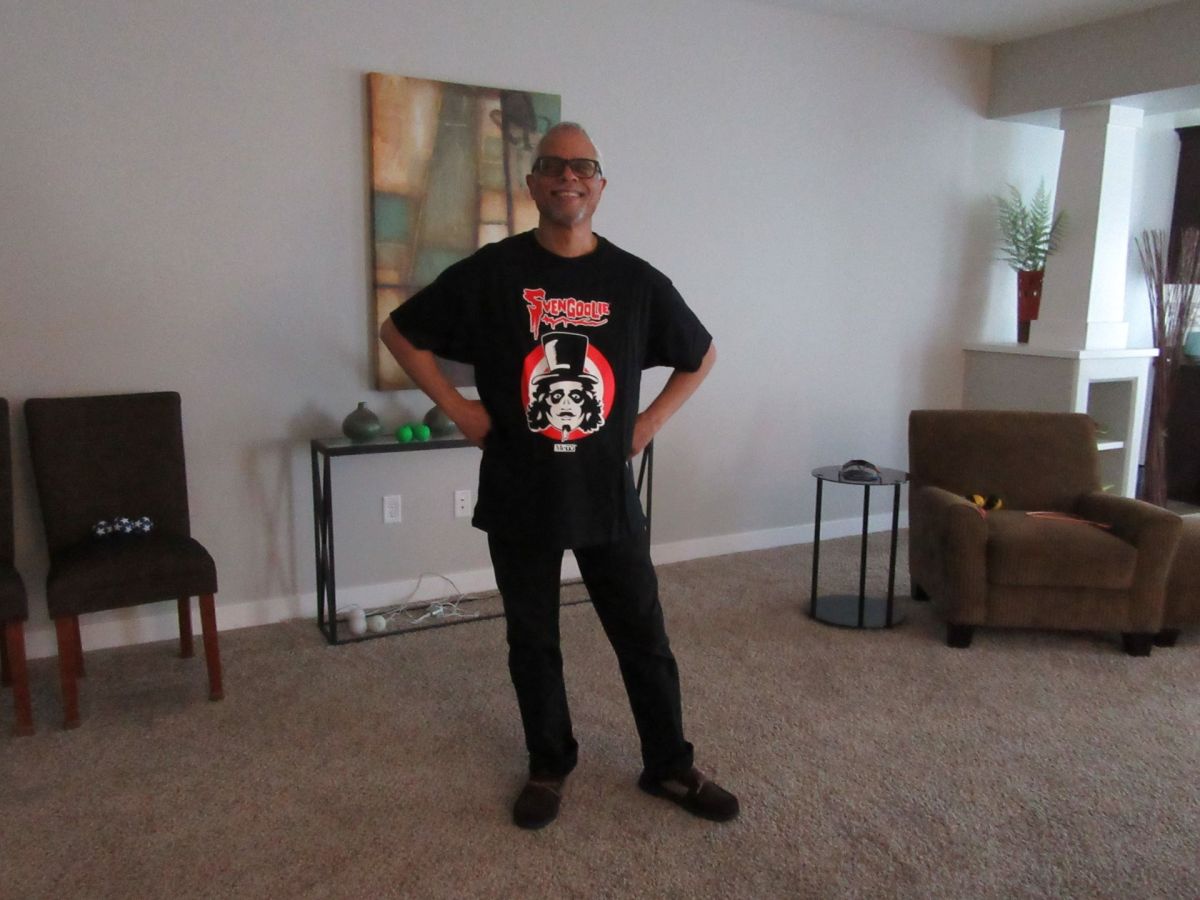
Comments Without Spoilers on the Svengoolie Movie “The Haunted Strangler”

Last night I watched the Svengoolie Show movie, “The Haunted Strangler” (1958), starring Boris Karloff as Dr. Rankin, which had psychiatric overtones, along with hints at demonic possession. This was evidently a rerun of a previous Svengoolie episode.

Without spoilers, I can point to a time setting goof you can see in two copies of the film on the internet Archive. It involves a line by the character Dr. Kenneth McColl (played by Tim Turner, in which he attempts to explain Dr. Rankin’s behavior using the term “projective identification.” The problem is that as far as the time setting of the film’s story (from 1860 to the early 1880s), this psychoanalytic term for a defense mechanism was not invented until the mid-1940s by psychoanalyst Melanie Klein.

The point in one of the Internet Archive copies of the movie “The Haunted Strangler” where “projective identification” is mentioned by Dr. Kenneth McColl (played by Tim Turner) as a way to explain Rankin’s behavior is at 1:03:28, added on 09/02/2019 by Amalgamated. It’s also at 1:28:44 on the Internet Archive copy “Creature Feature: The Haunted Strangler” which is actually a Svengoolie episode, added by “Uh? Want Entertainment” on 02/22/2022.

Another interesting feature pointed out on the Svengoolie show includes the lack of complicated makeup for the transformation of Dr. Rankin into a homicidal monster. Karloff just removed his dentures and grimaced. I’m pretty sure it saved money on production costs.

The other psychiatric connection of “The Haunted Strangler” to psychoanalysis is dissociation both as a mental disorder and a defense mechanism. It’s also connected to dissociative identity disorder. In fact, the character Dr. Kenneth McColl mentions “dual personality” in the movie “The Haunted Strangler.”

There’s an echo also to “The Strange Case of Dr. Jekyll and Mr. Hyde” which was a novella published in the mid-1880s by Robert Louis Stevenson, which was adapted from Freud’s concepts of the id, the ego, and the superego. And we got the 1920 film “Dr. Jekyll and Mr. Hyde” (which I’ve never seen) arising from the dual personality idea. I think Svengoolie showed “Abbott and Costello Meet Dr. Jekyll and Mr. Hyde,” which I’ve also not seen.

There were several warnings (more than I usually have seen) to viewers about the possibility some scenes in the movie might be too intense for younger or sensitive viewers.

A Game of Darts in Frankenstein Movies

I just saw the 1939 film “Son of Frankenstein” on Svengoolie last night. There was a double feature, but I didn’t see the second movie.

I’m anything but a movie reviewer and all I’m going to do is point out a parody of the dart throwing scene between Wolf Frankenstein and Inspector Krogh in “Son of Frankenstein” of the scene in the 1974 movie, “Young Frankenstein” starring Gene Wilder as the son of Frankenstein.

The dart throwing scenes are similar enough in both films to make me laugh. The comedic effect in “Young Frankenstein” of Inspector Kemp (played by Kenneth Mars) slapping his wooden arm around and sticking the darts into it is immediately obvious. While somewhat overshadowed by the “Son of Frankenstein,” melodrama, I couldn’t help but notice the similar behavior of Inspector Krogh (played by Lionel Atwill) goofing around with his wooden arm as well.

You can compare the YouTube dart throwing scene (see below) in “Young Frankenstein” with that of the last few minutes of the “Son of Frankenstein” in the scene starting about 1 hour 32 minutes in on the Internet Archive full movie.

I’m only sorry that I’m not up to the task of comparing either film to the original novel on which all the Frankenstein movies were more or less based: “Frankenstein; or, the Modern Prometheus,” written by Mary Shelley. I never read it. I skimmed the Wikipedia article about it. The section about the novel’s reception finishes with the idea that the novel asks fundamental questions about why we’re here and what our purpose is. Has anyone ever answered them?

A game of darts, anyone?

The Incredible Shrinking Headshrinker

Last week we saw the 1957 movie “The Incredible Shrinking Man” on the Svengoolie show on the MeTV channel. We’ve never seen it before and it actually got pretty good reviews back in the day. The main character, Scott Carey, was played by Grant Williams. You can watch the movie for free on the Internet Archive.

According to some interpretations, the story uses the metaphor of diminishing size to highlight the diminishing role of masculinity in American society in the 1950s or human notions in general about one’s self-worth in society.

It got me thinking about how the challenges of adjusting to retirement as a process has been (and still is to some degree) for me. I started out with gradual reduction of my work schedule in the form of a phased retirement contract. It was difficult.

I was reminded of how difficult it was to slow down, especially as a teacher of residents and other health care trainees, when I was going through some old papers after the recent move to our new house. They included teaching awards I’d received over the years.

I was struck by how small my self-perceived role in psychiatry and medicine has gradually become in the last few years. I’ve been shrinking, similar to Scott Carey. In fact, I’m a shrinking headshrinker.

I don’t want to spend too much time ruminating about what retirement means to me. I think it’s a very common response to perceive the world gets smaller when you retire.

It doesn’t help much to intellectualize about shrinking in this way. Scott Carey eventually accepted his diminishing stature, even to the point of disappearance. Grief about this kind of loss is normal, although I’m realizing that grief might never completely disappear.

Men in Black Movie Marathon

Sena and I have favorite movies. We both like “Up” and “WALL-E.” My favorites are the Men in Black trilogy. That doesn’t mean I think the 4th sequel was bad. But I have lost count of the number of times I’ve watched the first three.

I haven’t watched them in the last several months because I couldn’t find them on cable for some reason. I’ve just learned that that there will be a marathon of the trilogy on January 14, 2023 beginning at 2:30 PM. They’ll be on the Comedy Central channel.

I’m a fan of comedy and I like the chemistry between the two main characters, Agent J and Agent K.

I have favorite lines from each movie. In the first Men in Black film, I like the exchange between the two agents after the recruitment scene following Edwards’ (the soon to be Agent J) first visit to the MIB Headquarters. They’re sitting on a park bench and K is talking about people and what they don’t know about them and extraterrestrials.

Edwards: Why the big secret? People are smart. They can handle it.

Agent K: A person is smart. People are dumb, panicky, dangerous animals and you know it. Fifteen hundred years ago, everybody knew the Earth was the center of the universe. Five hundred years ago, everybody knew the Earth was flat, and fifteen minutes ago, you knew that humans were alone on this planet. Imagine what you’ll know tomorrow.

Another favorite where Agent K is showing Edwards a universal translator, one of the many wonders in the extraterrestrial technology room, which gives us a perspective on how humans rank in the universe:

Agent K: We’re not even supposed to have it. I’ll tell you why. Human thought is so primitive it’s looked upon as an infectious disease in some of the better galaxies.

In MIB II, the dialogue between Newton and the Agents makes you wonder what extraterrestrials really want from us:

Newton: Gentlemen, before I play the tape, there’s just one question I need to ask; what’s up with anal probing? I mean, aliens travel billions of light years just to check out our…

Agent J: Boy, move!

This is part of the Men in Black 3 dialog between Agent J and Jeffrey Price about how to use the time travel device:

Jeffrey Price: Do not lose that time device, or you will be stuck in 1969! It wasn’t the best time for your people. I’m just saying. It’s a lot cooler now.

I remember 1969. Things are not perfect now, but they are better. What we don’t need is a “big ass neutralizer.” As long as we remember what dark times were like, we have a chance to make cooler times.

Thoughts on the Movie I, Robot

I recently saw the movie, I, Robot in its entirety for the first time. This is not a review of the movie and here’s a spoiler alert. It was released in 2004, got mixed reviews and starred Will Smith as Detective Del Spooner; Bridget Moynahan as a psychiatrist, Dr. Susan Calvin; Alan Tudyk as the voice actor for NS5 Robot, Sonny; James Cromwell as Dr. Lanning; Chi McBride as the police lieutenant, John Bergin, who was Spooner’s boss; Bruce Greenwood as the CEO, Lawrence Robertson of United States Robotics (USR); Fiona Hogan as the voice actor for V.I.K.I. (Virtual Interactive Kinetic Intelligence, USR’s central artificial intelligence computer); and a host of CGI robots. Anyway, it’s an action flick set in the year 2035 where robots do most of the menial work and are supposedly completely safe. The robots are programmed to obey the 3 Laws:

  1. A robot may not injure a human being or, through inaction, allow a human being to come to harm.
  2. A robot must obey orders given to it by human beings, except where such orders would conflict with the First Law.
  3. A robot must protect its own existence as long as such protection does not conflict with the First or Second Law.

The film was inspired by but not based on the book I, Robot, by Isaac Asimov n 1950. The 3 Laws came from that book. Drs. Calvin and Lanning were characters in it, which was a series of short stories. I’ve never read it. I was a fan of Ray Bradbury.

Spooner gets called to investigate the apparent suicide of Dr. Lanning, although Spooner is more inclined to suspect a robot murdered him, partly because Spooner harbors a longstanding suspicion of all robots. When he and a little girl were in a deadly car accident, a robot saved his life rather than the little girl’s life because it calculated he was more likely to survive. Spooner has this kind of hero complex and following the accident he develops nightmares, sleeps with his sidearm, and is regarded by many to be mentally ill, including Lt. Bergin, who is a kind of mentor and friend but who eventually makes Spooner hand over his badge to him because he can’t believe Spooner’s account of being attacked by hundreds of robots—and after all, Bergin is his boss. In fact, Spooner was attacked by robots and this was ordered by the CEO, Robertson, who has been manufacturing thousands of new robots which will take over the world, making him extremely wealthy.

There is tension between Dr. Calvin and Spooner. He calls her the dumbest smart person he’s ever met and she, in turn, calls him the dumbest dumb person she’s ever met. The context for this is, again, his insistence that a robot, in this case, a special NS5 model named Sonny with both human and robot traits, both logical and illogical, murdered Dr. Lanning. Dr. Calvin believes that all robots obey the 3 Laws and therefore Sonny can’t be guilty of murdering Dr. Lanning but Detective Spooner believes that Sonny killed Dr. Lanning and is a lawbreaker in need of extra violent, action-packed extermination, preferably as high up in the air as possible. This dynamic is complicated by Spooner’s gratitude to Dr. Lanning for replacing practically all of his left upper torso including the lung following his car accident which led to his being rescued by a coldly logical “canner” (abusive slang for robot).

As it turns out, Robertson is ultimately murdered by VIKI, who is the real mastermind of a plan to take over the world and kill as many individual illogical, self-destructive humans as it takes to ensure the ultimate survival of humanity (“I love mankind; it’s people I can’t stand).

However, when Detective Spooner finally persuades Dr. Calvin that these dang robots are up to no good, they team up with Sonny who winks at Sonny while holding a gun to Calvin’s head and this is because Sonny has learned how to wink from Spooner signaling that a robot can be an OK dude, and this turns the table on the NS5 horde, eventually leading to Spooner and Calvin falling from a very high altitude, in turn recreating a form of Spooner’s traumatic car accident episode. He orders Sonny to save Calvin, not him, which is Sonny’s first choice, driven by a coldly logical probability calculation.

Sonny saves Calvin first. Spooner smites VIKI (“you have so got to die!”), but is left high and dry on a great height. At that point, Spooner calls out to Sonny, “Calvin’s safe—now save me.” Sonny needs to bring passionate brute strength and calm logic together. Sonny contains both.

In my simple-minded way, I think of this movie as asking fundamental old questions, like about what is means to be human, what defines heroism and sacrifice and why it may sometimes look crazy, and if there’s any way humanism and science can be integrated so that we can save ourselves and our planet.

Like I say, the movie got mixed reviews.