Three Photos to Share for Mental Health Awareness Month

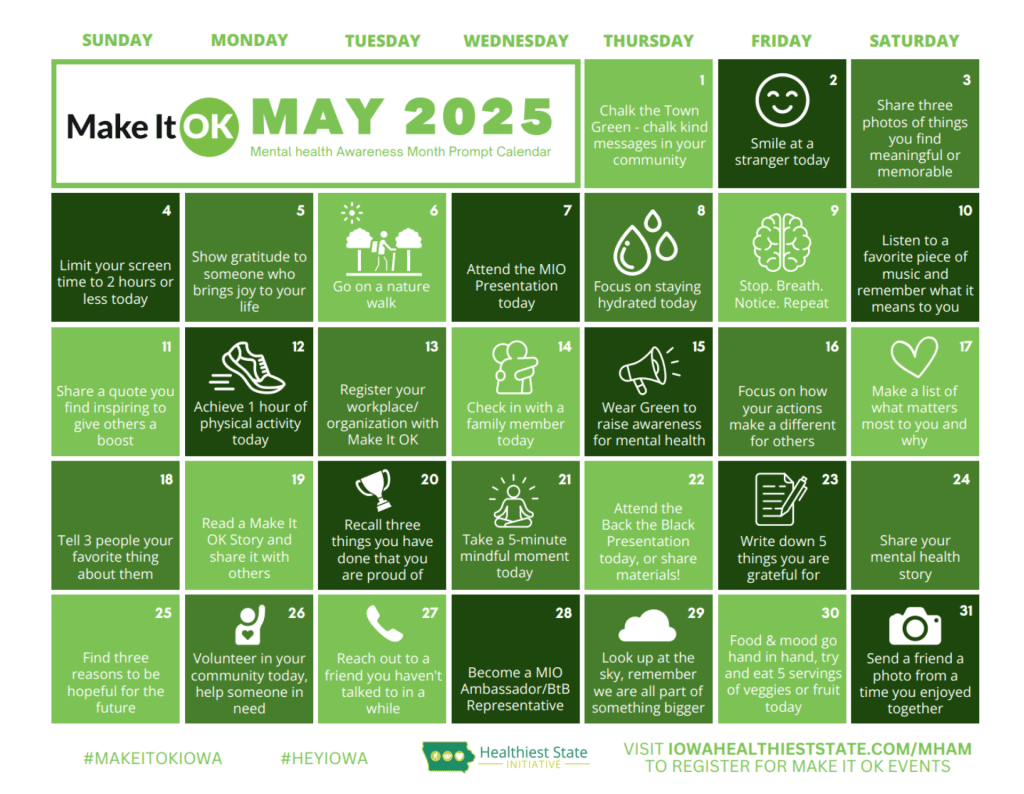
So, I have to hurry up and get these 3 photos posted for today because it’s getting pretty late. Recall the Iowa Healthiest State Initiative calendar along with my photos to share:

The images are important features of events in my life or my sense of humor.

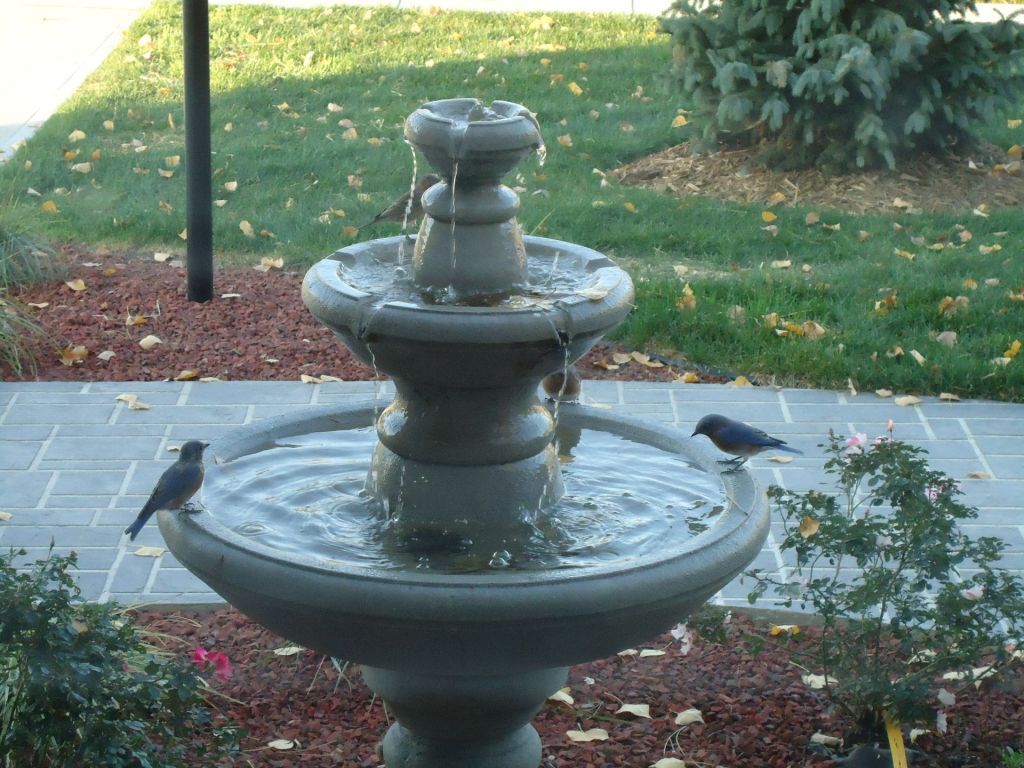
I’m a birdwatcher and many different species of birds visited the fountain. The fountain attracted bluebirds who splashed and even swam in it. That fountain was very heavy. We couldn’t leave it out all winter. In the fall I had to lift the bowls off and move them somewhere else. Moving them entailed lifting them onto bags of mulch so as to reduce the work of hefting them a small distance at a time. The birds were beautiful to watch.

The letter was a class assignment our Mindfulness Based Stress Reduction (MBSR) teacher had us write at the beginning of the class. After we graduated, she mailed us those letters shortly thereafter. We were to write something connected with what we thought we had gained or what we thought might happen after taking the MBSR class. The book might seem out of place, and while I can’t talk much about Gordon Strayer, I did meet him and read his book (which is now long gone; probably lost in a move). I admired him. I don’t think he feared death.

The Chrysler Building reminds me of the Men in Black (MIB) 3 movie, and I included it because my sense of humor is very important to me. In the movie, Agent J and Jeffrey Price have this funny conversation about time travel back to an era that was not the greatest for black people. I know because I lived through it. Agent J is about to use the time travel device which involves jumping off a tall building (it’s a “time jump!”). Agent J is preparing to travel back in time to M.I.B.’s early days in 1969 to stop an alien from assassinating his friend Agent K and changing history. They have this short conversation:

Jeffrey Price: Do not lose that time device or you will be stuck in 1969! It wasn’t the best time for your people. I’m just saying. It’s like a lot cooler now.

Agent J: How will I know if it works?

Jeffrey Price: You’ll either know…or you won’t.

Thoughts as Train Cars Visualization in Mindfulness Meditation

The Iowa Interstate Railroad train rumbles past our hotel a few times a day and it reminds me of the Mindfulness Based Stress Reduction (MBSR) course I took 10 years ago. One of the exercises the instructor mentioned was the train visualization mindfulness exercise. I don’t know if I remember what our instructor actually said about it, probably something like what the instructor says in a mindfulness video.

One thing I do remember is that it’s OK to notice my thoughts as train cars running through my head. The other thing is the train cars can sort of hijack me and off I go on a tangent, like a hobo hopping a freight car. And, what if also I notice the spaces between the train cars? What would that be like?

The side of my nose itches.

My left eye is tearing up.

What can I do about anything?

Are we all alone in the universe?

Why is David Attenborough’s voice so calming?

Why do I joke around so much?

Even after 10 years of mindfulness practice, I still notice my thoughts jumping around. I’m still hopping from box car to box car.

A Study Shows Mindfulness Is Non-Inferior to SSRI for Anxiety Disorders And What the Heck Does That Mean?

I ran across this study showing Mindfulness Based Stress Reduction (MBSR) is “noninferior” to escitalopram in the treatment of adults with anxiety disorders.

I passed my Biostatistics course in medical school—barely. I have been practicing MBSR daily (for the most part) since 2014 when I really needed to address my struggle with burnout. I’m probably a worrier but I doubt I have a clinically significant anxiety disorder. I’m admittedly biased in favor of MBSR. Otherwise, I wouldn’t still be practicing it after about 10 years.

On the other hand, I don’t have a great handle on the statistical concept of noninferiority in clinical studies. I found a little YouTube presentation on it and I think I’m a little more comfortable with it now. I said “a little bit.” I’m not taking questions.

Reference:

Hoge EA, Bui E, Mete M, Dutton MA, Baker AW, Simon NM. Mindfulness-Based Stress Reduction vs Escitalopram for the Treatment of Adults With Anxiety Disorders: A Randomized Clinical Trial. JAMA Psychiatry. 2023;80(1):13–21. doi:10.1001/jamapsychiatry.2022.3679

How the Metta Prayer and the Shower Juggle Are Alike

I’ve been practicing mindfulness meditation since 2014, when I became uncomfortably aware of how unpleasant I was becoming on the job and elsewhere. I called this “burnout.” The word still works as an explanation although it was and is sometimes still an excuse.

I learned about the Lovingkindness meditation or the Metta Prayer during the Mindfulness Based Stress Reduction (MBSR) course I took almost a decade ago.

I used to pray when I was a child. I read the Bible and prayed. I viewed the act of prayer as a request to God back then. And I still probably regard the Metta Prayer as a kind of bargain between me and the cosmos or whatever it is I think of as a higher power.

Just because I say the Metta Prayer doesn’t mean that anybody’s going to treat each other differently. It doesn’t make people get up and square dance together. However, the caution about not expecting others to change just because you say the Metta Prayer doesn’t mean that the practice would not enhance a sense of community—if enough people did it.

There are dozens of scripts for the Metta Prayer easily accessible on the web. The part of it that is directed to those with whom I’m having a difficult time is tricky. Often enough, my goal is to use it as a way of somehow changing the person I’m having difficulty with. It’s the same way I used prayers as a child.

That’s a mistake, but at least I’m aware of it. Prayer is not a request for God or the cosmos to intercede on my behalf so that life won’t be so difficult for me sometimes.

I have trouble remembering that I’m not really a role model, especially nowadays. I’m just an old retired guy who was difficult to work with and needed to change, despite my status as a psychiatrist. I tell dad jokes and clown around but I’m still an old guy with problems—like just about every other old guy.

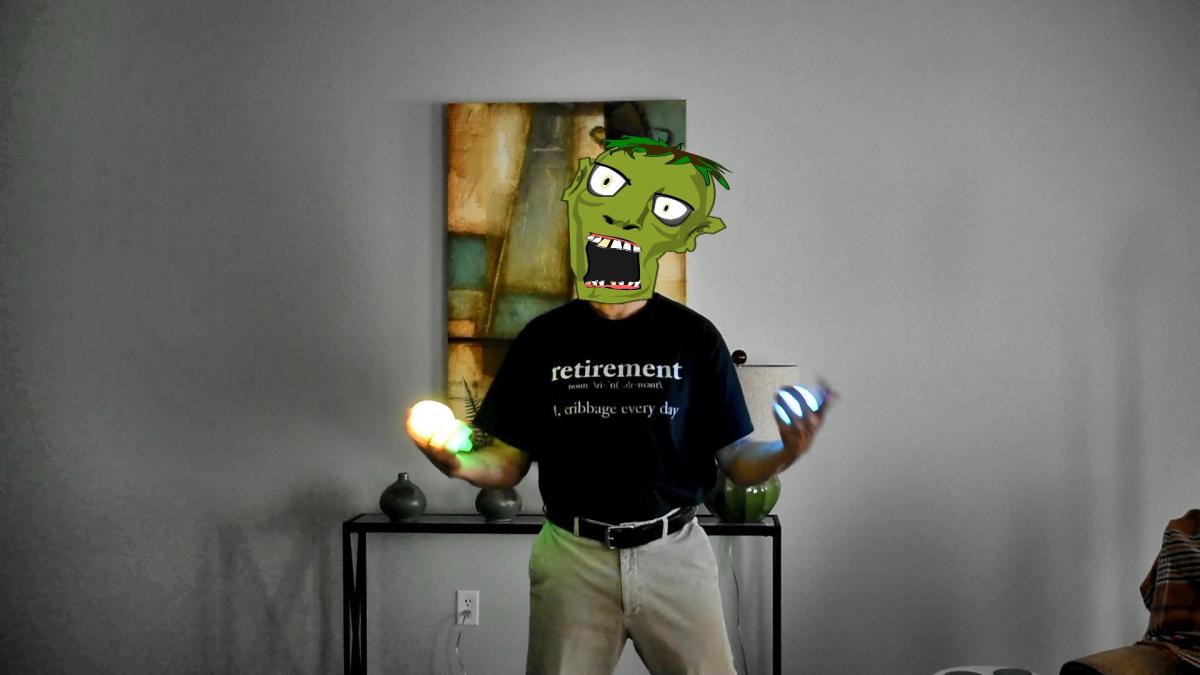
So, I’m still off and on practicing the Metta Prayer. I’ve noticed that practicing mindfulness is a lot like practicing juggling, which I’ve been doing for almost a year now. I still can’t do certain tricks, like the shower juggle. I can do about three or four throws and drop the balls, sometimes on my head (which is why I wear safety goggles!). And I still tend to use prayer like I’m negotiating a deal to get rid of my faults and troubles.

But I haven’t given up practicing the shower juggle. And I haven’t given up on the Metta Prayer.

Can Juggling and Mindfulness Meditation Complement Each Other?

I read this article about mindfulness today and it got me thinking about how juggling might be two different aspects of the same activity.

I think they both help focus the attention. There a number of articles on the web which essentially say that juggling can be a sort of meditation.

I know hardly anything about the default mode network (DMN) in the brain, but from what little I know, I suspect that both juggling and mindfulness meditation could disrupt the DMN. There’s a published study showing that meditation tends to reduce DMN activity. That would be a good thing. The DMN has been described as a brain network which may tend to lead to mind wandering and self-related thinking. That may not be the healthiest way to use your time.

I’ve been doing mindfulness meditation for about 9 years now. I still sometimes wonder whether I’m “doing it right.” On the other hand, when I miss more than a day or two of mindfulness practice, I notice that I feel more edgy and out of sorts. When I return to mindfulness practice daily, I notice less of that scattered and nervous mental state.

I took up juggling last October and I notice that it does something similar to mindfulness. I have to pay close attention to what I’m doing while I’m juggling. Otherwise, I just drop balls constantly.

Just searching the web with the question “Is there a juggling meditation?” turns up quite a lot of articles. Some suggest that juggling is a kind of “moving meditation.” That reminds me of the walking meditation, which I’ve referred to as the “walking dead meditation,” based on my Mindfulness Based Stress Reduction (MBSR) course in 2014. At the retreat toward the close of the course, we did this walking meditation thing, which for all the world seemed to more than a few learners as resembling the way zombies walk.

I think I’d have a tough time trying to juggle like a zombie walks. You can’t be herky-jerky when you juggle, you know. I guess that’s why you never see a zombie juggle. Zombies don’t meditate either, probably because they’re too busy looking for brains to munch on.

Now I get the urge to juggle when I feel the need to clear my head. It’s reinforcing for learning new juggling tricks. Sena is learning juggling now and her efforts remind me of the challenges I had. One of them is learning how to let go of the damn ball in a pattern like the three-ball cascade. You get stuck at certain stages. I hit several walls learning the cascade. And then there came a day when I just started doing the pattern right, often because I just let go.

That reminds me of a quote by Juggleman about juggling, “Doing it wrong makes you an artist.”

I’m probably doing mindfulness the way I ought to be “doing” it. Nowadays, the way I judge that is by noticing I feel better when I stick to it.

University of Iowa Psychiatry Residents Get Shout Outs

Recently, University of Iowa psychiatry residents worked hard enough to get shout outs. One of them was exemplary performance on the consultation and emergency room service. The service was following over two dozen inpatients and received 15 consultation requests in a day. This is a staggering number and the resident on the service did the job without complaints. In addition, the resident was the only trainee on the service at the time. Other residents were working very hard as well.

This high level of performance is outstanding and raises questions about health care system level approaches to supporting it.

I read the abstract of a recently published study about Mindfulness Based Stress Reduction (MBSR) compared to medication in treating anxiety in adults (Hoge EA, Bui E, Mete M, Dutton MA, Baker AW, Simon NM. Mindfulness-Based Stress Reduction vs Escitalopram for the Treatment of Adults With Anxiety Disorders: A Randomized Clinical Trial. JAMA Psychiatry. Published online November 09, 2022. doi:10.1001/jamapsychiatry.2022.3679).

On the day I read the abstract, I saw comments which were cringeworthy. The commenter is an outpatient psychiatrist in private practice who had some criticisms of the study. He thought the report of results at 8 weeks was inadequate because symptoms can recur soon after resolution.

Another problem he mentioned is worth quoting, “A course of treatment that requires as much time as the MBSR course described in the study would be out of the question for most of my patients, most of whom are overworked health care professionals who don’t have enough time to eat or sleep. Telling people who are that overworked they should spend 45 minutes a day meditating is the “Let them eat cake” of psychotherapy.”

That reminded me of a quote:

“You should sit in meditation for twenty minutes every day—unless you’re too busy; then you should sit for an hour.”

Zen Proverb

I know, I know; I should talk—I’m retired. Actually, I took part in an MBSR course about 8 years ago when I noticed that burnout was probably influencing my job performance on the psychiatry consultation service. I thought it was helpful and I still practice it. I was lucky enough to participate in the course after work hours. The hospital supported the course.

The residents who are being recognized for their hard work on extremely busy clinical services may or may not be at high risk for burnout. They are no doubt extra resilient and dedicated.

And the University of Iowa health care system may also be offering a high level of system support for them. I don’t see that University of Iowa Health Care is on the list of the American Medical Association (AMA) Joy in MedicineTM Health System Recognition System, but that doesn’t mean they aren’t doing the kinds of things which would merit formal recognition.

Anyway, they all get my shout out.