Hiked out to the mall today and watched the Zamboni smoothing out the ice-skating rink. It can help skaters a little.
It was pretty crowded this afternoon and there were several beginners. They’re easy to pick out because they fall a lot and tend to pull themselves along using the handrails along the sides of the rink. I think a few made the most contact with the ice not so much with their skates as with their knees and elbows.
I can’t remember if I had as much trouble turning left and right as one guy. But I’m pretty sure I fell just as hard when I first learned how to skate. He did fine in a straight line, but turning was his downfall—literally.
There was a short kid out there who was fast and nimble. He was evidently a hockey player and somebody was training him.
There are certain balance aids like stacked pylons. A little bitty girl used those twice for about 2 seconds each and figured she’d had enough.
There were more experienced skaters, but all of them were learning—and falling. They just picked themselves up and tried again. I guess that’s the main thing.
While yesterday’s post on Dr. Melvin P. Sikes was mainly about my personal impressions of him as a teacher, there are a couple of web resources which gives a little more texture about him apart from my imperfect memory and limited experience.
One of them is a formal course outline and evaluations he and another teacher wrote in 1975, which was the year I first encountered him when I was a freshman at Huston-Tillotson College at that time. I know it seems like a tough read, but I was pretty impressed by what teachers said about him in the evaluation part of the document entitled “Report on Teaching in Multi-Cultural/Multi-Ethnic Schools (1974-75).”
The pdf document is 39 pages long, but I suggest focusing on the student teacher evaluations of his course. That starts on page 19. They all praise it, without exception. Many note that he didn’t really just lecture. One of the evaluators called him “supercalifragalisticexpialadoches!” Not sure if that’s spelled just right (it’s on p.33 so you can check it yourselves), but the point is well made—he was viewed as an extraordinarily gifted teacher.
Dr. Sikes’ comments start on pp.35-39 (Attachment D, entitled “Teaching in Multi-Cultural/Multi-Ethnic Schools; EDP F382 -Summer 1975l Professor Melvin Sikes) and I think that’s also worth reading. It’s short and without lofty, academic terminology.
The reading list caught my eye. I looked for Ralph Ellison’s novel “Invisible Man” which had been published in 1952, but it wasn’t on the list. That book has special meaning for me personally, because when I encountered Dr. Sikes in 1975, I was a freshman at one of the Historically Black Colleges and Universities (HBCUs), Huston-Tillotson College as it was then known. I was born and raised in Iowa and had never been in the southern United States. I sort of identified with the unnamed protagonist because the first section of the book deals with his experience at a southern black college.
It was a culture shock. I never saw anyone like Bledsoe. In fact, I never personally met the president of H-TC (now Huston-Tillotson University as of 2005), who was Dr. John Q. Taylor King, Sr. at the time. My main connection was Dr. Hector Grant, who recruited me while he was visiting Mason City, Iowa in connection with support from a local church. I still don’t know what happened to Dr. Grant. It’s like he dropped off the face of the earth.
Anway, I wanted to share another item I pulled off the web about Dr. Sikes. It’s a newspaper article about him published in the West Texas Times issue published May 4,1977. It’s in the collection of the Texas Tech University on line, with the link to the main front page story “Judge Orders Officials to Clean Up the Jail,” interestingly enough. It automatically downloads a pdf of the newspaper issue to your computer when you click the link. I’m just going to try to summarize it and pull some quotes.
The title of the story about Dr. Sikes is down the page, “UT’s Dr. Sikes Helps Students Know Themselves and Others.” The story begins with an anecdote about an interaction Dr. Sikes had with a teacher. It involved a black student coming to her with a complaint that a white student had hit him and he used bad language in describing it. The teacher was going to discipline the kid about his bad language, which Dr. Sikes questioned.
Sikes thought the teacher should have first gotten more information about what the student actually experienced in the encounter. The implication was that if she had listened first, she might not have jumped down his throat about his bad language.
The author of the news article writes that, according to Sikes, “I want my students to be more flexible, to understand that people are first people,” the professor likes to say. “I want them to grow out of looking at a color of a skin and making determinations, good, bad, or indifferent.” He goes on to say,
“I don’t even want them to look at blacks and say, ‘these are great people.’ I just want them to look at blacks and say ‘these are people.’
Quotes from Sikes:
“Before you can deal with another in a meaningful kind of way, you have to find some meaning and purpose in your own life—which means defining yourself….”
About teaching:
“Yes, I was lucky, I was taught by my parents, to some degree. But then I had teachers who taught this to me… And much of whatever I am… is the result of teachers and their concern—black teachers, white teachers.”
About our differences:
“If we’re all the same, we can’t make unique contributions because the contributions would be the same.”
The author of the story points out that Dr. Sikes often took student teachers to Huston-Tillotson College to see predominantly black students. The author also writes that Dr. Sikes mentions something about politics which rings a bell.
“He [Dr. Sikes] talks about the politicalization of education, and says that educating has been taken away from the educator and usurped by the politician.”
On teaching the teachers:
Dr. Sikes says: “People don’t realize how important you are and you don’t realize how important you are. You’re molding and shaping human lives, millions of lives, who will become, depending upon how you mold and help shape or help them become.”
“Now the doctor deals with his patient for a short length of time, and the patient dies and he buries his mistake, or he lives and he’s all right. But we can’t bury our mistakes. They walk around and haunt us and other people…sometimes their living is death. But people never realize that it’s teachers—we are the ones who have power.”
And finally, about Mel Sikes himself, one of his students says,
“Sikes is intense, loquacious and supremely personal. He immediately grabs you and talks on a person-to-person wavelength. He tells his students a lot about himself, his struggles as a black and as a radically caring person. He says he would die if it would help all people relate better. And he would.”
There was a lot more to Melvin Sikes than a lemon-yellow leisure suit.
I was sitting in my office last night trying to read a book and noticed that the overhead light on the ceiling fan wasn’t providing enough light. The next morning I flipped the switch and could see through the glass globe cover that one of the bulbs was out. It flickered on about a half hour later and then went out again.
When I got the ladder out and tried to remove the cover, it wouldn’t budge. There weren’t any screws on it, so I looked at a few YouTubes to learn how to remove it. Lot’s of people were using tools and, of course, duct tape. Some methods looked dangerous.
For me, the most helpful hint came from a Wikihow lesson. The first example suggested using those rubber dishwashing gloves. I don’t know why I didn’t think of it right away because I use them to twist off stubborn lids on food jars. It worked on the fan light cover.
Sometimes the simple, old-fashioned tricks for solving problems are the best. In fact, it reminded me of what I’d been reading by the dim light. It was an essay by E.B. White from his book, Essays of E.B. White. The title was “The Winter of the Great Snows,” published by HarperCollins in 1977. Copyright restrictions prevent me from quoting directly, but his point was that tackling challenges with common sense and safety in mind is a good idea.
There are many light bulb moments in life that I’ve missed. I appreciate any help I can get.
I noticed an article the other day about Monash University in Australia getting funding for further research into growing brain cells onto silicon chips and teaching them how to play cribbage.
Just kidding, the research is for teaching the modified brain cells tasks. They succeeded in teaching them goal-directed tasks like how to play the tennis-like game Pong last year. You remember Pong from the 1970s? Shame on you if you don’t. On the other hand, that means you probably didn’t frequent any beer taverns in your hometown while you were growing up—or that you’re just too young to remember.
The new research program is called Cortical Labs and has hundreds of thousands of dollars in funding. The head of the program, Dr. Razi, says it combines Artificial Intelligence (AI) and synthetic biology to make programmable biological computing platforms which will take over the world and bring back Pong!
It’s an ambitious project. The motto of Monash University is Ancora Imparo, which is Italian for “I am still learning.” It links humility and perseverance.
There’s a lot of suspicion out there about AI and projects like the Pong initiative in Australia. It could eventually grow into a vast industry run by robots who will run on a simple fuel called vegemite.
Shame on you if you don’t know what vegemite is!
Anyway, it reminds me that I recently finished reading Isaac Asimov’s book of science fiction short stories, “I, Robot.”
The last two stories in the book are intriguing. Both “Evidence” and “The Evitable Conflict” are generally about the conflict between humans and AI, which is a big controversy currently.
The robopsychologist, Dr. Susan Calvin, is very much on the side of AI (I’m going to use the term synonymously with robot) and thinks a robot politician would be preferable to a human one because of the requirement for the AI to adhere to the 3 Laws of Robotics, especially the first one which says AI can never harm a human or allow a human or through inaction allow a human to come to harm.
In the story “Evidence,” a politician named Stephen Byerley is suspected of being a robot by his opponent. The opponent tried to legally force Byerley to eat vegemite (joke alert!) to prove the accusation. This is based on the idea that robots can’t eat. This leads to the examination of the argument about who would make better politicians: robots or humans. Byerley at one point asks Dr. Calvin whether robots are really so different from men, mentally.
Calvin retorts, “Worlds different…, Robots are essentially decent.” She and Dr. Alfred Lanning and other characters are always cranky with each other. The stare savagely at one another and yank at mustaches so hard you wonder if the mustache eventually is ripped from the face. That doesn’t happen to Calvin; she doesn’t have a mustache.
At any rate, Calvin draws parallels between robots and humans that render them almost indistinguishable from each other. Human ethics, self-preservation drive, respect for authority including law make us very much like robots such that being a robot could imply being a very good human.
Wait a minute. Most humans behave very badly, right down to exchanging savage stares at each other.
The last story, “The Evitable Conflict” was difficult to follow, but the bottom line seemed to be that the Machine, a major AI that, because it is always learning, controls not just goods and services for the world, but the social fabric as well while keeping this a secret from humans so as not to upset them.
The end result is that the economy is sound, peace reigns, the vegemite supply is secure—and humans always win the annual Pong tournaments.
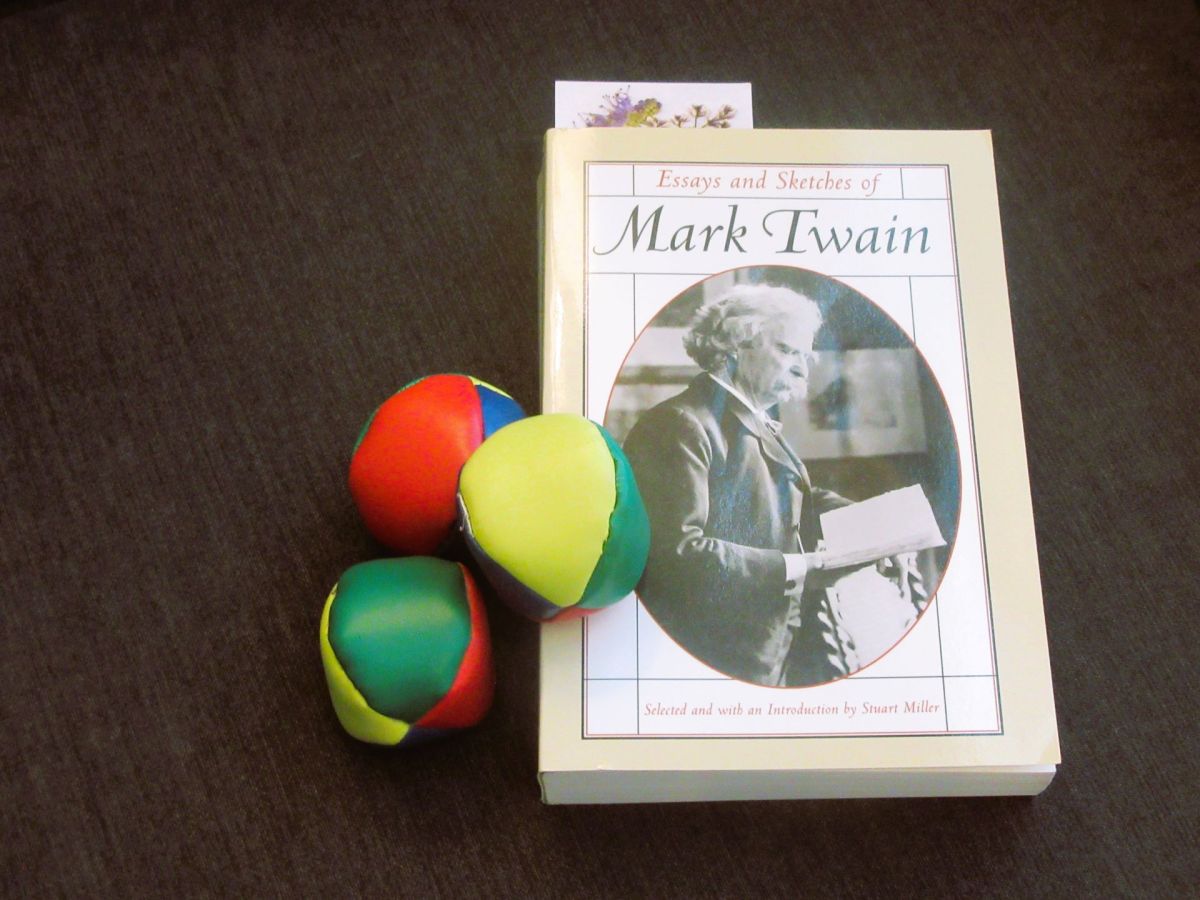
As of November 7, 2022 it has been 22 days since I purchased the Learn to Juggle kit from Barnes and Noble. So far, my learning experience reminds me of a story by Mark Twain, “Taming the Bicycle,” which was published posthumously—obviously after he succumbed from his injuries in the attempt to ride the high-wheeled bicycle in the early 1880s.
Just kidding of course, about his death from the bicycle riding adventure. He did mention using about a barrel of something called Pond’s Extract, which was a liniment for scrapes and other wounds.
Twain was writing about learning something new—a thing all of us are called on to do many times in our lives. He didn’t try to learn to ride the bicycle until he was over 50 years old.
I didn’t try to learn how to juggle until was well past my mid-sixties. How do you account for decisions to embark on new hobbies, adventures, and other nonsense at an age when most people would be content vegetating on the porch or in front of the TV?
I just answered the question, in case you didn’t notice.
Anyway, I am making some progress as juggling, although it’s uneven. It’s hard to believe, but sometimes I think I juggle better as I wander around. I think it might be because there is a natural tendency to throw the balls away from you. That way, I look more adept simply because I’m making a frequently observed beginner’s mistake. But I seem to be steadier even when I walk backward a few paces.
When I stand firmly in one place and attempt to juggle, I can often barely make it past half a dozen throws. Wandering a little, I have made thirty throws.
But then, randomly, the opposite occurs and the theory fails.
Counting the number of each throw seems to help—occasionally. I also notice that unscheduled, short practice episodes for 10 minutes or less work better than struggling along for a half hour or so at set times.
I don’t dread the practice sessions; in fact, I have a sort of itch to juggle at various times during the day. Sometimes I believe I do it to help me collect my thoughts, to keep my hands occupied, or just to pass the time.
I remember learning to ride the bicycle for the first time when I was a kid. I fell down a lot, just like Twain did—until I got the hang of it. Maybe juggling will turn out to be the same.
But I won’t need Pond’s Extract for juggling mistakes—as long as I don’t try juggling while climbing or descending stairs.
Since retirement, I’ve been very gradually casting about for another identity now that I’ve given up my professional identity. It doesn’t come naturally. I’m definitely not a handyman, although I’ve been learning a few skills.
For some reason, a large number of our electrical outlets didn’t hold power cords tightly enough. They were either cheap or worn out or both. Appliances would stop running because the electrical plugs fell out of the outlets.
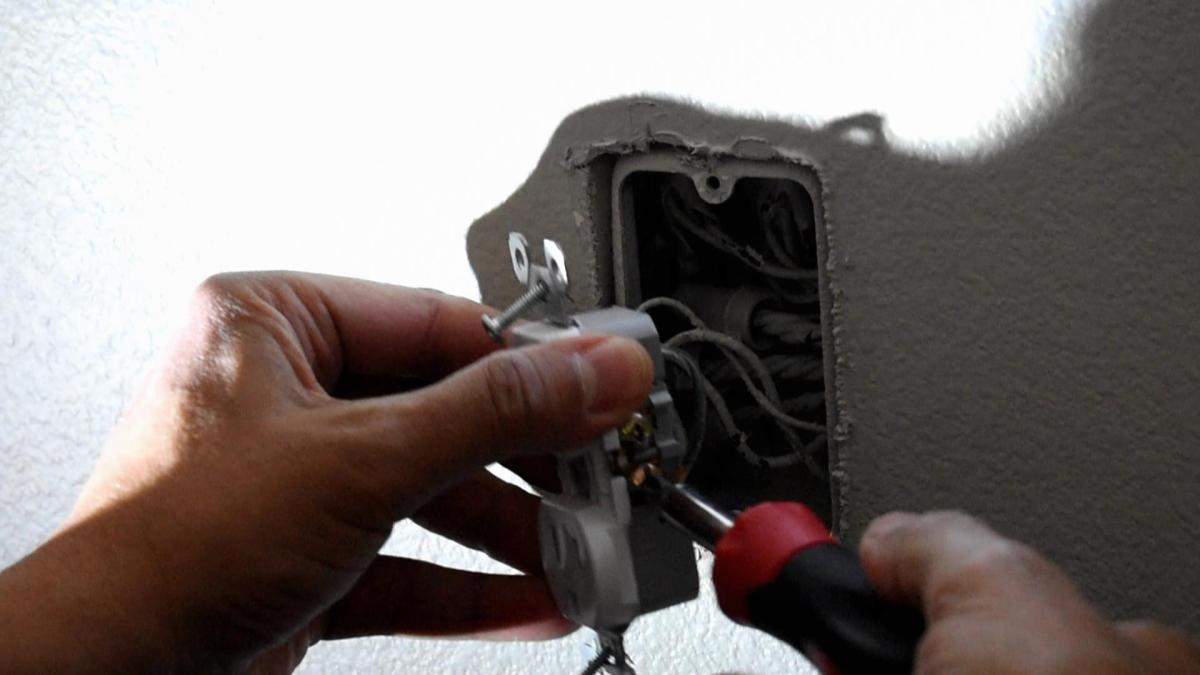
That led to Sena picking up an 85 gross of various replacement outlets, which led to losing one of my best excuses for not getting the vacuuming done. Since then, I’ve replaced a large number of outlets (see “instructional” video below). Toggle switch replacements are another item high on the list of vital electrical equipment to replace, mainly because they also get loose with age.
Funny how that doesn’t work for me. I get tighter in my joints as I age, which makes it very hard for me to sit cross-legged on the floor while replacing outlets. Standing up is even harder. That excuse doesn’t work either.
I’m pretty keen on checking outlets and the like for power before I start messing around changing them. I use a UL approved voltage tester for that—an electric can opener. Don’t let that get around. I always shut the power off at the circuit breaker to be safe.
Another skill comes to mine. Yesterday I had to install a soundbar on our TV for the first time. After Sena returned that one for a refund because it didn’t seem to improve on the TV’s audio, I installed a sound bar and subwoofer made by a different company.
I had a heck of a time getting it to work. It came with enough cords to hook it up, either by optical cable or something called HDMI ARC cable. Apparently, ARC stands for Audio Return Channel. I still don’t yet know why that makes it different from a regular HDMI cable.
What should have been a 10 to 15-minute hookup ended up taking most of an hour because neither cable worked. It was mysterious. I even hooked up both of them. The sound bar was soundless. In disgust, I yanked out the HDMI ARC—and abruptly the sound bar was loudly functional. Just prior to that I think I had moved the power plug from a power strip to a wall outlet. I figured the power strip might have just got old.
On the other hand, I had switched the sound bar plug and a CD player plug on the power strip which had been working fine and the sound bar still didn’t work. It was either aliens or luck. Sometimes it’s better to be lucky than good. I’m thinking about trying that HDMI cable again.
I have changed only in very small ways over the last 19 months (837,755 minutes; 50,265,308 seconds) since retirement. Some people say you can’t teach an old dog new tricks. I wonder if some people are just being ironic.








 Go Retire Psychiatrist