Sena alerted me to a news story about an Iowa City 8th grader landing a 68-pound flathead catfish yesterday in Iowa. While it’s not the all-time record, you have to admit he landed a monster fish. The record is an 81-pounder caught in 1958.
Now why would that remind me of KCCK Jazz and Blues Radio, Iowa’s only jazz radio station? It’s because of John Heim’s (aka Big Mo) blues show comedy bit on the Friday Night Blues Show featuring Mayree’s hand-battered catfish (“It’s better because it’s battered!”). You can hear more about it and other “Sponsor De Faux” on the Big Mo Pod Show 003.
It would be cool if KCCK sold a tee shirt that featured Mayree. Hey, don’t blame me; it’s Big Mo’s idea! I’ve searched the KCCK web page, but can’t find a tee for Mayree (hey, that rhymes, good for marketing!) but there’s a nice Big Mo tee in medium and 3XL sizes.
Anyway, I was fooling around with the idea and came up with a design for the tee today. Tell Big Mo what you think at email bigmo@kcck.org. It’s OK, he reminds listeners every Friday night how to get in touch with him when he hosts the Big Mo Blues Show, starting at 6 PM in the evening.
I’m pretty sure one of you could come up with a snazzier design. And just remember, Mayree’s hand-battered catfish are cooked to perfection, with manic delight, and they are just packed with nitrates! I can’t fit all that on a tee, which would have to be bigger than a tent.
Mayree’s hand battered catfish tee shirt design!KCCK fm radio 88.3
I was all set to hear the Big Mo Blues Show on KCCK 88.3 tonight starting at 6 pm and guess what? I must have fell asleep sitting up in my chair and didn’t wake up until this song “Bye Bye Blues” by Larry McCray came on a little past 6:30 pm. It makes me think of my wife, Sena-until she starts winning too many cribbage games.
I heard the Big Mo Blues Show just (Halloween theme) this last Friday night and was not surprised to see that one of the songs discussed on the Big Mo Pod Show on Saturday was Peetie Wheatstraw’s “Devil’s Son-in-Law.”
When I first heard it, it got me chuckling because I didn’t understand hardly a single word until the last line. It was babbling. I can remember googling the term “Peetie Wheatstraw and unintelligible,” which revealed I’m not the only one who thinks he’s unintelligible. It’s a mondegreen mine field. It’s a good thing the lyrics are available.
I want to hastily point out that he’s not always unintelligible—but William Bunch aka Peetie Wheatstraw is speaking in tongues on that song. For comparison I listened to another song, “Sweet Home Blues” and I could understand just about every word in the lyrics.
That led me down the rabbit hole about the artist in a web search that seemed to have no end. I should probably say Brer Rabbit hole since most of my searches pointed in the direction of a character called Peter Wheatstraw, Petey Wheatstraw, as well as Peetie Wheatstraw who had variations in their identities, most often in the context of African American folklore.
I’m not going to attempt a summary of my web search on Peetie Wheatstraw; there’s too many twists and turns. You can start with the Wikipedia article. But from there, you can get trapped in Brer Rabbit’s little tunnels, which can run in different directions.
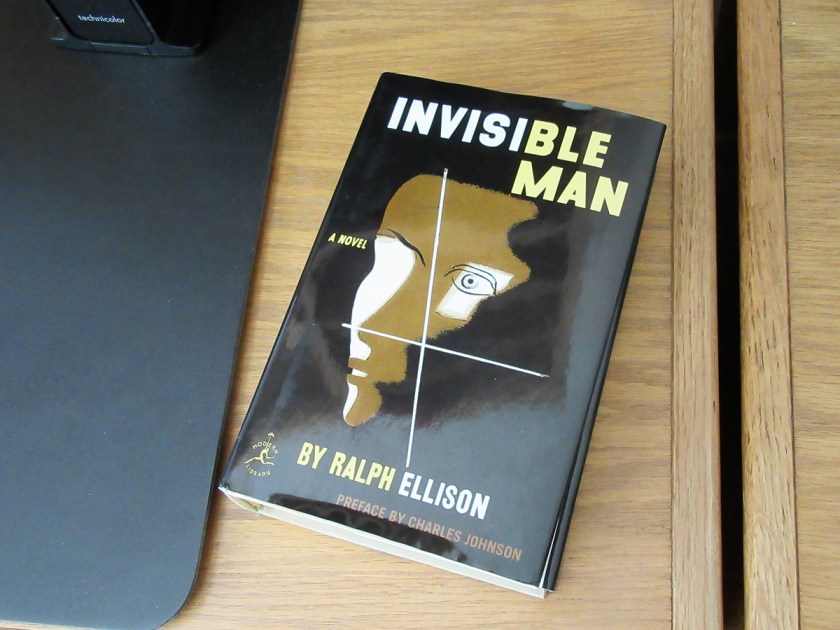
William Bunch was a blues artist in the 1930s who adopted the moniker “Peetie Wheatstraw.” While Big Mo says it’s sort of another name for Satan, I found confusing references by writers who claim that the Peter Wheatstraw character comes from Black folklore. There are those who believe that novelist Ralph Ellison wrote about a character in his book “Invisible Man” named Peter Wheatstraw and said it was the only character in the novel that was based on a live person—William Bunch.
Is that true? And did Ellison ever meet Peetie Wheatstraw (William Bunch)? I can’t tell from the web articles.
I was prompted to get my copy of “Invisible Man” out after reading a scholarly online essay mentioning the Peter Wheatstraw character, “Re-visioning Ralph Ellison’s Invisible Man for a Class of Urban Immigrant Youth” by Camille Goodison, CUNY New York City College of Technology. I couldn’t remember Wheatstraw at first, but there he was in Chapter 9.
Goodison reveals there is a lot more texture to the Wheatstraw character then just as a moniker adopted by William Bunch. Wheatstraw is probably more complex than the devil. He has many sides to him and could be helpful—but mostly in an indirect way. His guidance is full of riddles and there doesn’t seem to be a solid way to cut through the metaphorical morass. As Emily Dickinson advised, Wheatstraw may tell the truth—but tells it slant.
This is just a short piece on the Big Mo Podcast last Friday night and his comments about one of the songs he played that night. It made the list of 5 songs he and Producer Noah discussed a couple days later.
Big Mo’s had great comments about all the songs, but I took special notice of those about one of them. It was James Carr’s big hit in 1966, “Dark End of the Street.”
The most important thing about it is that I remember listening to it when I was just a kid. I was too young to understand the meaning of it. But his voice grabbed me. That’s really the only thing I can say about it. His performance still has the power to raise the hair on the back of my neck, even though I can’t identify with the lyrics or connect the theme to any life experience I’ve had. I suspect many people feel the same way.
The other reason I connect with the song other than Carr’s voice is his life story. He was said to have suffered from a psychiatric illness, the nature of which seems like it was never clearly identified. I’ve read a few web articles and terms like “bipolar disorder,” “depression,” and other similar references come up. His psychiatric diagnosis is the least important thing.
Carr’s life story is hard to read, despite what little there is of it to read about. It’s painful. The version on the Black Past website encapsulates what you find in several other articles: Tulino, D. (2018, February 21). James E. Carr (1942-2001). BlackPast.org. https://www.blackpast.org/african-american-history/carr-james-e-1942-2001/.
But to get the real point about James Carr, all you have to do is listen to that one song, “Dark End of the Street.”
I caught the Big Mo Blues Show June 14th last Friday night. And I also caught the Big Mo Pod Show as well. Produce Noah got the month wrong for some odd reason. He said it was May 14th. Let it go. Anybody can be temporally impaired from time to time, including me.
Anyway, the theme of the podcast was “Chromatic Rock,” which I gather applies mainly to harmonicas in this context. But in a more general sense, I think it means adding more color to music, mainly by variation in notes. The specific artist in the podcast was somebody I’ve not heard of by the name of Sugar Blue. He blew a tune on the harmonica called “Krystalline,” which is some kind of cocaine.
Big Mo got most of the items in the quiz. He always does pretty well, because of his encyclopedic knowledge about music. His memory is really strong. I bet he even knew what month it is.
Well, here comes my selection from last Friday’s Big Mo Blues Show, a number called “Plain Old Common Sense,” performed by Kenny Neal. Common sense is pretty important. It can keep your head above water and clear of cocaine.
I heard the song “Florida Man” by Selwyn Birchwood on the Big Mo Blues Show on KCCK radio tonight. I updated my post “Gators OMG” by adding the YouTube video to it.



 Go Retire Psychiatrist