Two Person 5 Ball Passing Jitterbugging Juggling!

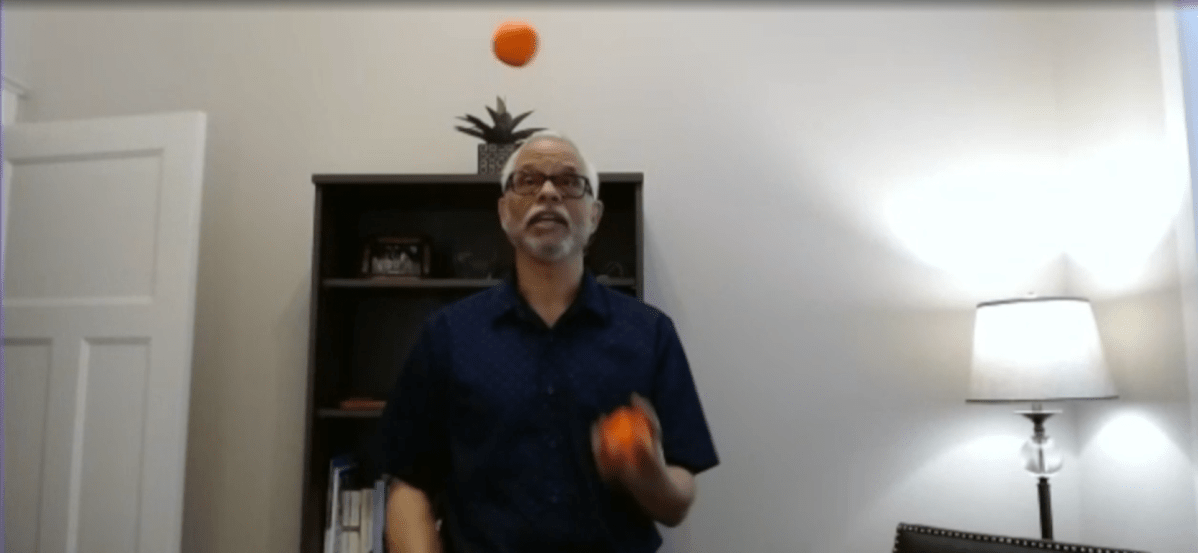
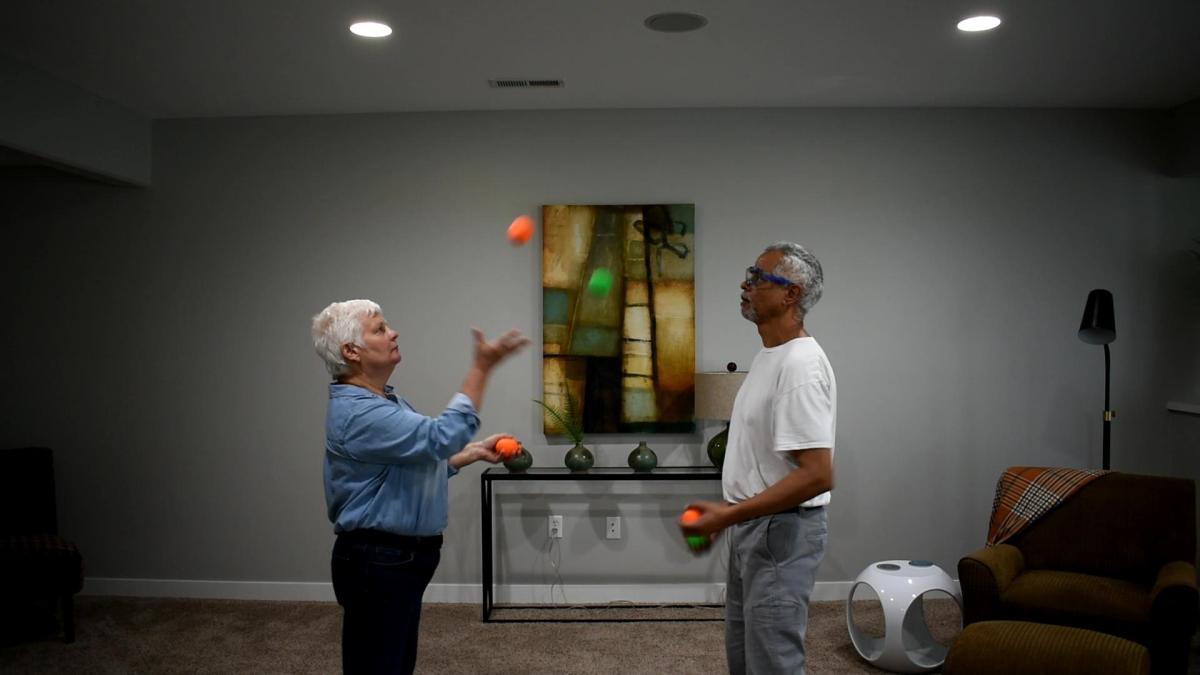
Sena and I are going to break the internet with another video of two person juggling! OK, so maybe we won’t exactly break the internet—but we might give it a nosebleed. We had to think of a way to top our recent side hug version of tandem juggling with 3 balls. So, we tried the 5-ball passing juggle pattern.

This one was also inspired by Niels Duinker and his sidekick Piet. On the other hand, it was difficult to get started at first. I found the video tough to follow and was dumbfounded on how to even get started.

Overthinking can put the brakes on any endeavor. Once we just got rolling and quit sweating the details, the pattern just seemed to flow. You have to give it your undivided attention. And you both have to be able to juggle the 3-ball cascade.

There are a couple of rules to remember. The jugglers face each other rather than stand side by side. One juggler tosses balls straight to the partner while the opposite partner tosses them back diagonally to the partner’s opposite hand.

In this pattern, I start with 3 balls, 2 in my right hand and one in my left. Sena starts with 2 balls, one in each hand. The person with 2 balls in the right hand starts by tossing one ball straight to the partner’s left hand. The partner must toss the ball in her left hand (to empty it so she can catch the ball flying in) across to the other’s left hand. One person always throws diagonally and the other always throws straight across.

Even saying that is confusing. You really have to see it and that’s why we included a slow-motion clip. There’s a sweet spot in the distance between jugglers. If you’re too far apart, there’s a tendency for throws to be too long and either too high or too low. There’s a juggle space between you and your partner just as there is for you alone. It’s a little wider, but not much, because lobbing it upwards more than tossing it in a shallow arc duplicates juggling by yourself.

The more we practiced, the smoother and easier the pattern felt. I tend to jitterbug around while Sena tends to stand solidly in place. Nevertheless, we both compensate for imperfections in our throws.

The result looks almost like dancing.
Discover Tandem Juggling Just for Fun!

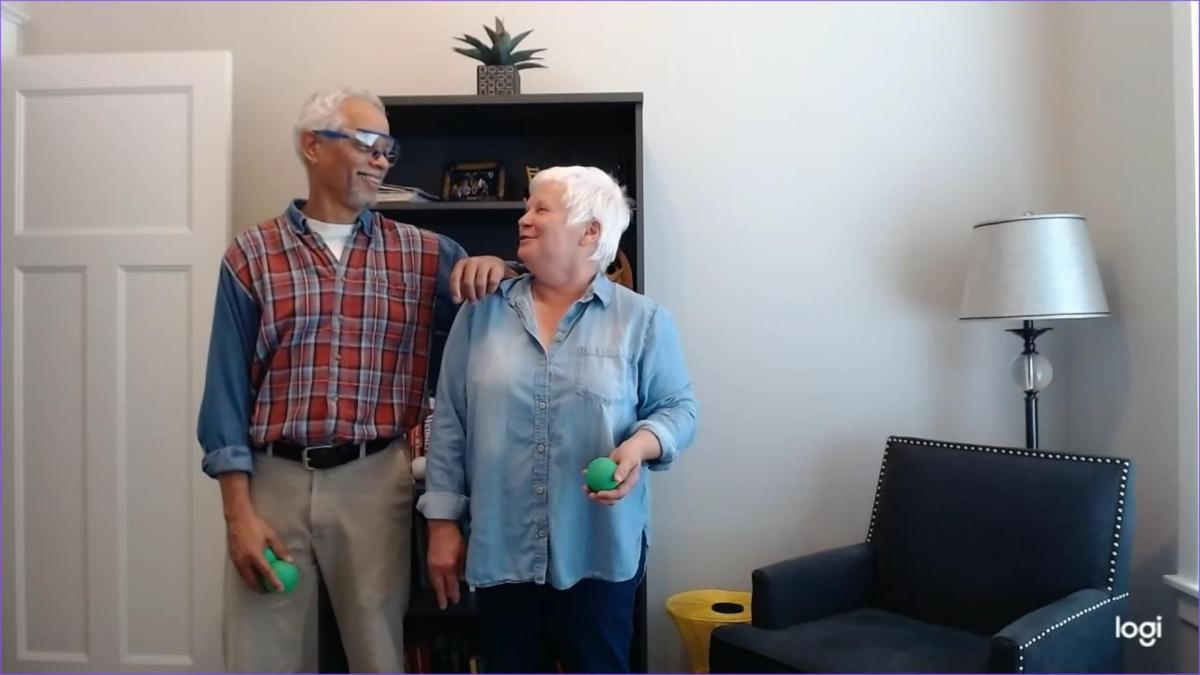
I found out about tandem juggling yesterday and learned how to do it from a YouTube video by genius juggler Niels Duinker and his sidekick, Piet van Steen. Sena and I picked it up pretty quickly.

It’s a wide frame form of the 3-ball cascade. All we had to do was practice throwing a little wider and higher. It’s a very entertaining way to play catch.

You still have to throw the balls within the pane of glass. You also have to compensate for each other’s height. The two of you have to stand pretty close together, basically shoulder to shoulder.

This is a barrel of laughs and great exercise as well!

Now Playing! See My Psychiatric Times and Medical Word News Juggling Videos

My juggling video is up for viewing now on the Psychiatric Times website! The title is “A Journey of Juggling.” It’s in the section called More Than Medicine.

You can also find it on the Medical World News website with a slightlly different title, “After Hours: Juggling 101.” It’s in the section called After Hours.

They’re both essentially the same video with slightly different editing. They’re both around 14 or 15 minutes long. The Medical World News site requires you to register, which would provide access to a lot more features.

These are not YouTubes so they work a little differently. You’ll have to manually unmute the audio for “A Journey of Juggling.” The “After Hours: Juggling 101” starts playing right away with audio. There’s an introduction that lasts about a minute.

Psychiatric Times staff did the editing and publishing via Psychiatric Times and Medical World News websites. I had a lot of fun making this video.

I’m still juggling and have improved a lot on the under the leg throw trick. I can do the behind the back throw more consistently but still drop balls. I practice doing tricks from both my dominant and non-dominant sides. I can still do only 3 throws most of time with the shower pattern, but I’m still working on it.

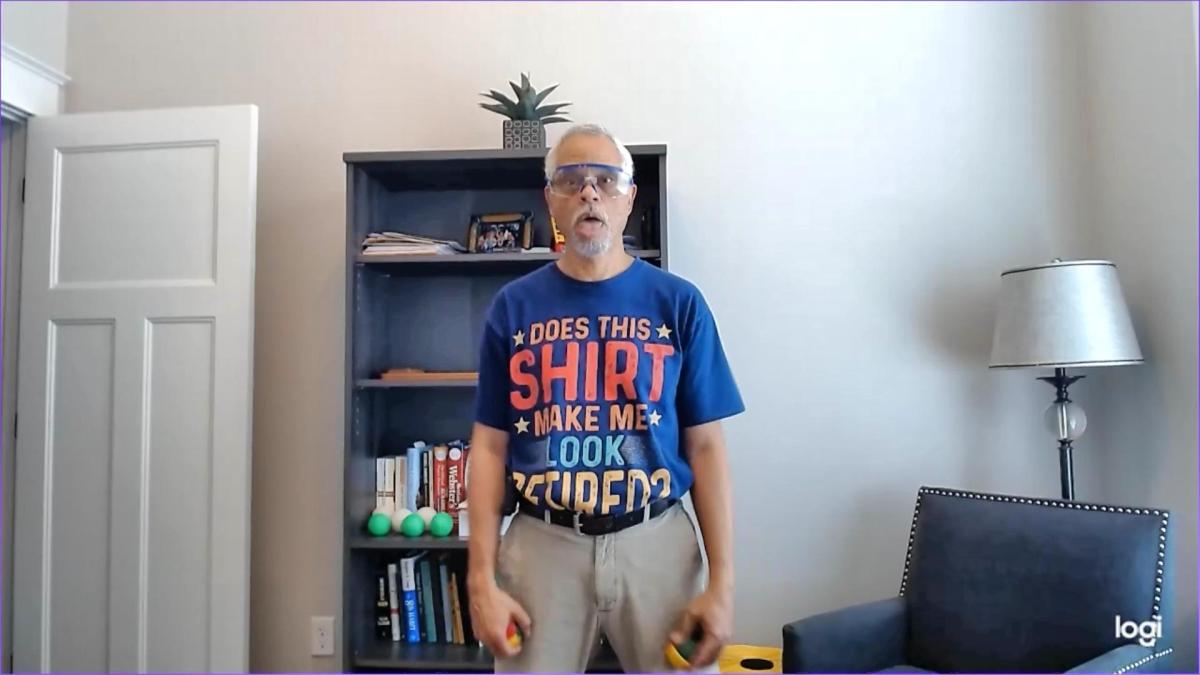
I wear safety goggles and it’s really not just one of my gags for YouTube. I had surgery for acute on chronic retinal tear in my right eye last year and I don’t want to go through that again. I didn’t get the retinal tear from juggling. Just getting older puts you at risk for it. On the other hand, I drop enough balls on my head that it makes me leery of taking any chances.

Sena is improving on learning the cascade pattern. She can do up to 20 throws-except while I’m watching!

How the Metta Prayer and the Shower Juggle Are Alike

I’ve been practicing mindfulness meditation since 2014, when I became uncomfortably aware of how unpleasant I was becoming on the job and elsewhere. I called this “burnout.” The word still works as an explanation although it was and is sometimes still an excuse.

I learned about the Lovingkindness meditation or the Metta Prayer during the Mindfulness Based Stress Reduction (MBSR) course I took almost a decade ago.

I used to pray when I was a child. I read the Bible and prayed. I viewed the act of prayer as a request to God back then. And I still probably regard the Metta Prayer as a kind of bargain between me and the cosmos or whatever it is I think of as a higher power.

Just because I say the Metta Prayer doesn’t mean that anybody’s going to treat each other differently. It doesn’t make people get up and square dance together. However, the caution about not expecting others to change just because you say the Metta Prayer doesn’t mean that the practice would not enhance a sense of community—if enough people did it.

There are dozens of scripts for the Metta Prayer easily accessible on the web. The part of it that is directed to those with whom I’m having a difficult time is tricky. Often enough, my goal is to use it as a way of somehow changing the person I’m having difficulty with. It’s the same way I used prayers as a child.

That’s a mistake, but at least I’m aware of it. Prayer is not a request for God or the cosmos to intercede on my behalf so that life won’t be so difficult for me sometimes.

I have trouble remembering that I’m not really a role model, especially nowadays. I’m just an old retired guy who was difficult to work with and needed to change, despite my status as a psychiatrist. I tell dad jokes and clown around but I’m still an old guy with problems—like just about every other old guy.

So, I’m still off and on practicing the Metta Prayer. I’ve noticed that practicing mindfulness is a lot like practicing juggling, which I’ve been doing for almost a year now. I still can’t do certain tricks, like the shower juggle. I can do about three or four throws and drop the balls, sometimes on my head (which is why I wear safety goggles!). And I still tend to use prayer like I’m negotiating a deal to get rid of my faults and troubles.

But I haven’t given up practicing the shower juggle. And I haven’t given up on the Metta Prayer.

Every Minute Counts in Physical Activity for Health Even If Your Step Counter Does Not Count It!

If you want a quick read for how every minute counts in physical activity for your health, see the JAMA article “Physical Activity for Health—Every Minute Counts” (Katzmarzyk PT, Jakicic JM. Physical Activity for Health—Every Minute Counts. JAMA. 2023;330(3):213–214. doi:10.1001/jama.2023.11014).

Just for fun, I tried to see if about 5 minutes of juggling would result in a change in the step counter on my cell phone. Unfortunately, it didn’t but I sure could feel the effort!

As the authors state, public health recommendations for physical activity set a bar of 150-300 minutes a week of moderate intensity aerobic activity to get substantial health benefit.

But you benefit from just about any increment below that level. Your step counter probably won’t register it, but you can feel it.

I made a short demo video to show what good exercise juggling is. I didn’t cut any mistakes (and obviously increased the speed on it because 5 minutes is a bit long). Anybody can tell I’m pretty puffed out at the end.

Try juggling for physical activity!

Learning to Let Go in Juggling

A couple of days ago, Sena asked me to watch her as she practiced the toss and catch in juggling 3 balls. She could do the one, two, three, catch pretty well but for some reason couldn’t let go of the ball in her left hand to move forward to the one, two, three, four catch series. Toss and catch by the numbers makes it a little easier to get to the point where you just let go of the balls you need to toss to keep the 3-ball cascade pattern going.

As I write this, I’m reminded how difficult it is to explain juggling the cascade pattern to someone instead of just showing them. When I stood in front of her and could count the throws, she could toss three balls and catch, no problem. But she was frustrated because she couldn’t see how to move past the toss 3 and catch drill. She was sometimes even doing a toss 2 and catch because she was tossing so fast.

I stood next to her and could see part of the problem, which is that she was not letting go of the key ball. In fact, she was aware of it and would try to push the wrong ball up in an effort to keep the pattern going.

This is hard to convey by writing or talking. But the idea behind keeping the balls churning in the cascade pattern is to continually throw a ball from your hand so as to empty it in order to catch the next ball coming down.

So, we counted the throws out loud together. We both started with two balls in the right hand and one ball in the left hand. We counted “one” when we tossed the first ball from the pair in the right hand. We counted “two” when we tossed the second ball in the left hand. We counted “three” when we tossed the third ball remaining from the pair in the right hand. When that ball reached the top of its arc, I noticed Sena was not tossing the first ball she had caught—which would have moved her into a toss 4 and catch, with two balls ending in the right hand. As it was, she was stuck in the toss 3 and catch, ending with two balls in her left hand.

This is really hard to keep track of by talking about it.

I had previously made slow motion videos of the toss 4 and catch, but it was still too hard to follow. And I couldn’t slow my own demonstration standing right next to her in an effort to show her what she needed to do—which was to let go of the ball in her left hand when the ball from her right hand was at the highest point in its arc.

In spite of the difficulty in talking it through—she got it. She actually could do toss 4 and catch several times in a row!

It was a eureka moment.

Sena Looks Out the Window

Yesterday Sena practiced her usual 2 or 3 minutes of juggling and then took a break to look out the window. She likes to see how the garden is coming along in the backyard.

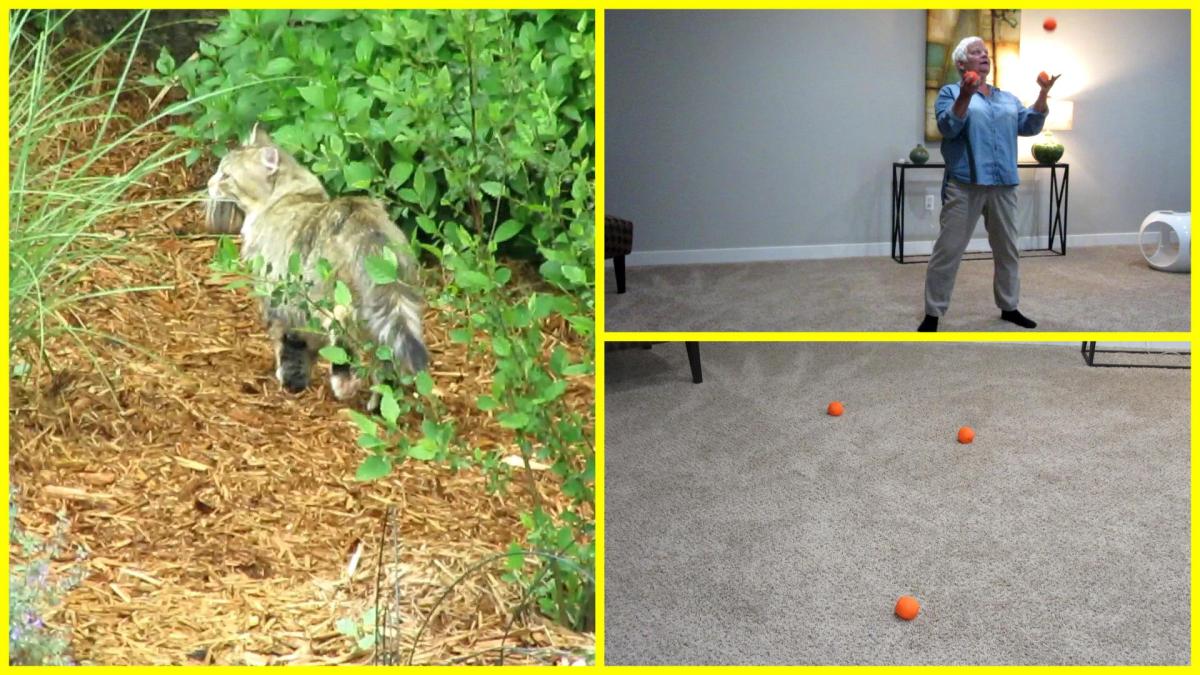
In fact, lots of things go on in our backyard garden and beyond. Critters are entertaining. We’ve seen all kinds of birds, deer, turkeys, and even cats catching their dinners.

There are some pretty talented mousers who hunt on the property. Sena got pretty excited when she filmed one catching what she thought was a mouse.

Juggling with New Safety Goggles

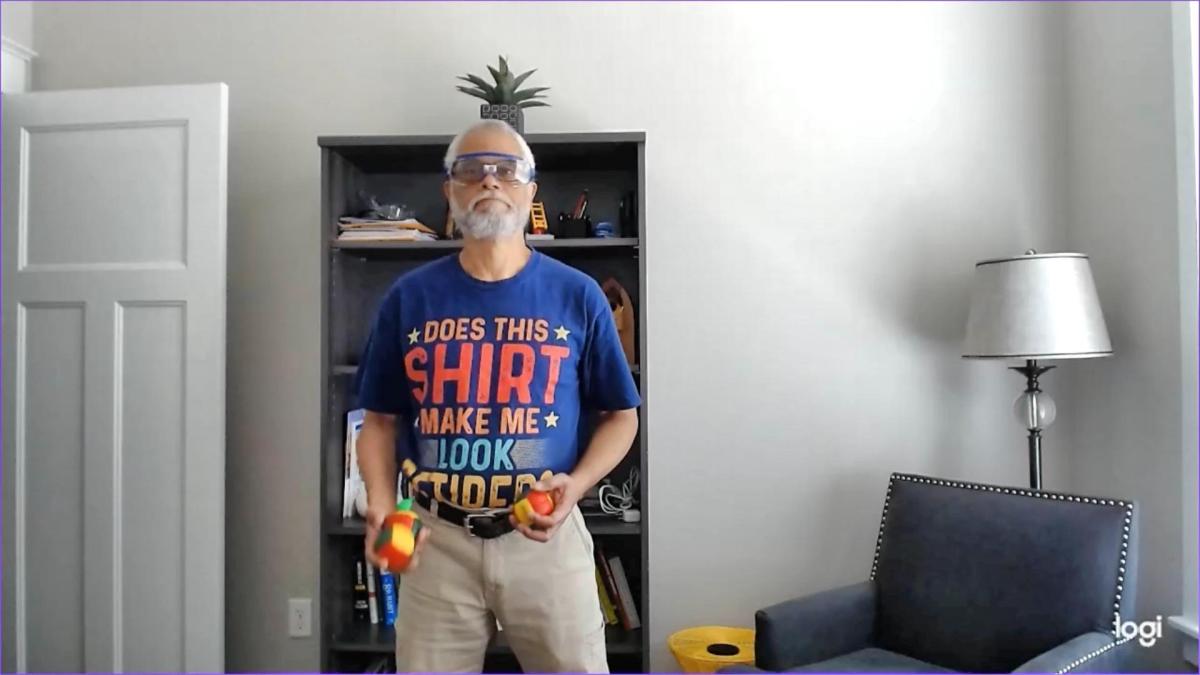
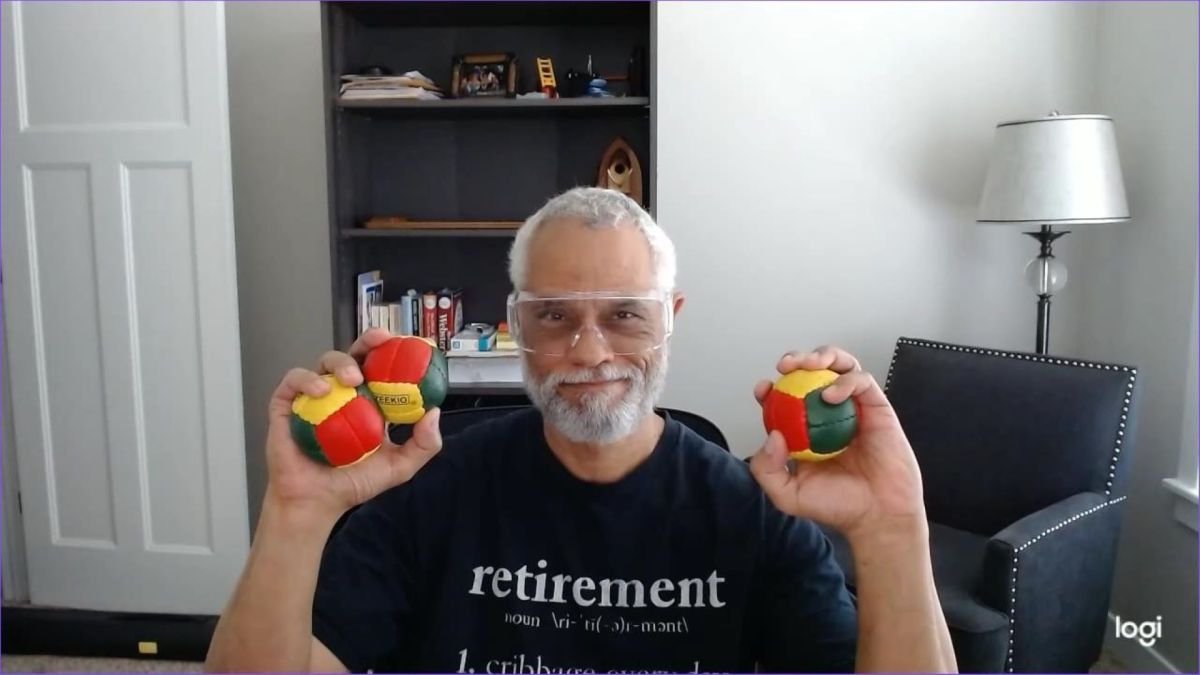
I got new safety goggles the other day. They’re to protect me when I juggle. They’re made by Sattron and Sena got them on Amazon at a good price for 3 pairs. They fit over my eyeglasses. These were my old eyeglasses, which I’ve since replaced with brand new ones. I’m still a little nervous about wearing the goggles over those.

The goggles come with a cleaning cloth and the bows are adjustable. They adjust at the temples up and down through 15 degrees (up, intermediate, and down). It’s hard to move them. You have to really crank them. I don’t think they make that much difference. The length adjustment is a little quirky. You pull them out or push them back in. It’s a ratchet setting adjustment. The soft silicone nose pads will leave smudges on your glasses.

They’re anti-fog, anti-UV, but unfortunately not anti-drop. On the other hand, when a juggling ball drops on my head, I’ll be protected because they’re impact resistant.

Juggling and The Wings of Change!

The other day we were at Terry Trueblood Recreation Area mainly to see how juggling goes outdoors for me. We filmed the event for posterity.

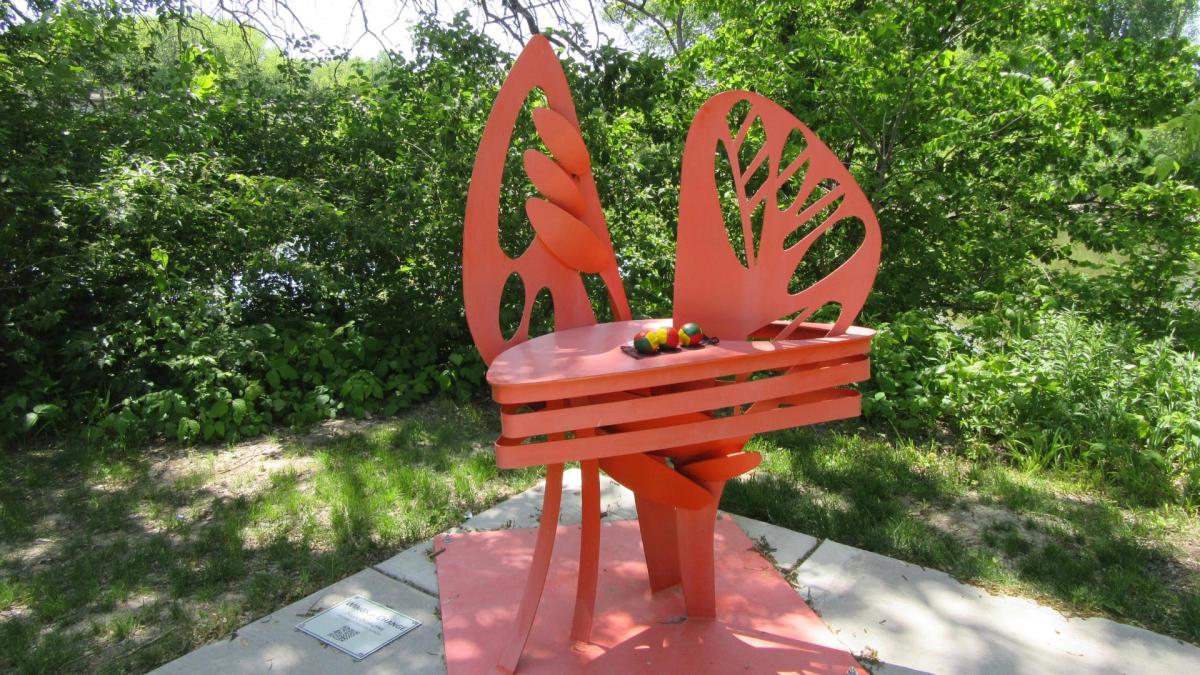
It turns out that “wings” had a lot to do with it. I juggled next to Hilde DeBruyn’s sculpture “Winds of Change.” It’s my favorite sculpture, although the winds of change are dictating that the Iowa City Parks Dept. is again going to accept new sculptures for this year which will replace all of those currently on display.

Wings figured in a different way and you can tell by how I react to the bugs flying around. We picked a nice spring day when all the winged insects were buzzing around in my face.

The level of juggling difficulty goes way up when gnats are zipping up my nose, my ears, my mouth, etc.

Always Wear Safety Glasses When Claw Juggling!

I just got a new eyeglass prescription a few days ago. I figured a year was long enough to wait after my surgery for an acute on chronic retinal detachment of my right eye. My vision in that eye has changed quite a bit, but I think new glasses will help a lot.

My old pair of eyeglasses is pretty beat up. Juggling has not helped. I’ve knocked them off my head a couple of times lately. That has not helped the poor fit.

I’m also practicing a new juggling trick called the claw. The throw and catch techniques are very different. You have to claw catch the balls from the top. I end up slamming them on the floor or off my groin. Juggling takes dedication and sacrifice—but there’s a limit.

I think I need safety equipment. I’ll be getting new eyeglasses, but it might be a good idea to get a pair of safety glasses. I just happen to have an old pair of plastic safety glasses from the time Sena bought me a battery-powered pole saw for tree trimming in the back yard a few years ago. Talk about safety. It takes at least as much agility and coordination to dodge a heavy falling tree limb as it does to dodge a juggling ball.

The claw trick puts a vicious spin on the ball and it can fly anywhere at meteoric speed. Controlling the arc and direction to fit the cascade pattern is quite a challenge. Balls frequently ricochet off each other, which is why I don’t drink my coffee during juggling practice. Practicing the claw reminds me that juggling is great exercise. I’m flying all over the place, lunging, leaning, and ducking.

But I might need a helmet.