Pegging Around Iowa

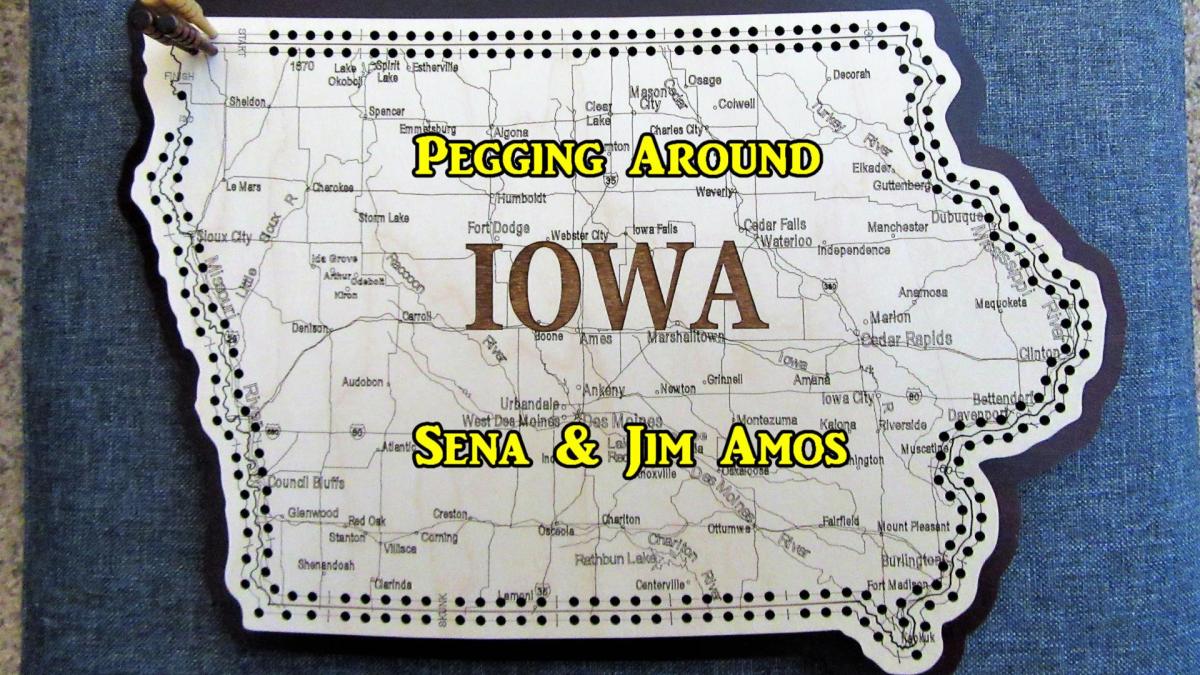
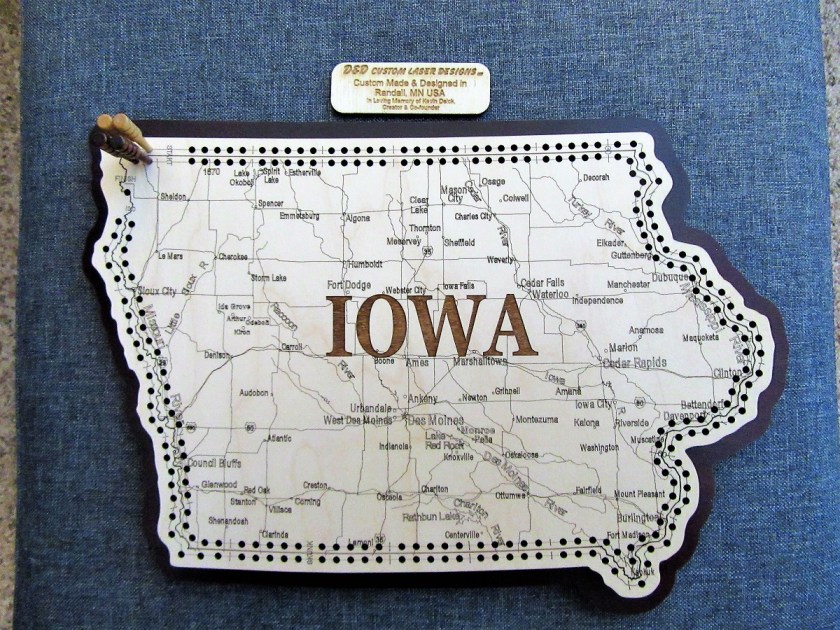
Sena and I got the Iowa map cribbage board and pegged around the state. It was a great way for us to relearn what’s great about Iowa. There is a ton of fun things to do in Iowa.

The 2022 RAGBRAI route, scheduled for July 23-30 will run from Sargeant Bluff to Lansing. It’s the oldest and largest recreational touring bicycle ride in the world, according to the RAGBRAI website. RAGBRAI stands for Register’s Annual Great Bicycle Ride Across Iowa. It’s the largest, longest, and oldest recreational bicycle touring event in the world.

It was started by Des Moines Register reporters John Karras and Donald Kaul. The 7-day trip goes from the Missouri River to the Mississippi River with many stops along the way.

One of them is Mason City, where John Dillinger robbed the First National Bank in the 1930s.

Lake Okoboji in northwestern Iowa is well known for a lot of reasons. It’s a great place to boat and fish, but if you’re an X-Files fan, you’ll recognize that it was the setting for the episode “Conduit,” in which a young woman was kidnapped by aliens although Fox Mulder was unable to prove it happened. The show misspelled the place as “Okobogee,” a mistake that was easy for any Iowan to detect. It was actually shot in British Columbia.

Of course, Iowa City is the home of the Hawkeyes, The University of Iowa, and the Iowa Writers’ Workshop. The African American Museum is in Cedar Rapids.

Clear Lake, as some of you might recall, is where the Surf Ballroom is. Buddy Holly, Ritchie Valens, and J.P. “The Big Bopper” Richardson, after performing there were killed when their plane crashed shortly after taking off from the nearby Mason City Municipal Airport in 1959.

Riverside is the site of the Star Trek Museum and the future birthplace of Captain James T. Kirk in 2233. There’s an annual Trek Fest festival. William Shatner played a hoax on Riverside in 2004 when he visited with a film crew, claiming that they were going to make a science fiction movie there.

Dubuque is the oldest city in Iowa. One of the places to see is the National Mississippi River Museum and Aquarium.

Although it’s not on the cribbage board Iowa map, about a half hour west of Dubuque is Dyersville, where the movie Field of Dreams was shot. The New York Yankees and the Chicago White Sox played there in 2021.

The Pella Tulip Time Festival runs in early May.

You can see Albert, the largest bull in the world, in Audubon. The solid concrete sculpture weighs 45 tons. That’s a lot of bull (obligatory rim shot here).

The Iowa State Fair is in Des Moines, the capital of Iowa. Iowa State University is in Ames. I’m part Cyclone and part Hawkeye because I got my bachelor’s degree at ISU and my medical degree at UI.

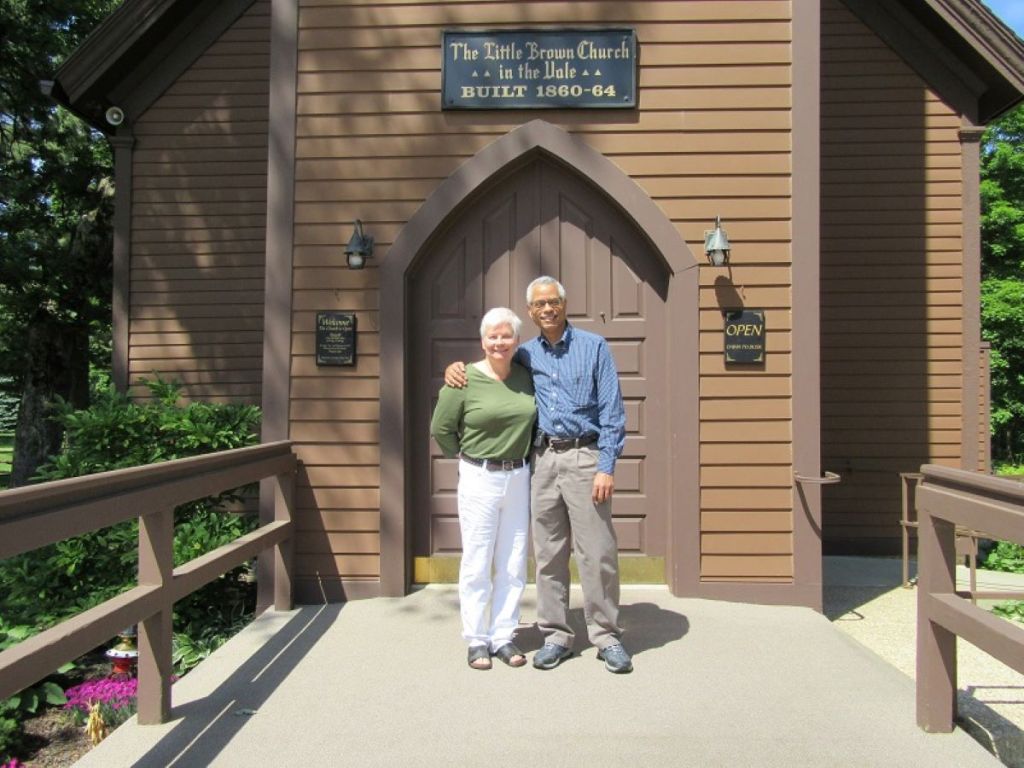
Although Nashua is not on the Iowa cribbage board, it’s in our hearts. We were reminded of our wedding at The Little Brown Church there 44 years ago. Come to Iowa and make memories of your own.

The Little Brown Church in Nashua, Iowa

Upcoming Video of Our New Iowa Map Cribbage Board

Three days and a new memory card later, Sena and I are almost done with our video of us pegging around our new Iowa map cribbage board. We’re watching the weather reports right now because rough weather is moving through the state.

Thoughts on “The Next Chapter: Blazing New Trails (1998-2047)

The final presentation of the series night before last, Uncovering Hawkeye History in honor of the 175th anniversary of the University of Iowa was a fascinating review of the changes in architecture of the campus, how local and national politics influenced the university and vice versa, as well as the expansion of the role of philanthropy to support its mission over the years. A YouTube video of the recorded presentation will be posted here at a later date.

There was not enough time to do much more than briefly mention the new trails being blazed by three leading programs. However, you can read more about them in Iowa Magazine.

Craig Kletzing is the principal investigator for NASA’s TRACERS mission. He’s a UI physics and astronomy professor who secured the largest research grant in the history of The University of Iowa in 2019 to study the interactions of the magnetic fields of the sun and the Earth.

Christopher Merrill is the director of the International Writing Program and professor of English. Merrill has made cultural diplomacy mission to over 50 countries. He once served on the U.S. National Commission for UNESCO and the National Council on the Humanities.

Dr. Patricia Winokur, the executive dean of the Roy J. and Lucille A. Carver College of Medicine, physician and professor of internal medicine—infectious diseases, and leader of Iowa’s Covid-19 vaccine clinical trials. Dr. Winokur is a nationally recognized leader in the field of infectious diseases. She created the UI Vaccine and Treatment Evaluation Unit, one of the top vaccine research programs in the country and one of only nine nationwide funded by the National Institute of Allergy and Infectious Diseases.

At the end of the presentations, university archivist David McCartney announced that he will be retiring as soon as next week. He wished everyone well and the presenters I’m sure all wish him well.

He has held the archivist position since 2001. He has led a very interesting and varied life. A story posted in The Academic Archivist on November 12, 2020 by Katie Nash, MLIS, CA reveals he got his undergraduate degree in journalism from the University of Wisconsin-Madison. He received his MA in history and MLS (master’s degree in library and information studies) in 1998, both from the University of Maryland at College Park.

He also was a reporter for radio stations in Alaska and the Midwest. I’ll bet that was interesting. He was between warehouse jobs in the summer of 1992 when he drove around the Midwest, researching Carrie Chapman Catt, the woman suffrage leader and founder of the League of Women Voters. It turns out Catt grew up near David’s hometown. That work led to publishing a collection of Catt’s papers in a catalog.

David has done a great many things. He believes that his profession’s worth and legitimacy are being challenged, and that the value of the work he and others do is often unrecognized. He firmly believes that institutions and corporations have to understand their responsibility to maintain a strong archives and records management program. He’s very motivated to advocate for his profession.

I probably would not have looked for any further information about David McCartney had he not announced his retirement at the close of the final presentation of this series. He made his point simply and humbly, saying the challenges of keeping up with the technology demands of his job were part of the reason for his retirement.

He even said he hoped he would see the presenters in the Ped Mall (officially named City Plaza), a pedestrian mall in downtown Iowa City near the UI campus, built in 1979 as the centerpiece of the city’s urban renewal project. It’s a popular gathering place for students and locals. There are concerts, jazz festivals, and art shows.

As a relatively recent retiree myself in June 2020 (19 months or 86 weeks or 606 days ago but who’s counting?), I can relate to David on this issue. Many of those I worked with were sad to see me go. I think many will be sad to see David go.

Iowa State Map Cribbage Board Size Matters?

I wrote most of this post while waiting for our internet service to reconnect, which it finally did.  I’m pretty sure the wintry mix ice caused the outage night before last.

Despite the icy conditions yesterday, our Iowa State map cribbage board was delivered. One of the first things Sena said about it was, “I thought it would be bigger.”

This triggered a couple of memories. When we were on one of the tours around New York City in 2017, someone remarked on the size of the Ball in Times Square that drops on New Year’s Eve, saying it was smaller than she thought it would be. Apparently, this was the tour guide’s cue to deliver a few well-rehearsed jokes about size that all related to a man’s penis size—which I am not in the least sensitive about at all in any way, shape, form or size. Can we talk about the weather, please?

The other memory is the Men in Black II scene in which Agents K and J are grilling Frank the talking alien Pug about the whereabouts of The Galaxy (which is the best source of subatomic energy in the universe), which was small enough to fit inside a thumbnail-size jewel attached to the collar of a cat. While shaking Frank vigorously, Agent K demands that Frank tell him where The Galaxy is.

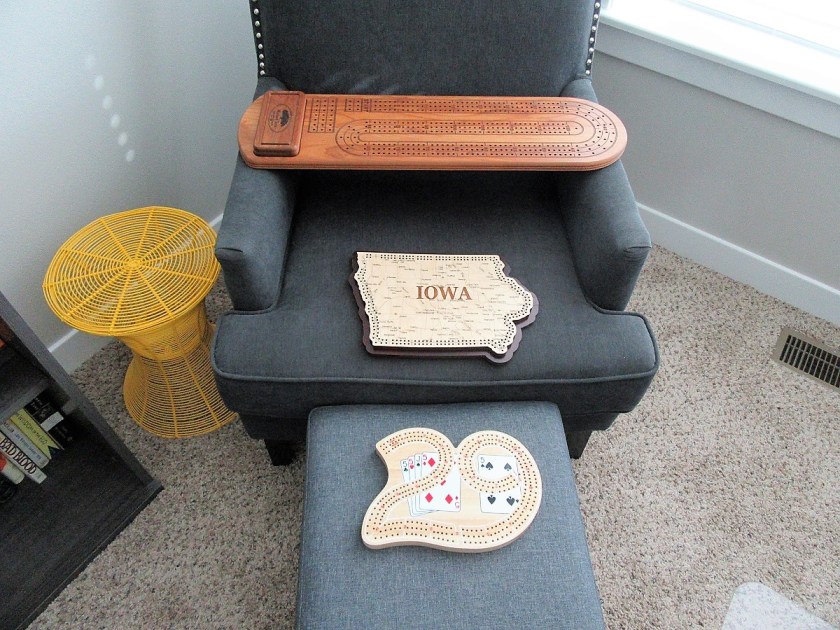
Anyway, the Iowa map cribbage board is smaller than our Jumbo board, but it’s a little bigger than the 29 board.

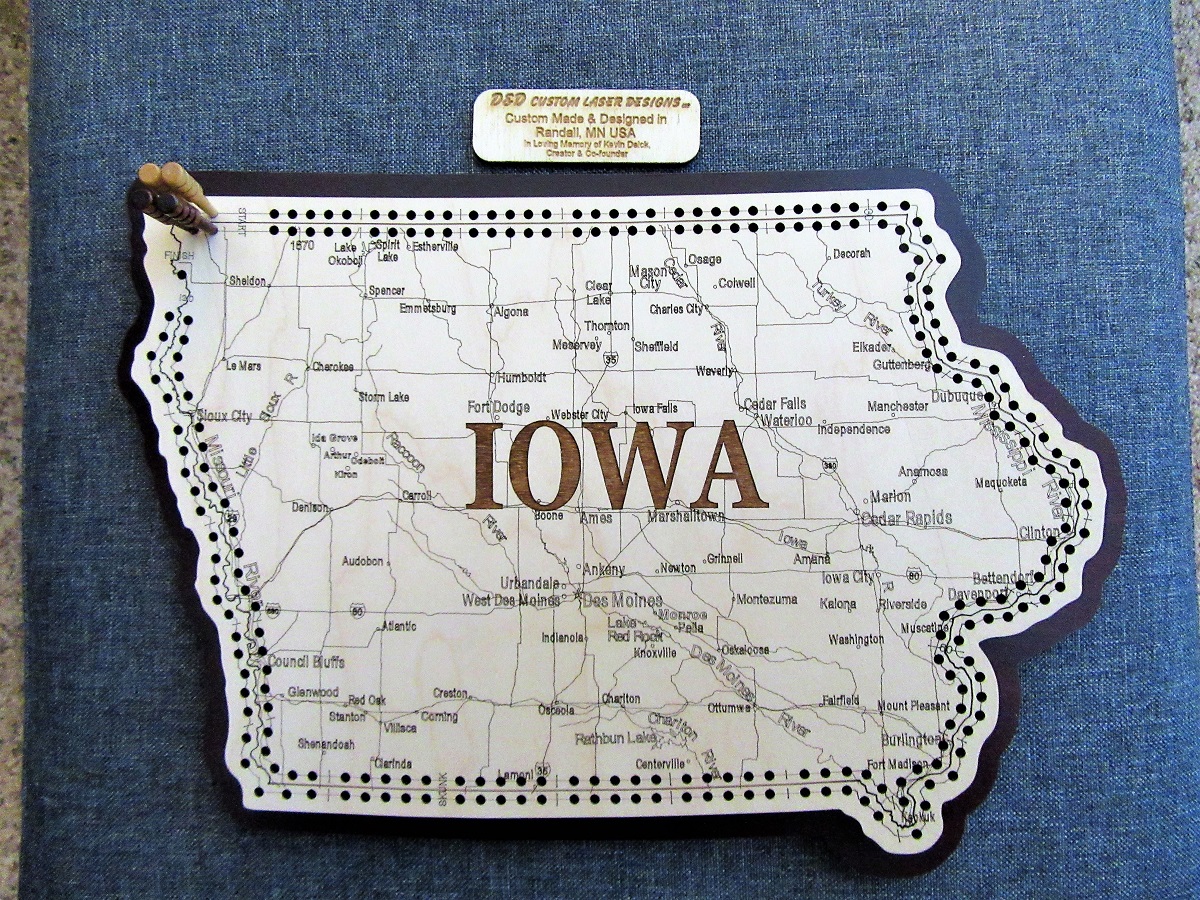
It’s made by D&D Custom Laser Designs. The name is lasered on a little cover which fits over the storage hole for the 4 wooden cribbage pegs. Below the name is “Custom Made & Designed in Randall MN, USA; In Loving Memory of Kevin Deick, Creator and Co-founder.”

I saw one review of the board on the web in which the reviewer expressed doubt that the maker knew anything about cribbage because the description indicates that it includes a pre-installed hanger so it can be used as a wall hanging. The hanger doesn’t interfere with it being used to play cribbage and the board even has small rounded feet in all four corners so you can set it on a table. And it does include pegs.

You can see the names of major and even small cities, the Mississippi and Missouri Rivers, and major highways. It reminds me of places we’ve been and what we did in those places. We haven’t played a game on it yet, but we plan to make a video of that in the near future and post it on YouTube.

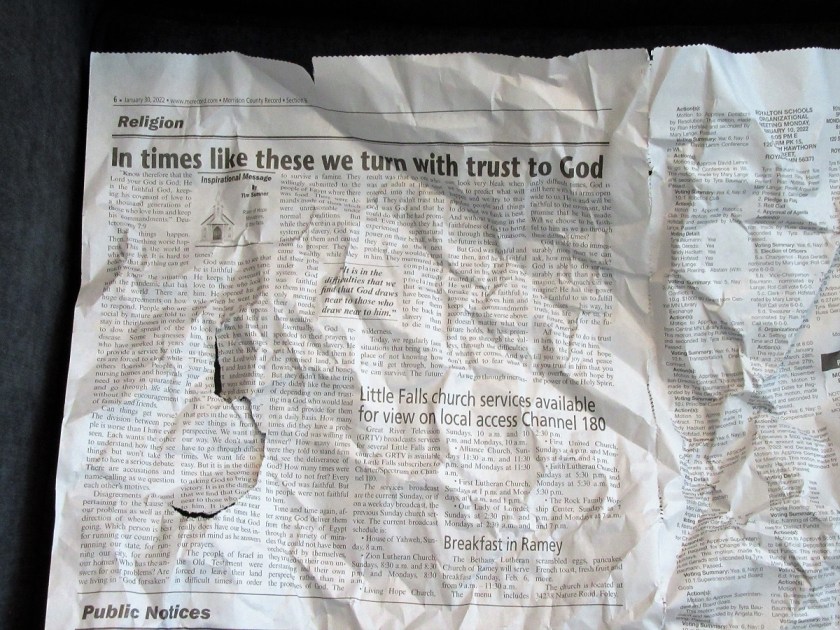
The Iowa cribbage board came wrapped in something we usually don’t see. It was a crumpled-up issue of a local newspaper in Minnesota. The board itself is made in Randall, Minnesota. The newspaper is the January 30, 2022 issue of the Morrison County Record.

I haven’t read a regular newspaper in a long time. The Morrison County Record has a lot of the features I remember from several newspapers like the Des Moines Register and the Globe Gazette (Mason City). I noticed a large column in a section titled “Religion.” I can’t remember the last time I saw a newspaper column like that. The title of the column was “In times like these we turn with trust to God,” with the caption Inspirational Message with a small drawing of a church and the byline was Tim Sumner, evidently the pastor of River of Hope Ministries, Little Falls. So, this newspaper was published in a place called Little Falls in Minnesota.

Little Falls is about 10 miles southeast of Randall.

Anyway, Pastor Sumner (I don’t know if that’s his title, but I’m hoping it’s safe to assume that) wrote what could be given as a Sunday sermon. Because this issue of the Morrison County Record was used as wrapping paper, I had to hold the ripped pieces of it together to read it. The link to the whole sermon on the web is here.

One quote from Sumner:

Today, we regularly face situations that bring us to a place of not knowing how we will get through, how we can survive. The future can look very bleak when we try to predict what will happen and we try to manipulate people and things to do what we think is best. And without trusting in the faithfulness of God to bring us through these situations, the future is bleak.

I have not thought about God in a very long time, but when I was a child, I read the Bible a lot. And I remember the pastor of our church, Reverend Glen Bandel, who was my family’s hero when he took care of mother when she was very sick, and welcomed us in their home when times were bad. Mason City’s local newspaper, the Globe Gazette ran a brief story about his life and ministry when he turned 90 years old a few years ago. You can read it once before the web site requires you to subscribe. It won’t tell you even a tenth of what I and most people feel about his kindness, courage, and wisdom. He has a heart the size of a galaxy.

The population of Randall, Minnesota is 625, and the population of Little Falls is 8,664 (as of 2019). Just because they’re small doesn’t mean they’re not important.

Educating Iowa: A University of Exploration (1847-1897) Uncovering Hawkeye History Part 1

I am thrilled to post this episode of the Uncovering Hawkeye History series out of order. It’s because Sena and I missed Part 1 but noticed that the YouTube video recording of it was posted. The volume is pretty soft, so crank it like you mean it. I plan to post something tomorrow about Part 3, The Next Chapter: Blazing New Trails.

The presenters gave stunning presentations and I’m delighted to let them tell their stories in the video below.

Sara Sanders, PhD, Dean of College of Arts and Sciences. She is all about making the most out of combining both the classical and the practical aspects of a college education.

Liz Crooks, Director of the Pentacrest Museum of Natural History. She loves museums, and told a great history about a character at the museum named Rusty the Giant Sloth (no relation to the third presenter, Dr. Rusty Barcelo). Rusty is made of Styrofoam and other materials. He is a giant sloth and the web page gives you a great idea about who he is. Remember, he’s made of artificial materials, so don’t expect too much. According to her LinkedIn profile, she is:

Experienced administrator with a demonstrated history of working in museums and higher education. Skilled in Nonprofit Organizations, Archival Research, Program Evaluation, Museum Education, and Historical Research. Strong professional skills with a Master’s Degree focused in Museum Studies from Western Illinois University.

Dr. Rusty Barceló held various positions at the University of Iowa from 1975 to 1996 including Assistant Provost and Assistant Dean with the Office of the Provost. Rusty has made a ton of other achievements in many other places in the country. Rusty is named for a scholarship to assist disadvantaged students at the University of Minnesota. Rusty was once the only Chicana student at The University of Iowa, and now is one of America’s most highly respected authorities on diversity and equity in higher education.

Next in The Series: The Next Chapter: Blazing New Trails (1998-2047)

The next and final presentation in The University of Iowa Hawkeye History series is entitled The Next Chapter: Blazing New Trails (1998-2047). I believe you can still register here.

It will be a Zoom presentation from 4:30-6:00 PM tomorrow, February 22, 2022. As in the previous presentations, the guide will be university archivist, David McCartney and will feature the following presenters:

Rod Lehnertz (02MBA), senior vice president for finance and operations

Lynette Marshall, UI Center for Advancement president and CEO

Peter Matthes (00BA, 14MBA), senior advisor to the president and vice president for external relations

Interesting highlights can be previewed below:

Milestones in University of Iowa History

Starting Over

Three Leading Professors on the future of The University of Iowa

Hope you can make it!

Wandering Thoughts on Talents and Traits in “To Kill a Mockingbird”

I’ve been reading To Kill a Mockingbird and thinking over something a character named Miss Maudie said in Chapter 10: “People in their right minds never take pride in their talents.” It seems to run counter to popular opinion. Why wouldn’t you take pride in your talents?

I got a lot of hits on my google search for this quote, by the way.

Miss Maudie’s statement was soon after Atticus shot a rabid dog with a marksman’s skill. Jem and Scout had been grousing about how they couldn’t find anything to be proud of in their old man. Atticus had never told his children about his skill as a marksman. He gave his kids guns but declined to teach them how to shoot.

I try to make sense of Miss Maudie’s comment by thinking about marksmanship as a skill, which is often distinguished from a talent, usually because the latter is thought to be a trait you’re born with. On the other hand, it’s hard to think of modesty (which is what keeps you from bragging or “taking pride”) as a talent. Some might say it’s more like a character trait.

Can you can develop a talent by practice? Can you improve your modesty by working at it and how would you do that, deadlifting your inner barbells? I tend to think you either have it or you don’t. And why does it take being in your right mind to refuse to take pride in or brag about your talent?

I often hear athletes (think Super Bowl) bragging non-stop about their talents. But I stop well short of admiring them for doing it. It’s annoying, but often preferable to the half-time show. Why do they grab their crotches?

Maybe it doesn’t make sense to brag about a talent you’re born with. I’m not sure if modesty is also something you’re born with. Babies seem very immodest, especially when they’re pooping, based on my extensive research of TV commercials and anecdotes.

On the other hand, a talent is also often said to be something which can be honed to perfection. In fact, Miss Maudie said that Atticus’s skill with a gun was a gift from God, a talent—which he perfected by practice. This might contradict the definition of talent as a thing you’re just born with. She goes on to say that Atticus thought this particular gift from God gave him an unfair advantage, so he gave it up. It would be unseemly to take pride in such a thing, and why would it even occur to someone with a talent to minimize it? The religious reference “pride goeth before a fall” is obvious, but religion doesn’t always seem to play a big role.

Maybe both talent and traits like modesty can be honed as well. What if they’re sort of like lifting just one of your eyebrows to make you look haughtily bemused? You can cultivate it, or at least some people say you can. There’s even a WikiHow for it. But it seems like you have to find your dominant eyebrow, which means there’s something inborn that makes it easier.

Can you develop modesty as though it’s a skill, assuming that it’s also a trait which is malleable? Is there a modesty cortex? Then, you could say some people have a talent for modesty. And how about those splinter talents or skills (like suddenly playing the piano like a virtuoso) which can appear abruptly after brain injuries? Can modesty be like that, a nascent itch in the body waiting to be scratched? That kind of makes you want to drop a piano on the guy at the cocktail party who brags about his golf game, doesn’t it?

I suppose some would take pride in being modest, although it sounds paradoxical—until I remember all the people I’ve seen who can feign desirable traits.

So, is there a Gold’s Gym for character traits where we can go and develop talents like modesty, patience, respect, kindness, and mercy?

Not exactly, but we can give ourselves a kick start by checking out some resources that aren’t that hard to find. Those would be different from what you can pick up from “To Kill a Mockingbird,” although it’s obvious that’s how I got steered to this topic in the first place. Remind me again, why is this book be taken off required reading lists?

Update on “Endless Innovation: An R1 Research Institution (1948-1997)”

Last night’s webinar on Uncovering Hawkeye History, “Endless Innovation: An R1 Research Institution (1948-1997) was fascinating for us.

Dr. Bruce Gantz kicked off the first presentation about his work in cochlear implant surgery. Business picked up for him as far as these procedures in the last year and a half partly because of the pandemic. We were stunned to learn that the demand was driven because so many people were wearing masks—which prevented the deaf from lip-reading.

Kevin Washburn was next up and highlighted the great performance of the UI Law school’s stunning list of 4 student-led law review journals. They rank extremely high in the country, up there in the company of Yale and Harvard. I’m off on a tangent here, but Washburn’s status as a citizen of the Chickasaw Nation (which is based in Oklahoma; there are no Chickasaw tribal members in Iowa despite there being a Chickasaw County, by the way) reminded me of a guy who was a year behind my class in medical school. His name is Orrenzo Snyder and he’s a urologist in Oklahoma. Orrenzo and several other fellow students founded the American Indian Student Association (AISA) in 1989, which was later renamed the Native American Student Association (NASA). The University of Iowa Pow Wow was established in 1990. The 26th Annual Pow Wow is scheduled for April 2, 2022. Give it up for Orrenzo!

Anyway, Washburn mentioned one of the many stars in the UI Boyd Law school: Willard (Sandy) Boyd (for whom the college is named) who became one of the youngest University of Iowa presidents to take office and did so during a rowdy time of student unrest—in 1969. He raised a lot of money for the institution and was an advocate of human rights. He was appointed first chair of the University of Iowa’s Human Rights Committee.

You can also discover other facts, such as in 1839 the Iowa Territorial Supreme Court ruled that Ralph, a slave brought into free territory, must be released from slavery, in 1846; Iowa was admitted to the Union as a “Free State;” and in 1868 In Clark v. Board of Directors the Iowa Supreme Court ruled that the Iowa Constitution guarantees the right to public education to all citizens. The plaintiff parent was Alexander Clark, Sr., who later graduated from the Iowa Law School (possibly the first African American to do so at UI). Justice Chester C. Cole wrote the opinion for the case.

University Archivist David McCartney also mentioned 1969 as a noteworthy year because that was the year of the Apollo 11 moon landing. There’s an Iowa connection to the Apollo 11 mission and that is State University of Iowa professor James A. van Allen in the Department of Physics, who warned of the danger to astronauts of the radiation belts encircling the earth (these were later renamed the Van Allen belts).

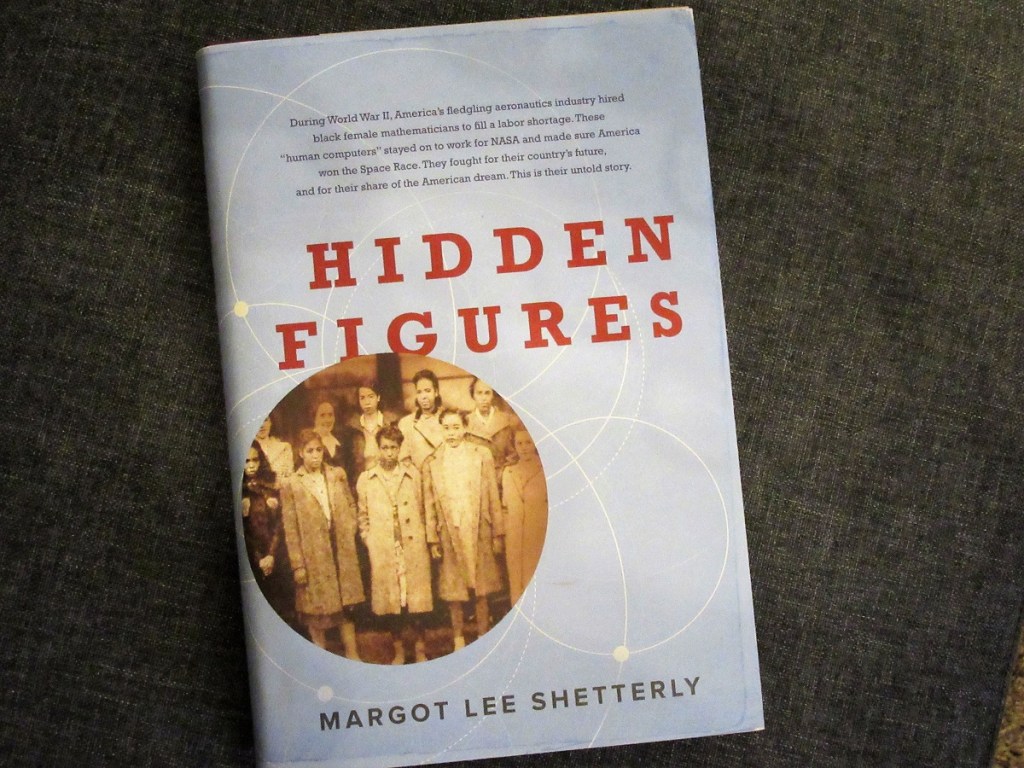
And I would add that African American women helped put astronauts on the moon in 1969.

Ed Wasserman expounded on his scientific work with pigeons and humans, comparing them on how they use their brains to solve problems. Are we better than pigeons? Maybe. Wasserman also gave many examples of how trial and error led to some surprising advances and innovations: the Ponseti method for treating clubfoot, the butterfly stroke in swimming, and Field of Dreams. His point is that the 3 Cs: consequence, context, and coincidence, play the larger role in many great achievements.

In other words, just keep pecking away at it.

Our Impressions of University of Iowa Free Webinar Yesterday: The Stories That Define Us”

We were overall delighted with yesterday’s presentation, University of Iowa Free Webinar: “Breaking Barriers: Arts, Athletics, and Medicine (1898-1947).” It’s one in a series of 4 virtual seminars with two more scheduled this month, which you can register for at this link.

February 15: Endless Innovation: An R1 Research Institution (1948–1997)

February 22: The Next Chapter: Blazing New Trails (1998–2047)

The moderator was university archivist and storyteller, David McCartney.

Presenters include:

Yesterday’s presentation was recorded and will be uploaded to The University of Iowa Center for Advancement YouTube site at a later date.

McCartney did an excellent job as moderator, although got stumped from a question from a viewer about who was the first African American faculty member in the College of Medicine. He’s still working on tracking that down. It wasn’t me. I’m not that old and I am not risen from the dead, as far as I can tell; but to be absolutely clear, you should ask my wife, Sena. I was able to google who was the first African American graduate of the University of Iowa law school: Alexander Clark, Jr. McCartney thinks he might have been the first University of Iowa alumnus, although he couldn’t confirm that.

On the other hand, I could have been the first African American consulting psychiatrist (maybe the only African American psychiatrist ever) in the Department of Psychiatry at UIHC—but I can’t confirm that. Maybe McCartney could work on that, too.

 There are a few words about me in the department’s own history book, “Psychiatry at Iowa: The Shaping of a Discipline: A History of Service, Science, and Education by James Bass: Chapter 5, The New Path of George Winokur, 1971-1990:

“If in Iowa’s Department of Psychiatry there is an essential example of the consultation-liaison psychiatrist, it would be Dr. James Amos. A true in-the-trenches clinician and teacher, Amos’s potential was first spotted by George Winokur and then cultivated by Winokur’s successor, Bob Robinson. Robinson initially sought a research gene in Amos, but, as Amos would be the first to state, clinical work—not research—would be Amos’s true calling. With Russell Noyes, before Noyes’ retirement in 2002, Amos ran the UIHC psychiatry consultation service and then continued on, heroically serving an 811-bed hospital. In 2010 he would edit a book with Robinson entitled Psychosomatic Medicine: An Introduction to Consultation-Liaison Psychiatry.” (Bass, J. (2019). Psychiatry at Iowa: A History of Service, Science, and Education. Iowa City, Iowa, The University of Iowa Department of Psychiatry).”

And in Chapter 6 (Robert G. Robinson and the Widening of Basic Science, 1990-2011), Bass mentions my name in the context of being one of the first clinical track faculty (as distinguished from research track) in the department. In some ways, breaking ground as a clinical track faculty was probably harder than being the only African American faculty member in the department.

I had questions for Lan Samantha Chang and for Dr. Patricia Winokur (who co-staffed the UIHC Medical-Psychiatry Unit with me more years ago than I want to count.

I asked Dr. Chang what role did James Alan McPherson play in the Iowa Writers Workshop. She was finishing her presentation and had not mentioned him, so I thought I’d better bring him up. She had very warm memories of him being her teacher, the first African American to win a Pulitzer Prize for fiction, and a long-time faculty member at the Workshop.

She didn’t mention whether McPherson had ever been a director of the Workshop, though she went through the list of directors from 1897 to when she assumed leadership in 2006. You can read this on the Workshop’s History web page. I have so far read two sources (with Wikipedia repeating the Ploughshares article item) on the web indicating McPherson had been acting director between 2005-2007 after the death of Frank Conroy. One source for this was on Black Past published in 2016 shortly after his death, and the other was a Ploughshares article published in 2008. I sent an email request for clarification to the organizers of the zoom webinar to pass along to Lan Samantha Chang.

I asked Dr. Winokur about George Winokur’s contribution to the science of psychiatric medicine. Dr. George Winokur was her father and he was the Chair of the UIHC Psychiatry Department while I was there. She mentioned his focus on research in schizophrenia and other accomplishments. I’ll quote the last paragraph from Bass’s history on the George Winokur era:

“Winokur, in terms of research, was a prototype of the new empirical psychiatrist. Though his own research was primarily in the clinical realm, he was guided by the new neurobiological paradigm (perhaps in an overbalanced way) that was solidifying psychiatry with comparative quickness. New techniques in imaging and revelations of the possibilities in genetic study and neuropsychopharmacology lay ahead. George Winokur had helped the University of Iowa’s Department of Psychiatry—and American psychiatry as a whole—turn a corner away from subjectivity and irregularity of Freudian-based therapies. And once that corner had been turned there was no going back.”

George Winokur was the department chair at University of Iowa Hospitals and Clinics from 1971 to 1990 and had a unique and memorable style. George also had a rough sense of humor. He had a rolling, gravelly laugh. He had strict guidelines for how residents should behave, only slightly tongue-in-cheek. They were written in the form of 10 commandments. Who knows, maybe there are stone tablets somewhere:

Winokur’s 10 Commandments

  1. Thou shalt not sleep with any UI Psychiatry Hospital patient unless it be thy spouse.
  2. Thou shalt not accept recompense for patient care in this center outside thy salary.
  3. Thou shalt be on time for conferences and meetings.
  4. Thou shalt act toward the staff attending with courtesy.
  5. Thou shalt write progress notes even if no progress has been made.
  6. Thou shalt be prompt and on time with thy letters, admissions and discharge notes.
  7. Thou shalt not moonlight without permission under threat of excommunication.
  8. Data is thy God. No graven images will be accepted in its place.
  9. Thou shalt speak thy mind.
  10. Thou shalt comport thyself with modesty, not omniscience.

Quinn Early has a lot of energy and puts it to good use. His documentary of the sacrifices of African American sports pioneers, including “On the Shoulders of Giants” (Frank Kinney Holbrook) is impressive.

There was a good discussion of the importance of the book “Invisible Hawkeyes: African Americans at the University of Iowa during the Long Civil Rights Era”, edited by former UI faculty, Lena and Michael Hill.

Sena and I thought yesterday’s presentation was excellent. We plan to attend the two upcoming webinars as well. We encourage others to join.

University of Iowa Free Webinar Tonight: The Stories That Define Us”

We just found out that the University of Iowa is presenting a free webinar this evening from 4:30—5:30 PM. It’s a zoom meeting and the title is “Breaking Barriers: Arts, Athletics, and Medicine (1898-1947)”. It’s part of a 4-part series that started February 1, 2022, “Uncovering Hawkeye History: The Stories That Define Us.”

Presenters include:

  • Lan Samantha Chang (93MFA), Iowa Writers’ Workshop director and acclaimed author
  • Quinn Early (87BA), Hawkeye football star and film producer
  • Patricia Winokur (88R, 91F), professor of internal medicine–infectious diseases

We discovered this presentation after a long, spirited conversation about race relations generally this morning over breakfast. Authors mentioned included Ralph Ellison, author of “Invisible Man” and James Alan McPherson, long time faculty and director of the Iowa Writers Workshop, author of first African American to win a Pulitzer Prize winner for fiction with his collection “Elbow Room.”

There were several cross threads in our conversation. One of them was my memory of a visiting professor (whose name, however, I can’t remember) who gave a presentation about being Black in America at Huston-Tillotson College (now Huston-Tillotson University; one of the HBCUs in America) in Austin, Texas. He said something I’ll never forget. I mentioned this in a book review published over 20 years ago in the American Journal of Psychiatry:

A guest lecturer (who, as I recall, had also written a book about being black in America) told us that the white man would never allow a black man to be a man in America. He had only three choices: he could be a clown, an athlete, or a noble savage. These corresponded to the prominent and often stereotyped roles that blacks typically held in entertainment, sports, and black churches. It begged the question of what on earth could we hope to accomplish— JAMES J. AMOS, M.D., Iowa City, Iowa (2000). “Being Black in America Today: A Multiperspective Review of the Problem.” American Journal of Psychiatry 157(5): 845-846.

This is related to another memory, that of the quasi-character Rinehart in Ellison’s “Invisible Man.” The name refers to the multiple perspectives from which a black person (or any person, really) can look himself. You can look at the word itself as compound, containing two words, “rind” and “heart.” Understood as metaphors, you can readily see how it could apply to anyone. We can have a surface personality socially, and we can have an inner core, a heart that is hidden and which can truly define who we are. We’re always changing, inside and out, backwards and forwards.

On the subject of hidden stories, I am also reminded of the book “Invisible Hawkeyes: African Americans at the University of Iowa during the Long Civil Rights Era”, edited by former UI faculty, Lena and Michael Hill. The book describes the mixed reactions of African Americans to the interracial climate in Iowa City and at the University of Iowa during that era. Not all felt welcome, although James Alan McPherson did. Indeed, the Hills often highlight the fluidity of the interactions, which makes me think of Rinehart.

David McCartney, the university archivist, is joining the presentation. He led the drive to rename Johnson County in Iowa for Dr. Lulu Merle Johnson, an accomplished University of Iowa alumna, by putting up an on-line petition which gathered 1,000 signatures. We’re looking forward to this evening’s presentation.