History Lessons in the Ramshorn Journal

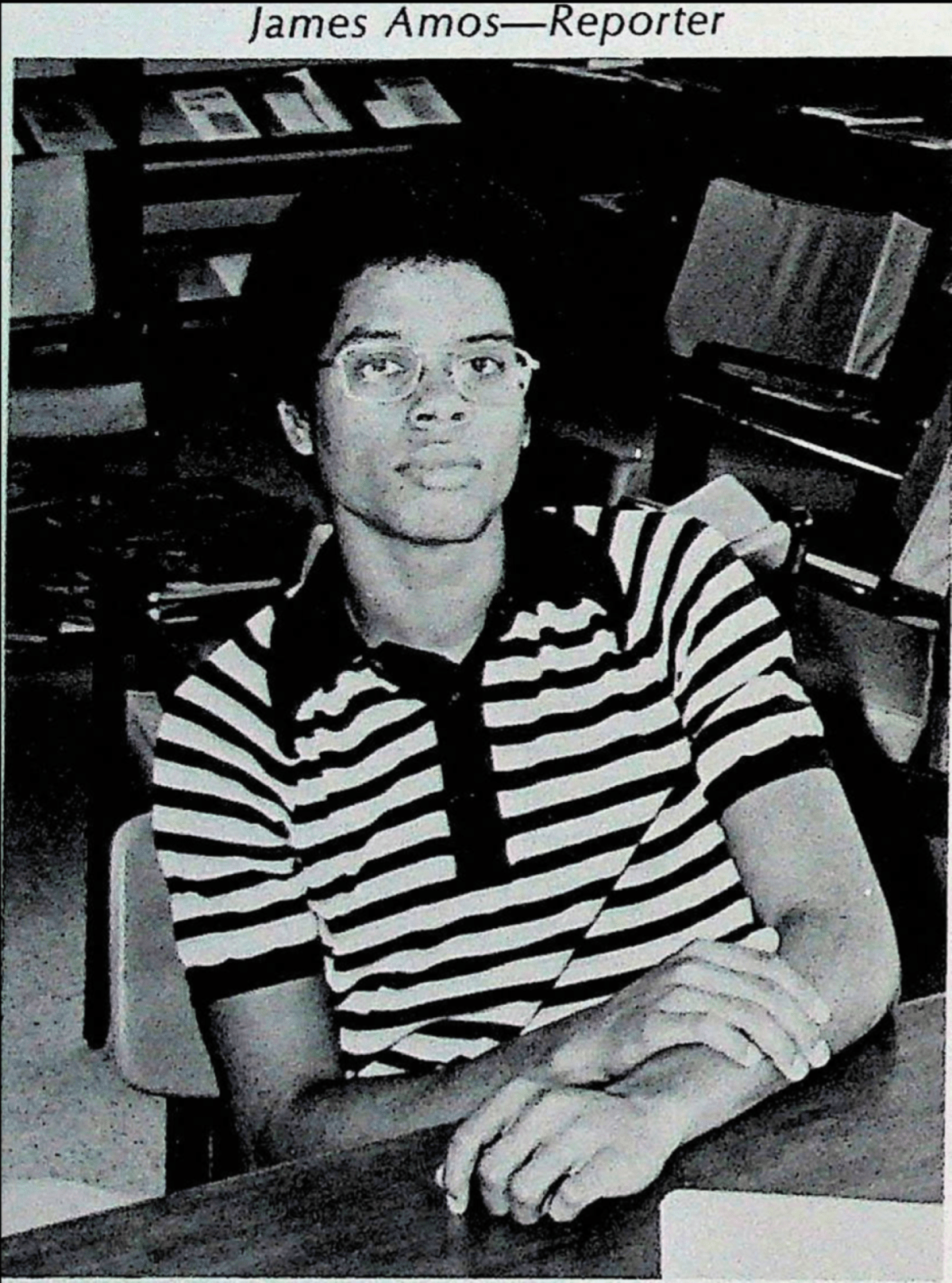
I think I found a pair of articles from the mid-1970s in the Huston-Tillotson College Ramshorn Journal that might have a connection to each other, even though the authors didn’t know it at the time.

One of them was written by yours truly and published in December of 1975, entitled “H-TC Sponsors Education Seminar.”

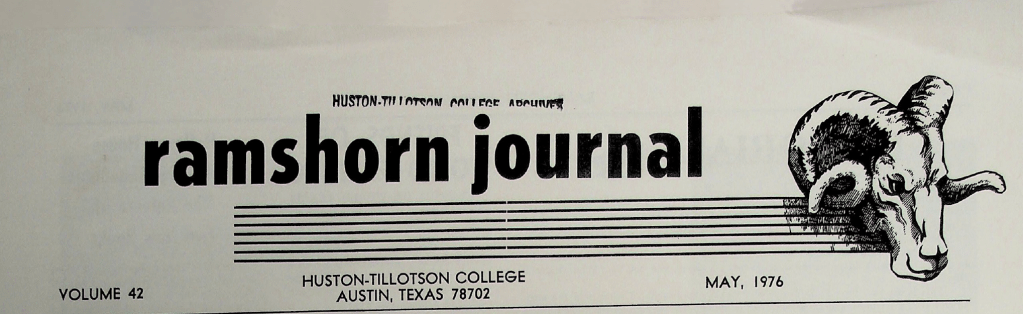
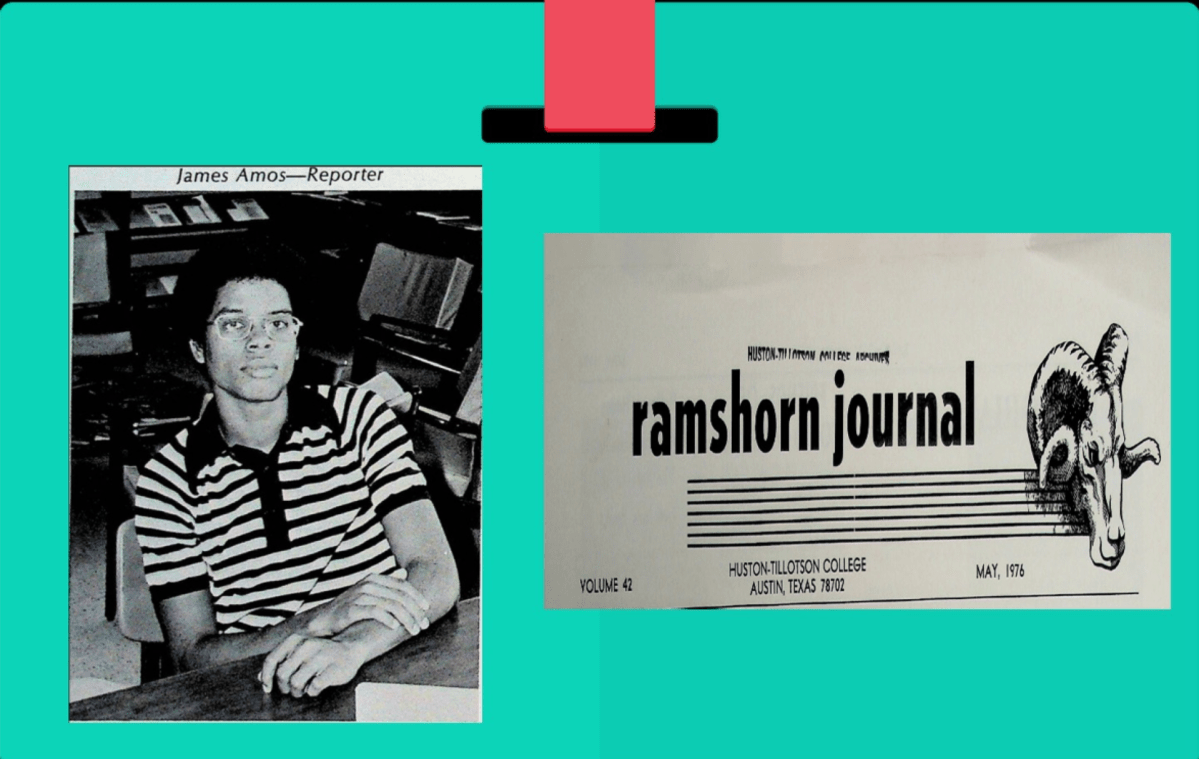
The other is a New York Times editorial from January 1976 which was reprinted in the May 1976 volume of the Ramshorn Journal and was written by Christopher F. Edley, a very successful lawyer and, at the time, the Executive Director of the United Negro College Fund.

Both were written about the same time, in the era of the civil rights struggles. I’m not comparing myself to the brilliant and accomplished Mr. Edley. And I’m just going to admit that I really don’t remember much about the trip to Houston for the Education Seminar about which I wrote my article, despite my being a participant. But I think it’s hard not to notice the language I used in my description of the importance of what the education seminar was all about. While much of the text is rather dry, when I discuss what was emphasized, I sound a little more intense. I may not remember much of what we specifically did and said but I caught the tone.

When I say the trip was not a guided tour, I mean that both faculty and students were serious about what the main message was for us—as black people. We had to measure up in a way that implied that we had to be better than best. That whole section starting with “Throughout the program, our people were reminded that any person who aspires to a position with any company must fulfill particular criteria.” It was as if I were saying we had to be perfect to make up for being black. We had to be the exemplars.

The individual must exhibit creativity, aggressiveness, ambition, self-confidence, initiative, dedication, maturity, and an ability and willingness to cooperate and effectively communicate with other people. The individual must punctual and reliable. Industry demands nothing less than high-gear performance. But they pay handsomely for that high-gear performance.

As I read this now, I get caught up on all the exhortations to be scrupulous, alert, and so on because, after all, we’re in a corporate jungle which is all about survival. I could have recast the last sentence above as “But they pay dearly for that high-gear performance”—which refers to the candidate, not the one doing the hiring.

I admit that how I wrote the story may reflect my reaction to rather than the reality of the emphasis of speakers at the seminar.  But I did get the impression that I, as a black person, would be held to a higher standard than a white person. And I was uncomfortable about that.

When I turn to the New York Times article by Mr. Edley, I again am impressed with the struggle for fairness and justice, which didn’t seem forthcoming. He expressed the same sense of unfairness that I felt in Houston. The tone is almost one of outrage. He described the black people who were going to college in those days as most likely being the first ones in their families to go to college.

That’s what I was.

Mr. Edley was expressing frustration about blacks and browns just being able to get to the door of opportunity. I got the message that the struggle would go on forever—even if we got in the door. We didn’t just have to prove we were equal. We had to prove we were better.

Anyway, as I read the articles I wrote for the Ramshorn Journal 50 years ago, I begin to realize why I had no memory of having written them. It gradually becomes less strange that I still don’t really remember much of my time at Huston-Tillotson College, one of the historically black colleges and universities (HBCU) in America. But I needed that experience, even if I did pay dearly for it.

Click in the gallery; click on the picture, click the icon with an “i” in a circle, click view full size, click the plus sign to enlarge the image.

Plate!

I was listening to the Big Mo Blues Show last night on KCCK radio, 88.3 on your FM dial. I didn’t hear him mention his favorite cook, May Ree. She cooks hand-battered catfish; it’s better because it’s battered. Often, he’ll add a little to the legend, like where you can find May Ree’s establishment where you can buy her hand-battered catfish, which is filled with nitrates, cooked to perfection with manic delight, and which you can pair with any one of three flavors of moonshine, including the famous Classic Clear.

I don’t know whether Classic Clear has fruity, nutty, or extraterrestrial notes. You’ll have to try to find her joint, which is somewhere at the intersection of a highway and a street the name of which I can never recall. The story gets a new variation every now and then. May Ree has many facets to her character.

May Ree actually reminds me of the head cook at Huston-Tillotson College (now Huston-Tillotson University) in Austin, Texas. Back in the 1970s, I was a student there for a while. The head cook in the college cafeteria was Miss Mack. I don’t think you could say she cooked anything with manic delight. In fact, some of us were regular visitors who rushed with manic delight to Church’s Chicken because the H-TC cafeteria didn’t always serve what you’d call top of the line fare.

I guess Church’s want to call themselves Church’s Texas Chicken these days, mainly because they got the business started in San Antonio. Back in the day, Church’s Texas Chicken was a five-minute walk from the college. I checked a map recently, and now there isn’t a joint within an hour’s walk.

Anyway, I was a fairly frequent customer to Church’s Texas Chicken. You didn’t have a whole lot of choices about what to select. In fact, I don’t recall that there was a selection, per se. What you saw was what you got.

Sometimes, certain students were pretty frank about what they thought of Miss Mack’s cooking. One day, a guy who was fed up, in a manner of speaking, of course, held up his plate so that it was vertical, and weirdly, none of the food slid off. It just stuck there, like it was sort of a sculpture of a meal.

And then he called out loudly to everyone else in the cafeteria (not that there were many people there) as if he were offering to give to anyone there:

“Plate!” (no takers). “Plate!” (still no takers). “Plate!” (students just ignored him, but started making funny looks at their own plates).

I don’t remember what happened, but I think he just left his plate on the table and departed. I doubt Miss Mack was there. I was ambivalent about the whole deal. I liked Miss Mack, as did a lot of other students. She was kind and always had a bright smile for us.

Maybe he made a run to Church’s Texas Chicken. Funny, I didn’t see him there.

KCCK Big Mo Blues Show Brings Back Memories

Last night on the KCCK Big Mo Blues Show I listened to something I haven’t heard since the mid-1970s. It was a radio commercial for the Green Beetle and Frank’s Liquor Store. It ran right after the song, “Memphis Women and Fried Chicken.”

I think I first heard this radio ad while I was a student at Huston-Tillotson College (now Huston-Tillotson University) in Austin, Texas in the mid-1970s.

I heard it early on in the evening in my sweltering college dorm room. Later on, I heard a stirring rendition of the opening song, “Lift Every Voice and Sing,” for another radio program, the name of which I can’t recall. I don’t know who sang it, but her voice was breathtaking. I have not heard a better version of it since.

The contrast between the “Old Crow Boogie” and “Lift Every Voice and Sing” was striking. No matter what race, culture, gender we are, we struggle to reconcile these opposites.

On the Other Hand Thoughts on HBCUs

Historically Black Colleges and Universities (HBCU) are in the news lately. It reminds me of the short time I spent at Huston-Tillotson College. It was renamed Huston-Tillotson University (H-TU) in 2005. I was there in the mid-1970s.

A new President and CEO was just named this month, Dr. Melva K. Williams. And H-TU was recently added to the National Register of Historic Places last month. It has been renovated and modernized. Pictures show a well-kept campus pretty much as I remember it over 40 years ago. I didn’t graduate from H-TU, but instead transferred credits to Iowa State University where I graduated in 1985.

My favorite teacher was Dr. Jenny Lind Porter-Scott, who was white, taught English Literature. Another very influential teacher was Reverend Hector Grant who was black. He taught philosophy and religion. He was instrumental in recruiting me to matriculate at H-TU. He helped me to process my loss on the debating team when the question was whether or not the death penalty played any role in the reduction of crime.

My opponent won the debate mainly because he talked so much, I couldn’t get a word in edgewise. I can’t remember which side of the question I argued, but I thought I could have done better if he had just shut up for a few minutes and let me speak. Reverend Grant used the word “bombastic” in describing the approach my opponent used. On the other hand, he also gently pointed out that sometimes this can be how debates are won.

There’s this “On the other hand” tactic in debating and in reflective thought that my debating opponent managed to repeatedly deflect.

I don’t know what ever happened to Reverend Grant. We spoke on the telephone years ago. He sounded much older and a hint of frailty was in his voice.

I could find only a photo on eBay of a man who closely resembles the teacher I knew and the name on the picture is Reverend Hector Grant. The only other artifact is a funeral program for someone I never knew, which lists Reverend Hector Grant as being the pastor and some of the pallbearers were members of one of the Huston-Tillotson College fraternities.

I think it’s unusual for people to disappear like that, especially nowadays when we have the world wide web. Reverend Hector Grant was an important influence for me. He was one of the few black men of professional stature I encountered in my early life.

On the other hand, contrast that with Reverend Glen Bandel, another clergyman who was a white man and another important influence starting in my early childhood. Reverend Bandel persuaded me to be baptized at Christ’s Church in Mason City, Iowa. He radiated mercy, generosity, and kindness. He died in June of this year. I can find out more about him on the web just from his obituary than I can ever find on Reverend Grant, who apparently disappeared from the face of the earth.

Both of these men were leaders for whom skin color didn’t matter when it came to treating others with respect and civility.

My path in life was largely paved by these two clergymen. Reverend Bandel sat up with our family one night when my mother was very sick. His family took me and my little brother into their home when she was in the hospital.

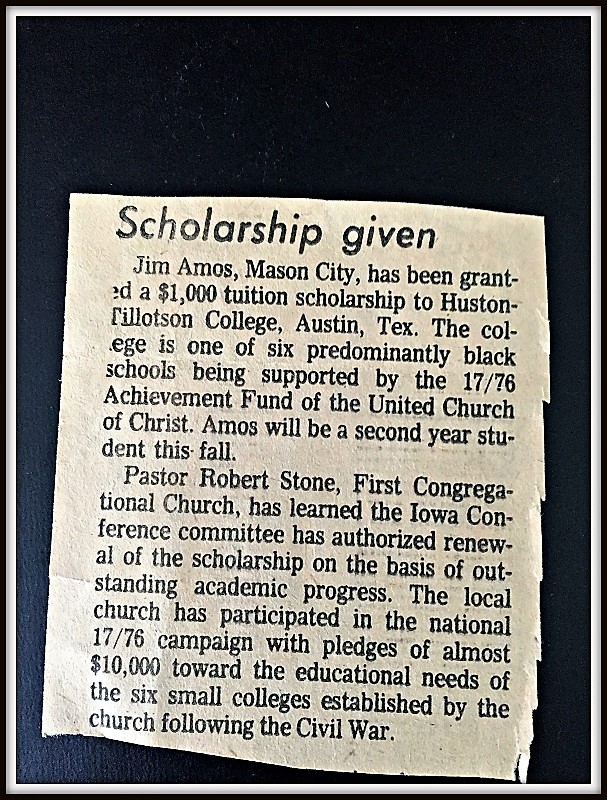
On the other hand, Reverend Grant was instrumental in guiding me to an HBCU where I saw more black people in a couple of years than I ever saw in my entire life. The First Congregational Church in Mason City was instrumental in making that possible because they helped fund the drive to support H-TU (one of six small HBCUs) by the national 17/76 Achievement Fund of the United Church of Christ.

The news is replete with stories, some of them tragic, about how Greek fraternities haze their pledges. On the other hand, H-TU was pretty rough on pledges too. Upper classmen would make the pledges roll down the steep hills around the campus. They looked exhausted, wearing towels around their necks, running in place when they weren’t running somewhere in the Texas heat.

One H-TU professor said that H-TU was “small enough to know you, but big enough to grow you.” Although I can’t remember ever seeing him on campus because he was traveling most of the time, I at least knew the name of the President was John Q. Taylor (1965-1988). On the other hand, when I transferred credit to Iowa State University, I never knew the name of the President of the university.

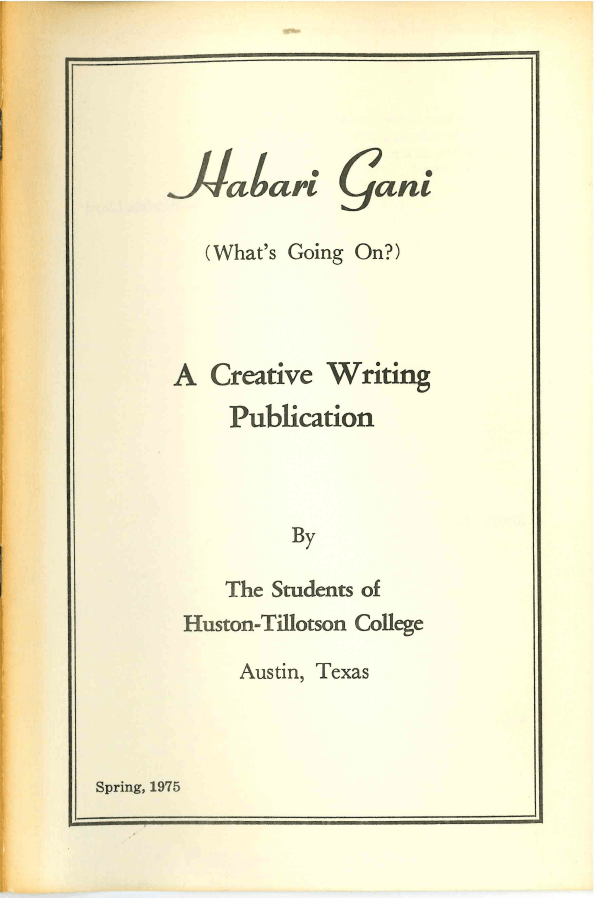
Habari Gani is Swahili for “What’s the news?” or as it translated in the context I’m about to set, “What’s going on?” Habari Gani was the name for the annually published book of poetry by the H-TU students. Dr. Porter supported the project. I submitted a poem for the 1975 edition, which didn’t make the cut. When I transferred to Iowa State University, I left without getting a copy.

On the other hand, years later, I got a digital copy of that edition. I tracked it down to the H-TU library in 2016. The librarian was gracious.

Habari Gani has always been a reminder of the reason why I went to H-TU in the first place. I grew up in Iowa and was always the only black student in school. I grew up in mostly white neighborhoods.

On the other hand, when I finally got to H-TU, one of the students asked me, “Why do you talk so hard?” That referred to my Northern accent, which was not the only cultural factor that made social life challenging.

Once I tried to play a pickup game of basketball in the gymnasium. I’m the clumsiest person for any sport you’ll ever see. I was terrible. But the other players didn’t give me a bad time about it. They softly encouraged me. This was in stark contrast to the time I played a pickup game with all white men years before in Iowa. When I heard one of them yell, “Don’t worry about the nigger!” I just sat down on the bleachers.

On the other hand, when I was a kid and our family was hit by hardship, Reverend Bandel was the kindest person on earth to us—it didn’t matter that he was white. And my 2nd grade teacher, who was black (the only black teacher I ever had before going to H-TU), slapped me in the face so hard it made my ears ring—because I was rambunctious and accidentally bumped into her. It’s far too easy to polarize people as good or bad based on the color of their skin, especially when you’re young and impressionable.

It takes practice and experience to learn how to say and think, “On the other hand….”

Black History Nugget: Huston-Tillotson University

I just encountered a nugget about the history of Huston-Tillotson University (H-TU), one of the 107 Historically Black Colleges and Universities (HBCU). There is an Iowa connection to the school. In 1877, a farmer named Samuel Huston from either Marengo, Iowa or Honey Creek Township, Iowa (depending on what you read) donated land and money amounting to $10,000 ($9,000 according to other records) to what would become Samuel Huston College in Austin, Texas. In 1952, Samuel Huston College merged with Tillotson College to form Huston-Tillotson College. I was a student there in the mid-1970s.

The Texas State Historical Association (TSHA) says Huston was from Honey Creek Township (there is more than one Honey Creek in Iowa), which is in Iowa County. Just about everyone else says he was from Marengo, which is also in Iowa County.

Baseball legend Jackie Robinson was the basketball coach for one season in the 1940s at Samuel Huston College prior to the merger with Tillotson College. The Rams didn’t fare well, according to the Wikipedia article about H-TU. I recall going to one of the basketball games when I was a student in the 1970s. They didn’t fare well at that game either. At one point, one of the H-TU students in the stands yelled out very loudly “Mets!” This drew laughter even from the fans. He was known for his sense of humor.

The H-TU baseball team played on Downs Field on campus. If I remember the layout correctly, you could cut across Downs Fields to get to Church’s Chicken. It was a short walk. If you press me for details about how I would know that, it might force me to make a few comments about the dining hall food. So, don’t press me. Don’t bother looking for Church’s Chicken in that area on Google maps. It’s long gone.

It wasn’t all about Church’s Chicken. There were outlets for activism at that time. Along with a couple of classmates, I attended a meeting of a few members of the Nation of Islam. We were frisked at the door. Malcolm X had been an influential leader of the Nation of Islam until his assassination in 1965. One speaker at the meeting said a number of times “You might see me anywhere” (Church’s Chicken?). I’m not sure why he said it so many times.

I recall a visiting sociology professor who delivered an electrifying lecture all about how to create change in society by direct action. He assigned me and another student to interview members of the Austin, Texas Police Department about how black people might be targeted for unequal treatment under the law in certain parts of the city. We got stuck in a corner of the department with very large volumes of the uniform crime report. The police were very polite but didn’t say much. I don’t remember how the professor graded us.

One of my favorite teachers at H-TU was Dr. Lamar “Major” Kirven. We called him Major Kirven because he was a military officer as well as a teacher. He taught Black History. He tried to write on the blackboard but nobody could read his handwriting because it was always illegible. It was a running joke with all of his students and he had a great sense of humor about it. One time, I complained about another student in the class who was pretty good at being interruptive. He said, “Brother Amos, patience is a virtue.”  

I’ve been trying to learn from Major Kirven ever since.

February is Black History Month: Lift Every Voice and Sing

February is Black History Month and I have been searching the web for a nice rendition of the song Lift Every Voice and Sing. This is otherwise known as the Negro or Black National Anthem. I found an excellent performance recorded on YouTube by over one hundred students and alumni of the Historically Black Colleges and Universities (HBCU). They are members of the National HBCU Concert Choir.

That means something special to me because I attended Huston-Tillotson University back in the mid-1970s. Sure enough there was a member of the choir from H-TU.

The school was called Huston-Tillotson College back then. I was there for just a couple of years before I transferred credit to Iowa State University, graduating from ISU in the mid-1980s. I remember my first year in the men’s dormitory. That’s right, the women were separated from the men. There was no air conditioning, if you can imagine that in the sweltering summer of Austin, Texas.

I remember vividly the powerful rendition of Lift Every Voice and Sing as performed by a woman on an evening radio show I would listen to while trying not to think about the heat. She sang it before every show. I don’t remember anything else about the format or content of the program—just her impossibly perfect voice. I have not heard anything more compelling since then by a single performer.

The history of the song and the lyrics is on the NAACP web site. The first performance was by 500 schoolchildren. The National HBCU Concert Choir version probably fits the intention of the authors, James Weldon Johnson and his brother, John Rosamond Johnson. It’s in the title of the song itself, Lift Every Voice and Sing. It’s meant to be sung by many in unison.

Jenny Lind Porter Scott: In Remembrance

I met Dr. Jenny Lind Porter Scott, one of my favorite teachers, in the mid-1970s during my first two years of college at what was then called Huston-Tillotson College (now Huston-Tillotson University or HTU). It’s one of America’s historically black colleges. I didn’t graduate from there, instead transferring credit to Iowa State University and taking a degree from there which eventually led to my graduating from the University of Iowa College of Medicine.

I’m sure there are no records of my attendance at HTU. I was recruited by Dr. Hector Grant, a professor of religious studies and philosophy who was traveling around the country and giving presentations to various church organizations to garner financial support for the college. I was awarded a $1,000 tuition grant under the auspices of the 17/76 Achievement Fund of the United Church of Christ.

 I have neither degree nor transcripts from HTU. But I have my memories, and one of the most special memories is of Dr. Porter. One of the main reasons for today’s post is my finding her obituary on the web this morning. She died at the age of 93 in July of this year. I saw two obituaries, one apparently written by the funeral home on the Texas State Cemetery web site and the other appears in the Austin American Statesman.

Both list her many achievements as an educator, a leader among women, and a gifted writer. They also cite what might seem to be a minor detail to anyone but me and other students who knew her in the 1970s, which is that she “…established a Creative Writing program at Huston-Tillotson University…”

One of the products of that program was Habari Gani, a poetry anthology created and supported by the HTU student government and sponsored by Dr. Porter. “Habari Gani” is Swahili, which means “What’s going on?”

There was a poetry contest which preceded the publishing of Habari Gani. Mine didn’t make the cut and I left the school before I could get a copy of the anthology. Luckily, after a short web search, I was able to connect with the HTU librarian, who was kind enough to send me a digital copy in 2016. I like the introductory poem:

“Let your hum be the dream

Of an understanding universe…

Let your hum be a perfect

Utopia of love”

–Patricia Lloyd

Around that same time and in previous years, I would sometimes hear about Dr. Porter. Just when I had forgotten her, it would seem like somebody would send me a message about her. That began around 2011 when I left the one and only review on Amazon about one of her books of poetry, The Lantern of Diogenes and Other Poems, first published in 1954. It’s the only one I have. I was never able to connect with her after I left HTU.

Sadly, in 2016, I found out that the City of Austin, Texas was proposing to demolish her house. I watched the video-recorded public proceedings of the city council meetings involving the Austin Historic Landmark Commission. Those who knew Dr. Porter wanted to preserve the house as an example of the work done by a famous local architect (which they believed they could verify) and to honor her stature in literature and education. The meetings were painful to watch. I gathered that Dr. Porter’s house had fallen into disrepair and little could be done to preserve it. She had also developed a dementing illness which impaired her ability to manage her own affairs. Her husband had died several years earlier and it sounded like a decision-maker had been appointed to help her.

I had email messages from the Historic Preservation Officer and the local architect who planned to build a house with similar architectural style for a client. The plan included a micro free library, a small replica of the original house at the corner of the lot, and other items. The project was to begin about 8 months after demolition and I’ve not heard anything since. A Google Map search dated March 2019 shows a weed-covered empty lot at 1715 Summit View Place. There are hard facts of life I would rather forget sometimes. But I keep a few memories.

What I remember most vividly is her live poetry reading performance at the annual Faculty Talent Show on campus. It was held in the Agard-Lovinggood Auditorium (now a campus administration building).

Her act brought down the house because it was a strip tease. Don’t get me wrong, there was nothing salacious about it. It was absolutely typical for her legendary sense of humor and style. Of course, it was the ‘70s. Too bad I didn’t have a camera.

Dr. Porter loved her students. We believed in her courage, kindness, and strict attention to the sense and structure of English literature and language. My poem didn’t make it into Habari Gani for any other reason other than it was bad poetry. The important thing was—our lives mattered a great deal to her. She tried to teach me about Rosicrucianism, but it was over my head. The lead poem from her book is pretty down to earth.

The Lantern of Diogenes

by Jenny Lind Porter

All maturation has a root in quest.

How long thy wick has burned, Diogenes!

I see thy lantern bobbing in unrest

When others sit with babes upon their knees

Unconscious of the twilight or the storm,

Along the streets of Athens, glimmering strange,

Thine eyes upon the one thing keeps thee warm

In all this world of tempest and of change.

Along the pavestones of Florentian town

I see the shadows cower at thy flare,

In Rome and Paris; in an Oxford gown,

Men’s laughter could not shake the anxious care

Which had preserved thy lantern. May it be

That something of thy spirit burns in me!