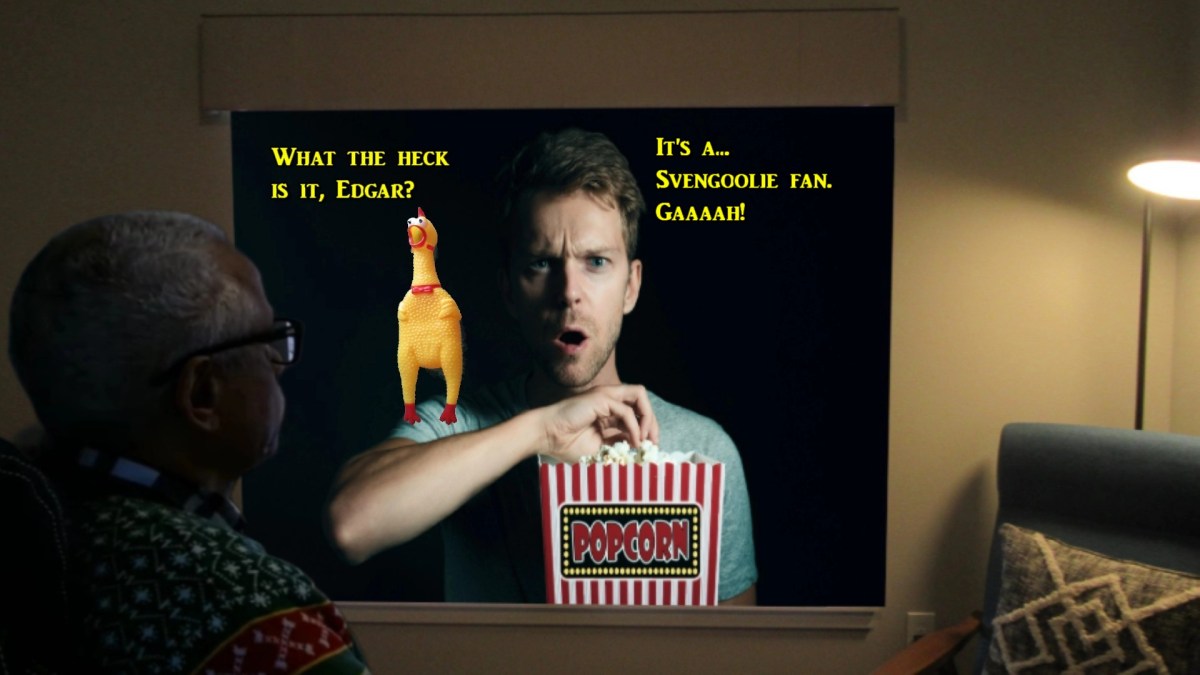

Svengoolie Intro: “Calling all stations, clear the air lanes, clear all air lanes for the big broadcast!”
This coming Saturday, the Svengoolie show movie will be the 1973 horror flick, “The Night Strangler” starring Darrin McGavin who plays an investigative reporter/detective named Carl Kolchak, which I’ve never seen. Neither did I see the first movie, “The Night Stalker.”
The setting is in Seattle. Apparently, there’s some monster serial killer who’s really, really mad about getting chewing gum stuck all over him whenever he goes hunting for victims on Post Alley. He’s written dozens of letters to the city about cleaning up the Gum Wall, which they actually do periodically, but hey, sticking chewing gum wads on the wall is a time-honored tradition, which Sena and I noticed when we were visiting Seattle on vacation about 9 years ago. Don’t lean up against the Gum Wall.
Anyway, the killer has come up with a plan to blow up the Gum Wall with dynamite to spite the Seattle city council, which Kolchak can’t figure out without consulting Artificial Intelligence (AI) until late in the movie. AI instructs Kolchak to build a rudimentary time machine which is this really souped-up car which, when it reaches warp speed, can send Kolchak back in time to the scene of the crimes and with the assistance of a kid named McFly, he can…no wait, that’s a different movie.
I watched the Svengoolie show movie “Tarantula” last night, although I fell asleep for what turns out to have been about 20 minutes or so during the second half hour of this 1955 film about radioactive nutrient producing a giant tarantula. I had to catch up on what I missed on the Internet Archive.
Don’t get me wrong, the movie didn’t put me to sleep; in fact, there were various segments that reminded me of various tangents I’m about to go off on.
Anyway, the film was directed by Jack Arnold and starred John Agar (Dr. Mass Hastings), Mara Corday (Stephanie ‘Steve’ Clayton), and Leo G. Carroll (Prof Gerald Deemer, who I guess was in a lot of Hitchcock films including North by Northwest, which Sena has seen). Raymond Bailey (Townsend, Arizona dept of agriculture scientist) had an interesting line I’ll mention later. Bailey also played the banker Milburn Drysdale in the Beverly Hillbillies TV show in the early ‘60s-early ‘70s.
The short summary of this film is that it’s one of several related to the fear of radioactivity-linked science gone bad leading to the creation of really big bugs running amok in tiny towns in the desert southwest. The main angle here is Prof Deemer’s scientific work on preventing world starvation from overpopulation by creating a nutrient that would, if mixed with the evil radioactive isotope, cause hungry tarantulas to grow to enormous size, in turn leading to cattle mutilations that would prevent long wait times for motorists waiting for cows to cross Route 66, consequently unblocking the path to McDonald’s restaurants, although the food chain interruption from the beef shortage caused by tarantula predation would eventually result in the loss of big macs leading to cannibalism, thereby cancelling world hunger by population reduction.
Scientists never think this one through.
But there are other things to talk about with respect to this movie. One of them is the word “acromegalia.” I know about acromegaly, but the term “acromegalia” was a new one to me, although it turns out to be an old term. Acromegaly is the usual name for the medical condition. Why the writers chose this word is a mystery. Both mean a rare pituitary gland problem which produces too much growth hormone leading to gigantism in which the hands, feet, and face grow bigger.
Another fascinating thing about the film is that I think I can hear Dr. Deemer call the radioisotope a specific name, something that sounds sort of like “ammoniac.” In the internet archive version, see if you can hear it at about 27:47.
Sena can hear it too. But I can’t find any reviewers who mention it and even AI denies that the radioisotope is given a name in the movie. Also, if it was made just for the movie, it doesn’t make sense because most isotopes’ names end in “-ium,” so no made-up word for it should sound like “ammoniac” which makes you think of ammonia, something somebody would wave under your nose to smell if you fainted from the sight of the giant tarantula.
Another interesting thing is the dialogue between Dr. Hastings and an Arizona Agricultural Institute scientist, Dr. Townsend (played by Raymond Bailey). The gist of the interaction is that Dr. Hastings brought a specimen of giant tarantula venom for Dr. Townsend to analyze, but when he says he found giant pools of it, Townsend is incredulous and accuses Hastings of either having a nightmare or being the biggest liar since Baron Munchausen. On the internet archive this exchange happens at about 59:07.
This is priceless. I know about Baron Munchausen because, as a consulting psychiatrist for many years I saw patients who had the syndrome which used to be called Munchausen’s Syndrome (now called Factitious Disorder) which is essentially a mental disorder in which patients claim to have diseases which they don’t actually have but fake them and lie to doctors about it. I gave lectures about the syndrome. There’s a fascinating literature about it and, the odd thing is that the real Baron von Munchhausen was a famous adventurer and raconteur—but he was not a liar.
What many people don’t know is that it was actually a fellow named Rudolf Erich Raspe, a German scientist and scholar who wrote a book about the baron which was mostly made up. Raspe was the liar, not Baron Munchhausen.
A person with Factitious Disorder was hospitalized at University of Iowa Health Care back in the 1950s and a long case report about it was published in the Journal of the American Medical Association (JAMA). Further, a physician named William Bennett Bean, MD in the Department of Medicine at the University of Iowa wrote a very long poem about this which you can access. There was also a fascinating case report published in 1980 in the New England Journal of Medicine (NEJM) by medicine residents claiming they had seen a patient who lied about having Factitious Disorder (Factitious Munchausen’s Syndrome). The residents later admitted that they made up the story. I summarized most of this in a blog post a few years ago.
Finally, there is a line by Dr. Hastings at about 1:04:45 which reminded me of a Verizon commercial years ago: “Can you hear me now?”
I think that’s more than enough about this movie, which I would give a rating of 4/5 mainly because it evoked so much from the deep recesses of my memory.
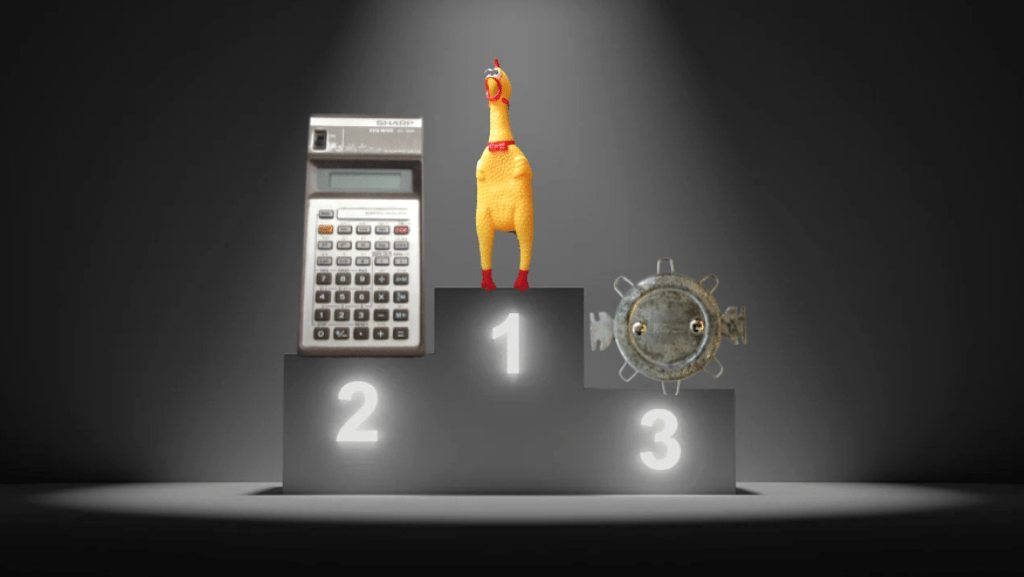
Shrilling Chicken Rating 4/5
Addendum: I couldn’t shake an urge to comment on a gesture of earlobe tugging that Dr. Matt Hastings engaged in while asking Prof Deemer about how quickly Jacobs developed his physical malformations. You can find this on the Internet Archive at time 28:36. Deemer dismisses it as acromegalia and nothing more but finally suggests Hastings could see that an autopsy be performed on Jacobs. I suspect Hasting’s earlobe tug might be dismissed as simple overacting, but there could be other interpretations.
Here’s another video on head stall juggling, this time using glow in the dark juggling balls. They’re heavier and I drop more often. On the other hand, when one hit the glass top coffee table, it didn’t leave a scratch! It did make a heck of a racket, though.
I did switch off between left and right for the off the head trick. It’s a lot harder using larger, hard plastic balls.
Remember that off the head juggle I was trying to learn way back over two years ago? The other name for it is the head stall and I could not get the hang of it. I watched video after video and the performers who could do it all did it the same way—which I could not imitate. You can see the disaster by looking at my post “Off The Head Juggle Trick So Wrong but My Way.”
It never helped that every teacher said it was an easy trick to learn.
That was over two years ago. Every time I tried it since, it was a no go. But yesterday, I found another video of a guy who does the head stall differently. I tried it last night and within minutes I was doing the head stall. This guy has the hack for the head stall juggle.
I’m pretty sure what made the difference for me is throwing one ball high with one hand, but using the other hand to place the ball on my head. Every other video shows the juggler using one hand for the throw the ball and the same hand for placing the ball on the head. At least that’s what it looks like to me. I’ve got a slow-motion clip in the YouTube video I made today showing me doing it and not only that, alternating between left and right.
The idea behind this head stall thing is the same as the one behind learning the under the leg and behind the back tricks in and out of the 3-ball cascade. You throw one ball high to allow you time enough to do the trick ball.
Now I’m doing the head stall boogie using the same method. Sena says I look sexy in the video. I think I look like I’m trying to catch my breath.
I watched the Svengoolie show movie, “The Baddest Seed on the Planet” yesterday on the Internet Archive because I wanted to see the Iowa Hawkeye vs UMass football game last night. Hey, the Iowa Hawkeyes and the Iowa State Cyclones both won yesterday!
Actually, I thought “The Bad Seed” was a pretty good movie, just to let the shrilling chicken out of the bag. It’s a good break from the rubber mask, stop motion animation, shlocky howlers. It does run long, a little over 2 hours and at times there’s a little too much lofty psychoanalytic dialogue. At times it seemed like a play.
It’s a 1956 Warner Bros. Pictures production. There was a Perry Mason regular on it; William Hopper played Col. Kenneth Penmark (father of Rhoda). Henry Jones played Leroy, the really creepy sociopath handyman who had a lot in common with Rhoda (played by Patty McCormack), the psychopathic 8-year-old daughter of Kenneth and Christine Penmark (played by Nancy Penmark). Eileen Heckart played the heck out of her role as the tipsy Hortense Daigle, mother of her unfortunate murdered child Claude—who is never seen.
The main underlying theme is the question of whether psychopaths are born bad or victims of bad environments.
How this gets treated in the film is fascinating. When Rhoda saws through a fawn with a dull straight razor while singing Elvis Presley’s “Don’t Be Cruel,” it really doesn’t leave much to the imagination.
Things start to go bad early when Claude wins a penmanship award instead of Rhoda who is thinking, “OK bud, over your dead body!” I’ve got to tell you; I got chills just looking at her after a while.
The handyman Leroy pegs Rhoda for a bad seed right away, mainly based on the idea that bad seeds think alike. He keeps telling her he’s got her number until he has a close encounter of the excelsior kind, and “excelsior” means ever upward only in the sense that burning wood shavings used for packing fragile items tend to be carried by the wind.
Just to gloss over the scientific psychiatric literature on psychopathy, the most recent paper I could find on the web suggests that structural and functional brain abnormalities of psychopathic persons contribute substantially to the observed behavioral patterns of callousness and poor adaptability to prosocial motivations beginning early in life and which tend to be resistant to change as one gets older. The younger the person, the more plastic the antisocial traits may be to change via behavioral modification, hopefully leading to greater empathy. (Anderson NE, Kiehl KA. Psychopathy: developmental perspectives and their implications for treatment. Restor Neurol Neurosci. 2014;32(1):103-17. doi: 10.3233/RNN-139001. PMID: 23542910; PMCID: PMC4321752.)
By far, Hortense Daigle has the most awkwardly comical role as she combines grief, inebriation and eerie suspicion of Rhoda in her own son’s death. Every time she shows up to the Penmark house, she’s roaring, dramatically staggering drunk. She helps herself to the booze in the house, even making it clear which bourbon she prefers (Never mind my grief! I said I wanted that martini in a dirty glass!).
Other than the movie being a bit too long, I thought it was very good. I could have done without the theater like credits with all the actors coming out to take a bow (or curtsy in Rhoda’s case), a slapstick bit between Christine and Rhoda, and the warning to the audience not to reveal the ending to anyone.
I think I just found out why we have to tune in to the upcoming Svengoolie movie “The Bad Seed” an hour early this Saturday. It comes on at 6:00 p.m. because it’s two hours long!
There’s another crisis. The Iowa Hawkeye vs UMass college football game comes on at 6:40 p.m. tomorrow evening.
That means I’d have to choose between watching “The Bad Seed” or watching the football game. In order to see both I’d have to watch the movie on the Internet Archive.
That means I’d miss Svengoolie’s corny jokes. Hmmmm.
I made this YouTube video of a full six deal game of cribbage solitaire—and missed a 3-card run which would have won the game!
What the heck, I probably made other mistakes too that others will notice.
The rules:
Cribbage solitaire has six hands and six cribs and you peg your six hands.
Start by dealing two cards down to form part of your hand, then one down to form part of the crib. Deal two more to your hand, one more to the crib, and finally two more to your hand (which now has six cards and the crib has two.
Discard two of the six cards to form a four-card crib. Then flip the top card of the deck for the starter card.
Then peg your hand for maximum count, which would not always be the way you’d peg in a game with an opponent. Colbert’s example paraphrased: if you hold 5-10-10-jack. Play the 5 first, then a 10 for “15-2,” then the other 10 for “25, a pair for two and a go.” The remaining jack also scores a “go” for one point. Your peg is six points total.
After scoring the peg, count your hand, then your crib.
Then start the second deal by using the first-hand starter card, which becomes one of the first six cards for your hand. Again, deal the crib two cards. Repeat this process until you complete the game with the sixth deal (the deck will have four cards after six deals). (Colvert, 2015)
Reference
Colvert, D. (2015). Play Winning Cribbage 5th ed. Missoula, Montana: Starr Studios.
I watched the 1956 Universal-International Pictures production of “The Creature Walks Among Us” last night on the Svengoolie show. It’s a movie about chain-smoking scientists who capture the aquatic Gill-Man, transform it into an air-breather and blow smoke into its face to make it cough. This annoys it so much it starts breaking stuff.
The scientist who pushes the whole project is Dr. William Barton (Jeff Morrow) who at times can be seen smoking 10 cigarettes simultaneously which sets his hair on fire. He’s bald for the rest of the movie, which doesn’t endear him to his wife Marcia (Leigh Snowden) who copes with his pathological jealousy by playing several musical instruments throughout the movie.
The team of scientists includes a geneticist, Dr. Thomas Morgan (Rex Reason), a prince of a guy who spars with Dr. Barton about the pros and cons of contributing to the delinquency of a major monster by altering its biology, moving it closer to the “jungle or the stars.” Dr. Barton doesn’t buy this metaphor and is bent only on pursuing a maniacal plan to teach the creature how to shoplift cigarettes and bottles of Thunderbird wine.
Dr. Morgan is sweet on Marcia but so is the guide, Jed Grant (Gregg Palmer). Marcia plays various musical instruments to keep between her and Jed, starting with a piano, progressing to a guitar and, when he gets more insistent on messing up her hair, she hauls out a cello!
The group of scientists catch the creature out on the river. They’re all smoking when it suddenly leaps into the boat and when it picks up a gas can spilling the contents all over itself, all they have to do is flick their cigarettes at it on a pre-arranged signal (Dr. Barton farts). While the creature is wrapped in flames, the crew takes a little while to figure out which fire extinguisher they should use (what works on scales, foam or dry chemical?).
Apparently, the Creature evolves spontaneously once it’s out of the water and grows a feeble set of lungs. The scales fall off to be replaced by skin, and it develops fingers. Then it tries to steal Marcia’s banjo.
The scientists imprison the creature in a pen which has an electrified fence, which Dr. Barton forgets to re-activate after he dumps Jed (whom he has knocked out with Marcia’s clarinet) in there to distract it.
This doesn’t fool the creature but I wouldn’t want to spoil the ending for you. The moral of the story is that smoking is bad for your health.
Sena went over to ForeverGreen, a popular landscaping and garden center locally, to see the butterfly house. She got pictures and video clips which showed the monarch butterfly management operation they have. They have quite a conservation program, including a large monarch butterfly house enclosure along with demos of life cycle stages. The butterfly house is just part of the deal and it’s open to the public. It opened in June of this year and runs until September 14th. The schedule shows there’ll be a big release then and possibly even tagging prior to that. You might want to call ahead and check to see if they’re still going to tag the monarchs.
I think this is also a good way to rehabilitate Bigfoot’s image because they could be sort of like ranch hands tending to the monarch as they go through their life cycle. The monarchs migrate to Mexico every fall. You can learn more about the monarch watch program and why many people believe the monarchs are at risk of extinction.
The Svengoolie show last night was the 1957 Hammer production “The Curse of Frankenstein” starring the 3 stooges. Actually, this film was no laughing matter and this was my first time (and last time) seeing it.
That’s not saying it’s a “bad” movie. It’s just tough to come up with anything comical to say about a gothic horror flick that was inspired by Mary Shelley’s novel, “Frankenstein; or, The Modern Prometheus.”
I’ve not read Mary Shelley’s novel and I only skimmed the Encyclopedia Britannica entry. That’s good enough for an old guy pretending to be a movie reviewer.
What hooked me, though, early on the film was a short dialogue between Paul Krempe (Robert Urquhart) and Elizabeth Lavensa (Hazel Court). Paul describes Victor Frankenstein (Peter Cushing) in contemptible and scary terms, to which Elizabeth reacts by saying that Victor is either “wicked or insane.” Paul answers that Victor is neither—which struck me as odd.
I would have no trouble saying Victor is evil, but what do I know? On the other hand, I ran across a couple of web articles that mentioned “psychopath” as a suitable label for someone who thinks nothing of pushing an old man like the scientific scholar Professor Bernstein (Paul Hardtmuth) over a banister to kill him in order to dig his brain out of his skull to insert into a do-it-yourself hodgepodge of spare body parts in an experiment to create a living being.
Victor, from the time he first meets Paul, presents as an insufferable, entitled brat lacking a conscience and by the time he reaches adulthood he’s the perfect example of someone with the most creepily severe case of antisocial personality disorder (ASPD) imaginable.
He gets the housekeeper Justine (Valerie Gaunt) pregnant, tricks her into entering the laboratory where the monster (Christopher Lee) kills her, marries Elizabeth and then abandons her on their wedding night in order to cheat in a cribbage game with the monster.
He pretends to bury the monster in the woods after Paul kills it by shooting it in the eye with an AK-47—then sneaks back to dig it up, carry it back to the lab and reanimates the wreck. He proudly shows it off to Paul, who throws up on him. This makes no difference to Victor who is always smeared with dirt anyway because he hangs out in morgues, graveyards, and golf courses (“as he approaches this critical putt, somebody leaps out and cuts off his feet”), filching eyes, hands, Adams apples and what have you to assemble and repair the monster.
There are big differences between Shelley’s monster and Hammer’s creature—the latter doesn’t speak at all while the former is eloquent. Hammer’s creature can barely stand up or sit down on command while Shelley’s monster can do triple axels skating across the Arctic ice as Victor pursues him.
During the movie, my mind often wandered off to memories of Mel Brooks’ “Young Frankenstein.”