Anyone for 12-Card Cribbage?

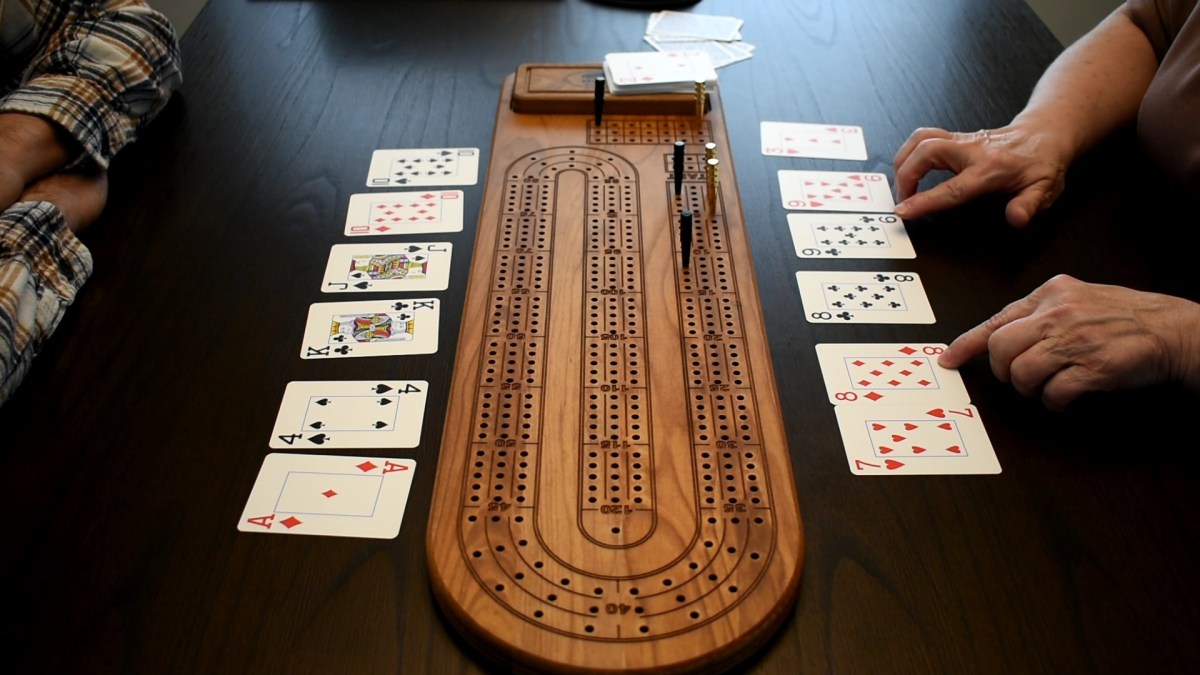
You know the winter is getting long when Sena and I talk about trying to play 12-card cribbage. We’ve come up with a way to manage the deal and the crib and we’ll try to play it tomorrow.

Sena’s been bugging me for a while now to try playing both 11-card and 12-card cribbage—despite the fact that no rules exist for them. There is the mystery of the American Cribbage Congress (ACC) having a section in their cribbage history which clearly claims that:

“Did you know that there are at least 18 variations to the BASIC game of cribbage? There is the basic 2 or 4 handed game, and then there are the 5 card, 7 card, 11 card and 13 card cribbage games. “

Notice that the author (who doesn’t have a byline) says there are both 11-card and 13-card variations. On the other hand, I’ve spoken with someone else at the ACC who knows everything there is to know about tournament cribbage and he and everyone else he asked at a recent tournament never heard of these variants. And you can’t find them anywhere on the web.

This whole Calvinball Crib thing comes from our having tried 7-card, 8-card, 9-card, and 10-card cribbage. Sena wore me down. So, we cobbled together some rules for 12-card cribbage. We’ll let you know what happens. If anybody out there has suggestions and comments, let us know!

The Missing 29 Cribbage Board and a Little History

We’ve been searching around for our 29 Cribbage Board. It’s in the shape of 29 which is the highest score you can get in cribbage. The hand is typically shown with three 5’s and the nob Jack and the cut card is the other 5. This is usually a diamond 5, but the heart or the spade 5 is also shown on some boards. The odds of getting this hand are 1 in 216,580.

Sena didn’t find it after a thorough search top to bottom of our house, so it must have gotten lost in the move last year. One of the reasons why this suddenly became an issue of national importance is that I read another one of those long historic articles on the American Cribbage Congress (ACC) website—which never lists the bylines of the persons writing them.

It turns out that a guy named Edward M. Hirst in Canada who first designed and started making the 29 board by himself back in the early 1950s. Customers would wait months for them. They weren’t mass-produced until two years after he died. Crisloid, Inc. (based in Rhode Island) made them for a while and this name is familiar to me because I shopped for a giant cribbage board from them a few years ago. They had stopped making the 29 board long before then. Interestingly, they made one of those very complicated continuous 3 track cribbage boards with complicated scoring for things like “Legs” and other features that eventually were more of a hallmark with another famous cribbage board maker–Drueke Co. And then Drueke Co. started making the 29 boards.

Eventually manufacturing of the 29 boards moved to Taiwan because they could be made more cheaply there. Nowadays, America’s role in sales has moved to vendors, such as Hoyle, Bicycle, Walmart, etc. There’s a reddit thread which shows a picture of a 29 board which contains a short history of the board.

Anyway, by way of personal history, we started playing cribbage again in 2019 after a 20-year hiatus. I have a dim memory of us experimenting with several card games back then, including cribbage. And then we dropped card games for a long time. And about 5 or 6 years ago we got a 29 board, because it was interesting and cheap.

I made a YouTube video of the game. It got about 1,800 views. It had some of the features discussed in the ACC history, which we think is really interesting. The nob Jack and 5 cut card were diamonds. There was a 121 hole (which some boards don’t have, believe it or not!).

And there’s also a Cribbage Board Collector’s Society (CBCS). The interesting thing they point out is that no one has ever reported to them about finding a 29 board with the Jack and the 5 cut card in the club suit. I couldn’t find one on the web, even on Ebay.

We immediately shopped for another 29 board but the one we want is sold out. Until then, we can reminisce.

Merry Wicked Cribbage Christmas!

We hope you all had as nice a Christmas as we did. We played Wicked Cribbage! It’s an overlay variation of 6-card cribbage. This turned out to be more fun than we every imagined. Short story—I got skunked! We made a video of the hilarity. Happy holidays!

And here’s a great Christmas card from Sena!

See Me at the Neckademy Awards About This Neck Massager

Sena bought some device for neck and shoulder massage called the Shiatsu cordless heat massager today. She tried it and then wanted me to try it. I’m not up for massagers of any kind, especially after seeing the extraterrestrial massage torturer I posted about early this month, “So, Is This Anything?”

She didn’t want it for various reasons. It doesn’t get warm enough, it’s difficult to hold on to it, and has this general weirdness that’s difficult to describe. That’s why I made a little video about it. Sena made me do it.

Thoughts on Comebacks

I watched the first half of the Colts vs 49ers game last night and I thought Philip Rivers didn’t look half bad for a 44-year-old guy who’s been out of the game for five years. Did you know he has 10 kids? OK, now that I’ve got that out of my system and that would be, what—the 44th time you’ve heard that since he took the field?

So what the Colts lost? His big family was up in the stands going crazy, cheering him on.

I read an article this morning which had Steve Young saying he could make a comeback at his age—which is 64. I couldn’t believe it. The same story mentions that George Blanda played for the Oakland Raiders when he was 48 back in 1975.

It got me wondering whether I could make a comeback as a general hospital consulting psychiatrist. Could I gallop up 6-8 floors of University of Iowa Health Care? You bet your bottom dollar—I couldn’t.

It’s hard to retire. Every once in a while, I miss hiking up and down the hospital with my camp stool, deftly swinging it around and sitting with the patients and families, telling medical students and residents all kinds of lies (I mean “wise old adages and pearls of clinical wisdom”).

I get a kick out of just wondering what it would be like. I get a vision of myself with a big, golden glowing aura of greatness around my head—until I come to my senses. Hey, nobody’s going to pay me a quarter million dollars to run the consult service for the few months I’d be able to limp around the hospital, falling off my camp stool when my legs go numb or the chair breaks.

It’s not like I can just throw a football like it’s nothing after 5 years. I’d have to prove I still have enough clinical smarts to figure out how to introduce myself (Hi! I’m Philip Rivers and you need to go long!”).

The Maintenance of Certification Circus is still a thing and it’s worse. I’m not saying doctors don’t undertake the arduous task of essentially retraining to be what they once were—because that’s not good enough anymore.

Last night, the camera caught Phil more than once being just as hard on himself as he was with other members of the team who weren’t in the right spot at the right time. Most physicians are perfectionists and if you’ve been out of the game for a while and you try to squeeze back in, you could wind up mumbling to yourself, “They don’t make footballs like they used to!”

I didn’t stay up for the second half of football game. It wasn’t because of anything Philip did or didn’t do on the field.

I just can’t stay up that late nowadays.

Profound Thoughts on Topological Brain Changes

I ran across this article in the news about topological changes that happen in our brains as we age. You can try to read the original open access paper published by the author Alexa Mousley.

The topological changes in the brain that occur in the brain are linked to the structural connections that are made or not in human development and roughly correspond to the main epochs of brain structure in our lives: childhood (transition to adolescence around 9 years old), adolescence lasts until around 32 years old when we finally reach adulthood, then at age 66 we reach the early ageing stage and that finally changes into late ageing or old farthood around age 83. It’s a good thing I retired 5 years ago.

What this says, of course, is that nobody should be getting married or driving until they hit age 32. There are buses, you know, although we do have self-driving cars which explode on impact so thank goodness we don’t need to worry about that.

Also, it implies that you shouldn’t be drafted into military service until you’re presumably old enough to know that war doesn’t solve any problems.

Furthermore, this could lead to earlier retirements, reducing the need for awkward discussions with tenured professors who are apparently unaware they often arrive at the office with their pants on backwards. Just boot them out the door!

Why didn’t we think of this topology thing a long time ago?

For an interesting topology discussion, see the Wikipedia article, which has an interesting photo of something called homeomorphic topology, an amusing example of which is the picture of continuous transformation of a coffee mug into a donut, or as many Iowa City people would prefer, a bagel (something that looks like a doughnut but is so tasteless you have to slather it with a pound of cream cheese).

If you have any questions, call the author of the study. You’re welcome!

Mousley, A., Bethlehem, R.A.I., Yeh, FC. et al. Topological turning points across the human lifespan. Nat Commun 16, 10055 (2025). https://doi.org/10.1038/s41467-025-65974-8

Swearing as a Performance Improvement Method?

I read this article about swearing being a good thing to do to increase your workout performance or whatever. There’s a link to the study that a researcher says supports that conclusion. I mean this story is talking about really bad words being good for you. It reminds me of a time when I was a pre-teen kid and broke my wrist falling out of a barn loft. I don’t remember exactly how I got to the emergency room. We didn’t have a car so our next-door neighbor must have driven me with my crooked arm and my hysterical mom to the hospital.

My mom was in the emergency room with me. When I cut loose with a torrent of really bad words, nurses had to practically carry her out because she fainted. This was right after I asked the doctor if it was OK if I swore and he said “Go ahead,” injected anesthetic—and immediately started to manhandle my wrist. I don’t think I ever swore in front of my mom before that.

I don’t remember if the swearing helped me withstand the pain or not. I don’t think so.

There was my other trip to a hospital for chest surgery when I was in my early teens. I had a chest tube after the operation. My roommate had undergone some kind of abdominal surgery. We had a lot of stitches and were in a lot of pain, which was bearable if we didn’t move at all. It even hurt to breathe. But the other factor was the TV in our room. It was way across the room and there was some kind of comedy show on. It was really funny—which made us feel really terrible. We could barely move and even had to talk quietly, yet this funny show made us laugh, which expanded our chest and abdomen areas, stretching the sutures. It was excruciating.

Even swearing would have hurt, not to mention laughing out loud. We really couldn’t stand to laugh and it was too bad I can’t describe the sound of two guys trying not to even chuckle. If you e4ver watched Loony Tunes cartoons and remember how Elmer Fudd sounded with he laughed—that was how we sounded because we were trying to suppress laughing. It was funny but pitiful. My roomie finally made this desperate slow motion move out of bed, crept to the TV and shut it off. I was so grateful. Neither one of us ever swore.

The other thing this swearing for power reminds me of is the movie Signs, which starred Mel Gibson as Graham Hess. It was about an alien invasion and in one scene, some people/aliens (they don’t’ yet know what) are running around the house and Graham’s brother Merril (Joaquin Phoenix) are getting set to chase them. Merril tells Graham to yell and curse, although because Graham is a former Episcopal priest, swearing is beyond him:

  • All right, listen, we both go outside, move around the house in opposite directions. We act crazy, insane with anger, make them crap in their pants, force them around till we meet up on the other side.
  • Graham Hess: Explain “act crazy”.
  • Merrill: You know, curse and stuff.
  • Graham Hess: You want me to curse?
  • Merrill: You don’t mean it. It’s just for show. What?
  • Graham Hess: Well, it won’t be convincing. It doesn’t sound natural when I curse.
  • Merrill: Just make noises, then.
  • Graham Hess: Explain “noises”.
  • Merrill: Are you gonna do this or what?
  • Graham Hess: No, I’m not.
  • Merrill: All right, you want them stealing something in the house next time?
  • [outside light comes on]
  • Merrill: On the count of three. One…
  • Graham Hess: All right.
  • Merrill: two… three!
  • Graham Hess: Ahh! I’m insane with anger!
  • Merrill: We’re gonna beat your ass bitch! We’re gonna tear your head off!
  • Graham Hess: I’m losing my mind! It’s time for an ass-whupping!
  • [Merrill and Graham meet each other]
  • Graham Hess: I cursed.
  • Merrill: I heard.

Anyway, I think we have to make a distinction between cursing about something or cursing at someone before we start claiming, like the author of the study says:

“Swearing is literally a calorie-neutral, drug-free, low-cost, readily available tool at our disposal for when we need a boost in performance.”—psychology researcher Richard Stephens of Keele University in the UK.

Our House Rules for Crib Wars

Based on what I found out from Artificial Intelligence (AI) yesterday, I thought I’d share our house rules for Crib Wars. The only reason I’m including information from AI is because I couldn’t find specifics on how to manage pegging for the Blue Penalty Box anywhere else.

If you already know how to play basic cribbage, you can ignore most of what’s on the rules sheet (available on the web) because there’s only a short section for the Crib Wars rules. It describes the colored areas and what the players are supposed to do with them.

There’s no Muggers Alley on the Ebonwood board and we never play muggins. Below are my updated descriptions of the colored zones, which we discuss and demonstrate during the video.

Red Skips: There are 3 of these. The rule says if you land on the first red box you should slide to the next red box which gets you 20 holes further along the board. The red box just means the set of 3 holes highlighted with a red color. You get from the first one to the next one by just moving the peg 20 holes. You’ll land in the 2nd set of holes marked in red. This is a boon in the first Red Skip area. However, if you pay attention to the directional arrows in the path guiding you, it looks like they accelerate you toward two of the Blue Time Traps.

Blue Time Traps: There are 4 of these and there will be three blue lines, meaning the blue color covers all three holes and all three peg tracks (3 holes along the track and 3 holes across the track). If you land in a set of three holes highlighted in blue, you end up moving to a blue area of holes that actually set you behind several holes. You have to play your way out of them. Players note that you can end up in repetitious cycling back to the traps largely because of how often you can get one or two points at a time while scoring. In fact, some say that if their opponent gets close to a Blue Time Trap they may purposely lead with a five card (something you would rarely if ever do in a standard cribbage game). That could trap the opponent into playing a ten card or a 5 card, which might risk them moving only a couple of holes right back into the Blue Time Trap. The same thing could happen with falling into the Blue Penalty Boxes.

Blue Penalty Boxes: There are three of them. You fall into one of these by moving your peg into one of the single blue hole lines, meaning one blue track across the three peg tracks. This is a disaster because you immediately have to move back 20 holes and fold your hand and your crib while your opponent moves forward 20 holes and counts their hand and crib (if they have the crib). Asking AI is the only way I could find out how to learn how to peg moving back and forward 20 holes. The player who lands in the penalty box moves their front peg back 20 holes starting from the penalty box. You don’t move the rear peg. If your front peg lands behind the rear peg, it becomes the new rear peg. The player who doesn’t land in the penalty box moves their front peg forward 20 holes. The player who lands in the penalty box immediately folds their hand and crib.

Green Advances: There are two of them. If you land in a green hole, you take short cut path. The long one saves you from moving toward the Blue Time Trap in the left lower quadrant. You don’t avoid the potential other trap above. If you take the normal track instead you end up moving toward the lower left quadrant Blue Time Trap—but you have a chance at getting into the short Green Advance track before you get there which loops back away from it and you end up going in the direction of the upper Blue Time Trap.

You think you’re in the clear after that? You’re not because there is a sadistically placed Blue Penalty Box in the next to the last hole before the Finish Line!

New Do it Yourself (more or less) Electrotherapy for Depression at Home!

OK, so the title is a little provocative; on the other hand, this is my take on a legitimate treatment for depression that was just approved by the FDA only last week. A company called Flow Neuroscience is marketing the newly approved FL-100 device for treatment of depression and their website definitely has their marketing skills down. And I definitely was reminded of a TV commercial about removing your own appendix.

That’s my smartass joke, but hang on, there’s more to it than jokes. I had to search around a while to find actual FDA web evidence that they actually did approve the FL-100, but I was saved by the reliable and trustworthy Psychiatric Times article about the FL-100 with references that I could verified the FDA’s approval.

So, I’m a retired psychiatrist and I was a clinician educator type doctor, not a neuroscientist, but I can read the FDA approval document section XV. Conclusions Drawn from Preclinical and Clinical Studies (starts on page 12). It boils down to, yeah, this device’s probable benefits outweigh its probable risks.

The Effectiveness Conclusions subsection on effectiveness outcomes at Week 10 contains what sounds like realistic answers: “The medical literature lacks consensus regarding what constitutes a clinically significant or meaningful between-group difference in HDRS-17 scores. As such, the clinical significance or meaningfulness of the between-group difference of -2.3 points on the HDRS-17 scale has not been established. Nevertheless, the 2.3 point between-group difference helps support the view that FL-100 provides probable benefit.”

I’m not familiar with the EQ-5D-3L scale of health-related quality of life but the summary says:

“The EQ-5D-3L measures a person’s health-related quality of life by assessing five dimensions: mobility, self-care, usual activities, pain/discomfort, and anxiety/depression. There was no between-group statistical difference in EQ5D-3L scores at Week 10. The EQ-5D-3L frequently fails to detect mild depressive symptoms, as individuals with subclinical depression often select “no problems” on the anxiety/depression dimension. The insensitivity of EQ-5D-3L is documented in the literature.”

I happen to think that comparison of medical treatments with psychotherapy is a good idea but: “Data were not provided regarding FL-100 used adjunctively with psychotherapy or with psychotherapy and antidepressants.”

The device has no recommendation for use with patients with treatment-resistant depression:

“Patients who previously had an inadequate clinical response to two or more antidepressants at an adequate dose and duration were excluded from the study, limiting the evidence for use of the FL-100 in a more treatment resistant population.”

The potential risks are first degree skin burns if you’re not careful with the electrodes, headaches, and scalp pain. The benefit is modest but outweighs the risk.

You can use the device at home under the supervision of a clinician—they don’t do house calls so you’d presumably do this by zoom call. You can also get advice through an app on your device, which may or may not be a monotonal AI. You pay $500-800 and there won’t be any answers to questions about insurance coverage until at least next spring. But it’s being used by tens of thousands of people in Europe and beyond.

So go ahead, take your own appendix out (just kidding; put that jack knife away!). Did you know that at least one guy actually did that? A Russian surgeon, Dr. Leonid Rogozov managed it in 1961 while he was stranded in Antarctica.

It’s just my opinion, but the headset could be more stylish.

The Big Crib War Hybrid with 10 Card Cribbage!

Well, we did manage to get through a hybrid of 10-card Cribbage and Crib Wars although I had a kerfuffle with pegging which led to extra points I shouldn’t have got. I probably made other mistakes (just let me know).

However, it probably didn’t make that much difference. As luck would have it (as it tends to do in cribbage and in life) I won mainly because Sena ended up going through the final Blue Time Trap twice!

 Here’s a recap of the rules for 10-card Cribbage: This one is fun. Deal 10 cards each and two to the dealer’s crib. Divide your remaining 8 cards into 4 separate hands. Use one for pegging and both for the show (means scoring your hands). Play to 121 (unless you’re playing Crib Wars and then you’re in for a marathon). You get big scores but they’re manageable.

We completed the game in an hour, very similar to our time in regular 6 card cribbage on the big Ebonwood Crib Wars board. I started to get a little punchy mid to late phase in the game because of the several hands you get in 10-card cribbage. It’s a lot to count.

High scores over the long haul probably don’t affect what fairways and sand traps you fall into.

If you already know how to play basic cribbage, you can ignore most of what’s on the rules sheet (available on the web) because there’s only a short section for the Crib Wars rules. It describes the colored areas and what the players are supposed to do with them.

There’s no Muggers Alley on the Ebonwood board and we never play muggins. Below are my updated descriptions of the colored zones, which we discuss and demonstrate during the video.

Red Skips: There are 3 of these. The rule says if you land on the first red box you should slide to the next red box which gets you 20 holes further along the board. The red box just means the set of 3 holes highlighted with a red color. You get from the first one to the next one by just moving the peg 20 holes. You’ll land in the 2nd set of holes marked in red. This is a boon in the first Red Skip area. However, if you pay attention to the directional arrows in the path guiding you, it looks like they accelerate you toward two of the Blue Time Traps.

Blue Time Traps: There are 4 of these and there will be three blue lines, meaning the blue color covers all three holes and all three peg tracks (3 holes along the track and 3 holes across the track). If you land in a set of three holes highlighted in blue, you end up moving to a blue area of holes that actually set you behind several holes. You have to play your way out of them. Players note that you can end up in repetitious cycling back to the traps largely because of how often you can get one or two points at a time while scoring. In fact, some say that if their opponent gets close to a Blue Time Trap they may purposely lead with a five card (something you would rarely if ever do in a standard cribbage game). That could trap the opponent into playing a ten card or a 5 card, which might risk them moving only a couple of holes right back into the Blue Time Trap. The same thing could happen with falling into the Blue Penalty Boxes.

Blue Penalty Boxes: There are three of them. You fall into one of these by moving your peg into one of the single blue hole lines, meaning one blue track across the three peg tracks. This is a disaster because you immediately have to move back 20 holes and fold your hand and your crib while your opponent moves forward 20 holes and counts their hand and crib (if they have the crib). Asking AI is the only way I could find out how to learn how to peg moving back and forward 20 holes. The player who lands in the penalty box moves their front peg back 20 holes starting from the penalty box. You don’t move the rear peg. If your front peg lands behind the rear peg, it becomes the new rear peg. The player who doesn’t land in the penalty box moves their front peg forward 20 holes. The player who lands in the penalty box immediately folds their hand and crib.

Green Advances: There are two of them. If you land in a green hole, you take short cut path. The long one saves you from moving toward the Blue Time Trap in the left lower quadrant. You don’t avoid the potential other trap above. If you take the normal track instead you end up moving toward the lower left quadrant Blue Time Trap—but you have a chance at getting into the short Green Advance track before you get there which loops back away from it and you end up going in the direction of the upper Blue Time Trap.

You think you’re in the clear after that? You’re not because there is a sadistically placed Blue Penalty Box in the next to the last hole before the Finish Line!