Last night the Big Mo Blues Show focused on women vocalists, partly because he said he got phone calls urging him to play more music from female performers. It was an exceptionally good show and I can mention 3 of the women singers who really impressed me.
Early in the show, he played a song called “This Train” by Sister Rosetta Tharpe. I can’t remember hearing her recordings on his show before, but then my memory is not what it used to be. This song was first recorded in the 1930s and Big Mo played a version from the 1950s with her accompanying herself on an electric guitar. It was fun to listen to.
She led an interesting life according to biographies I found on line. She was black and queer and while it must have made her life really challenging (especially during the time of the Jim Crow laws in the 1940s), she was a great success. She was inducted into the Rock and Roll Hall of Fame in 2017.
I can pick out a couple of other songs by female artists that were memorable. One of them was “Let the Tears Roll Down” by Marcia Ball. It was haunting.
And I thought the guitar riffs were stunning on Samantha Fish’s “Highway’s Holding Me Now.” The hairs on the back of my neck always stand up when I hear her song “She Don’t Live Around Here Anymore.” She has that kind of voice.
I got a big kick out of the Big Mo Blues Show last night. And the Big Mo Pod Show this morning was another great teaching session by John Heim aka Big Mo.
It’s also another peek into the lives of blues and rock musicians which would appeal to the headshrinkers in the listening audience, including me. Coincidentally, on the shout-outs part of the show, Big Mo announced somebody he called “Dr. Jim, the shrink.” There are probably a lot of guys who could fit that moniker, not just me.
Anyway, one of the artists listed on the pod show included James Booker who played a piano piece entitled “Junco Partner.” It turns out Booker was in and out of jail and struggled with substance use disorder. He eked out a living from tips playing piano in bars.
The highlight of the pod show was Big Mo’s history of Howlin’ Wolf (Chester Burnett) who is well known for his song “Smokestack Lightnin.” As I usually like to do, I glanced at the web articles on sites with biographical information about Burnett, although I’m unable to curate them for accuracy. So, I checked the Britannica website entry. There are different versions of the story about what “Smokestack Lightnin” means. As near as a I can tell, I think Big Mo’s explanation is probably as accurate as you can get. There are web articles that claim Burnett said it was about train engine sparks blowing out of the stack.
Interestingly, Burnett formed a group that included another artist on the pod show, Little Junior Parker, whom I knew nothing about and as it turns out, neither did Big Mo. The question posed by Producer Noah was about how he got his name. Did “Little” mean there was a senior Parker? The African American Registry entry doesn’t shed any light on it. But both Burnett and Parker were inducted into the blues hall of fame. Burnett was also inducted into the rock and roll hall of fame.
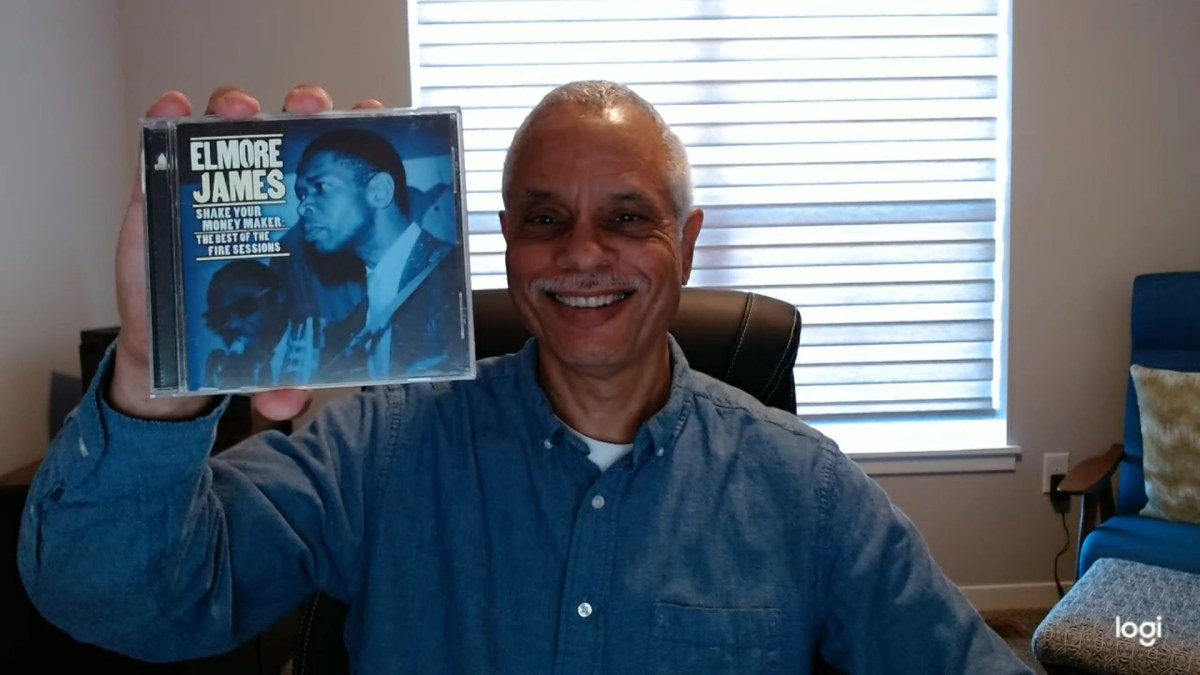
Just a smidgeon of trivia on Little Junior Parker’s song “Look on Yonders Wall.” I know that other artists have recorded this song. Elmore James is one of them and I happen to still have a copy of the CD, Elmore James, Shake Your Money Maker, Best of the Fire Sessions, released in 1960 (I didn’t buy it in 1960). It’s just an odd thing that you can find on the web a YouTube version of that, the title of which has an odd note, “Wrong Lyrics.” It has the lyric “look on yonders wall, hand me down my precious cane” instead of “walkin’ cane.” I’m unsure if it’s legit. And the words of the title are “Look on Yonder Wall” instead of “Look on Yonders Wall” although I think I can hear Elmore James sing “yonders.”
Now, one of the most interesting parts of the blues show last night was not something on the pod show today. I think it was during the last half hour of the blues show. I heard a rock and roll song I’d never heard of and I don’t know how I missed it because it was during my wasted youth when I was listening to similar songs at the time. It was released in 1975. It was the song “Green Grass and High Tides” by The Outlaws. I was absolutely open-mouthed thunderstruck by the guitar licks. One bit of trivia is that the song title is very similar to the title of an album released in 1966 by the Rolling Stones, “High Tide and Green Grass.” There’s no song with that title ever done by the Rolling Stones, it’s just the name of their album.
I was all set to hear the Big Mo Blues Show on KCCK 88.3 tonight starting at 6 pm and guess what? I must have fell asleep sitting up in my chair and didn’t wake up until this song “Bye Bye Blues” by Larry McCray came on a little past 6:30 pm. It makes me think of my wife, Sena-until she starts winning too many cribbage games.
I listened to the Big Mo Blues Show last Friday night on June 21, 2024 and wouldn’t you know, he was recorded. He wasn’t there live that night but as usual he put on a great show of blues music.
And I listened to the Big Mo Pod Show a few days later, and the theme was Absorbing Influences. Very thought provoking. The choice of tunes was interesting and Big Mo pretty much got them all identified. He usually does.
I can’t remember all the tunes he played on June 21st, but as usual, I had a different perspective about the selection for the podcast. I think I heard a Catfish Keith number on the Big Mo Blues Show, which I can’t remember too well and furthermore, don’t quite understand. It was “I Don’t Know Right from Wrong.”
And I’ll throw you another curve. That’s not the number I want to talk about in terms of the absorbing influence theme. Briefly, it just means that many blues artists get influenced by a musician they really like, pick up on what they learn from a song and gradually make it their own.
I think Catfish Keith was influenced by Son House, who sang a song called “A True Friend is Hard to Find.” Catfish Keith absorbed the music, and did his own version which I recently heard. I think it’s a gospel number. Memorable lines include:
“Bear this in mind, a true friend is hard to find.”
It’s true. You have a real treasure if you ever find one.
When I listen to the Big Mo Pod Show, I tend to almost free associate to memories which the songs sometimes evoke. The 5 songs this week came from, as usual, his Big Mo Blues Show this past Friday night. The theme of the pod show was “In Search of Good Company.”
I’m not so sure about good company thoughts, but the comments about Muddy Waters song “Long Distance Call” reminded me of something way back in my past. Big Mo talked about making long distance calls a long time ago, which he connected with pay phone booths.
I don’t think I’ve seen an actual pay phone booth in decades, since the invention of cell phones and that kind of technology. But the conversation about phone booths reminds me of my youth.
I used to live at the YMCA and the rooms didn’t have phones. No cells phones were available back then because it was well before the 1980s. The only way you could place a phone call was to use the one phone booth in the building, which was on the second-floor landing. The rooms were on the third floor, and they were for men only, of course.
Also on the third floor was an old snack vending machine and I’m pretty sure I’ve told this story before as I recollected while writing this post.
I got a Butterfinger candy bar from that vending machine one time. I took a bite out of and saw half a worm wiggling around in it. You don’t want see a worm at all, but half a worm has a whole different meaning.
I was worried and used the pay phone to call the local emergency room. I think I paid less than a quarter to place the call.
I guess I would have been relieved to hear the ER doc tell me that I would be OK—if he hadn’t been laughing so hard. Good thing it wasn’t a long distance call.
I heard the Big Mo Pod Show, which relates to the quiz about 5 songs he played on the Big Mo Blues Show last Friday night. He got all the artists right, just missed 3 song titles!
I had a couple of thoughts about the song lineup related to the theme “Music Changes Context.” Actually, the point was that one of the songs had what might have made some people mad. It was “Funky B***h.” The idea was that some words might be offensive if you say them, but when words are sung, that might make them not offensive, in a way. It’s a matter of opinion.
How that happens is not clear. Big Mo’s example of it was in a historical context related to slavery. Slaves could not say certain words while they were working in the fields. But the overseer would let them get away with if they used the words in a song.
I heard one song that was not part of the Big Mo Pod show that might put a different spin on the idea of how music changes context. It’s about brotherly love, in a manner of speaking—or in a manner of singing, I should say.
I want to give a shout out to the Big Mo Pod Show Subverting Expectations that aired on May 11, 2024 following the Friday Big Mo Blues Show on May 10, 2024.
What impressed me most and puzzled me a lot was the tune that Big Mo didn’t talk about on the podcast. The tune was a dazzling guitar performance called “Hot Fingers” by a duo called Lonnie Johnson and Blind Willie Dunn. Big Mo said it was recorded in the 1920s.
I looked for a video of it and could find several with the picture of what looked like a Caucasian guitarist and nobody else. I also saw one picture with the Caucasian guitarist and what looked like a cut-and-pasted photo of a black guitarist.
Because I couldn’t tell who was who, I googled their names. It turns out that Lonnie Johnson was a well-known blues guitarist. He was black. Lonnie Johnson recorded “Hot Fingers” with another famous jazz guitarist named Eddie Lang, who was white. Eddie Lang used the alias of Blind Willie Dunn in order to hide his race while performing with Lonnie Johnson. I’m not sure how Eddie Lang could pass for black, an interesting twist in the late 1920s. I’m not saying either was racist. Why would they have performed together if they were? And why would Eddie Lang have adopted the black-sounding pseudonym?
So that brings me back to the title of the Big Mo Pod Show which was Subverting Expectations. The expectation that gets subverted had to do with a tune I don’t remember hearing on Friday night. It was “That Lovin’ Thang,” by the group Tas Cru, with which I’m unfamiliar. Big Mo remarked that you could listen to the blues as played by Tas Cru with an expectation that they were going to make mistakes in their performance—which never happened, attesting to their talent.
On the other hand, it strikes me that the story behind Lonnie Johnson and Blind Willie Dunn (Eddie Lang) does create its own sort of subverted expectation, in a different sense. I know Blues music experts already knew that, but it was news to me.
Well, ever since last fall, the Iowa jazz and blues radio station KCCK has been available only on channel 88.3 FM on our radio dial. Channel 106.9 has been out for months. We just found out that 106.9 is now working again and has been for over 3 weeks. It has been a translator channel that broadcasts in addition to 88.3 FM out of Cedar Rapids so that people in Iowa City can have better reception.
The story about why KCCK 106.9 has been out is complicated and traces back to when the Daily Iowan reported in early October of 2023 that because the Iowa City campus of Kirkwood Community College closed, the antenna for KCCK in the area was shut down and other arrangements had to be made for KCCK radio reception in Iowa City.
We never really lost KCCK reception, except on 106.9. It always came through just fine on 88.3. But just a couple nights ago, I heard John Heim aka Big Mo who broadcasts the Big Mo Blues Show on Friday nights starting at 6:00 PM say, as usual, that KCCK is on 88.3 in Cedar Rapids and in Iowa City by translator channel 106.9. He has been saying that for months but nothing came through but static mostly.
And now KCCK 106.9 is back, just like that.
The other news from KCCK is that Big Mo has a Pod cast show now. It just started in recent weeks also. One of them reminds me of what turns out to be a comedy bit he does about May Ree’s hand-battered catfish. He always says she is one of the sponsors for his show. I’ve had my doubts about it but enjoy it anyway. I was evidently one of the many who contacted him asking whether or not the hand-battered catfish story is real. He just advised me to “keep listening.”
It’s not real, but it’s funny. It’s one of a few “Sponsors de faux” comedy bits he has done for a long time. I remember wondering about May Ree and her hand-battered catfish at least a couple of years ago. He has a couple of others which I’ve never heard about: Shorty’s Adult Diapers and Big Furry Shaving Products. I’ve blogged about May Ree a few times. Just search “hand battered catfish.”
Anyway, I thought I’d just pass this along. You can have a lot of fun listening to KCCK radio out of Cedar Rapids and Iowa City, Iowa. I guess now only newcomers will ask whether the May Ree’s Hand-Battered Catfish story is real or not. KCCK of Iowa welcomes new listeners, so…keep listening.
I wish I could have made the title of this post “Why It’s So Hard to Be a Human.” But that would mean I know why it’s so hard to be a human.
The reason this comes up is because of a song I heard last Friday night on the Big Mo Blues Show on KCCK radio in Iowa. The title is “Hard To Be A Human.” I’ve never heard of the vocalist, Bettye LaVette, who has been around a long time. A musician named Randall Bramblett wrote the song and he’s been around forever too, although I just learned of him as well.
I’m going to connect this song with the paranormal show I usually watch on Friday nights, “The Proof is Out There,” which I watch after I listen to the Friday Night Blues with Big Mo.
The show lives on videos from people who report seeing and hearing things like UFOs and Bigfoot or whatever that’s paranormal. There are a lot of fakes and conventional explanations uncovered on “The Proof is Out There,” including UFO videos sent in by contributors.
The reason I’m connecting the song “Hard To Be A Human,” to the paranormal is the letter “A” in the title. There’s another song with a similar title, but without the “A.” In my mind, leaving out the article “A” makes it clear that song is about humans for humans.
By contrast, the song with the article “A” makes me think of extraterrestrials. “A human” could imply that there might be some other life form aside from humans. Of course, there’s no such song as “Hard To Be An Extraterrestrial” (or, if you’ve read Douglas Adams’ book, “The Hitchhiker’s Guide to the Galaxy,” maybe “Hard To Be A Vogon”). Insert “Martian” if that makes thinking about this any easier, which it probably won’t.
There is a song entitled “Hard To Be Human,” which I think is really about how difficult it is to be human, without considering whether there could be any other beings besides the human ones.
Just adding the specific article “A” in front of the word “human” led me to wonder if you could interpret the song in a galactic sense. Now, I have no problem admitting that all this is probably just because of the temporal juxtaposition of the song and the paranormal TV show.
On the other hand, I have this thought. While I couldn’t find the full lyrics to “Hard To Be A Human,” I could understand some of them. I could discern underlying themes suggestive of Christianity. There are definite references to the Bible, such as walking in the garden “apple in my hand”, the lyric “I’m just another life form,” and “First He made the mountains, then He filled up the sea; but He lost his concentration when he started working on you and me.”
I’m willing to concede that the “just another life form” phrase might have been restricted to just the life forms on planet Earth. However, might it suggest that God made beings (and mistakes) on other planets and their inhabitants?
I hope these references are familiar to at least some readers, because I think the point of the song might go beyond the everyday struggle of being human. I think there might be an attempt to raise the notion of trying to compare the sense of being a human with that of some other kind of being not from this planet.
The older I get, the less sure I am that a human is the only kind of being in the universe. It’s a big universe. If we’re not the only life form in the universe, could life be harder for other life forms?
Probably the answer is no. I don’t see extraterrestrials in millions of flying saucers blotting out the sun in a desperate attempt to move here. Inflation is outrageous. And, after all, it’s pretty hard to be a human.
I heard the song “Florida Man” by Selwyn Birchwood on the Big Mo Blues Show on KCCK radio tonight. I updated my post “Gators OMG” by adding the YouTube video to it.



 Go Retire Psychiatrist