Connection Between Cribbage and Obituaries?

Just for fun today (which is New Year’s Day of 2025) after Sena and I played a few games of cribbage, I searched the internet using the term “cribbage in Iowa.” I found a local newspaper story entitled “There’s No Crying in Cribbage. There’s No Politics Either,” published August 18, 2024 in the digital version of the Cedar Rapids Gazette which, by the way, promised me that I have “unlimited” access to articles.

It was written by Althea Cole and it was longer than I expected it to be. Much of the story was about the longstanding history of annual cribbage tournaments at the Iowa State Fair. She also mentioned that her grandfather had been an avid cribbage player.

But I was also puzzled by the significant number of obituaries that popped up in the web links. I’ve looked up cribbage dozens of times but not with this particular search term. I checked several of the obits and found the majority mentioned that the decedents had been avid cribbage players.

I’m not sure what to make of this. What does it mean that cribbage is associated with obituaries in Iowa? I suppose some would say that it might mean that cribbage is a game mainly played by old people—which is probably true. The American Cribbage Congress (ACC) web site makes it very clear that they encourage young people to play cribbage. Be patient, the site takes a while to load.

That said, whenever I see photos of people of playing cribbage, almost all appear to be over 50 years old.

So, I tried searching the web using the term “cribbage in Wisconsin” and didn’t get any obituaries. I got the same result with “cribbage in Minnesota” and “cribbage in Illinois.” I decided not to run the search for every state in the country, because I think the point is already made. For whatever reason, cribbage in Iowa seems to be associated with obituaries and advanced age.

I imagine some reading this post might point out that the connection with obituaries in Iowa and cribbage could just mean that a lot of Iowans enjoy cribbage. That could be true. However, on the ACC web site, I can find only one city in Iowa that has an ACC Grass Roots Club, and it’s in Des Moines.

There’s a web article entitled “Is cribbage too antiquated to survive this digital world? Players and board collectors sure hope not.” It was written by Rebecca Zandbergen in April 2023 and I reviewed it again today. One thing I can say about cribbage is that it’s probably good exercise for the brain. I can find plenty of article which praise cribbage as a way to keep your brain healthy and engage socially.

I don’t know if there are any scientific studies on the benefits of cribbage for your brain. I had trouble finding them on the web, although I admit I didn’t conduct anything like a thorough search. I did find one study on the association of playing cribbage with social connectedness.

Kitheka, Bernard & Comer, Ronald. (2023). Cribbage culture and social worlds: An analysis of closeness, inclusiveness, and specialization. Journal of Leisure Research. 54. 1-21. 10.1080/00222216.2022.2148145. Accessed January 1, 2025.

“Abstract: Recreation specialization through the lenses of social worlds is a common approach used to describe how people define and are defined by recreation activities. This ethnographic study investigates the social worlds of cribbage players. The study analyzes cultural structures through the lenses of closeness, inclusiveness, and recreation specialization. Using survey questionnaires, informal interviews, and researcher observations, data were collected at cribbage events over a period of 3 years. Findings reveal a distinct cribbage culture characterized by varying levels of commitment, specialization, and degrees of connectedness. The study contributes to the currently limited literature on social worlds and indoor recreation specialization. It provides insight as to how people align at a community level to find meaning via recreational activities. Data also reveals a lack of social diversity in the cribbage community. Findings could be used in leisure programming for diversity and inclusion at community and grassroots levels.”

There was also a paper entitled “Cribbage: An Excellent Exercise in Combinatorial Reasoning:

Markel, William. (2005). Cribbage: An Excellent Exercise in Combinatorial Thinking. The Mathematics Teacher. 98. 519-524. 10.5951/MT.98.8.0519. Accessed January 1, 2025.

Abstract: Card games have long been a rich source of combinatorial exercises. Indeed, determining the probabilities of obtaining various hands in poker, and often in bridge, has been standard fare for elementary texts in both probability and combinatorics. Examples involving the game of cribbage, however, seem rare. This omission is especially surprising when one considers that cribbage hands offer excellent applications of combinatorial reasoning.

It’s a math thing, which is good for brains. Math won’t kill you and neither will cribbage. Happy New Year!

“Muggling” Through Muggins in Cribbage

We play cribbage and we tried playing using the Muggins Rule the other day. We “muggled” through it is what I should say.

During one game, Sena got the total count wrong, which led to a confusing situation leading to her overpegging and eventually winning a game, which didn’t make a lot of sense.

Most of the problem was misunderstanding how to apply Muggins rule to overpegging. It’s not clear to us how to address that. Underpegging is easier to understand. If Sena underpegs and I catch it, I’m supposed to call Muggins and peg the difference between the actual pegging score and her over score.

She overpegged a large number of holes and got so far ahead, that I couldn’t catch up. What we didn’t understand is that, according to some rules, the player who overpegs is supposed to move her peg back to the original position behind the front peg.

On the other hand, there is more than one set of rules for how play Muggins. The American Cribbage Congress (ACC) has official rules for it, and they say it only applies to underpegging. It applies after you peg.

On the other hand, I can find guidance for overpegging elsewhere on the ACC website, and it covers overpegging. It’s in the Tips Library and interestingly there’s a slang term for it: Hauling Lumber.

“Hauling Lumber – Hauling Lumber (or Timber) usually refers to intentional Over Pegging, which is one form of cheating during a cribbage game. It is believed the term originated due to most boards being made out of wood and the offending player was pegging more wood than what they were entitled to.”

“Overpegging – Overpegging is pegging more points that what you are entitled to take. It may happen during the play of the hand, in counting the hand or by accidently taking more pegs than indicated. If the opponent catches the Overpegging, you must return your front peg to the proper place and the opponent gets to take the difference between what was pegged and the correct total. If you notice your own Overpegging before your opponent, you may announce the fact and correct your front peg to its proper location with no penalty. See also False Claim of Game and Hauling Lumber.”

However, the Tips Library also says this about Muggins:

“Muggins – Muggins is taking points your opponent misses. Muggins points come from one of two sources. If your opponent misses points during the play of the cards, Muggins may be called after a pause to make sure the opponent is truly missing the points. The other situation is where your opponent fails to count and/or take all the points in the hand. Once he has under pegged his hand, Muggins may be called for the difference in what was pegged and the actual count in the hand. Muggins may not be taken in the case of an opponent failing to take his two points when a Jack is the starter card, those points are lost once the dealer plays a card. Muggins is not applicable in the case where an opponent over pegs his hand, see Over Pegging – Hauling Lumber.”

The bottom line seems to be that overpegging is not allowed in Muggins. If you do it deliberately, you might want to haul ass away from the game table.

I wondered about what the term “Muggins” itself means so I made a cursory search for the origin of the term. I found out that the term is connected to the word “mug,” which means fool or idiot. By extension, I guess it could mean that a cribbage player who makes mistakes in the game is thought to be a simpleton.

This is part of the reason why we’re not going to use the Muggins rule anymore. It takes a bit of the fun out of playing cribbage.

Learning to Use ClipChamp While Recording Cribbage Game on Cribbage Pro

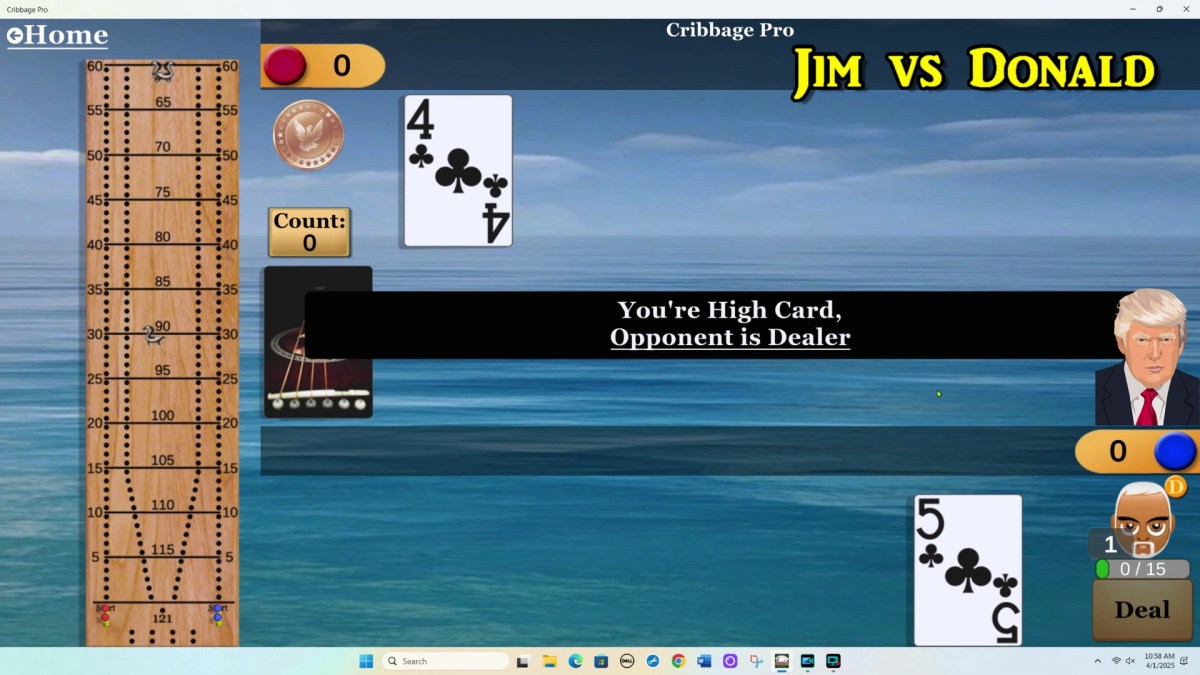
I’m learning how to use the video editor ClipChamp, the free version on the new laptop. So, I muddled through a screen recording of playing what’s called the Daily Cribbage Scrimmage on Cribbage Pro, a feature-rich computer Cribbage game on which you can different skill levels of computer players from easy to impossible as well as online with other live players.

I’m used to using an old version of PowerDirector for my video editing. I would have to expend a fair amount of energy and a little more money to install it on the laptop. I can deal with the webcam on the laptop, but using ClipChamp takes some getting used to.

Great Cribbage Tutorial for Beginners!

I’ve seen a couple of Cribbage videos on Huddle Around Games, which is a YouTube site dedicated to Cribbage as well as other games.

This one is a tutorial on how to play Cribbage for beginners. He calls himself Zulwarn, which is his name when he plays the online form of a computer Cribbage game called Cribbage Pro. I play (well, mainly lose) on Cribbage Pro, but not on line. I just play the computer, on Brutal level. I guess I like punishment because Brutal doesn’t make mistakes.

Zulwarn is funny and smart. He likes coffee.

Is Cribbage Mostly Luck?

I found this cribbage YouTube site that does a really nice job of teaching you how to play Cribbage. Here’s a video about whether Cribbage is mainly a game of luck or skill. It turns out it’s a mix of both.

I play computer Cribbage games with high level computer opponents who-let’s face it, don’t make mistakes. You have to get used to losing pretty often, but there is a certain amount of skill which can help you win-sometimes.

The Mumbo Jumbo on Some Big Antique Cribbage Boards

Today, I’m going on a tangent about big, mostly antique cribbage boards which were specially made for making the scoring more complex. The main perpetrator (I mean manufacturer), was Drueke (variously pronounced as Drooky, Drew, Drooka).

The Drueke name turns up on most of the big two, three and four track vintage cribbage boards you find for sale on eBay. There are a few other makers, but Drueke is the one you commonly see. I don’t know anything about Drueke except it was a well-known maker of board games including chess and cribbage sets. The company was based in Grand Rapids, Michigan.

If you know how to play the basic version of cribbage, you probably think it’s complicated enough as is. But Drueke made boards that allowed you to score many aspects of the game right on the playing surface.

There are other 4 track cribbage boards that aren’t designed to allow players to go crazy with scoring everything you do in a cribbage game. But typically, you’ll see a lot of what Drueke called the “Once-A-Round Scoremaster” boards. I got curious about the rules and found a couple of web pages on which I found out more about them. The rules are a little hard to find and a little vague when you do find them.

I couldn’t find out anything about them even on the American Cribbage Congress (ACC) website—and it’s the main authority about cribbage rules.

Reddit has a page titled Cribbage-Four Track Board (Example Rules). Click the “read more” below the image. It also shows a nice photo of a typical board. It’s tough to follow.

Then I found a Board Game Geek (BGG) page on which a guy named Jeff Bridghman outlined a clearer explanation of how to play on such a board. It’s actually better than the rules included with the Drueke game. By the way, if you have trouble with the web page, just reload it by typing “4 track boards and all the extra mumbo jumbo?” and hit the search button again.

What puzzled me were his comments about the High Hand score. He said his board had something I’ve not seen on pictures of the boards on eBay. The High Hand score goes from 1-10 on every one of those I saw. On the other hand, his board shows actual scores (14 through 29). I think it must have been a custom build. The thread has longevity; it started in 2011 and the latest comment I saw was in 2023.

If you buy the Drueke board, you’ll need the rules. But even if you have the Drueke rules, you’ll probably need something more specific. Maybe Drueke figured people would be more creative than they are. It’s a lot like life. I think sometimes you have to make up some rules.

Cribbage for Three Players

Hey, I found a great website for learning how to play cribbage with more than two players. In fact, you can learn how to play all kinds of games. If you already know how to play two-hander cribbage, you can learn the other common variations. Here’s the YouTube on the 3 player version.

Thoughts on Down Time Activities for Land Survey Technicians

I was just thinking about the old-time land survey crews. When I was getting on the job training as a survey technician, the typical land survey crews were at least 2-3 persons. One rodman, one instrument man, and a crew chief who organized the job, which could be property or construction jobs.

Nowadays, you get by sometimes with one man doing the jobs using a theodolite that measures angles and distances. You don’t always need a physical measuring tape; you can use something they call “total stations.”

It’s cheaper for engineering companies to use one man survey outfits. On the other hand, one disadvantage is the lack of mentoring for learners who want to become land surveyors or civil engineers.

Mentoring from surveyors on the survey back in the day not only taught me such skills as how to throw and wrap a surveyor’s steel tape—it also taught me how to work well with others as a team. Of course, this was transferrable to working on the psychiatry consultation-liaison service in a big hospital as well.

It’s well known that playing cards in the truck while waiting for the rain to stop was an essential skill. I don’t know how they manage downtime nowadays. We didn’t play cards on the consultation service during downtime, partly because we didn’t have much downtime.

Anyway, as I mentioned in a recent post, we played Hearts in the truck on rain days. I always sat in the middle. At the time, I was a terrible card player in general. It was a cutthroat game and I had trouble remembering which cards had been played.

When you consider that the strong suit of engineers and surveyors is math ability, you’d think that survey crews would have figured out a way to play Cribbage during downtime. You can have a Cribbage game with 3 or 4 people although I’ve never played it that way. If there are 3 players, it can still be cutthroat.

The one problem I can see is that, the guy sitting in the middle would have to set the board on his lap. You’d almost need a special, custom-made board which would have a space for placing the cards to keep track of what’s been played. I think that might have made things easier for me.

The other drawback to one man survey crews is that pretty much the only card game you can play is solitaire.