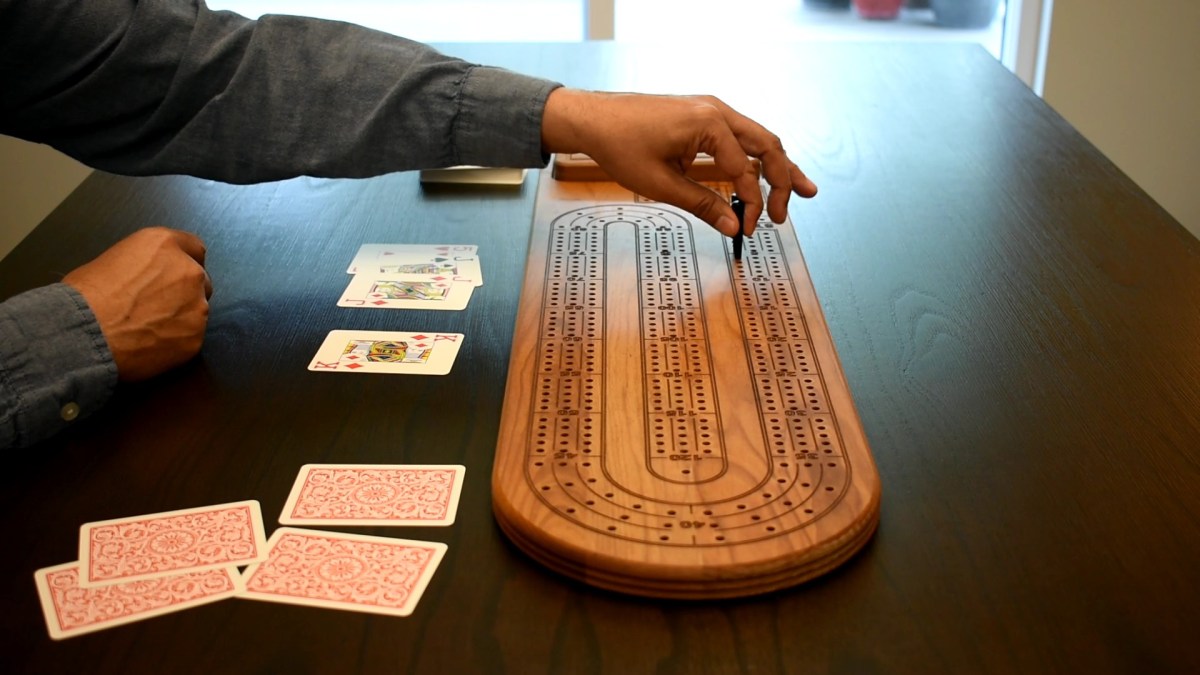
OK, sorry, I just noticed that my cribbage post “The Best Cribbage Song You Never Heard Of” has lost the video for the cribbage song “One for his nob” by British artist, Richard Thompson. I don’t know where it went (maybe abducted by extraterrestrials), but I think I found another one. It’s called “The Crib Song” and it’s by somebody named Brett Kissel. All I know about him is that he’s a Canadian country singer.
There’s only a couple of hitches relating to the short and speedy cribbage video Sena and I made in March: one is that it was timed to go with “One for his nob.” Brett Kissel’s number is longer than “One for his nob”—and the other is that I’m not a huge fan of country music. One the other hand, it does have a ton of cribbage terms in it, many of which I’ve never heard of.
So, I would have to modify our cribbage game video to fit the length of the song. I think I could manage but it would take a little time and effort. In the meantime, you can hear it here.
I already have an update to the cribbage kerfuffle I posted about yesterday! The American Cribbage Congress (ACC) representative clarified what to do if the non-dealer and dealer by mistake switched roles during the cut of the deck and picking the starter card. According to Dan:
“This mishap of the cutting of the starter card is addressed in the rulebook under Rule 6.1 Even though it does not specifically address the wrong person cutting the starter card, it alludes to a similar situation and says, the starter card must be returned to the pack… the dealer reshuffles the pack, and the pone cuts the starter card. No penalty is assessed. Therefore, you did the exact right thing by keeping your hands and the crib and shuffling the remaining deck and then correctly cutting. The jack that was originally cut is not in play at all.
Hope this helps.”
Dan got back to us the same day we sent the question, which was a fantastically quick response in my book!
Yesterday while playing cribbage, Sena and I accidentally switched non-dealer and dealer roles during the cut and pick the starter card phase of the game. I was dealer and by mistake cut the deck. Sena was non-dealer and by mistake picked the starter card—which happened to be a jack.
At that point we both realized this was wrong. I was the dealer and should have got the two for his heels, but I was also guilty of cutting the deck which the non-dealer is supposed to do. Sena, for whatever reason, picked the starter card, compounding the mistake of switching roles. This actually would have resulted in her getting 16 points!
At first, she suggested she get the two for his heels points and proceed. I thought this would compound the mistake further and thought we should reshuffle and redeal—which she did after a fairly long discussion. We kept our original hands and cribs and just repeated the cut and picked a new starter card the way it was supposed to be done—nondealer (Sena) cut and dealer (me) picked the starter card. In all fairness, we’ve both done this in the past but caught the mistakes before it got as far as it did yesterday.
However, we then looked for any rule which would cover what we should have done. I couldn’t find one either on the American Cribbage Congress website rulebook page or anywhere else. The link takes you to the ACC 2025 version of the tournament cribbage rules; which gives the cut card rules starting on page 28 of the flipbook. It covers the mistakes of the dealer turning up the starter card before both players discard to the crib, nondealer looking at the bottom card of the upper pack when making the cut, and the dealer placing the cut card in his hand and not showing it to the nondealer. It doesn’t cover the wild mistake of both dealer and nondealer accidentally switching roles either by somehow switching to a parallel universe or by extraterrestrial intervention.
We also tried to ask Artificial Intelligence (AI): What happens in cribbage if the dealer cuts the cards by mistake and the non-dealer turns up the starter card by mistake?
AI answer: “In cribbage, if the dealer cuts the deck by mistake and the non-dealer mistakenly turns up the starter card, the dealer loses the deal and the crib. The non-dealer then becomes the new dealer, and the cards are dealt again.”
I couldn’t find anything on the web which supported the AI answer or its detailed explanation. Long story short, I think this might be an example of an AI confabulation (some would call this a hallucination).
However, when I searched again asking the same question, AI gave a different answer:
“In a friendly cribbage game, if the dealer cuts the deck and the non-dealer turns up the starter card by mistake, the cards should be reshuffled and re-dealt. There is no penalty for this mistake as it is considered a misdeal.”
The explanations for the AI answer make sense but tend to sound like rephrasing of the initial answer and there are links which don’t seem connected to the answer. And if I search again, I get a slightly different answer and the explanations are not really connected to the original question.
But we reshuffled and redealt. I sent a question about this to the relevant ACC representative who takes general questions about cribbage. If I get an answer, I’ll pass it along.
We were distracted from our cribbage match today when Sena saw a couple of goldfinches out in the back yard. One of them was clearly a male, bright yellow all over except for his black wings. The other was probably a female because it was olive colored. The sunlight must have varied because at times it looked like it had colors more like the male.
At one point the male seemed to be distracted by something we couldn’t see shaking the bushes behind them. They sure were hungry. I took the video with my Canon point and shoot. Sena reminded me about the Nikon DSLR and I rushed to get it. By that time, the goldfinches were gone. I have to remember to leave both cameras out after this.
This is a red-letter day! First of all, I saw this article on line about how older people can stay sharp and fit. One of the suggestions for cognitive fitness was to play “complex card games.” Cribbage counts (literally) because today, Sena had a Raggedy Ann hand!
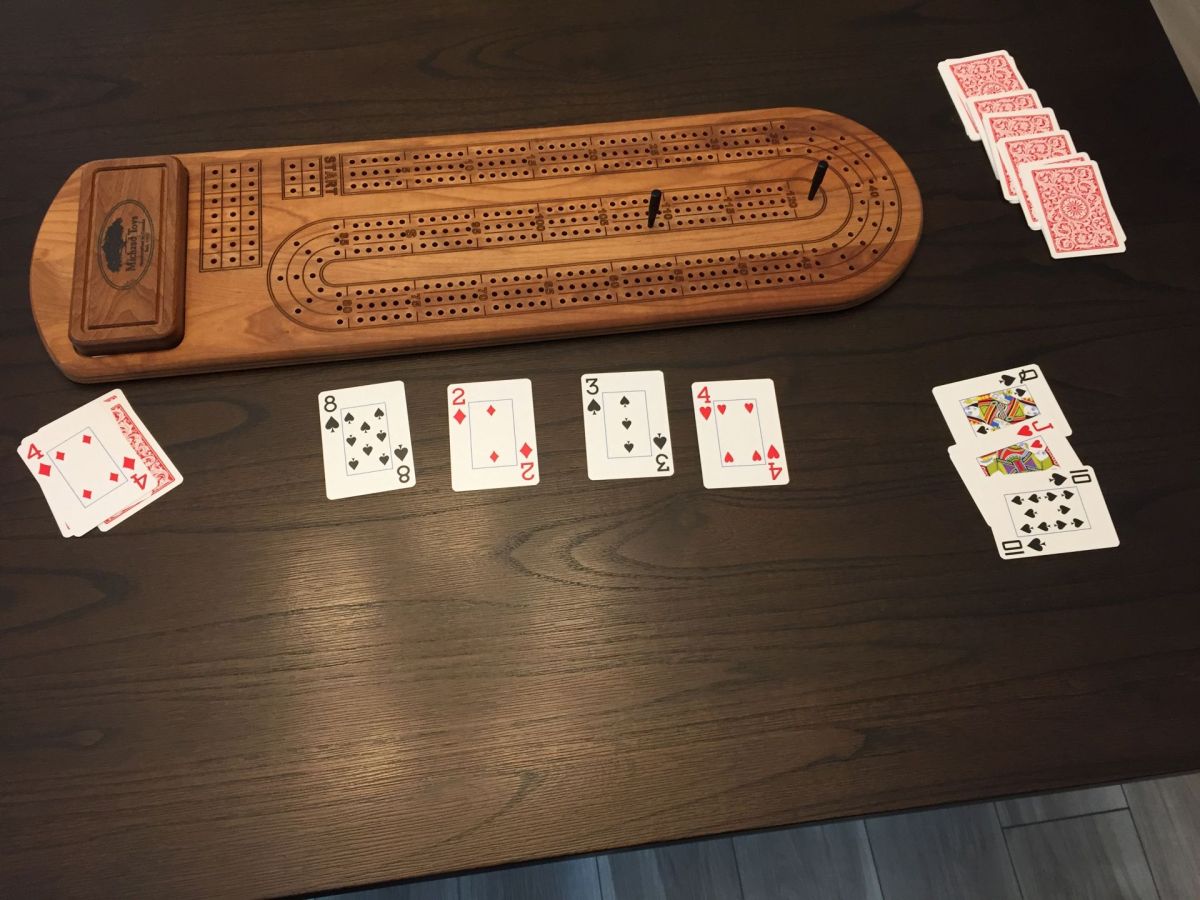
A Raggedy Ann is, as my old medical school pathology textbook authors put it, “not excessively rare,” but it’s uncommon enough that it can trip you up on how to count the points. It consists of 8-7-6-A-A with one of the aces being the cut card, of course. It’s worth 13 points.
First count the 15s, which are cards adding up to 15: the 8 and the 7, the 8 and the 6 and the A diamond, the 8 and the 6 and the A club in the crib, finally the 7, 6, and the two A’s=8 total. Add the three card run 6,7,8=11; then add the A pair for 2 more=13.
What’s hilarious about this is that we thought it was 11 points—which is another weird hand called a Raggedy Andy. It consists of 8-7-6-2-2. But because Sena’s hand had aces, the other 15-point combo was hard to pick out. Both hands are often miscounted.
Substitute deuces for the aces and try to count it. You should come up with 11 and that’s the Raggedy Andy.
Another funny thing about this is that when I was looking on the web for the odds on getting these hands, the AI (which always comes up) got it all wrong, saying “In cribbage, a “Raggedy Ann” hand refers to a hand with a score of 28, which is also known as a “28-hand”. This hand is quite rare, with odds estimated at about 1 in 15,028.” The second time I searched, AI corrected itself and got it right.
As far as I know, there’s no particular name for a 28-hand. Also, I couldn’t find any information of the statistical likelihood of getting a Raggedy Ann or a Raggedy Andy. I couldn’t find any explanation for how the hands got their names either although many assume that it’s because the count is so—raggedy.
As I mentioned earlier, it’s tough to spot one of the fifteens in the Raggedy Ann. Check out the American Cribbage Congress web site for more cribbage lingo.
This kind of gets us pumped for hoping one of us will get the very rare 29 hand.
By the way, the other thing we did today was to plug in the automatic card shuffler to top off the charge, so we both hand shuffled. We plugged it in at 10:30 am and it wasn’t fully charged until 4:30 pm. And you’re supposed to get 2,000 shuffles out of it, and I’m pretty sure we’re nowhere near that. Anyway, shuffling was a lot less noisy.
I wish we’d filmed the cribbage match we just played because it was marked by the weird combination of luck and strategy so typical of every cribbage game. On the other hand, I know if we’d tried to film it, we’d have been too flustered to make anything useful of it.
So, I’m going to point out generalities that might be interesting and useful to anyone who wants to know about how to play cribbage.
One skill I’ve picked up from playing the computer game Cribbage Pro is how to figure out which two cards I should throw to either my crib or Sena’s. In general, you can learn from any cribbage player you should throw “bad” cards to your opponent and “good” cards to yourself. It’s just about keeping the most points for yourself and as few as possible to your opponent. Cribbage Pro rates your throws. You want to keep cards that you can make points on when you’re the dealer and you want to throw cards to your opponent which will be least likely to make points for them.
It’s easy to get hypnotized into thinking that the crib tosses are the main way to win—but it’s a false hope. I’ve gotten perfect ratings on my crib throws and been skunked by Brutal, the Cribbage Pro game’s toughest opponent.
Luck is an important part of cribbage and counting on just one of the aspects that you have some modicum of control over is a mistake. In fact, one of the reasons I get dinged by the computer is my tendency to ignore the 3-point run in my hand, which when counted with a two card 15 combo can make me 5 points. I usually get mesmerized by the common double 15 with two 10 cards and a five card, which are worth 4 points and break up the 3-point run. I can’t figure out why I do that so often.
The other thing I miss is the flush in my hand, which often would net me more points, especially when I don’t see what I usually get stuck on—the 15s!
But there’s always a big luck factor along with simple inattention to careful counting that does me in. And focusing too much on the throw to the crib can distract you from learning pegging skills, which is governed by some basic understanding of probability (nothing esoteric here, please, because I barely got through biostatistics in medical school!) and whether or not you’re playing with someone you know pretty well and able to anticipate their usual moves (she always drops the 9 spot on the 6 lead!).
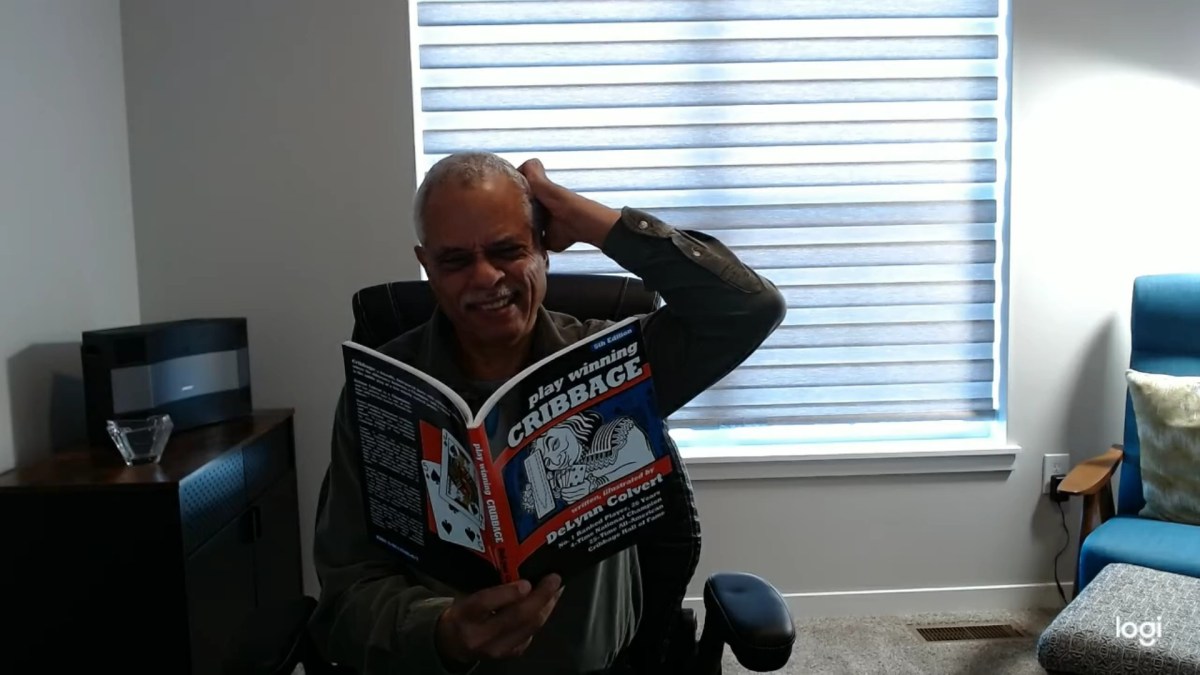
That reminds me of somebody who was one of the top cribbage players in the world, DeLynn Colvert. He won several national cribbage championships in his career and wrote a book about the statistical aspects of the game, including something he called the Twenty-Six Theory. I have the book and I’ve never really even tried to read that chapter. You can get a sense of what kind of cribbage expert he was by reading Part 1 of his Twenty-Six Theory on the American Cribbage Congress (ACC) web site.
Paraphrasing Master Yoda: “That is why I fail.”
Cribbage YodasDeLynn Colvert cribbage book
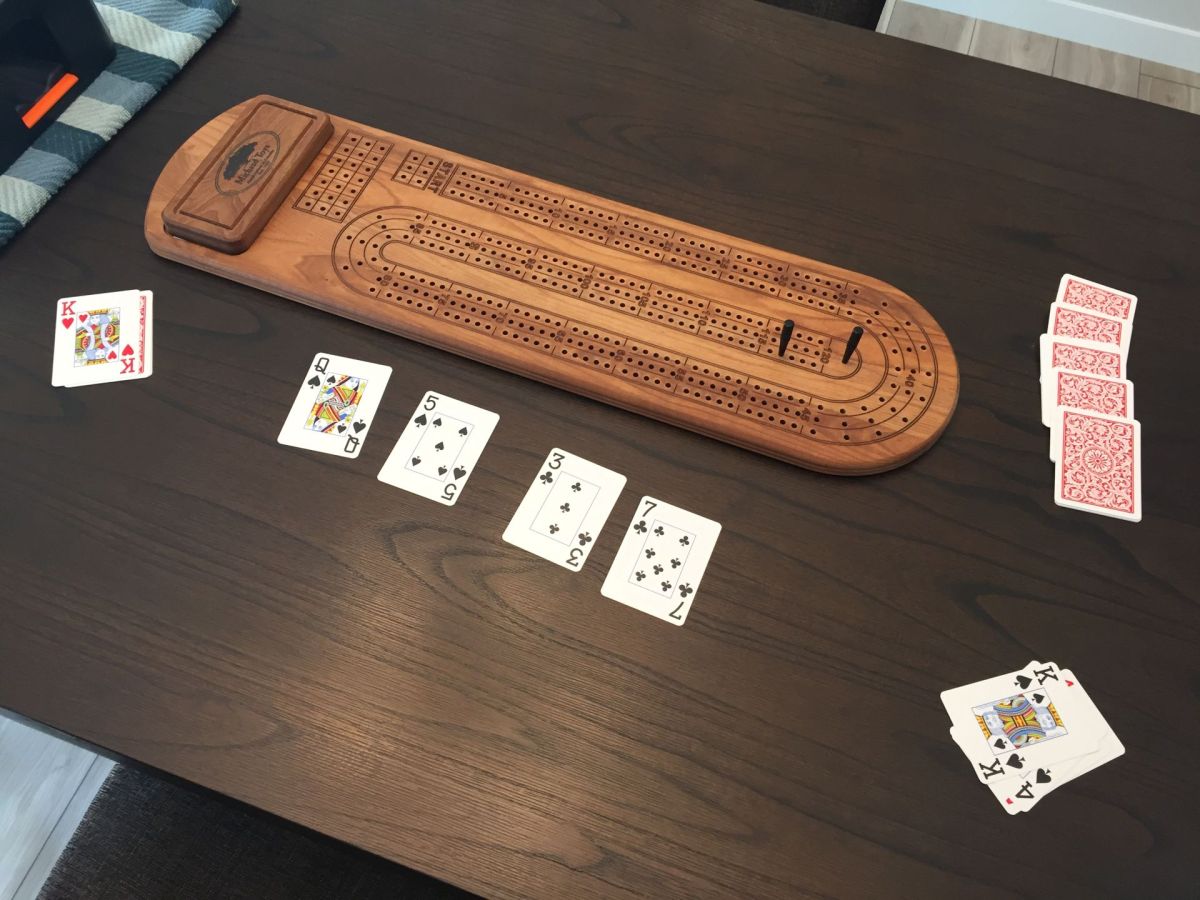
Another thing that sometimes prevents us from getting points is the uncertainty about seeing the run during the pegging phase. It’s common for players to place their cards on their sides of the table with the cribbage board between them. Here again, Cribbage Pro can sometimes interfere with learning an important skill. It does all the work because all the cards from both players are automatically placed in the center of the screen, where runs are clearly discernible.
I think in most games nobody has the luxury of seeing how runs actually look in the usual table setup. Maybe others have no trouble spotting what are called interrupter cards in sequences, but we do—although we’re getting better.
What that can lead to is avoiding playing into runs because both players have to sort of conspire to make them. You can actually see them coming and “run” away because you don’t want to get embarrassed by puzzling over what counts as a run or not. We know the cards don’t have to be in order but they do need to be resolvable into a consecutive sequence on close inspection.
That’s harder to do if the players’ cards are on opposite sides of the cribbage board. You also have to pay attention who leads after a go because it’s relatively easy to tell where a run starts at the beginning of a game since pone always leads.
It’s really hard to talk about cribbage. It would be better to make a video of it, but I’m not sure we could do it. Cribbage has been called a “finicky” game by Barry Rigal, who co-edited the book “Card Games for Dummies” and it’s tough to argue that point.
On the other hand, if you stick to it, you can get drawn into all that finickiness.
We were playing cribbage this afternoon and Sena spotted a blue bird perched on top of our crab apple tree in the back yard. I rushed to get the camera and got a quick video about 7 seconds long before it flew off. I pulled a few images of the back of the bird; it never turned around. We’re both pretty sure it’s a male indigo bunting, which Sena probably spotted about a week or so ago.
Click each image and then click the little “i” icon, which will open up to instructions on how to enlarge the image.
According to my field manual, it’s actually a gray bird without actual blue pigment in the feathers. They look blue because of how they refract light, similar to blue jays. I have personally not seen an indigo bunting in over 20 years.
And I won the cribbage game, which is pretty rare because Sena will not be defeated! How much excitement in one day can I stand?
Sena got a measles vaccine booster today just to be on the safe side given the increase in the number of measles cases all over the country, including Iowa.
The history of the measles vaccine is fascinating by the way. It can make it challenging to figure out who might need a booster.
Despite the mild headache from the shot—she won our cribbage match again. She will not be defeated!
Sena after measles vaccine boosterSena wins cribbage match again!
Sena has again been winning virtually every cribbage game. We always play 3 games, best of two wins and skunk wins don’t count. I think I play pretty well. She just plays better.
It reminds me of the song “Anything You Can Do (I Can Do Better).” It’s a song from the musical “Annie Get Your Gun.”
Her motto is “I will not be defeated!” I’m beginning to suspect there is extraterrestrial assistance at her elbow. If that’s the case, can a 29 hand for her be far behind?
Today’s essay by Dr. Moffic was pretty interesting about the role of video gaming in health for men and women. Computer games were emphasized but it got me thinking about hands-on games that you might thing of as being more old-fashioned—like cribbage.
I wrote a post about cribbage already today, but there’s another angle on it that’s readily adaptable to considering its role in promoting mental health for both men and women.
That reminds me that until yesterday and today, I was on a major losing streak in cribbage with Sena. Cribbage wins and losses seem to occur in streaks and I was beginning to wonder if I’d lost my touch.
There’s a cribbage connection with the electronic gaming realm in that we also play the computer video cribbage game Cribbage Pro. There are three levels, Standard, Challenging, and Brutal (the toughest opponent). We always play Brutal, and often win. There’s a way to play internet cribbage on Cribbage Pro, but we don’t. I prefer playing live. I think the popular view of cribbage is that it’s an old guy’s game. I suspect people think it’s a card game old men play on their lunch hour at the factory.
Nothing could be further from the truth. It’s very popular with women and kids and my guess is that no matter what your gender preference is, there’s a greater diversity of cribbage players out there than anyone realizes.
Playing cribbage promotes and maintains brain health by requiring you to practice basic arithmetic by counting your scores and pegging. You lose a little of that in Cribbage Pro although you can turn on the feature allowing manual counting of scores.
And the American Cribbage Congress (ACC) accommodates internet cribbage tournaments. It’s very popular and competitive. By the way, expanding on my other post today about how to verify your luck in getting a 29 hand in cribbage, you can easily prove it on Cribbage Pro by taking a screen shot of it!
Computer games are fine, but I like to manually shuffle the cards for cribbage. Sena likes to use the shuffling machine—which is very loud but gets the job done. I’ve not yet found a way to “accidentally” lose the shuffling machine (Can’t imagine where it went; must have grown legs and walked downtown!).
We always help each other count our scores. The one time we tried muggins rule, which involves penalizing each other for missing scores by taking them from each other, we just couldn’t seem to get it straight. And it wasn’t as much fun.
There are local cribbage clubs that you could get involved in although they might be hard to find. The nearest one to us is several hours away.
I used to play computer games years ago (although not Nintendo), but nowadays I feel more like Agent K in Men in Black II as he’s trying to quickly learn how to steer a spacecraft using what looks like a PlayStation 2 controller (I used to have one of those).
after K turns on the auto pilot during the chase…
Agent K: It is not automatic pilot.
Agent J: He doesn’t work when we’re in hyperspeed.
Agent K: I could really use a steering wheel!
Agent J: We don’t have no damn steering wheel! This is what we got! [turns off auto pilot] Didn’t your mother ever give you a Gameboy?