We finally got a couple of videos of a goldfinch! It has been years since I’ve been able to catch a brilliant male goldenrod and it happened last week on the Clear Creek Trail.
In fact, we saw a few birds with the usual idiosyncratic behavior. Goldfinch are rocket fast and hate getting caught on camera.
On the other hand, robins seem to be aware of when they’re being watched and ham it up.
Catbirds also seem to know when they’re being observed and flit away just as I’m getting the camera focused. The one I caught seemed to moon me with its rusty-feathered rump as it took off.
Cardinals also show off and can sit for several minutes preening while you get decent footage.
Birdwatching is a lot like fishing. When you tell others about the whoppers you lost at the lake, it’s a lot like birders telling you about the rarely seen, mysterious birds everyone but experts almost always never see.
And I swear I saw a blue bunting while we were out that day. It flew right in front of me. You should have been there. I haven’t seen a blue bunting in decades!
The other day we walked the Terry Trueblood Trail (when do we not do that?) and saw interesting sights. I finally got a video clip of a goldfinch! And a male northern cardinal either sang to us or cussed us out. It was hard to tell.
It was a scorcher out there. We started out looking for a walking trail a guy gave us directions to a week or so ago. It’s a great place for birding. We found it, but here was no parking anywhere close. He told us that we could park in a farmer’s field, but we saw the farmer out there and decided not to chance it.
While we were out doing that, we drove by a cornfield, which really impressed Sena because we could drive right up close to it. She’s never detasseled corn. I have and I don’t think she missed anything. I walked the rows with fellow detasselers and we yanked them. We were in rows right next to each other. We could hear each other collapse from time to time from exhaustion. When you pulled the tassels out, they sort of squeaked. You could hear us: Squeak, squeak, squeak, thud.
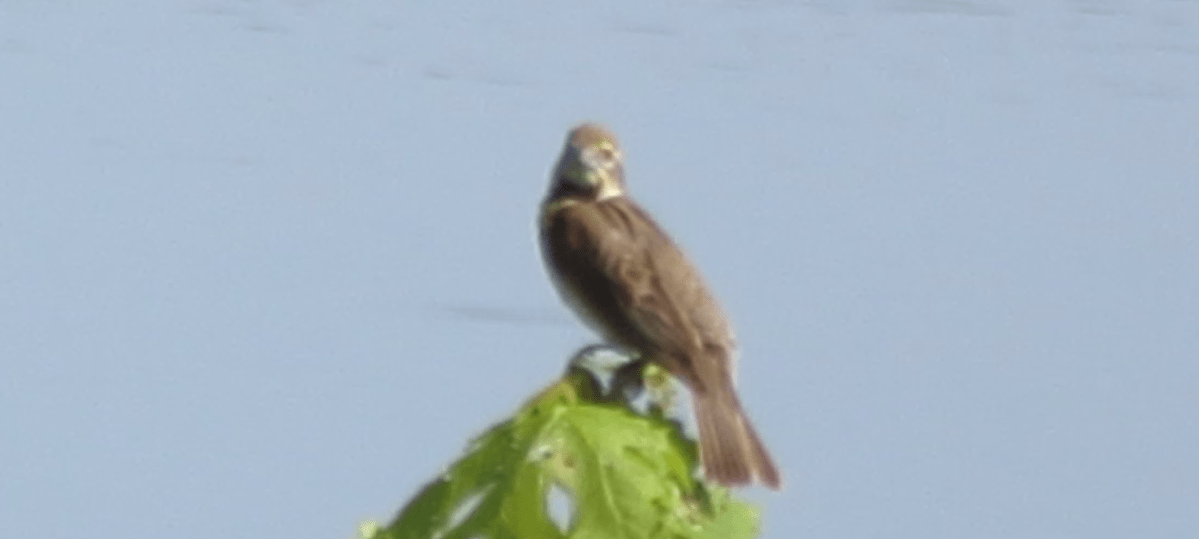
On the other hand, we had a pretty good day birding out at Trueblood. I got a better video clip of a dickcissel. We saw a couple of geese scare a turtle off a rock in Sand Lake. We didn’t notice it at the time, but saw it on the video clip after we got home (which is still the hotel, by the way).
We saw several dickcissels. We still don’t think they sound like they’re singing “dick, dick, dick.” I think that’s a load of squeak, squeak, squeak. They are pretty birds, though.
We walked the Terry Trueblood Trail the other day and ran into a couple of other bird watchers. They said they’ve seen many birds called dickcissels on the trail.
I couldn’t remember ever seeing or hearing a dickcissel. We have enough trouble catching a clear sight of goldfinches. Both birders said the name comes from the bird’s song. They said it sounds like the bird is saying “Dick, Dick, Dick.”
I’m not so sure. As it happened, I think we saw a few dickcissels that day. We think the bird doesn’t sound like it’s saying “Dick, Dick, Dick.” I think it’s more like “chirp, chirp, chirp.”
Anyway, I think I got a video of three dickcissels, along with a few other birds. Do you agree or disagree? And what do you think of the name “dickcissel” for a bird? I read one article written by someone who had a low opinion of how the bird got its name.
What are those things in the water? I think they’re fish.
The other day we went birding on the Terry Trueblood Trail. You couldn’t ask for better weather. We saw a lot of birds paired off and checking into the nest boxes or building from scratch.
I don’t know how we got so lucky. We saw male and female red-wing blackbirds, tree swallows, sparrows, and goldfinches.
The difference between the guys and gals is that the female birds tend to be drab. It’s mainly for protection. The females don’t want to attract attention from predators. The males tend to be flamboyant, as if you didn’t know that from your own experience with humans.
The red-wing blackbird male has stunning red and yellow epaulets on its wings. The female is mostly brown.
The tree swallow male is startling bright greenish-blue. The female is a bit duller.
The goldfinch male is a loud yellow while the female is kind of drab olive.
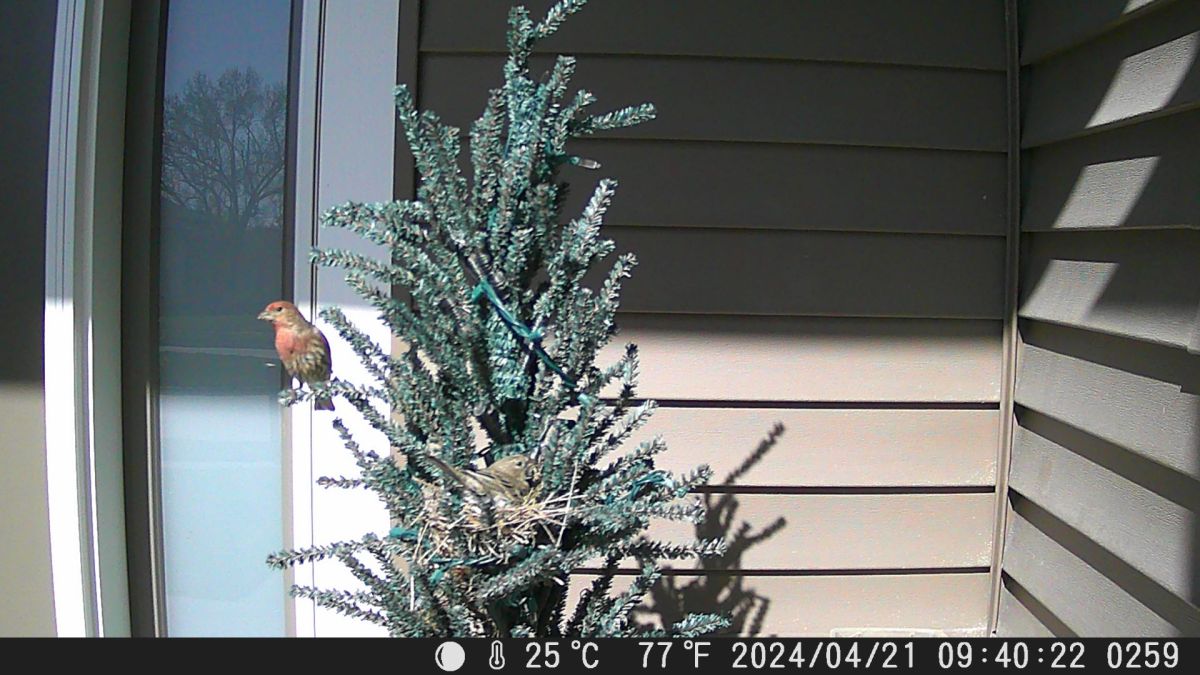
We managed to get some critter cam footage of the male and female house finch pair nesting in the fake Christmas tree in our front entry way yesterday. Crank up the volume on your audio to hear them singing.
The male sports a red face and chest. The female is plain brown except for brown streaks on a white belly. While she incubates the eggs, he feeds her periodically.
It’s definitely a tough job sitting there most of the time with temperatures getting well into the 80’s Fahrenheit on our porch even before noon. On the other hand it’s still getting pretty cold at night.
We don’t know when the eggs were laid, but they take about two weeks to hatch. After that the chicks will take a couple of weeks to fledge.
I’m a little nervous about going out there periodically to pick up the critter cam and peek at the eggs. It always startles the female. It can also alert large predatory birds to the prospect of a meal. This actually happened about 4 years ago when I heard what sounded like large bedsheets flapping in the wind. It turned out to be the biggest crow I ever saw taking off with its beak full of house finch nestlings from the real evergreen tree in our front yard (different house).
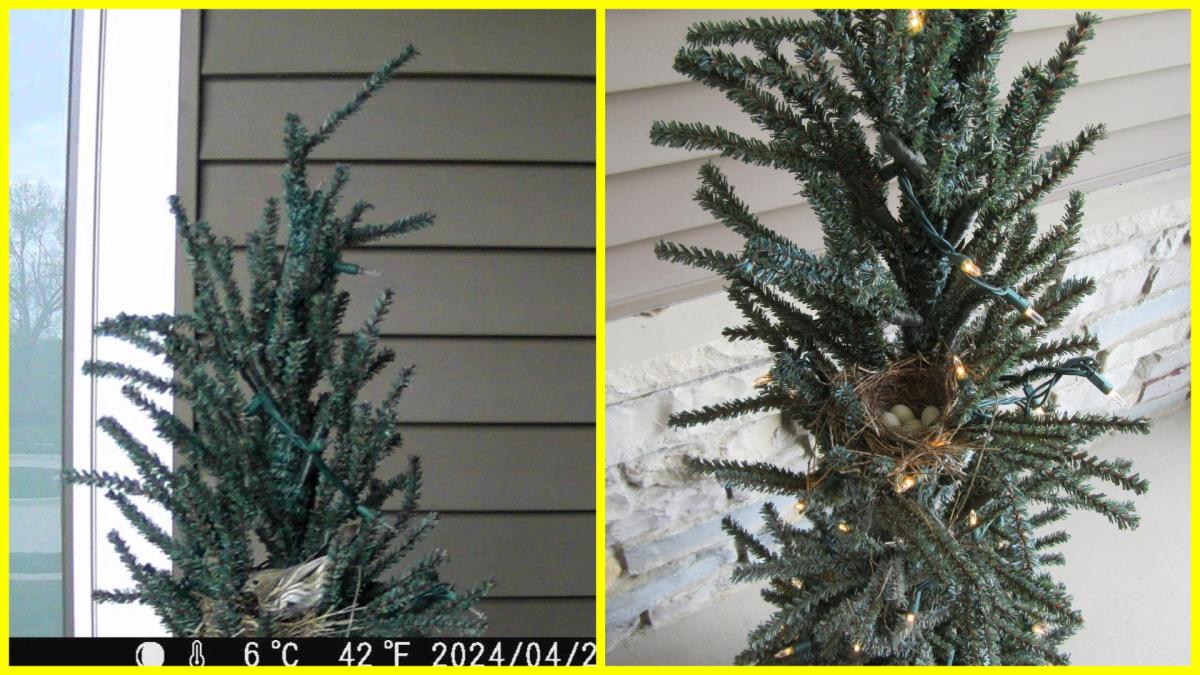
A couple days ago, Sena found a bird’s nest in our front porch artificial Christmas tree. The small nest is made from the clippings of Sena’s ornamental grasses. It has 4 small eggs, which are white with dark specks.
We could hear a bird singing while we were sitting in the house and it always sounded close by. We could see it flitting around but we couldn’t identify it. We thought it might be nesting in our magnolia tree at first but Sena couldn’t find one.
I’ve scared a bird a couple of times lately and it always seemed to be flying off our front porch from somewhere. I never thought to peek in the little fake Christmas tree sitting in a big pot.
So, I got the critter cam out. It hasn’t been getting any use since we solved the problem of our yard drain grate lids popping off by having them screwed down last year. We never did find out what flipped the lids.
Anyway, Sena suggested moving the pot with the tree around to face the front of the porch and set up the critter cam facing the tree. Both the tree and the camera on a tripod are somewhat sheltered from the wind behind one of the columns.
Moving the tree confused the bird a little because it had a little trouble finding it at first. We got a good enough video to identify it as a female house finch. We don’t know when she laid the eggs, but they take a couple of weeks to incubate.
We had been trying to keep birds off our porch by setting out a couple of fake snakes. The birds ignored them. And I guess they don’t mind nesting in fake trees, either.
The nest is probably in a fairly safe spot on the porch. Crows and other predatory birds fly around, but might be less likely to see it from the air. Maybe we should get a fake dog.
We’ll try to keep our intrusions to a minimum, because it tends to tip off big, hungry birds. On the other hand, we would like to get enough footage to make short videos of the progress of the nestlings.
I thought I would share a couple of ideas about the Czech composer Antonin Dvorak. I’m not a music expert by any stretch of the imagination, but I enjoy listening to classical music on the Music Choice Classical Masterpieces channel.
Music Choice always have interesting bits of biographical information about the musicians. The items about Dvorak are very interesting. For example, a couple of them mention that he had idiosyncrasies. One was that he stole all of the pencils at a place where he was supposed to be working because the pencils were “perfect for composing.” Another factoid is that he was fascinated with the trains in Prague and, in fact, had memorized the entire train schedule.
This makes me wonder if he was something more than eccentric and might have had some form of autism spectrum disorder (formerly Asperger’s Syndrome). On the other hand, I’ve always been a little suspicious of the Music Choice channel’s little biographical blurbs. I couldn’t verify from a quick internet search whether or not he had the disorder or not—and probably he didn’t.
On the other hand, Dvorak did visit Spillville, Iowa during the summer of 1893. There’s a short video which tells about his visit. One of the images shows a picture of a scarlet tanager, and the voice over mentions that Dvorak was often inspired by birdsong. In fact, there is an online reference to an anecdote about Dvorak basing one of his compositions, String Quartet in F major (op. 96, the ‘American’), on the song of a bird.
There was some controversy about whether it was more likely he based it on the song of the red-eyed vireo or that of a scarlet tanager. But after an extremely long article, the authors of the reference conclude that Dvorak’s composition was based on the song of the red-eyed vireo, which doesn’t resemble a scarlet tanager at all (McKone MJ, Beccue DA. The Iowa Bird That Inspired Antonín Dvořák’s American String Quartet in 1893: Controversy over the Species’ Identity and Why It Matters. Nineteenth-Century Music Review. 2021;18(3):521-537. doi:10.1017/S1479409820000282).
I’m an amateur bird-watcher and I’m pretty sure I’ve never heard or seen a red-eyed vireo. I have seen a scarlet tanager but I can’t remember what its song sounds like. I’m pretty sure Dvorak didn’t mistake either bird’s song with the well-known howl of Bigfoot, who may have been sneaking around Spillville, hunting for beef jerky.
Let’s see Music Choice channel try to add that to the anecdotes about Dvorak.
We caught sight of several birds engaged in the usual interactions with each other and their prey (in the case of the hawk). Call it civil or uncivil society, it’s natural no matter how you see it.
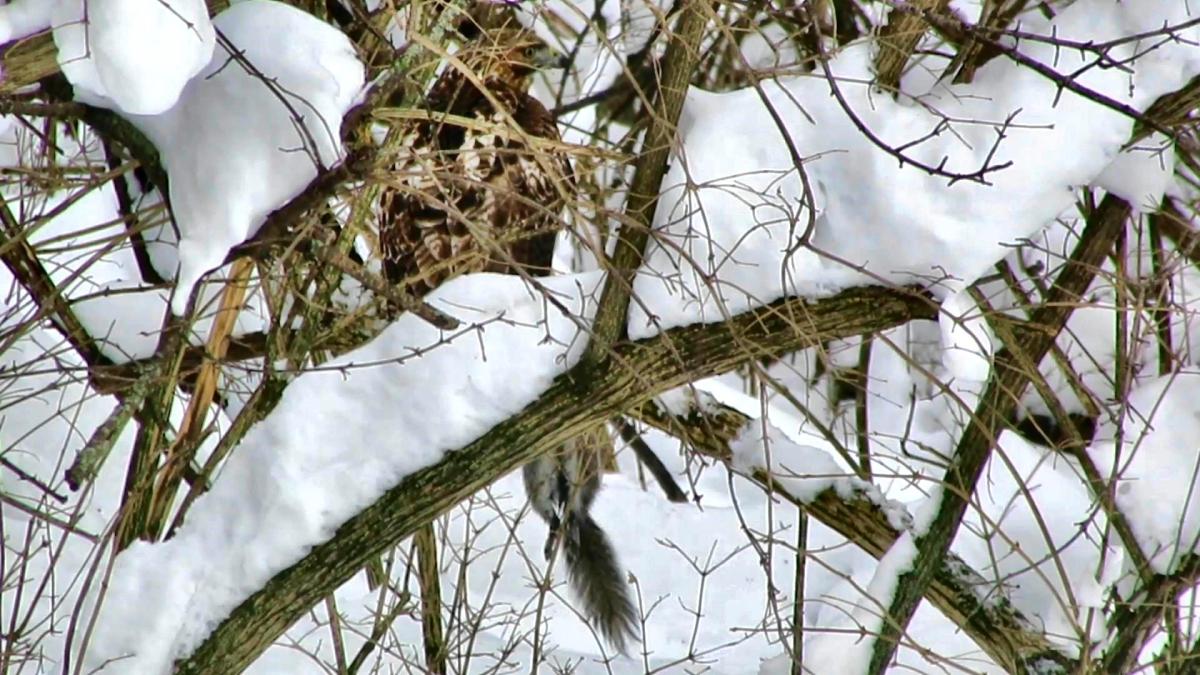
I’m going to call it a Red-tailed Hawk that caught a gray squirrel and had a tough time managing to eat it or even carry it up a tree.
We saw a male Cardinal nip a sparrow who was dining a little too close to him on a tree. I’m going to go out on a limb and guess it was a White-throated Sparrow.
We a Black-capped Chickadee flitting around and a couple of wild turkeys trudging through the snow. The turkeys seemed to be almost encouraging each other at times.
We have not seen any birds in our backyard since the arctic blast began this past week or so—until a couple of days ago.
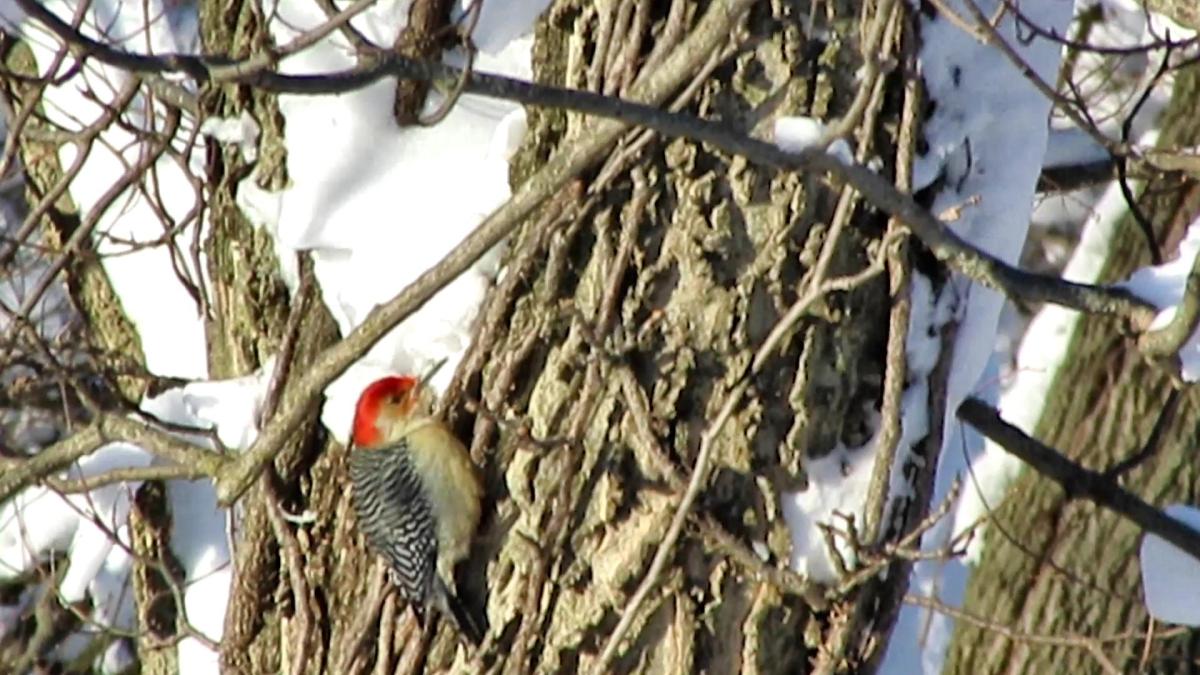
We saw a Red-Bellied Woodpecker, a Downy woodpecker, and a White-Breasted Nuthatch. Hardly a flock, but interesting anyway.
We had a little trouble deciding whether we saw a White-Breasted Nuthatch or a Black-Capped Chickadee. But there were a few clues. The bird was climbing down the side of a tree. Chickadees don’t do that. It didn’t have a black throat patch, either. And it had a chestnut undertail.
The downy Woodpecker had a stubby little bill and it was smaller than a Hairy Woodpecker.
That reminded Sena of the time about twelve years ago when she went to a lot of trouble looking for our camera. She caught a shot of a Pileated Woodpecker in our backyard while I was at work. She thought I wouldn’t believe her unless she had a snapshot to prove it. I’m glad I didn’t bet on it.
The other day it was about 60 degrees and the sun shone brilliantly—not a day to stay indoors! We went out to Terry Trueblood Recreation Area and did some bird-watching.
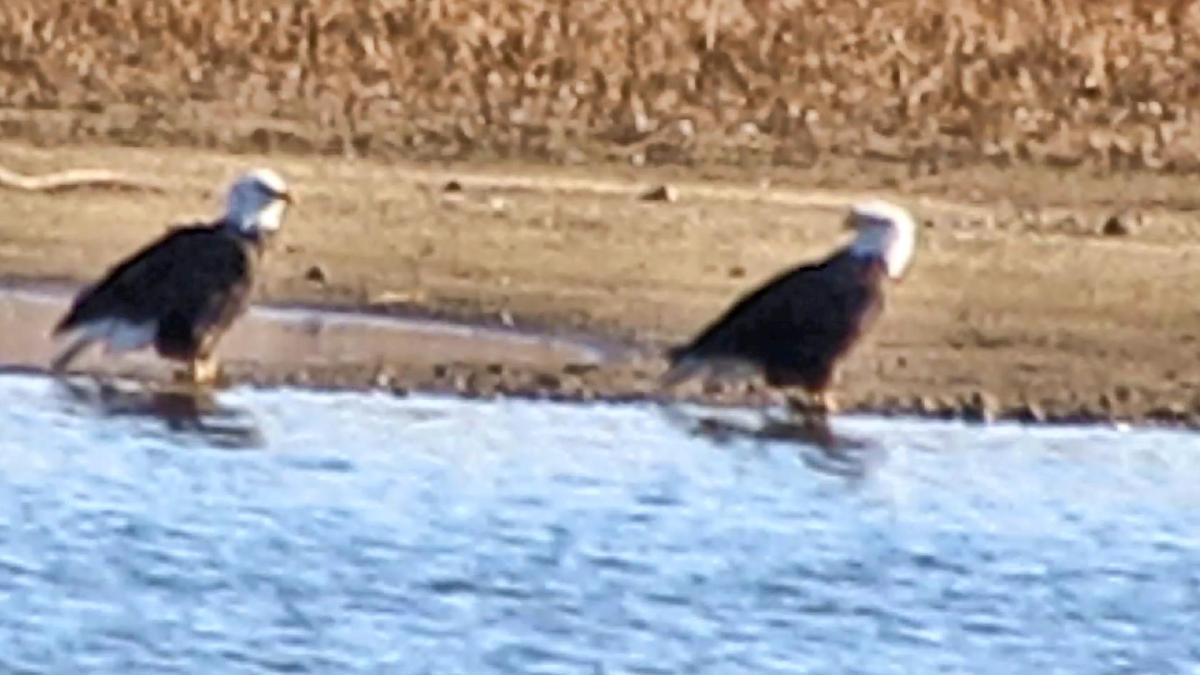
Out on a sand bar on Sand Lake, we caught sight of two bald eagles. They seemed to be a mated pair. They actually courted by vocalizing and billing. I know about their spectacular cartwheel flying ritual, but I didn’t capture that on camera as they took flight. They mate for life.
We also saw a flock of migrating Northern Shovelers, dabbling in the lake. We’ve been going out to that park for years and this was the first time we’ve ever seen them. They’re also known as spoonbills or spoonies because of their large bills, which they use to sieve the water for food.
We put on about two and a half miles on my step counter, and we worked up an appetite. Climbing up and down the banks of Sand Lake is a lot of work. So, we got the two for one price on the Culver’s butter burger and topped it off with a Wendy’s peppermint frosty.









 Go Retire Psychiatrist