Big Mo Pod Show: “Blues: The Universal Mixer”

We listened to the Big Mo Pod Show (Sena stuck with it for about the first hour anyway) last night and then I got a mini-education in the forms of music, at least, as it relates to timing and rhythm. The theme was “Blues: The Universal Mixer.” Frequently, the blues show and the podcast remind me of previous eras in my life and lead to a few free associations.

Big Mo Pod Show 085 – “California Bluesin” KCCK's Big Mo Pod Show

After a short break during the Thanksgiving holiday your hosts are back at it again with another episode! This week features the usual mix of blues eras you’ve come to expect along with a few Californian artists, tune in to see which ones! Songs featured in the episode: Solomon Hicks – “Further On Up The … Continue reading
  1. Big Mo Pod Show 085 – “California Bluesin”
  2. Big Mo Pod Show 084 – “Garage Blues”
  3. Big Mo Pod Show 083 – “Legal Pirate radio”
  4. Big Mo Pod Show 082 – “Tribute”
  5. Big Mo Pod Show 081 – “Cheers To Kevin”

The 5 songs reviewed by Big Mo and Noah are probably recognizable to many listeners. As usual, I have to search for the lyrics because I seem to have an inborn tendency to hearing mondegreens. And as usual, I don’t always pay the most attention to the songs chosen for the podcast.

But Big Mo did a little teaching session about rhythm forms, which he related to a couple of songs on the list. One of them was “Wait on Time” by The Fabulous Thunderbirds. I happened to notice that a couple of lines in the lyrics of “Wait on Time” reminded me of another artist who didn’t make it to the list on the podcast but was on the blues show playlist last night. That was Junior Walker and the All Stars. Their song “I’m a Road Runner” was one of my favorites because it reminded me of how I ran all over the hospital as a consult psychiatrist. But I can’t relate to the song as a whole.

The lines the two songs share are:

“Wait on Time” lyrics:

“Well, I live the life I love
And I love the life I live
The life I live baby
Is all I have to give”

“I’m a Road Runner” lyrics:

“And I live the life I love
And I’m gonna love the life I live
Yes, I’m a roadrunner, baby.”

Although the lyrics are similar, the themes are different. The guy in the song “Wait On Time” is promising he’ll get back to his lover someday. On the other hand, in the “I’m a Road Runner” lyrics, that guy is making no such promise and is actually is saying just the opposite.

Big Mo pointed out that there is a common rhythmic form in blues that easily mix with other forms of music, including Latin forms (I don’t understand that music lingo but I think I hear and feel what he means). He mentions that Bo Diddley mixed certain rhythms like that into his music, which surprised me because I didn’t know that. It may be why I like Bo Diddley.

Big Mo didn’t play “I’m a Road Runner” last night but played another hit from Junior Walker and the All Stars: “Ain’t That The Truth.” Just an aside, that tune is mostly instrumental and has a total of only 4 lines apparently, which express a common blues sentiment about relationships:

“Say man, what’s wrong with you?
Oh man, my woman done left me
Say it, man, play me some blues, jack
Get it, baby
Ain’t that the truth”

Several artists covered “I’m a Road Runner” including but not limited to the Grateful Dead and Steppenwolf. Bo Diddley did a song called “Road Runner” but it was not the Junior Walker tune. There’s a YouTube video relating it to the cartoon Roadrunner and Wile E. Coyote.

I’m not a roadrunner by any definition, but I learn a little something new just about every time I hear the Big Mo Pod Show.
The Big Mo Pod Show 043 All Dem Christmas Favorites

We listened to the Christmas tunes on the KCCK Big Mo Blues Show last night, “All Dem Christmas Favorites.” We both liked Earth Kitt’s “Santa Baby,” which wasn’t on the podcast list, but what the heck. I got a kick out of Brave Combo’s silly rendition of “O Holy Night.” Fareed Haque’s guitar solo of “You’re a Mean One, Mr. Grinch” was pretty impressive.

Big Mo Pod Show 085 – “California Bluesin” KCCK's Big Mo Pod Show

After a short break during the Thanksgiving holiday your hosts are back at it again with another episode! This week features the usual mix of blues eras you’ve come to expect along with a few Californian artists, tune in to see which ones! Songs featured in the episode: Solomon Hicks – “Further On Up The … Continue reading
  1. Big Mo Pod Show 085 – “California Bluesin”
  2. Big Mo Pod Show 084 – “Garage Blues”
  3. Big Mo Pod Show 083 – “Legal Pirate radio”
  4. Big Mo Pod Show 082 – “Tribute”
  5. Big Mo Pod Show 081 – “Cheers To Kevin”

Thoughts on the Big Mo Pod Show 034: Laughing in the Face of Death

I heard the Big Mo Blues Show just (Halloween theme) this last Friday night and was not surprised to see that one of the songs discussed on the Big Mo Pod Show on Saturday was Peetie Wheatstraw’s “Devil’s Son-in-Law.”

When I first heard it, it got me chuckling because I didn’t understand hardly a single word until the last line. It was babbling. I can remember googling the term “Peetie Wheatstraw and unintelligible,” which revealed I’m not the only one who thinks he’s unintelligible. It’s a mondegreen mine field. It’s a good thing the lyrics are available.

I want to hastily point out that he’s not always unintelligible—but William Bunch aka Peetie Wheatstraw is speaking in tongues on that song. For comparison I listened to another song, “Sweet Home Blues” and I could understand just about every word in the lyrics.

That led me down the rabbit hole about the artist in a web search that seemed to have no end. I should probably say Brer Rabbit hole since most of my searches pointed in the direction of a character called Peter Wheatstraw, Petey Wheatstraw, as well as Peetie Wheatstraw who had variations in their identities, most often in the context of African American folklore.

I’m not going to attempt a summary of my web search on Peetie Wheatstraw; there’s too many twists and turns. You can start with the Wikipedia article. But from there, you can get trapped in Brer Rabbit’s little tunnels, which can run in different directions.

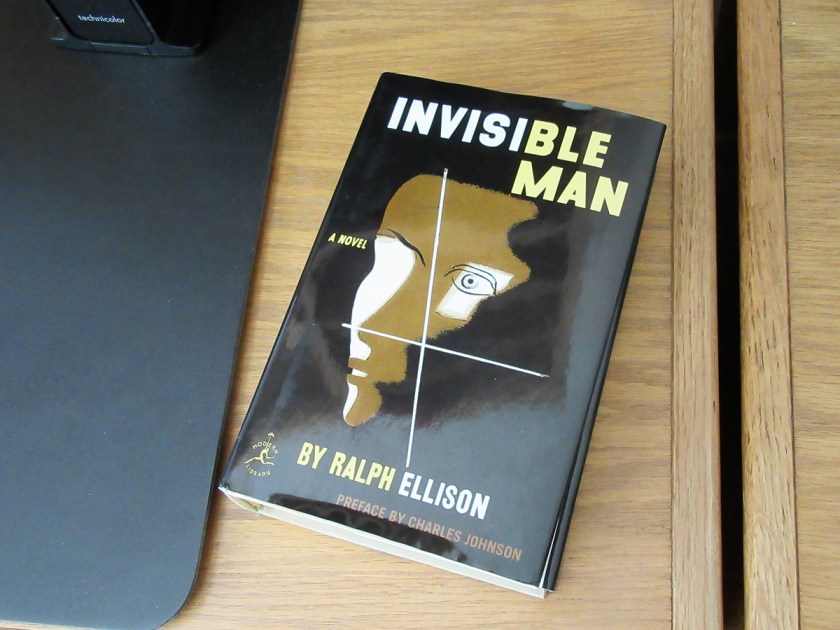
William Bunch was a blues artist in the 1930s who adopted the moniker “Peetie Wheatstraw.” While Big Mo says it’s sort of another name for Satan, I found confusing references by writers who claim that the Peter Wheatstraw character comes from Black folklore. There are those who believe that novelist Ralph Ellison wrote about a character in his book “Invisible Man” named Peter Wheatstraw and said it was the only character in the novel that was based on a live person—William Bunch.

Is that true? And did Ellison ever meet Peetie Wheatstraw (William Bunch)? I can’t tell from the web articles.

I was prompted to get my copy of “Invisible Man” out after reading a scholarly online essay mentioning the Peter Wheatstraw character, “Re-visioning Ralph Ellison’s Invisible Man for a Class of Urban Immigrant Youth” by Camille Goodison, CUNY New York City College of Technology. I couldn’t remember Wheatstraw at first, but there he was in Chapter 9.

Goodison reveals there is a lot more texture to the Wheatstraw character then just as a moniker adopted by William Bunch. Wheatstraw is probably more complex than the devil. He has many sides to him and could be helpful—but mostly in an indirect way. His guidance is full of riddles and there doesn’t seem to be a solid way to cut through the metaphorical morass. As Emily Dickinson advised, Wheatstraw may tell the truth—but tells it slant.

I still don’t know why he mumbles the song.

Thoughts on The Big Mo Podcast 033: “A Balance of Old and New”

This is just a short piece on the Big Mo Podcast last Friday night and his comments about one of the songs he played that night. It made the list of 5 songs he and Producer Noah discussed a couple days later.

Big Mo’s had great comments about all the songs, but I took special notice of those about one of them. It was James Carr’s big hit in 1966, “Dark End of the Street.”

The most important thing about it is that I remember listening to it when I was just a kid. I was too young to understand the meaning of it. But his voice grabbed me. That’s really the only thing I can say about it. His performance still has the power to raise the hair on the back of my neck, even though I can’t identify with the lyrics or connect the theme to any life experience I’ve had. I suspect many people feel the same way.

The other reason I connect with the song other than Carr’s voice is his life story. He was said to have suffered from a psychiatric illness, the nature of which seems like it was never clearly identified. I’ve read a few web articles and terms like “bipolar disorder,” “depression,” and other similar references come up. His psychiatric diagnosis is the least important thing.

Carr’s life story is hard to read, despite what little there is of it to read about. It’s painful. The version on the Black Past website encapsulates what you find in several other articles: Tulino, D. (2018, February 21). James E. Carr (1942-2001). BlackPast.org. https://www.blackpast.org/african-american-history/carr-james-e-1942-2001/.

But to get the real point about James Carr, all you have to do is listen to that one song, “Dark End of the Street.”

Big Mo Pod Show Theme “Limitation Brings Innovation”

Last Friday night, the Big Mo Blues Show was recorded. I found the podcast, which had the theme “Limitation Brings Innovation.” The idea behind that was that sometimes when musicians lack the resources to, say, put together a big band sound, they often innovate to create a sound that’s new and surprisingly fresh and rivals the production of bigger and better funded orchestras.

Along those lines, Big Mo played Seasick Steve’s song “Backbone Slip.” It’s a rocker. On the other hand, my favorite from him is “You Can’t Teach an Old Dog New Tricks.” Seasick Steve did a live version of it about 13 years ago. He played a homemade guitar made of a broomstick and a couple of hub caps.

I guess you call that limitation leading to innovation. It could be the anthem for old retired guys.

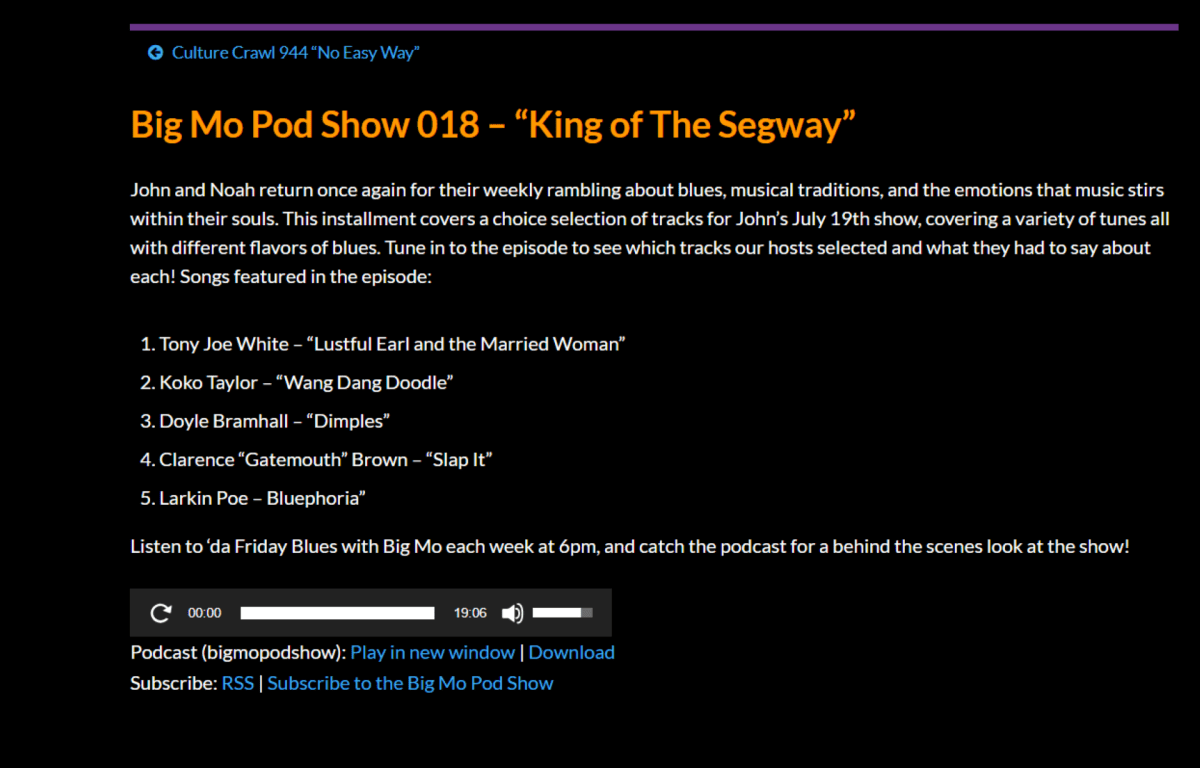
Big Mo Pod Show “King of the Segway”

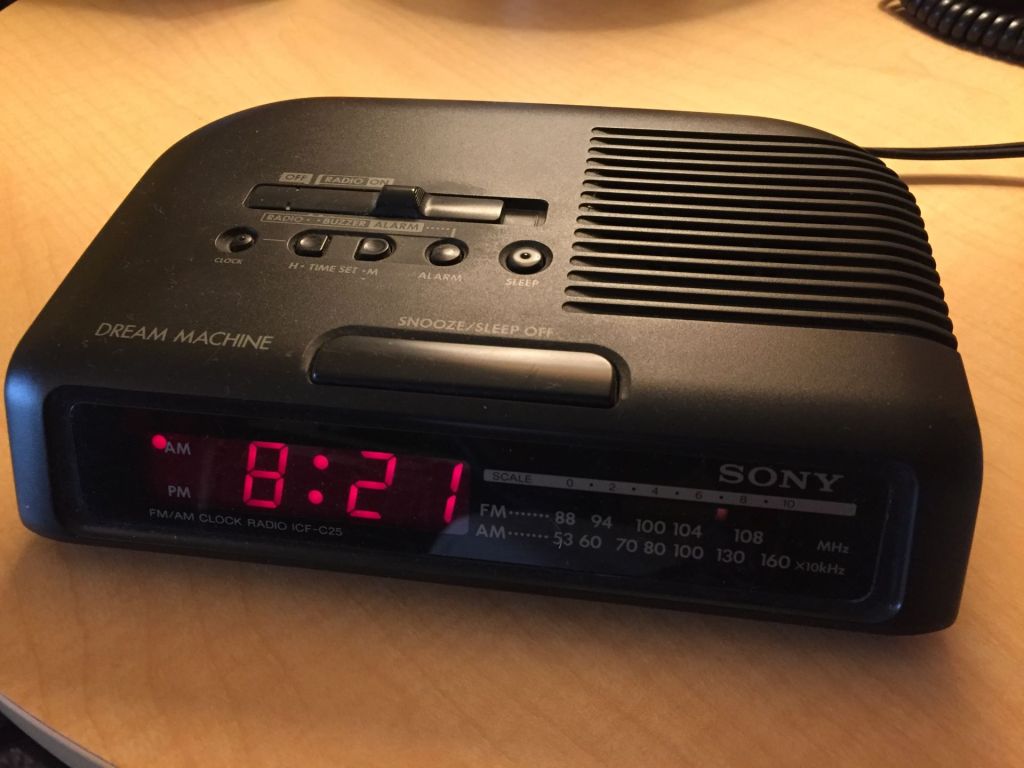
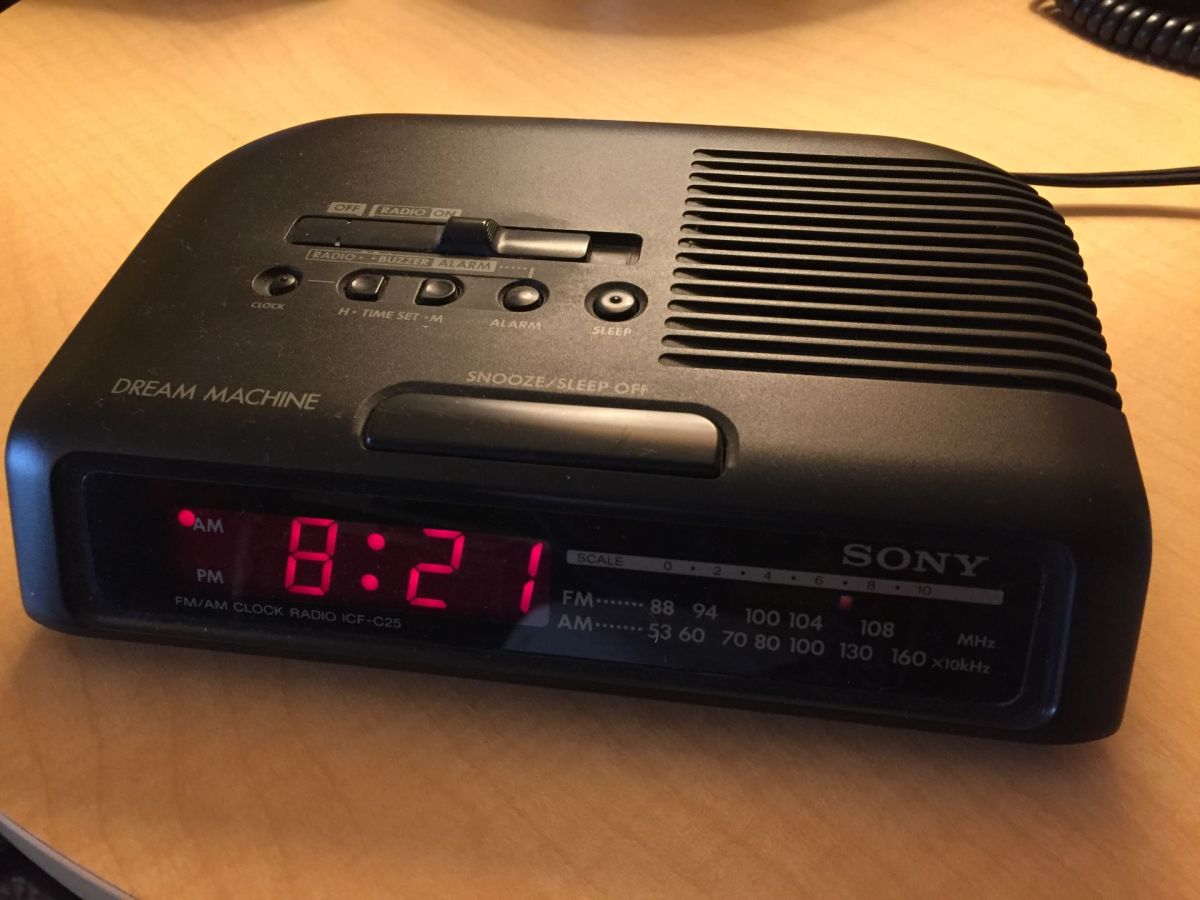
Hey, I managed to catch the Big Mo Blues Show on July 19, 2024 and then listened to the podcast the next day. Because our big Bose wave radio is packed away in storage as we wait for our house to be built, I had to use our little portable Sony Dream Machine in the hotel. I think it dates to the early 2010s. I couldn’t get the local Iowa City KCCK 106.9 or 88.3 station unless I switched the radio to AM first, then tuned to 106.9, then flipped back to FM. It gets staticky if you hover over it or touch the radio, but if you leave it alone, it sounds OK.

Now I’m just going to comment on the theme of the pod show, which was “King of the Segway.” This is in the spirit of my frustrated grade school English teacher, Miss Piggott. One of her comments on my report card was, “A little too exuberant.”

OK, that segues into my correction of the use of the word “segway” in the podcast theme title. If you listen to the show, Big Mo clearly uses the word as a verb that mean to move without stopping from one theme, song, etc to another. That should be spelled “segue.” The word “segway” is a trademarked name for an electric transportation vehicle. To be fair, the two are often confused.

Big Mo did a pretty good job of getting most of the points on the 5 songs; at least he could name all the artists. The first part of the ‘da Friday Blues show played a couple of numbers that show the funny edge of Blues music. The latter part played Blues numbers that are on the gritty side.

I’ll take the funny side over the gritty side of the Blues any day of the week.

The funniest number was the song “Lustful Earl and the Married Woman,” by Tony Joe White. I remember his tune “Poke Salad Annie” from way back. Lustful Earl is hilarious and had me laughing out loud.

Big Mo Pod Show- “Goodness is a Practice”

I’m out of sync with the Big Mo Blues Show and his podcast, mostly because we’re in the middle of this big move and we’re staying in a hotel waiting for this house to be built. I missed his most recent show, but caught the one before that.

The podcast title was “Goodness is a Practice.” Big Mo mentioned that moving (among a lot of other sorrows and hardships) could cause the blues-and he’s right.

But some perspective on it shows that a lot of other troubles take priority over moving (even though boxes are bad, admit it). Troubles that call for a little human decency are just one variety. Practicing goodness would come in handy right about now, in a lot of places.

Big Mo Pod Show: “Absorbing Influences”

I listened to the Big Mo Blues Show last Friday night on June 21, 2024 and wouldn’t you know, he was recorded. He wasn’t there live that night but as usual he put on a great show of blues music.

And I listened to the Big Mo Pod Show a few days later, and the theme was Absorbing Influences. Very thought provoking. The choice of tunes was interesting and Big Mo pretty much got them all identified. He usually does.

I can’t remember all the tunes he played on June 21st, but as usual, I had a different perspective about the selection for the podcast. I think I heard a Catfish Keith number on the Big Mo Blues Show, which I can’t remember too well and furthermore, don’t quite understand. It was “I Don’t Know Right from Wrong.”

And I’ll throw you another curve. That’s not the number I want to talk about in terms of the absorbing influence theme. Briefly, it just means that many blues artists get influenced by a musician they really like, pick up on what they learn from a song and gradually make it their own.

I think Catfish Keith was influenced by Son House, who sang a song called “A True Friend is Hard to Find.” Catfish Keith absorbed the music, and did his own version which I recently heard. I think it’s a gospel number. Memorable lines include:

“Bear this in mind, a true friend is hard to find.”

It’s true. You have a real treasure if you ever find one.

Big Mo Blues Show Podcast: “Chromatic Rock”

I caught the Big Mo Blues Show June 14th last Friday night. And I also caught the Big Mo Pod Show as well. Produce Noah got the month wrong for some odd reason. He said it was May 14th. Let it go. Anybody can be temporally impaired from time to time, including me.

Anyway, the theme of the podcast was “Chromatic Rock,” which I gather applies mainly to harmonicas in this context. But in a more general sense, I think it means adding more color to music, mainly by variation in notes. The specific artist in the podcast was somebody I’ve not heard of by the name of Sugar Blue. He blew a tune on the harmonica called “Krystalline,” which is some kind of cocaine.

Big Mo got most of the items in the quiz. He always does pretty well, because of his encyclopedic knowledge about music. His memory is really strong. I bet he even knew what month it is.

Well, here comes my selection from last Friday’s Big Mo Blues Show, a number called “Plain Old Common Sense,” performed by Kenny Neal. Common sense is pretty important. It can keep your head above water and clear of cocaine.

Big Mo Pod Show: “In Search of Good Company”

When I listen to the Big Mo Pod Show, I tend to almost free associate to memories which the songs sometimes evoke. The 5 songs this week came from, as usual, his Big Mo Blues Show this past Friday night. The theme of the pod show was “In Search of Good Company.”

I’m not so sure about good company thoughts, but the comments about Muddy Waters song “Long Distance Call” reminded me of something way back in my past. Big Mo talked about making long distance calls a long time ago, which he connected with pay phone booths.

I don’t think I’ve seen an actual pay phone booth in decades, since the invention of cell phones and that kind of technology. But the conversation about phone booths reminds me of my youth.

I used to live at the YMCA and the rooms didn’t have phones. No cells phones were available back then because it was well before the 1980s. The only way you could place a phone call was to use the one phone booth in the building, which was on the second-floor landing. The rooms were on the third floor, and they were for men only, of course.

Also on the third floor was an old snack vending machine and I’m pretty sure I’ve told this story before as I recollected while writing this post.

I got a Butterfinger candy bar from that vending machine one time. I took a bite out of and saw half a worm wiggling around in it. You don’t want see a worm at all, but half a worm has a whole different meaning.

I was worried and used the pay phone to call the local emergency room. I think I paid less than a quarter to place the call.

I guess I would have been relieved to hear the ER doc tell me that I would be OK—if he hadn’t been laughing so hard. Good thing it wasn’t a long distance call.