The Big Mo Pod Show: “In the Pocket”

Here’s something fun, try to explain what the phrase “in the pocket” means. The song selections in the pod show led up to a short discussion of what it means—which I didn’t get at all. I don’t think it matters for the ordinary listeners, although former music teachers like Big Mo obviously know what the term means. He taught music for years, has performed, and uses the lingo to explain what “in the pocket” is all about. It’s way over my head, but then I don’t need to know anything about it to enjoy music.

I tried to look up the meaning of the terms “in the pocket” on the web. I took a quick look at a website called Sage Audio. The title is “What is In-the-Pocket for Music?” I couldn’t find the author’s name because I didn’t see a byline.  It’s very long and technical and seems geared for sound engineers. One sentence by the writer caught my attention under the heading “What is In-the-Pocket for Music in Detail”:

“It isn’t uncommon to hear a music term and wonder what it means exactly. Becoming well versed in music means understanding its discourse, which can certainly be easier said than done.”

Here’s how far out in left field I am. Depending on how I read that, I’d almost recast the last part of that sentence: “…which can certainly be easier done than said.” I realize the sense of it is that becoming adept in making music means understanding the lingo. I just don’t understand the lingo, which makes me wonder if musicians have some kind of inner body sense for timing in music as it’s performed which may not readily translate to language for the layperson.

I was like a lot of other students in junior high music class. We were pretty good at whispering or half-mumbling the songs we were supposed learn to sing out loud. That really annoyed the music teacher. I don’t know if Big Mo can relate to that or not. We were supposed to learn the song “Sloop John B.” I’m not sure if we were doing the Beach Boys version or the original “The John B. Sails.”

It hardly mattered. We sounded like we ate up all the corn and held it in our mouths while mumbling. We just stuck our hands in our pockets, moaned the words, and were never in the groove. I don’t think a metronome helped. In fact, I’m not sure there was a metronome.

I have to mention that I probably was too young to know that the song by Little Ed and the Blues Imperials, “Walking the Dog,” was about a kind of dance. I never danced although most of the dancing kids on American Bandstand had the same answer to Dick Clark’s question on what they liked about the song—it was always “the beat.” I guess they knew that meant the number was “in the pocket.”

Big Mo Pod Show: “Wiggle Your Way Into People’s Hearts”- and Down The Rabbit Hole!

Hey, I’ve got some confusion about one of the tunes in the Big Mo Pod Show today. I heard most of the Big Mo Blues Show last night although I think I might have dozed off for a few minutes about the time one song came on about 7:40 pm. I guess I don’t feel so bad about not remembering Kris Lager’s song “Shake It” because Big Mo didn’t either.

The first thing I wonder about is the spelling of Kris Lager’s name on the pod show. His first name was spelled “Chris.” That’s minor; those things happen. But the remarks by Big Mo and producer Noah on it were intriguing.

While the short clip (starts about 10 minutes or so in) of the song “Shake It” (which is a cover) by Kris Lager was played, Big Mo said the song originally was done by Howlin’ Wolf and he thought it was “Shake for me.” I also vaguely remembered the guitar licks from somewhere in my distant past, but when I played the YouTube Howlin’ Wolf “Shake for Me,” it didn’t sound at all to me like Kris Lager’s version of “Shake It.” The clip from the On Air Schedule from last night didn’t sound like the clip on the pod show either. I tried looking up Lager’s song “Shake It” from the album Blues Lover and got misdirected to other artists who did songs with the same title. I found Lager’s version on Apple Music and heard a preview, but it didn’t sound like the pod show clip either.

I realize that probably part of the problem is the clips are too short. But I can’t account for why Howlin’ Wolf’s version would sound so different. Big Mo mentions Hubert Sumlin’s guitar lick, referring to the clip but I just can’t get that from the Howlin’ Wolf band recording of “Shake for Me,” at least not the one I found.

Big Mo mentions a Mike Welch, which implies that he “Shake It” but all I can find is a blues artist called Monster Mike Welch but no connection to a song by that name. He mentions John Popper (musician connected to the group Blues Traveler) but nothing “shakin” there.

Long story short, which is too late because we’re way down the rabbit hole by now, Big Mo gives up and has to admit he doesn’t recall playing the song “Shake It.” He says he found something which he might have been doing a web search on at the time of the pod show. He found something from 2023 but the Blues Lover album with the song “Shake It” is from 2021. He says Lager was “around here this summer” but I don’t know whether “here” means Iowa or not. I think he’s coming to Okoboji this summer but I’m not sure.

Then Noah asks Big Mo which version of “Shake It” he likes better: Howlin’ Wolf’s or Kris Lager’s. Hang on a sec, I didn’t find comparable versions on the web as I mentioned earlier! Amazingly, Big Mo then replies that Lager’s version is a lot slower than the one by Howlin’ Wolf—but near as I can tell they’re not the same song. He says it has that “recognizable Hubert Sumlin lick” on the guitar—except I can’t hear Hubert Sumlin doing that.

That’s how far I went down the rabbit hole. Can anybody throw me a rope?

Big Mo Pod Show: “Smoke Stack Howlin”

I got a big kick out of the Big Mo Blues Show last night. And the Big Mo Pod Show this morning was another great teaching session by John Heim aka Big Mo.

It’s also another peek into the lives of blues and rock musicians which would appeal to the headshrinkers in the listening audience, including me. Coincidentally, on the shout-outs part of the show, Big Mo announced somebody he called “Dr. Jim, the shrink.” There are probably a lot of guys who could fit that moniker, not just me.

Anyway, one of the artists listed on the pod show included James Booker who played a piano piece entitled “Junco Partner.” It turns out Booker was in and out of jail and struggled with substance use disorder. He eked out a living from tips playing piano in bars.

The highlight of the pod show was Big Mo’s history of Howlin’ Wolf (Chester Burnett) who is well known for his song “Smokestack Lightnin.” As I usually like to do, I glanced at the web articles on sites with biographical information about Burnett, although I’m unable to curate them for accuracy. So, I checked the Britannica website entry. There are different versions of the story about what “Smokestack Lightnin” means. As near as a I can tell, I think Big Mo’s explanation is probably as accurate as you can get. There are web articles that claim Burnett said it was about train engine sparks blowing out of the stack.

Interestingly, Burnett formed a group that included another artist on the pod show, Little Junior Parker, whom I knew nothing about and as it turns out, neither did Big Mo. The question posed by Producer Noah was about how he got his name. Did “Little” mean there was a senior Parker? The African American Registry entry doesn’t shed any light on it. But both Burnett and Parker were inducted into the blues hall of fame. Burnett was also inducted into the rock and roll hall of fame.

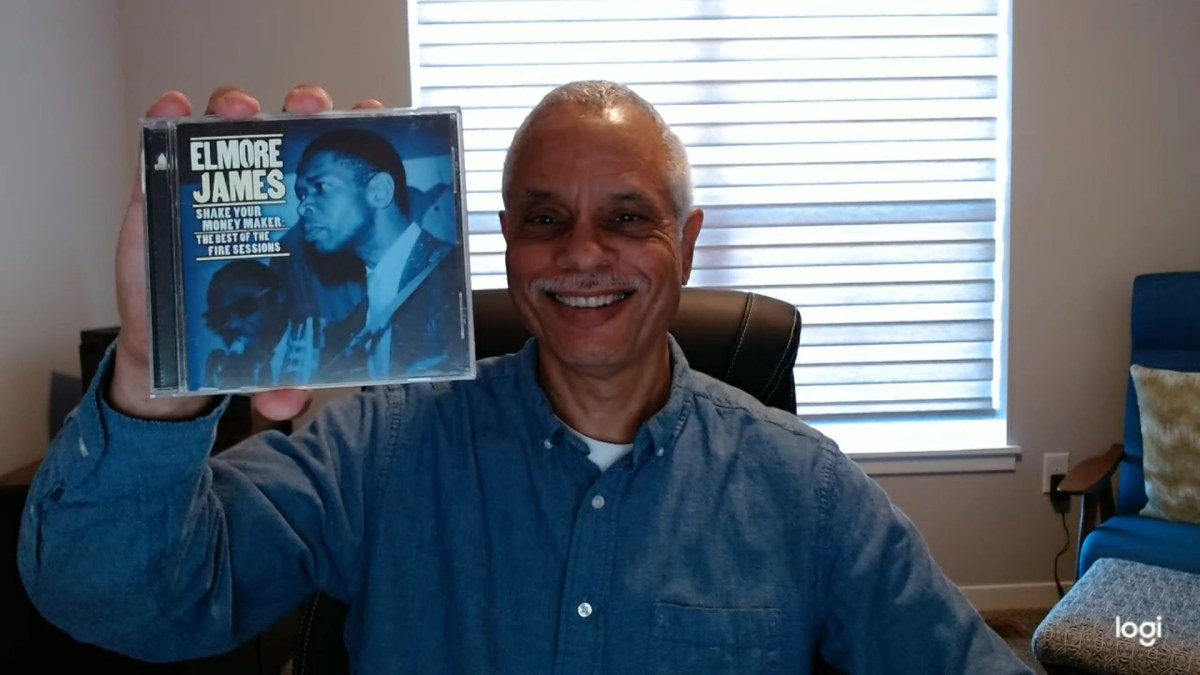
Just a smidgeon of trivia on Little Junior Parker’s song “Look on Yonders Wall.” I know that other artists have recorded this song. Elmore James is one of them and I happen to still have a copy of the CD, Elmore James, Shake Your Money Maker, Best of the Fire Sessions, released in 1960 (I didn’t buy it in 1960). It’s just an odd thing that you can find on the web a YouTube version of that, the title of which has an odd note, “Wrong Lyrics.” It has the lyric “look on yonders wall, hand me down my precious cane” instead of “walkin’ cane.” I’m unsure if it’s legit. And the words of the title are “Look on Yonder Wall” instead of “Look on Yonders Wall” although I think I can hear Elmore James sing “yonders.”

Now, one of the most interesting parts of the blues show last night was not something on the pod show today. I think it was during the last half hour of the blues show. I heard a rock and roll song I’d never heard of and I don’t know how I missed it because it was during my wasted youth when I was listening to similar songs at the time. It was released in 1975.  It was the song “Green Grass and High Tides” by The Outlaws. I was absolutely open-mouthed thunderstruck by the guitar licks. One bit of trivia is that the song title is very similar to the title of an album released in 1966 by the Rolling Stones, “High Tide and Green Grass.” There’s no song with that title ever done by the Rolling Stones, it’s just the name of their album.

Rock on, Big Mo!

Big Mo Pod Show: “Grab a Twelve Pack and be Somebody”

I caught the Big Mo Blues Show last night and the podcast this morning, titled “Grab a Twelve Pack and be Somebody.” I had a hard time picking out any of the five songs having anything close to a lyric that would be close to “Grab a Twelve Pack and be Somebody” but it’s easy to get the idea that many blues and rock songs seem to involve references to alcohol.

I think even Big Mo thought one of the selected songs had something to do with either a 6 or 12 pack of beer. But he did talk about the song “Brown Liquor” by Ally Venable & Christone Kingfish Ingram reminding him (and it reminded me also) of Bob Margolin’s song “Brown Liquor in a Dirty Glass.”

In line with the theme of the podcast today, you could endorse the saying “The Blues had a baby and they named it rock and roll.” I had to look up that line and it’s from Muddy Waters” album, Hard Again (which I still have, by the way) and there’s a song on it with that title. Bob Margolin was in the band at that time. I still don’t understand the lyrics of another song on the album with the title “Crosseyed Cat.” But it’s still one of my favorites.

Just a remark on the Margolin’s song “Brown Liquor in a Dirty Glass” I found out something I didn’t know about ordering a drink “in a dirty glass.” It might mean adding an olive or olive juice. I don’t know if that’s true or not.

I was surprised to learn that one of last night’s song, “Sinner,” was by Robert Randolph, head of a gospel group. Judging from the lyrics, it sounds like the song is against religion.

But the first song of the night was “Summertime Blues”. It sort of fits the heat wave this weekend.

Big Mo Pod Show: Music of the People

I caught the Big Mo Pod Show today, “Music of the People” and of course, I listened to his Friday Blues show last night.

Big Mo Pod Show 085 – “California Bluesin” KCCK's Big Mo Pod Show

After a short break during the Thanksgiving holiday your hosts are back at it again with another episode! This week features the usual mix of blues eras you’ve come to expect along with a few Californian artists, tune in to see which ones! Songs featured in the episode: Solomon Hicks – “Further On Up The … Continue reading
  1. Big Mo Pod Show 085 – “California Bluesin”
  2. Big Mo Pod Show 084 – “Garage Blues”
  3. Big Mo Pod Show 083 – “Legal Pirate radio”
  4. Big Mo Pod Show 082 – “Tribute”
  5. Big Mo Pod Show 081 – “Cheers To Kevin”

Big Mo is a bottomless pit of blues music knowledge (as well as other genres) and that takes me back to my wasted youth when I had a short conversation with one of my former bosses when I worked for Wallace Holland Kastler Schmitz & Co., a consulting engineer firm in Mason City, Iowa.

Ages ago, Ralph Wallace and I got into a short conversation one day about blues music, believe it or not. I can’t recall what actually got that short chat started but it was kind of surreal. He asked me about what I liked about the blues and I brought him up short by telling him I didn’t know anything about it.

I think Ralph thought I would know about the blues just because I was black. I didn’t. He even tried to prompt me by asking about different kinds of blues music, for example 12 bar blues and so on. I’ll never forget his facial expression when he realized I barely knew it existed. He looked puzzled and incredulous. He was a white man and knew more about it than I did. I think it stunned him that a black guy was completely ignorant of the blues.

I could dismiss the interaction simply as a mild form of racism, but I think it was more complicated than that. He was the boss of the company who gave me my very first real job but really didn’t know anything about my background. I was the child of a black man and white woman and my father left home when I was just a little kid. I went to an all-white church. I went to all-white schools, that is, until I was persuaded by a white woman and the black pastor and professor of religion and philosophy to enter Huston-Tillotson College (now Huston-Tillotson University), one of the HBCUs in America located in Austin, Texas. I first heard gospel music there and it raised the hair up on the back of my neck.

It’s a little ironic but I also think of John Heim (aka Big Mo) as another white man who knows more than I’ll ever know about the blues. And I’ve been learning from him for years, which is great.

So, the point is that the theme of the Big Mo Pod Show today is “Music of the People.” The blues is music for all people and the songs can have broad appeal.

One example is the song “Artificial” by Walter Trout. It’s a modern rant against the many synthetic artifacts in modern society and that includes something I rail against—Artificial Intelligence (AI). I can relate to it.

One song that didn’t make it to the list of 5 on the pod show but which was on the blues show last night was “Room on the Porch” by Taj Mahal and Keb’ Mo’ (featuring Ruby Amanfu). I got a surreal feeling about it because it’s about being openly welcoming to everyone. I hear a note of irony in it related to the current conflicts in America and around the world which highlight the opposite of openness and welcome. They’re not new.

On the other hand, I don’t think either Taj Mahal or Keb’ Mo’ intended for the song to be ironic. Maybe I just hear it because of all the background noise that has to be called reality because that’s what’s out there.

What if they’re not being ironic? What if they believe it and they’re trying to say there’s a good reason we should think of the blues as the music of the people—all the people? Where could we go from there?

 Big Mo said it last night, “The blues can heal you, if you let it.”

Big Mo Pod Show “BluesMore” Today

So, the Big Mo Pod Show was on just now and I listened to it because I heard the Big Mo Blues Show last night.

Big Mo Pod Show 085 – “California Bluesin” KCCK's Big Mo Pod Show

After a short break during the Thanksgiving holiday your hosts are back at it again with another episode! This week features the usual mix of blues eras you’ve come to expect along with a few Californian artists, tune in to see which ones! Songs featured in the episode: Solomon Hicks – “Further On Up The … Continue reading
  1. Big Mo Pod Show 085 – “California Bluesin”
  2. Big Mo Pod Show 084 – “Garage Blues”
  3. Big Mo Pod Show 083 – “Legal Pirate radio”
  4. Big Mo Pod Show 082 – “Tribute”
  5. Big Mo Pod Show 081 – “Cheers To Kevin”

I just want to mention that I heard Big Mo do an extended version of his comedy bit on Mayree’s hand-battered catfish last night too. I never know when he’s going to do the long version of it and I nearly always regret not having some way to record it. It’s kooky and complicated with twists and turns like a long hairy dog story with punchlines scattered like land mines all over it.

Anyway, the pod show was pretty interesting. I think the Beth Hart song “Can’t Let Go” could be about more than a busted relationship, a frequent subject of a lot of blues songs. There’s a lot of baggage that we can’t let go of in life. The other notable feature of that song is Sonny Landreth cutting all the way loose with guitar licks spinning out beyond every nearby galaxy.

What was strange during last night’s blues show was I could have sworn I heard the lyrics of “Stand by Me” but it’s not on the list of songs. Songs sometimes don’t get on the list. Anyway, it reminded me of the Playing for Change version that starts with Roger Ridley and goes around the world, released 16 years ago.

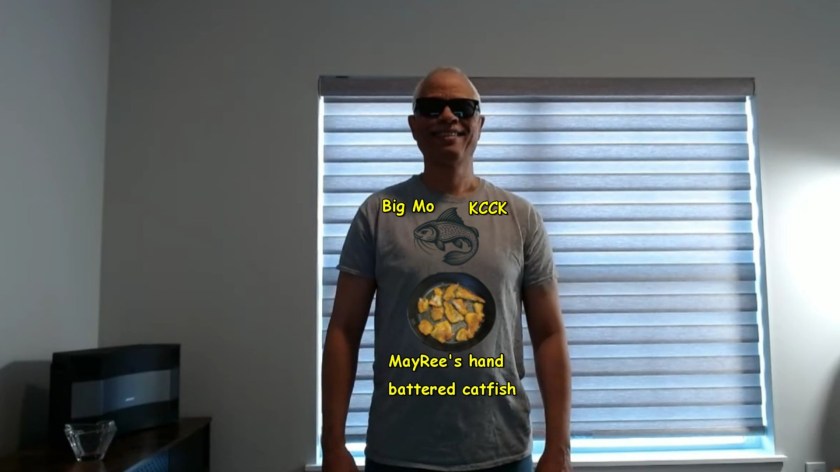
Find a Tee for Mayree!

Sena alerted me to a news story about an Iowa City 8th grader landing a 68-pound flathead catfish yesterday in Iowa. While it’s not the all-time record, you have to admit he landed a monster fish. The record is an 81-pounder caught in 1958.

Now why would that remind me of KCCK Jazz and Blues Radio, Iowa’s only jazz radio station? It’s because of John Heim’s (aka Big Mo) blues show comedy bit on the Friday Night Blues Show featuring Mayree’s hand-battered catfish (“It’s better because it’s battered!”). You can hear more about it and other “Sponsor De Faux” on the Big Mo Pod Show 003.

It would be cool if KCCK sold a tee shirt that featured Mayree. Hey, don’t blame me; it’s Big Mo’s idea! I’ve searched the KCCK web page, but can’t find a tee for Mayree (hey, that rhymes, good for marketing!) but there’s a nice Big Mo tee in medium and 3XL sizes.

Anyway, I was fooling around with the idea and came up with a design for the tee today. Tell Big Mo what you think at email bigmo@kcck.org. It’s OK, he reminds listeners every Friday night how to get in touch with him when he hosts the Big Mo Blues Show, starting at 6 PM in the evening.

I’m pretty sure one of you could come up with a snazzier design. And just remember, Mayree’s hand-battered catfish are cooked to perfection, with manic delight, and they are just packed with nitrates! I can’t fit all that on a tee, which would have to be bigger than a tent.

The Big Mo Pod Show: “Variety is the Spice of Life”

We heard the Big Mo Blues Show last night and heard a couple of tunes that were fun. One of them was mentioned on the Big Mo Pod Show today, “Feelin’ Alright” by Stuff. The other was a riot but was not on the podcast, and it was “I Feel So Good (I Wanna Boogie” by Magic Sam.

Big Mo Pod Show 085 – “California Bluesin” KCCK's Big Mo Pod Show

After a short break during the Thanksgiving holiday your hosts are back at it again with another episode! This week features the usual mix of blues eras you’ve come to expect along with a few Californian artists, tune in to see which ones! Songs featured in the episode: Solomon Hicks – “Further On Up The … Continue reading
  1. Big Mo Pod Show 085 – “California Bluesin”
  2. Big Mo Pod Show 084 – “Garage Blues”
  3. Big Mo Pod Show 083 – “Legal Pirate radio”
  4. Big Mo Pod Show 082 – “Tribute”
  5. Big Mo Pod Show 081 – “Cheers To Kevin”

The one that brought back memories was “Feelin’ Alright” by Stuff. It sounded so familiar and we finally figured out it was a cover of song of the same title and sung by Joe Cocker (the one I remember). However, I guess it was originally written by Dave Mason of the group Traffic in 1968. And there’s even an album “Joe Cocker With Stuff Feelin’ Alright.”

The one Big Mo played last night was from the album Stuff Live at Montreux 1976. It was instrumental and hard to recognize at first. The lyrics are sad, though and it’s about unrequited love, I guess. I associated it years ago with drug and alcohol addiction after seeing the 2012 movie “Flight” on TV. Every scene in which the main character Whip Whitaker (played by Denzel Washington) got high, that song was a part of the scene.

Anyway, moving right along, the song that was not on the podcast and which was a whole lot of fun to listen to was “I Feel So Good (I Wanna Boogie) by Magic Sam. We’ve never heard of him but the way he sang the number made us laugh out loud.

The title of the podcast was right on target: “Variety is the Spice of Life.”

Big Mo Pod Show- “Goodness is a Practice”

I’m out of sync with the Big Mo Blues Show and his podcast, mostly because we’re in the middle of this big move and we’re staying in a hotel waiting for this house to be built. I missed his most recent show, but caught the one before that.

The podcast title was “Goodness is a Practice.” Big Mo mentioned that moving (among a lot of other sorrows and hardships) could cause the blues-and he’s right.

But some perspective on it shows that a lot of other troubles take priority over moving (even though boxes are bad, admit it). Troubles that call for a little human decency are just one variety. Practicing goodness would come in handy right about now, in a lot of places.

Big Mo Pod Show Theme: Subverting Expectations

I want to give a shout out to the Big Mo Pod Show Subverting Expectations that aired on May 11, 2024 following the Friday Big Mo Blues Show on May 10, 2024.

What impressed me most and puzzled me a lot was the tune that Big Mo didn’t talk about on the podcast. The tune was a dazzling guitar performance called “Hot Fingers” by a duo called Lonnie Johnson and Blind Willie Dunn. Big Mo said it was recorded in the 1920s.

I looked for a video of it and could find several with the picture of what looked like a Caucasian guitarist and nobody else. I also saw one picture with the Caucasian guitarist and what looked like a cut-and-pasted photo of a black guitarist.

Because I couldn’t tell who was who, I googled their names. It turns out that Lonnie Johnson was a well-known blues guitarist. He was black. Lonnie Johnson recorded “Hot Fingers” with another famous jazz guitarist named Eddie Lang, who was white. Eddie Lang used the alias of Blind Willie Dunn in order to hide his race while performing with Lonnie Johnson. I’m not sure how Eddie Lang could pass for black, an interesting twist in the late 1920s. I’m not saying either was racist. Why would they have performed together if they were? And why would Eddie Lang have adopted the black-sounding pseudonym?

So that brings me back to the title of the Big Mo Pod Show which was Subverting Expectations. The expectation that gets subverted had to do with a tune I don’t remember hearing on Friday night. It was “That Lovin’ Thang,” by the group Tas Cru, with which I’m unfamiliar. Big Mo remarked that you could listen to the blues as played by Tas Cru with an expectation that they were going to make mistakes in their performance—which never happened, attesting to their talent.

On the other hand, it strikes me that the story behind Lonnie Johnson and Blind Willie Dunn (Eddie Lang) does create its own sort of subverted expectation, in a different sense. I know Blues music experts already knew that, but it was news to me.