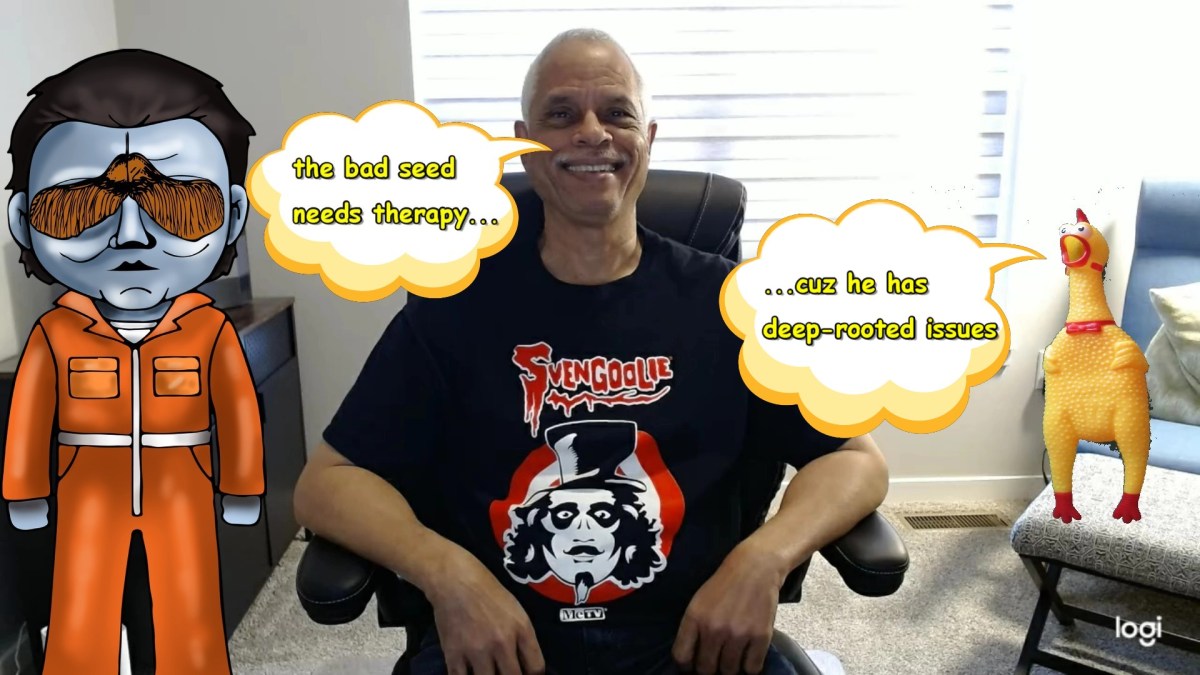
Svengoolie intro: “Calling all stations, clear the air lanes, clear all air lanes for the big broadcast!”
The Svengoolie show will be airing the movie “Werewolf of London” this coming Saturday night. It was released in 1935 and features something I don’t usually associate with werewolves—a special flower.
Anyway, it’s the first full-length werewolf film. This guy is not looking for beef chow mein.
Hey, I watched the Svengoolie show “The Black Scorpion” last night and I think a subtitle could have been “Stay Out of Trouble, Juanito!” Every time I woke up, that seven-year-old kid was getting himself into another jam.
But I’m getting ahead of myself. This is a 1957 film starring Richard Denning as Hank Scott, Carlos Rivas as Artur Ramas, Mara Corday as Teresa Alvarez, and Mario Navarro as the irrepressible Juanito. Perry Mason has a bit part as a scorpion.
Hank and Scott are geologists who get roped into investigating the cause of a disaster in Mexico City after a volcano blows its top, waking up a gang of giant scorpions who can’t stop drooling partly because they’re hungry for human flesh, but vitamin B12 deficiency can’t be ruled out. The scorpions are stop motion animation creations which look pretty good, actually.
Right away, Juanito starts messing around getting attached to Hank, opening doors for him, shining his shoes and just making a general nuisance of himself, especially when he starts ignoring his safety from the scorpions—which in turn necessitates his need for being rescued dozens of times. I think this is just attention-seeking after the first few times, one of which involves wandering around and dropping dead fireflies behind him to get the giant arachnids to follow him within shouting distance of Hank, who has to constantly snatch him away from danger.
Juanito: “Hank, help, Hank! The scorpion is about to catch me!”
Hank: “Thunderation, Juanito! What the heck are you doing down here in the cave?”
Juanito: “Save me, Hank! And then I will shine your shoes for only 11,436 pesos!”
Hank (after getting out his exchange rate calculator): “That’s 600 dollars you little hustler!”
Juanito: “Hurry, Hank, before the rate changes; and now the scorpion is close enough to drool on me!”
I found out one thing on the web about one of the items (which was tequila) that Dr. Delacruz wanted to run further tests on with the corpse of one of the scorpion’s victims. Of course, he was joking about the tequila but I guess there is such a thing as a scorpion drink from a bottle of tequila that contains a scorpion. It turns out that the scorpion shot tequila is a macho thing which the giant scorpions hate and destroying mankind is their revenge for it. Just so you know.
Juanito: “Help, Hank! The scorpion is inches away from me now that I’m in their cave after sneaking down here in the bucket with the weapons and the press cameras!”
Hank: “What on earth made you do a stupid thing like that, Juanito?”
Juanito: “I was bringing you this bottle of tequila with a little, edible scorpion in it because I know you’re a macho guy! Then you could waste your time chewing the little scorpion instead of wasting your time taking pictures of the giant drooling scorpion with the old-fashioned big clunky press camera with the huge bulb.”
Hank: “Shut up, Juanito, and bring me another bulb!
The movie could have been shorter if it had ended after the good guys exploded the rocks into the cave. But no, there was a long segment of a guy explaining in pseudoscientific language why Hank and Artur had to return after they left thinking they had finished off the bugs. The guy used a map and PowerPoint slide presentation, carefully explaining while using a laser pointer to indicate various places that provided an implausible escape route for the scorpion which did not clearly show why the giant scorpion had not been killed in the explosion. So much for PowerPoint!
But it did prolong the movie and provided more gruesome footage of scorpions snacking on various human hors d’oeuvres. None of them managed to catch Juanito.
I fell asleep very briefly only a couple of times during the film, so overall I thought it was OK. I believe there’s a sequel in which Juanito, now a teenager, challenges a giant inchworm to a thumb wrestling match.
I have an update on Sena’s patio tomatoes. The last time I wrote about this, there were virtually no slicer tomatoes although there were a lot of cherry tomatoes.
There are now visible slicer tomatoes in the pot on the right, which I’m sure will make it to our dinner table soon!
I got off my schedule last week on listening to the Big Mo blues show, but as it turns out, he was gone last Friday. I heard last night’s blues show and heard Stevie Ray Vaughn’s Riviera Paradise.
So, of course that was not on the list of songs for the pod show today, but Big Mo did mention that Riviera Paradise and the name of the collection, which was In Step was related to Stevie Ray Vaughn’s having been successful at staying sober from substance use disorder for a year. The name In Step was evidently related to his going through a 12-step program to achieve sobriety. I learned about Stevie Ray Vaughn early in my residency (if I recall correctly) from a University of Iowa psychiatrist who is now the chair of the psychiatry department.
The name of today’s pod show was “The Yellow Butane Curse” which is about superstition. I’m not sure if this means that blues music enthusiasts are prone to being superstitious, but Big Mo did admit to believing that yellow butane lighters were unlucky for him.
This is probably going to seem like a disconnected transition but I missed last week’s pod show (“He plays what can’t be written down” see below), which was not the usual format of song talk but an interview with a successful local musician, Merrill Miller. I don’t know anything about him except what I learned in the podcast. I got a kick out of listening to a couple of musicians just more or less shooting the breeze about living the musician’s life.
Merrill mentioned playing in places like Strawberry Point, Iowa. I don’t have a musical connection to Strawberry Point, and I never went anywhere there that was connected with music like Merrill did. In fact, the only reason I was in Strawberry Point was because I was part of a survey crew staking Highway 13 between there and Elkader to straighten out some of the many curves in the road. We didn’t have much time to listen to music.
One piece of Iowa history they talked about was the issue of black musicians not being able to find a place to stay in this area because of racism. They had to find somebody they knew who would put them up while they were in town for a gig. Funny where a rambling, relaxed conversation will sometimes lead you.
I had few connections to music while I was growing up. My mother tried to teach my little brother and I how to play piano. It was an old out of tune piano. I managed to learn where the “middle C note” was—and that’s about all I recall about it. I took guitar lessons and got pretty good at making buzzing notes with it. Man, I could make that guitar buzz, although my teacher got a good laugh out of it—and couldn’t get me to break the habit. I could blow into a harmonica (what real musicians like Merrill and Big Mo call a harp), but I couldn’t kidnap any notes out of it. I tried picking notes on a banjo for a short while, had a second stab at the guitar, and got not much more than callouses on my fingers before moving on to non-music making careers.
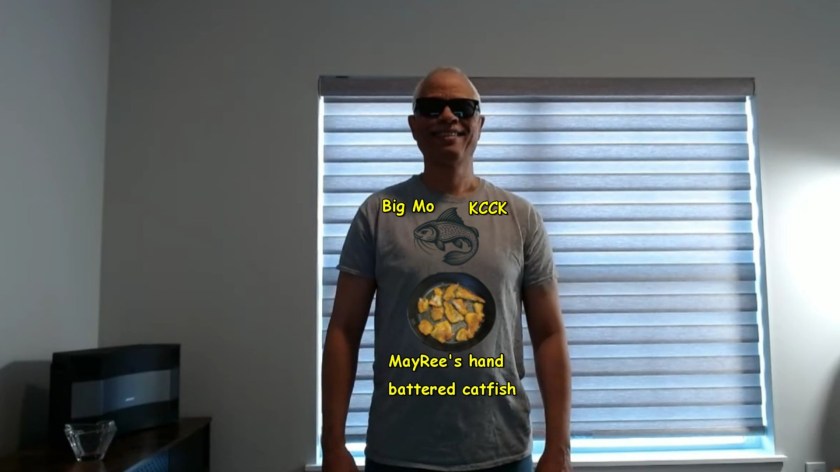
You can be glad about that. Now about that suggestion that I have for a tee shirt design about my favorite faux sponsor created by Big Mo, Mayree of the legendary Mayree’s hand battered catfish; it’s better because it’s battered. I wonder if there’s any movement on that.
After a short break during the Thanksgiving holiday your hosts are back at it again with another episode! This week features the usual mix of blues eras you’ve come to expect along with a few Californian artists, tune in to see which ones! Songs featured in the episode: Solomon Hicks – “Further On Up The … Continue reading
While yesterday’s post on Dr. Melvin P. Sikes was mainly about my personal impressions of him as a teacher, there are a couple of web resources which gives a little more texture about him apart from my imperfect memory and limited experience.
One of them is a formal course outline and evaluations he and another teacher wrote in 1975, which was the year I first encountered him when I was a freshman at Huston-Tillotson College at that time. I know it seems like a tough read, but I was pretty impressed by what teachers said about him in the evaluation part of the document entitled “Report on Teaching in Multi-Cultural/Multi-Ethnic Schools (1974-75).”
The pdf document is 39 pages long, but I suggest focusing on the student teacher evaluations of his course. That starts on page 19. They all praise it, without exception. Many note that he didn’t really just lecture. One of the evaluators called him “supercalifragalisticexpialadoches!” Not sure if that’s spelled just right (it’s on p.33 so you can check it yourselves), but the point is well made—he was viewed as an extraordinarily gifted teacher.
Dr. Sikes’ comments start on pp.35-39 (Attachment D, entitled “Teaching in Multi-Cultural/Multi-Ethnic Schools; EDP F382 -Summer 1975l Professor Melvin Sikes) and I think that’s also worth reading. It’s short and without lofty, academic terminology.
The reading list caught my eye. I looked for Ralph Ellison’s novel “Invisible Man” which had been published in 1952, but it wasn’t on the list. That book has special meaning for me personally, because when I encountered Dr. Sikes in 1975, I was a freshman at one of the Historically Black Colleges and Universities (HBCUs), Huston-Tillotson College as it was then known. I was born and raised in Iowa and had never been in the southern United States. I sort of identified with the unnamed protagonist because the first section of the book deals with his experience at a southern black college.
It was a culture shock. I never saw anyone like Bledsoe. In fact, I never personally met the president of H-TC (now Huston-Tillotson University as of 2005), who was Dr. John Q. Taylor King, Sr. at the time. My main connection was Dr. Hector Grant, who recruited me while he was visiting Mason City, Iowa in connection with support from a local church. I still don’t know what happened to Dr. Grant. It’s like he dropped off the face of the earth.
Anway, I wanted to share another item I pulled off the web about Dr. Sikes. It’s a newspaper article about him published in the West Texas Times issue published May 4,1977. It’s in the collection of the Texas Tech University on line, with the link to the main front page story “Judge Orders Officials to Clean Up the Jail,” interestingly enough. It automatically downloads a pdf of the newspaper issue to your computer when you click the link. I’m just going to try to summarize it and pull some quotes.
The title of the story about Dr. Sikes is down the page, “UT’s Dr. Sikes Helps Students Know Themselves and Others.” The story begins with an anecdote about an interaction Dr. Sikes had with a teacher. It involved a black student coming to her with a complaint that a white student had hit him and he used bad language in describing it. The teacher was going to discipline the kid about his bad language, which Dr. Sikes questioned.
Sikes thought the teacher should have first gotten more information about what the student actually experienced in the encounter. The implication was that if she had listened first, she might not have jumped down his throat about his bad language.
The author of the news article writes that, according to Sikes, “I want my students to be more flexible, to understand that people are first people,” the professor likes to say. “I want them to grow out of looking at a color of a skin and making determinations, good, bad, or indifferent.” He goes on to say,
“I don’t even want them to look at blacks and say, ‘these are great people.’ I just want them to look at blacks and say ‘these are people.’
Quotes from Sikes:
“Before you can deal with another in a meaningful kind of way, you have to find some meaning and purpose in your own life—which means defining yourself….”
About teaching:
“Yes, I was lucky, I was taught by my parents, to some degree. But then I had teachers who taught this to me… And much of whatever I am… is the result of teachers and their concern—black teachers, white teachers.”
About our differences:
“If we’re all the same, we can’t make unique contributions because the contributions would be the same.”
The author of the story points out that Dr. Sikes often took student teachers to Huston-Tillotson College to see predominantly black students. The author also writes that Dr. Sikes mentions something about politics which rings a bell.
“He [Dr. Sikes] talks about the politicalization of education, and says that educating has been taken away from the educator and usurped by the politician.”
On teaching the teachers:
Dr. Sikes says: “People don’t realize how important you are and you don’t realize how important you are. You’re molding and shaping human lives, millions of lives, who will become, depending upon how you mold and help shape or help them become.”
“Now the doctor deals with his patient for a short length of time, and the patient dies and he buries his mistake, or he lives and he’s all right. But we can’t bury our mistakes. They walk around and haunt us and other people…sometimes their living is death. But people never realize that it’s teachers—we are the ones who have power.”
And finally, about Mel Sikes himself, one of his students says,
“Sikes is intense, loquacious and supremely personal. He immediately grabs you and talks on a person-to-person wavelength. He tells his students a lot about himself, his struggles as a black and as a radically caring person. He says he would die if it would help all people relate better. And he would.”
There was a lot more to Melvin Sikes than a lemon-yellow leisure suit.
I noticed the headlines about the DEI flap at The University of Iowa, the one with the official apparently spilling the beans about University of Iowa’s DEI program not going away despite being illegal while maybe being unaware of being filmed. I’m not going to retell the story.
However, it does remind me of a time back in the 1970s in the days of affirmative action when I was a freshman student at Huston-Tillotson College (now Huston-Tillotson University) in Austin, Texas.
I learned about tenacity to principle and practice from a visiting African American professor in educational psychology from the University of Texas. It was 1975. Dr. Melvin P. Sikes paced back and forth across the Agard-Lovinggood auditorium stage in a lemon-yellow leisure suit as he talked about the importance of bringing about change in society.
He was a scholar yet decried the pursuit of the mere trappings of scholarship, exhorting us to work directly for change where it was needed most. He didn’t assign term papers, but sent me and another freshman to the Austin Police Department. The goal evidently was to make them nervous by our requests for the Uniform Crime Report, which Dr. Sikes suspected might reveal a tendency to arrest blacks more frequently than whites. He wasn’t satisfied with merely studying society’s institutions; he worked to change them for the better. Although we were probably just as nervous as the police were, this real-life lesson about the importance of applying principles of change directly to society was awkward.
Nothing like confronting social issues head on, right?
We would have preferred a term paper. We sat in the police station looking at the Uniform Crime Report, which was the only resource we could get. I think we were there a couple of hours; it felt a lot longer than that. The officer who got us the paperwork was polite, but a little stiff and wasn’t really open to anything like an interview or anything close to that. I can’t remember what we came up with as a write-up for what felt like a fiasco. I’m pretty sure we didn’t bring about anything even close to change. It was a humbling experience. Maybe that was the point but I’ll never know.
Dr. Melvin P. Sikes was a member of the Tuskegee Airmen although he didn’t see combat. He was the dean of two historically black colleges, a clinical psychologist, and a University of Texas professor. He died in 2012 after a long and successful career as a psychologist, teacher, and author.
I found a podcast about him which was sponsored by the Hogg Foundation for Mental Health and which aired February 15, 2024. It’s an hour long, but there are segments of interviews of him in 1972 that I consider fascinating. A couple of times he says something which I wish the interviewer had allowed him to expand on. The gist of it is that we need to have a system of education which allows people to speak from the standpoint of pride rather than rhetoric. I think what he might have meant is that it would be wonderful if we felt secure and confident in ourselves to express our minds sincerely. The word “rhetoric” makes me think of talk that is persuasive, even impressive, but maybe insincere. I think it still fits today.
So, for the past several days, Sena has been bugging me to let her give me a facial. I’ve never had a facial; it never occurred to me; I had no idea what it even entailed. I looked it up on the web. I read things that kind of scared me.
Facials can result in something called “purges.” It turns out facials can sometimes lead to them and it could transport you pack to the days when you were a pimply teenager. Yeah, like I want to break out in pimples! Are you kidding me?
I read about the shaving controversy surrounding facials. Should you shave or not before a facial? No, because it’s like a double exfoliation, and that’s against federal law! Nah, no reason to worry about shaving or not shaving, just go and get the facial!
She just kept after me. Every single day, the question was some variation on the same theme: And when would you like your facial? Are you ready for your facial? Did I mention I can give you a facial? Have I asked you yet about your facial?
Yeah, about five minutes ago.
Sena gives herself facials and says it’s relaxing and does wonders for her skin. What’s wrong with my skin? Is my facial skin defective? It covers my skull. That’s what it’s for.
I also recalled the Men in Black scene in which Agents J and K question Beatrice about what happened to her husband Edgar, who got eaten by a giant alien cockroach who took his skin and wore it as a disguise. When Agent K neuralyzed Beatrice, Agent J suggested she “find somewhere where you can get a facial.” I don’t think anybody suggested Edgar get a facial, but he probably needed one more than Beatrice did.
I finally realized I would never hear the end of it, so I said yeah, go ahead give me a facial. It tingled. It didn’t take an hour. So far there has been no purging of any kind. I think I glow. Maybe I could try another one in a year or so.
I’ve been looking for other ways that Iowa addresses mental illness and its impact on homelessness and other adverse outcomes since my last post on the issue.
It turns out that, despite Iowa ranking 51st out of all U.S. states for the low number of psychiatric beds according to the Treatment Advocacy Center statistics (in 2023, it had just two beds per 100,000 patients in need), a new mental health court established in in May of 2023 has made substantial progress in reducing the number of crisis contacts, psychiatric hospitalizations, and days in the hospital. Arrests, jailings, and days in jail were also reduced.
Participants in the new program include the University of Iowa Health Care, Iowa City VA Hospital, the Abbe Center, Guidelink Center, National Alliance for the Mentally Ill (NAMI), Shelter House, and several other mental health service agencies in Johnson County.
The Johnson Mental Health Court continues to operate since June of this year when the pilot program’s funding from the East Central Iowa Mental Health Region was supposed to have ended on June 30, 2025, due to the change in mental health regions. This is a program for patients under involuntary mental health commitment that avoids incarceration and placement in a state psychiatric hospital.
This civil mental health program didn’t exist until well after I retired and I hope for its continued success.
Hey, I thought it would be fun to share an interview that somebody did of Svengoolie at the Comic-Con in San Diego yesterday. Svengoolie is played by Rich Koz and he’s been around a long time. He’s definitely not thinkinig of retiring. The only way we would have recognized him is by his voice!
Svengoolie intro: Calling all stations, clear the air lanes, clear all air lanes for the big broadcast!
I plan to watch the upcoming blockbuster Svengoolie movie this Saturday night, “The Black Scorpion” and so far, I haven’t read much about it except for a couple of lines from a synopsis or two. A volcano erupts and all of a sudden, a little town in Mexico is infested with giant scorpions.
I bet you, just like me, remember the TV series Meerkat Manor. Why would I say that, since probably none of you will fess up to it? Because meerkats eat scorpions! Not to mention the meerkats were often not much bigger than the scorpions. But could a mob of meerkats tip the scales? You’d need more than a mob to take down a bed of giant scorpions.
So, can you use bug spray on them? I mean the scorpions, not the meerkats. It turns out that scorpions are arachnids, not insects—but that doesn’t mean some bug sprays won’t work. On the other hand, you could just stick them in a freezer to kill them—not yours, of course. You’d need a freezer the size of a warehouse.
By the way, a bunch of scorpions is called a bed (see above). And so, I guess you can figure out a punch line for a Chuck Norris joke with the lead-in: What does Chuck Norris sleep on when he camps out in the desert?