Well, after 5 grueling weeks of icy cold showers, a qualified plumber—oh wait, you guys already know our hot water heater croaked just last Friday. And the plumber fixed it in a jiffy on Monday—miraculous.
So, the cold shower ordeal lasted only 3 days. But those were really dreadfully, awfully, cosmically cold shower days.
I don’t know what he did other than to clean the burner and re-ignite it. But it must have been a special cleaning method using Obi Wan Kenobi moves and a spell, “These aren’t the droid reigniters you’re looking for.”
Anyway, he walked in without anyone else with him and wasn’t carrying a new hot water heater on his back. That said two things to us. He was not a technician in training and he was very confident he could get our water heater working again. And he did.
On the other hand, he did carry a very large pack on his back, and I wondered if just maybe there was a little old jedi in it. Maybe Yoda was hiding in there, ready to encourage the plumber to concentrate more deeply if necessary, “The burner clean. Yes, hrrrm.”
We were impressed and didn’t even ask him about his qualifications. We know what can happen when you ask questions like that.
Clean Version
Although he couldn’t tell us how long the fix would last, he did tell us the approximate price of a new water heater. I got the urge to take another cold shower as a countershock. But I resisted. And the plumber didn’t give a hard sell.
Anyway, he’ll get back to us with a quote. Until then, we’re hoping the cold shower days are gone.
The other day Sena and I went on a nature walk at the Terry Trueblood Recreation Area. There’s a lot of Mullein growing out there. It’s a pretty invasive prairie type plant. It’s said to have medicinal uses, but don’t eat it.
The tree swallow chicks have all fledged. We didn’t see any water fowl but the red wing blackbirds were raising a ruckus.
There were many common butterflies like Monarchs and Black Swallowtails.
And there were a few rare species—compliments of Sena’s brooches, which you view for the first time ever in our video.
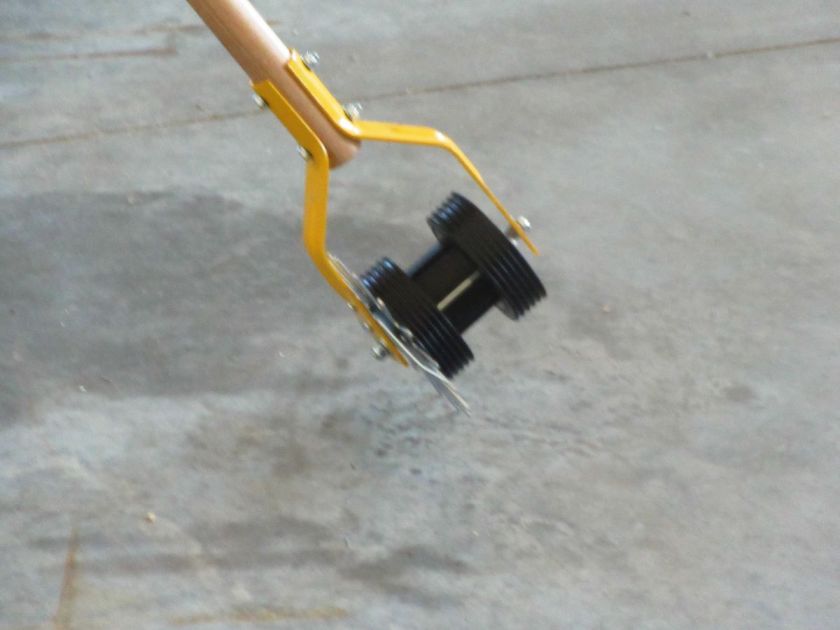
We were out doing yard work today. I usually do the edging with an old-fashioned manual edger to trim grass off the sidewalk to get a cleaner look. I think that’s difficult to achieve with a gas or electric powered trimmer. Sena did some extra mowing with the reel mower, which is also not a power machine—unless you count muscle power.
My edger has lasted about 12 years. I’ve used it for so long, I can’t tell what company made it anymore. The label is rubbed off. It had a 15-year guarantee, but I’m not chasing that one down. Today I noticed the job was a lot harder. I had to keep stopping because the blades kept getting stuck.
When I finally took a closer look at the tool, I noticed that the rubber was cracked and about to fall off the wheel next to the blade. I was able to finish the job, but had to run out to buy a new edger before the next time.
Menards had one. The brand was Yardworks, which I’ve never heard of. It cost about $45 with tax. I thought that was steep and can’t remember how much the old one cost. I suppose the price can go up a bunch over a couple of decades, but I wondered if I could get it cheaper at Lowes.
I drove over there only to find out that the salesmen barely knew what I was talking about. All they had were gas or electric powered models and I knew they weren’t edgers. They were trimmers.
So, I had to drive back over to Menards to buy the Yardworks model. There was a half-dozen left, which tells you how unpopular they are. I noticed something wrong with the first one I picked up. The wheels wouldn’t turn. It was jammed. The second one rolled normally. That’s essential. The blades self-sharpen.
Just because they roll doesn’t mean the chore is easy, though. You know you’ve done some work after you edge around the walkways everywhere in the yard. Some people say that’s why only people with postage-stamp yards should use a manual edger.
There’s a video of how to use the Ace model, which looks exactly the same as the Yardworks edger.
The Ace guy in the video says you should edge about every couple of weeks or so to keep thing looking neat and clean. If you do that you could end up looking like I did at one time. When my quads got so huge, they were flopping over my knees which made it difficult to put my pants on, I cut back on the edging to 2 or 3 times a season.
Sena and I both worked pretty hard in the hot sun today. This is day 3 of the hot water heater failure—meaning cold showers for me. She had decided to try sponge baths until today. So, she took a cold shower instead of a sponge bath.
Our hot water heater went kaput yesterday and I’ve now endured the only 2 cold showers I’ve ever taken in my life that I can recall.
Sena will be doing sponge baths, even though I’ve told her cold showers are great, easy, and healthy. Her hesitation might have something to do with my screams while I’m in the shower. The neighbors called emergency services yesterday, but now they probably know the story.
It’s strange how hot water heaters can just plain fail, especially on a Friday when the plumber is booked until late Monday afternoon. When I told the scheduler I would be more than happy to donate every single one of my cribbage awards to their company (which number exactly zero at last count), she just chuckled. When she told me our water heater was “out of warranty,” it didn’t surprise me and made me wonder if I would be taking daily cold showers until the day I die (meaning in about one week given my current level of recurrent hypothermia).
My cold shower method is the jump-in-yikes-out approach. Sena hauls me out in a wheelbarrow to unthaw me in the refrigerator—body part by body part.
In fact, there’s some evidence that cold showers are actually healthy for you, provided you don’t die of cold shock. Believe it or not, a cold shower drives blood flow from your skin to your internal organs. I don’t think that includes your brain, mainly because I don’t think you could pay me enough to stick my head into the freezing water which would turn me into a Jimbo-cickle.
On the other hand, there’s not a wealth of scientific evidence that cold showers are always good for you. On the other hand, it may be good for your immune system and circulation. Consult your doctor if you have cardiovascular disease. Cold showers can shrink your blood vessels. They can also shrink other parts of a guy’s anatomy, if you know what I mean.
Hey, did you know that Chuck Norris’ balls make cold water shrink? You get my drift.
This is not the first time we’ve had problems with a hot water heater. A few years ago, in a different house, the water heater developed a leak around the base. This is supposedly something the homeowner can deal with.
You get my drift. You might think you’re lucky this is the age of YouTube and you’d be partly right. However, I found a number of do-it-yourself videos in which different consultants had slightly nuanced approaches to checking and maintenance of hot water heaters. Watching several videos and getting the gist of the steps is what ordinary people probably do if they do this at all.
Is there only one way to check the Temperature Pressure Release (TPR) valve? Do you always have to shut off the gas line valve or can you get by with turning the thermostat knob to the pilot setting?
Should you really watch that MythBusters episode in which there is a very explosive example of how the wrong procedures in hot water heater maintenance can lead to very deadly consequences? No kidding; a couple of experts recommended it.
I gotta tell ya, I can do without the “guttural thud.”
Anyway, start to finish, the project of checking for leaks around the drain valve and the TPR valve, getting the garden hose and hooking it up to the drain valve after shutting off the cold-water valve, turning the thermostat to pilot, draining the 50 gallon tank (don’t forget to turn on your hot water faucets to help the process along!) to see tea-colored water briefly which cleared quickly, and reversing the steps, with a total time of about 2 hours including clean up and shazam—the leak was not fixed.
That’s why I call a plumber. And I’ll be keeping track of the number of cold showers I take.
The attack a few days ago by what was most likely a mentally ill person on staff at the recently opened GuideLink Center in Iowa City reminded me of what may appear to be disparate views by mental health professionals on the link between mental illness and mass violence perpetrators.
The GuideLink incident involved a person who assaulted GuideLink staff and who also left bags containing incendiary devices at the center and another building in Iowa City. The person is being charged with terrorism and is currently in custody in the Johnson County Jail.
I have not seen information about any injuries sustained by the mental health center staff. There were no explosions or fires at either location where incendiary devices were left. Bomb squad experts removed the devices. It’s not clear whether the perpetrator had been a GuideLink Center client.
Dr. H. Steven Moffic, MD, a retired psychiatrist who writes for Psychiatric Times, readily says that the perpetrators sometimes do have mental illness that at least contributes to committing acts of mass violence. Dr. George Dawson, MD, another retired psychiatrist, seems to say that the major reason for mass shootings is the ready availability of guns, a culture of gun extremism, and mental illness accounts for a small proportion of acts of mass violence.
But neither Dr. Moffic nor Dr. Dawson say that it’s only either mental illness or guns (or other instrument of mass violence) that lead to acts of mass violence. Both are important.
I’m a third retired psychiatrist and by now some readers might be asking themselves whether they should listen to any retired psychiatrist. Experience counts.
Speaking for myself, as a general hospital psychiatric consultant I was frequently faced with violent patients in the general hospital. Often, I found it necessary to ask a judge for a court order to involuntarily hospitalize a violent and/or suicidal patient on a locked psychiatric unit by transfer from an open medical or postsurgical unit.
In order to obtain an order in the state of Iowa, I had to be able to state to the judge that the patient in question had a treatable mental disorder and was an acute threat to himself and/others. In most situations, I had an open bed on a locked psychiatric unit available ahead of time.
Even if a Code Green was necessary, I usually had an inpatient resource to which I could move the patient. A Code Green is a show of force or takedown maneuver by a specially trained team to control a violent patient while minimizing injury to everyone involved.
I don’t know if that kind of approach is even possible in a community crisis stabilization setting like the GuideLink Center. I think it’s fortunate that it partners with many other community resources including the Johnson County Sheriff’s Office.
The outcome of the incident at the GuideLink Center was that the overall safety of the staff, the patient, and the community was preserved. More resources like this are needed everywhere. They deserve all the support we can give them.
Does your pet dog, cat, or sloth ever get the zoomies? We don’t have pets; I just read about animals getting the zoomies the other day. It’s an interesting phenomenon. Right after a bath, a dog might race around the yard, getting all dirty again. They look like they’re having great fun and veterinarians say it’s harmless.
It would be great if we could catch a sloth with the zoomies. Not only would that be a first for zoology. Maybe it would outrun the fungus and other parasites growing on its hair, making it easier to gather by scientists. Some of that stuff might have potential for use in developing medicines for humans.
Other animals including those in the wild can get the zoomies, and some version of it might be done by Springbok antelope, although it’s called pronking. They just run around and leap, maybe for no apparent reason. Some claim that dogs occasionally pronk, but I wonder if it’s just a special case of the zoomies.
The veterinary term for zoomies or (and maybe pronking) is Frenetic Random Activity Periods (FRAP).
Technically, I don’t think humans get the zoomies although some would debate the issue. Many of us try to do the opposite, especially nowadays. One example is mindfulness, which I’ve been doing for the last 8 years. It’s difficult for me to describe, but you’re really not trying to do anything, not even trying to relax, per se.
But I try to be still and notice whatever is unfolding, nonjudgmentally. It’s a little hard not to scratch that itch right next to my temple. I’ve seen on the web that some people call it the zennies—maybe we could call it Focused Regular Awareness Periods (FRAP).
I guess dogs and cats enjoy their brand of FRAP, or at least it looks that way. It’s really hard to tell what’s going on if you just watch people doing the human brand of FRAP. Sometimes they just look like they might be asleep—which occasionally happens.
Zoomies or zennies; could they be different paths to the same place?
Here’s a side note on my recent post about using a smartphone to help you find where you parked your car. I just saw a few news items about something people are calling the “dumbphone.” I gather they’re making a comeback, and not just for old folks.
Hey, I used to have one of those. It was a flip phone. Several years ago, before I retired, residents rotating through the general hospital psychiatry consultation service suggested I graduate to a smartphone.
After I finally got one, I used it basically as a phone and did little else with it for a long time. It was my smart dumbphone.
I gradually added apps to it, including a step counter, epocrates, and whatnot. But I’m not constantly on it playing games and checking the news, mail, and so on.
The battery swelled up on it a couple of years ago, which worried me. But I took it to a cell phone repair shop where the battery was replaced and it’s been fine ever since.
I still use it mainly as a phone. However, I wonder what I’ll do, say, if the battery swells up again. I don’t know if it would make any sense to go back to the dumbphone.
It got up to 110 degrees today and there was an Excessive Heat Warning. I hope everyone found a way to bear it or escape it. It reminds me of the Africa Sahara episode of the Silver Desert Ants.
This is a post about how easy it is to forget where you parked your car in a big parking lot, say at the grocery store, and ways to help prevent it. This sometimes attracts the kindness of strangers, which is puzzling because it’s not very clear how helpful they can be in this situation.
But you want to say more than something like, “Oh, that’s too bad, hope you find it before the ice cream melts.”
The other day, Sena forgot where she parked the car at the grocery store. The circumstances were a little unusual. She parked near one entrance to the store and after getting the groceries, left from an entrance on the other side of the store way across the parking lot. The landmarks were all different.
This is how things started: she ran into a guy with his little boy. The guy actually couldn’t remember where he parked his car and was trying to use his car key fob remote to locate it. This is actually pretty common nowadays. I remember leaving the eye clinic a few months ago and hearing a small symphony of beeps from a number of people using their key fob remotes this way trying to find their cars in the large parking garage.
Sena was sympathetic to the guy, but it was understandably really difficult to help him. He eventually found his car using the key fob trick.
Then the situations were reversed. Sena had trouble finding our car. She was roaming about the parking lot, pushing the grocery cart, obviously looking lost. This attracted 4 different persons (including the first guy she met) who were sympathetic and offered advice—mostly on how to use a key fob to locate the car by pressing one of the buttons (probably the lock/unlock although there might be a panic button). They demonstrated it by pressing the key fob button while standing right next to their cars. They suggested holding it far above your head.
This trick usually works best when you’re fairly close to the car because the key fob remote is a transmitter which uses low-power signals. The operating range may sometimes be limited. Sena was probably pretty far away from our car. She actually began to suspect our car had been stolen. She eventually found it by trial and error.
This episode resulted in attracting a number of people who were kind to her. That’ s encouraging since it looks like kindness is often in short supply. On the other hand, it’s not always good to be alone in a large unfamiliar parking lot, perhaps at night, looking lost and surrounded by strangers.
We can’t remember having this problem years ago before the era of keyless fob remotes, which I read was in the mid-1990s. And we didn’t have them until years after that. I guess we were just more careful about noting landmarks in large parking lots.
There are few things to do in order to avoid forgetting where you park.
You can try to find your car using your key fob remote, although the effective range of the signal might be too short to trigger the horn or the lights. And it might not work if the fob remote battery power is low. And if you’re surrounded by a lot of other people hunting for their cars using the same method, you might have a little trouble discriminating which beep is yours. This could become a YouTube meme, especially with different beep tones (like the 5 tones in the movie “Close Encounters of the Third Kind”).
You can pick a landmark which will make it easier to remember where your car is. Many parking lots have large signs with numbers and letters which can help you.
You can take a picture of your car’s location using your cell phone, including more permanent landmarks than just the other cars adjacent to it—which can be driven off by their owners.
You can also use a cell phone with Google Maps or another geolocation app to help guide you back to your car. Just about all smartphones have this feature. You can consult the owner’s manual for instructions for flip phones, some of which have this function. I don’t think car owners’ manuals typically have instructions for how to use the key fob remotes to find your car. At least ours doesn’t.
There is a heat advisory for Iowa today. Temperatures could reach as much as a 105 degrees. Please follow recommendations for preventing and managing heat-related illness and stay safe on this July 4th holiday!











 Go Retire Psychiatrist