Cribbage Tee Shirts!

Sena got me a couple of cribbage themed T-shirts and they arrived yesterday. One of them is perfect for a retiree like me. The other has an image of the perfect 29 hand. It’s also perfect for me, not because I’ve ever had a 29 hand, but because I’ll take any lucky talisman I can get.

They’re extra-large because they’re 100 per cent cotton—not because I have an Arnold Schwarzenegger chest. They’ll shrink some, but we won’t leave them in the dryer very long.

One or both should be lucky for me, so I might wear them when we play. Usually, the winner is whoever wins 2 out of 3 games. We don’t use the skunk rule and we don’t play muggins. In fact, we help each other count our scores.

We switch off between playing Scrabble or cribbage. I usually lose the Scrabble games. The other day she played “um.” I looked at her and said “Um?” She just said, “Challenge me.”

I decided not to challenge and was glad. I still lost. I looked it up later in the Scrabble dictionary and it’s in there. It means to hesitate or pause speaking. Believe it or not, “ummed,” “umming,” and “ums” are also legal.

“Ummification” is not legal.

Cribbage scoring is more straightforward than that, and if you can count to 31, you’re generally OK.

Scott Boulevard Trek

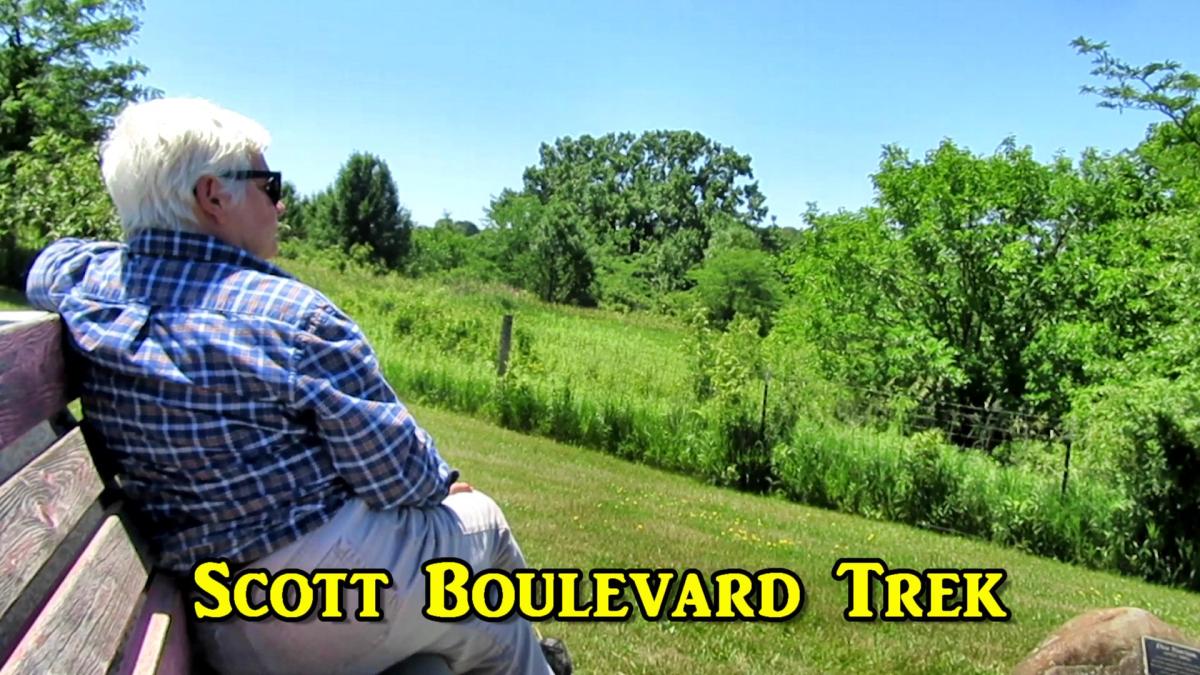
We took a walk on Scott Boulevard on a gorgeous day. We said hello to the Sitting Man. And we found a new sculpture of a praying dog just inside the entrance to Harvest Preserve. It looks like a very pious Bassett Hound. We don’t know the significance of the piece. I did a quick google search and couldn’t find anything comparable although there were hits on praying dog sculptures.

The Sitting Man reminded me of a quote I thought was by Winston Churchill and it turns out it’s by Franklin Delano Roosevelt: “Be sincere; be brief; be seated.” Sena did a pretty good job of calling a Mourning Dove. However, we never got a reply.

Also, inside Harvest Preserve yet visible from Scott Boulevard, is a sculpture of a boy climbing out on a tree limb to catch a cat. I wondered whether there was ever a quote about going out on a limb. It turns out there is: “Don’t be afraid to go out on a limb, that’s where all the fruit is.” There are variations of it and it’s often attributed to either Will Rogers or Mark Twain. Quote Investigator says it’s from a journalist named Frank Scully, who coined it in 1950.

I don’t know if we’ll ever find out what that praying Bassett Hound is all about.

No Swimming at Terry Trueblood Recreation Area

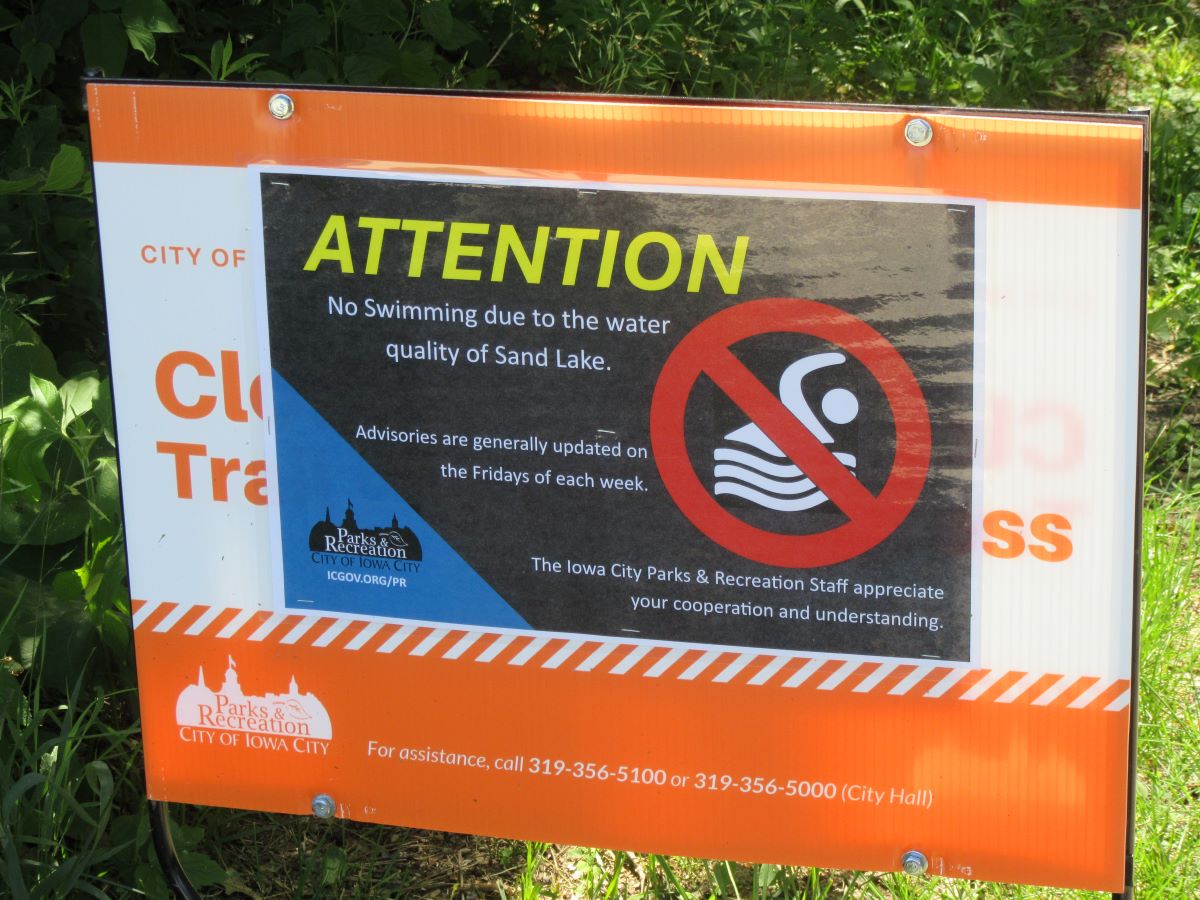
There is no swimming at the Terry Trueblood Recreation Area because E. coli has been detected in Sand Lake. Check Iowa City parks web site for updates.

No swimming: E. coli bacteria detected in Sand Lake at Terry Trueblood Rec Area; can lead to gastrointestinal illness

Be Kind

We went for a walk on the Terry Trueblood Trail yesterday. It was a nice break from reading the news.

Sena wore her shirt which has printed on it, “be kind, be nice, be love.” She got a compliment about it.

We saw a lot of birds, including Tree Swallow nestlings in the nest boxes along the trail.

There were three in one of the boxes. They seemed to be doing well. I thought we saw a Gray Catbird, although it was singing a complex song at the top of its lungs—from a treetop. I guess I’m not sure what it was because Catbirds are usually secretive and makes sounds like a house cat’s mewing.

I guess all I know is that the bird looked gray.

Anyway, friendly people were out and we said hello to each other. Kindness was in the air.

The Proof is Way Out There

I watch the History Channel show, The Proof is Out There, hosted by Tony Harris, an American journalist and filmmaker. The show reviews videos of paranormal events, supposed cryptids, and other weird stuff and generally ends up debunking at least half of them. I’ve seen some of the videos on another TV show, Paranormal Caught on Camera, which airs on the Travel Channel. Interestingly, the hosts of that show tend to uncritically endorse the authenticity of the videos while The Proof is Out There usually debunk them as faked.

I don’t know how the videos get swapped between the two shows. In fact, the last episode I saw of The Proof is Out There was subtitled “The Skinwalker Edition.” The History Channel blurb on it says that Tony Harris “…travels to the Skinwalker Ranch, a place known as the epicenter of strange and mysterious phenomena.”

In fact, Harris does nothing of the kind and many of the videos were previously aired from other episodes. The only connection with Skinwalker Ranch were a few photographs from another History Channel show, The Secrets of Skinwalker Ranch. I wonder if the producers of that show didn’t allow Harris to actually evaluate the alleged paranormal events of their show because they were afraid he would debunk them.

Obviously, the title of the show “The Proof is Out There” got its name from the X-Files subtitle, The Truth is Out There. Some viewers have suggested that there may be another meaning to the subtitle, which is that the truth may be “out there” in the sense of outlandish or crazy instead of from aliens in outer space.

So, what’s going on with The Proof is Out There? Is it designed to do a better job of picking out the faked paranormal videos? Sometimes they miss them, like the one about the glitch in the matrix which turned out to be a cool camera trick.

Most often they hedge their bets and say they don’t know what’s going on in the video. But they don’t shy away from calling something a hoax if the evidence points in that direction.

On the other hand, do the producers of The Proof is Out There somehow collude with those of other paranormal TV shows, sharing videos and creating the impression that they’re more objective just to sustain interest in the show and even deliberately foster controversy for the same reason?

That would be way out there, although I still like the show. And the cryptid chaser parody, Mountain Monsters, obviously pokes fun at other sasquatch-themed shows. Not only do they get away with it, some people love it for just that reason—including me.

When we’re taking ourselves too seriously, I think it’s healthy when somebody comes along and makes us laugh at ourselves.

Weather Sealing Your Door Jambs

The other day I mentioned that I put off replacing the weather sealing around our sun room door because of the heat. Yesterday, I did it in the morning before it got to 100 degrees, because there was another Excessive Heat Warning.

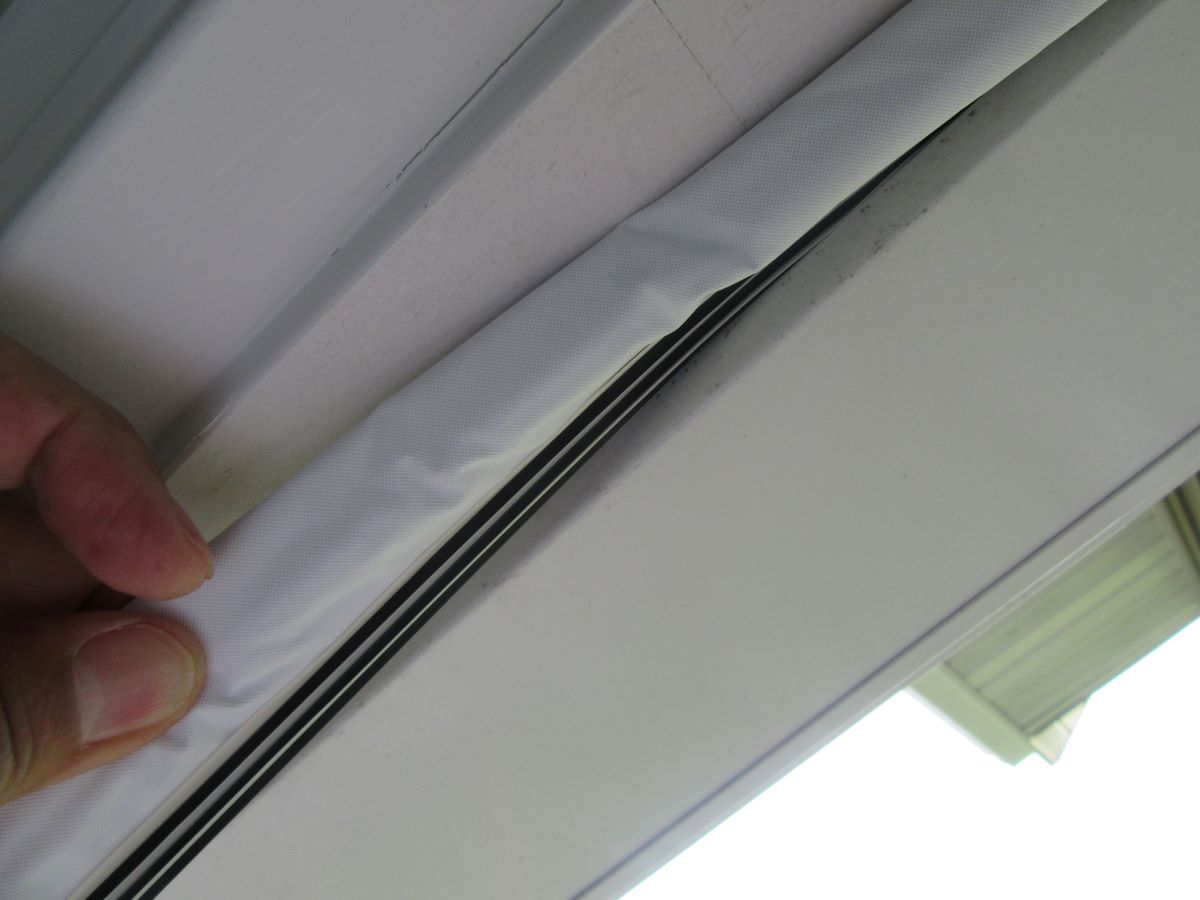
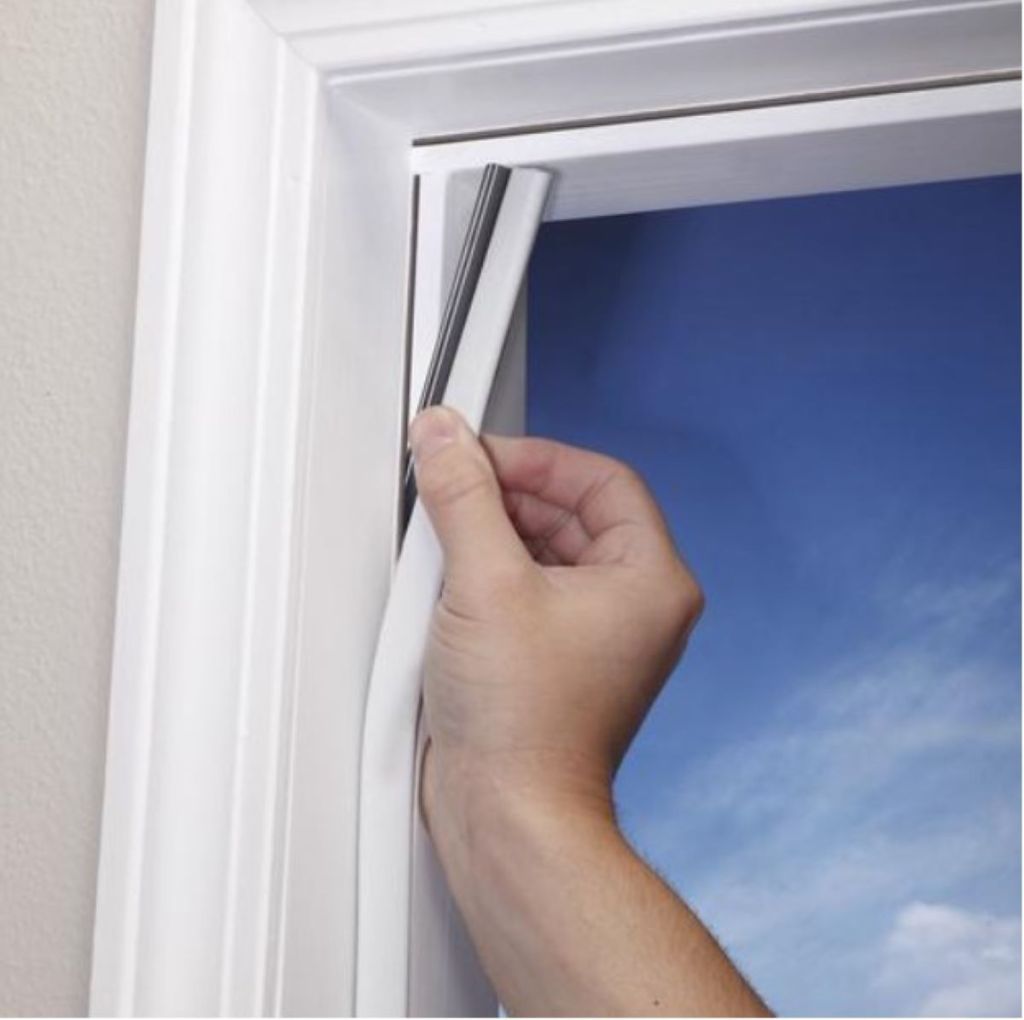
I saw a YouTube video of how to do this, and a guy was pushing the replacement strip in the kerf with a chisel. “Kerf” is a just fancy word for a slot in which you push the tab of the strip into the door jamb.

As I watched the video, I thought to myself, “I hope he doesn’t tear a hole in the strip with that chisel.” Then the guy actually warned viewers to be careful not to rip the weather seal with any sharp tool used to push the seal into the kerf.

It’s actually pretty easy to push the seal into the kerf. You just press it in with your fingers. The hard part is trying to keep your hands and work area clean while you’re peeling out the old strip. You do this by gripping it with needle nose pliers and pulling it out of the kerf just to get it started. This can lead to what amounts to a mini-rock slide spilling on the floor and maybe even in your face. You might think this would make you look like you worked really hard, mitigating any fallout from the mess you made.

Of course not! That’s because it’s hard to explain to your better half why there’s a pile of dirt, pieces of old seal on the floor, and grime on the fresh, new seal (the color of which is, of course, white) in addition to the swarm of hornets and flies, sparrows, the odd skunk—which you tried to hide by wiping things off with a new sponge that is earmarked for other cleaning jobs around the house, and calling pest control.

You can either try to measure the strip first and cut it before installing it or just start pressing it in at one end and estimating where to trim it (You can easily trim with a pair of stout scissors; don’t use the pair in the kitchen) when you get to the other end.

I tried the latter and the technical term for the unfortunate resulting quarter inch piece across the top of the doorway I added to make up the shortfall is “tacky.” Because of the orientation of the kerf tab, you can’t just flip it around to make it look like there’s no gap. That trick never works, apparently.

Fortunately, I’m entitled to a limited number of tacky handy man moves. Good luck.

The Scientific Skinny on Bigfoot

What’s up with this Bigfoot thing? Could it be a few humans with the rarest form of Hypertrichosis (Werewolf Syndrome)? You know, some scientists said that Patty, the hairy creature featured on the Patterson Gimlin film back in the 1960s, was not genuine because she had hairy breasts. Hey, guess what? If a woman has Hypertrichosis she can grow hair anywhere, even on her breasts.

But I guess that would not account for the huge size of Bigfoot. Why would they be seven or eight feet tall? They’re sometimes described as being ferocious carnivores. What would they find to eat in the forests? Deer, maybe. But are they quick enough to catch deer?

Can a 1,000 pound bipedal humanoid chase down a deer? Hey, it’s more likely Bigfoot could be a grazer. Some of the largest animals on the planet eat nothing but grass. Take cows for example. They’re pretty big and they munch on things like grass and frosted mini-wheats—with just a little milk they squeeze from their non-hairy breasts.

That’s a tough skill to master when all you’ve got are hooves. And like some chimpanzees who can learn to crack nuts with big rocks, if cows don’t get the hang of milking themselves by the time they’re a few years old, they just never get it. They’re stuck with trotting to Hy-Vee to get a gallon of two percent.

But sometimes you hear about Bigfoot making these tree structures. That’s what some people call them. They usually don’t look like they amount to much. It’s not like they have a well-defined sun room or even a roof. It’s a stick laying across another stick, unless you’re watching the TV documentary Mountain Monsters. Then they’re split levels or log cabin vacation lodges with a jacuzzi.

And how about the noises that Bigfoot makes? The sounds vary a lot from screams to deep bellows to nasal twangs reminiscent of Willie Nelson singing “You Were Always on My Mind.” Do they have a language of some kind? Or do they just grunt and growl and ask where to get the best beef jerky?

Bigfoot sometimes knocks on trees. I’m not sure why. It could be like knocking on wood for luck, I think. Maybe it’s their music. Knock three times on the big tree if you fear me.

This stuff gets pretty deep after a while. Your thoughts?

How Hot?

It’s 97 degrees and with the heat index it feels like 103 this afternoon. There is an Excessive Heat Warning today. I was going to replace the sun room door jambs weather stripping today—but decided against it. I’d have to turn off the air conditioning and leave the door open. I did that yesterday when replacing weather stripping elsewhere in the house.

It takes a while to cool back down.

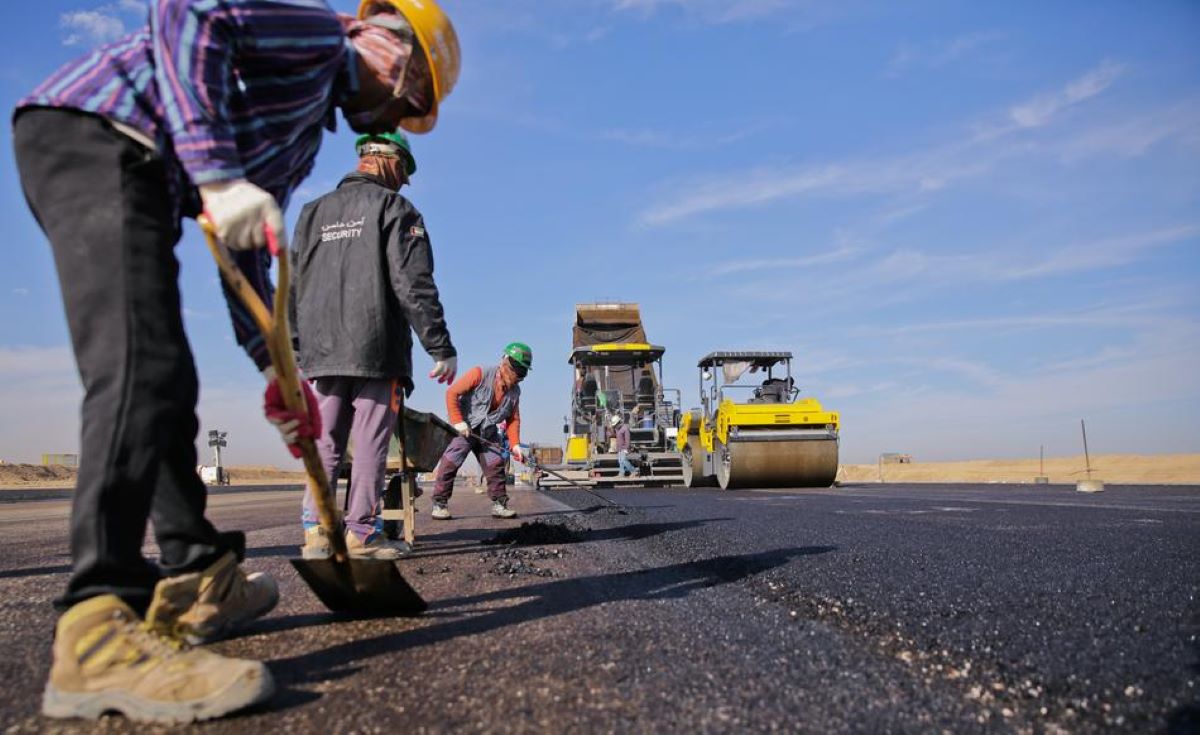
I’m reminded of working as a survey crew assistant way back when, working on new asphalt airport runway construction sites. That gets pretty hot.

On a 90-degree day, the asphalt temperature can get up to 110 degrees. Now imagine you have to work next to the asphalt paving machine. The asphalt mix usually arrives at the job site at a temperature of 275 to 300 degrees Fahrenheit.

I don’t recall ever seeing anyone pass out from the heat on those job sites. But it was awfully hard to drag yourself up and down the runway.

Temperatures today are nowhere near what it is on an asphalt paving job—but if you don’t have to work out there, it’s a lot safer to stay indoors with the air conditioning on than to venture out for very long in 100-degree temperatures.

You can risk heat exhaustion or heat stroke on days like this. Read about the different kinds of heat stress at the University of Iowa web site.

And from the time I started writing this post to the time I stopped, the temperature got up to 105 degrees with the heat index.

Stay cool.

Replacing a Two-Hole Faucet

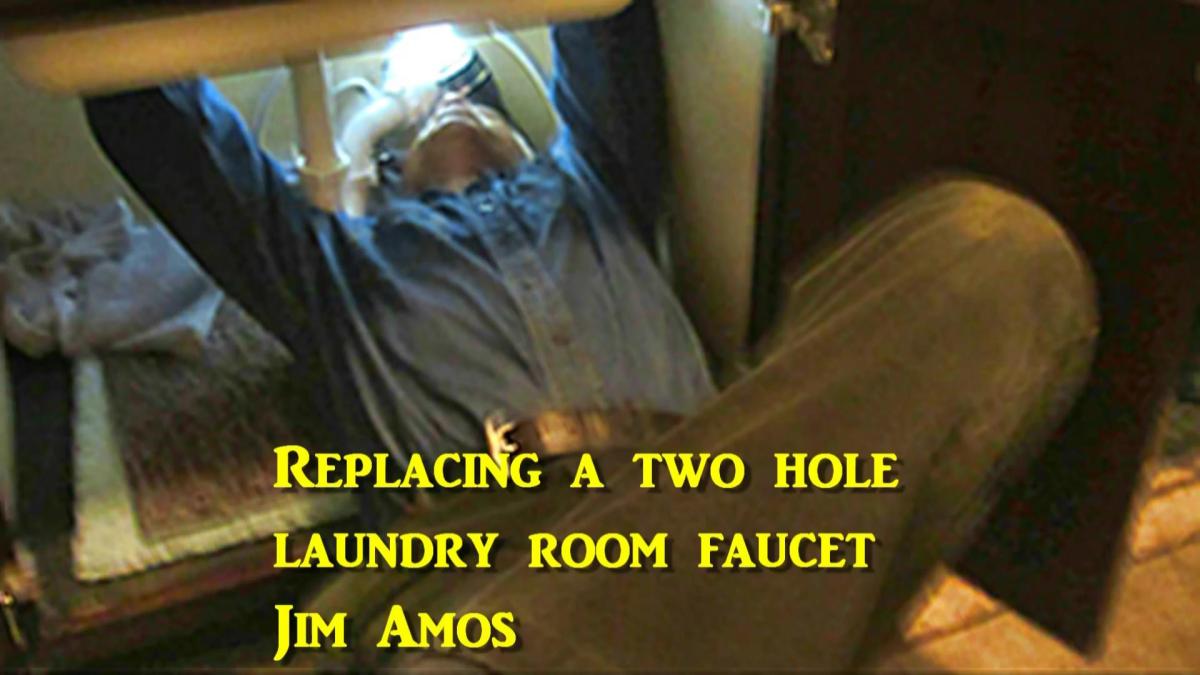
I’m the least handy person on the planet. If I can replace a two-hole faucet, then even Bigfoot can do it.

Replacing the two-hole faucet is probably one of the easiest DIY jobs you can do. That doesn’t mean I didn’t have a problem or two with it.

When you get to the step in which you flush the water lines before installing the new faucet, turn the water lines back on very slowly. If you turn them back on as fast as you turned them off, the water pressure will blast you like Niagara. Water will go everywhere.

Hey, I’m an expert. And do you know what the definition of an expert is? A retired drip under pressure.

So Much Depends Upon the Serial Number

You’ll probably think I’m nuts and you’d be right, but a problem with ordering a replacement part for something from Pella Windows and Doors Company made me think of William Carlos Williams’ poem “The Red Wheelbarrow.” The poem is in the public domain because it was published before 1927, so I guess that means I can include it in this post:

The Red Wheelbarrow

so much depends

upon

a red wheel

barrow

glazed with rain

water

beside the white

chickens

–William Carlos Williams

I’m not a poetry scholar and I have no idea what this poem written by a doctor means. One writer says that it’s probably impossible to get its meaning because it’s part of a much longer book-length work, “Spring and All” and the poem was split out of its context.

My connecting it to the Pella company has nothing to do with “Spring and All” or chickens or red wheelbarrows. It has to do with trying to order a replacement weather stripping part for a Pella door depending on having the right serial number.

It’s a bottom of door seal, made by Pella specifically for a specific Pella door on a house we moved into a couple of years ago and which was built over a decade ago. We have the size and type of the door, and the size and other important dimensions of the weather seal, which required us to take the door off the hinges in order to remove the old one and install the new one—if we can get one.

It’s a special type of bottom of door seal, which you can’t just run over to Lowes or Menards to pick up. In fact, they’ll tell you that you have to buy it direct from the Pella company.

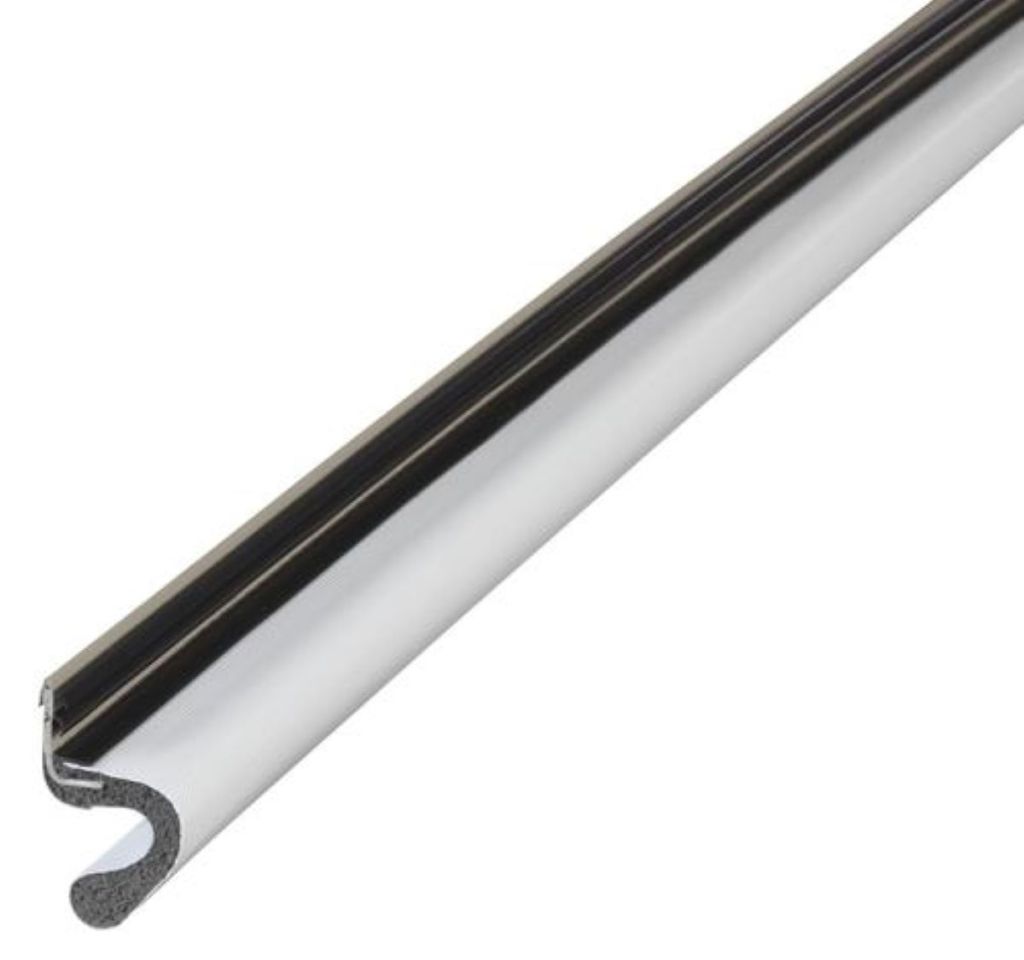
It’s a peculiar looking seal. It fits into kerfs on the bottom of the door. I didn’t even know what a kerf was until we had to get a replacement bottom of the door weather seal. It’s just a slot into which some other piece fits into. There are two raised barbs or blades which fit into slots along the bottom of the door. The blades have to be exactly 5/8 inch apart and they run the length of the seal.

It’s called either a kerf seal or a drive-on door bottom seal, I guess because you drive it into the slots. The old one was stapled at both ends of the door bottom. It was 32 inches long. It was 1 and ¾ inches wide. The blades were in the kerfs doing what blades do in kerfs, which is securing the seal to the door bottom. I pulled the old one off and would need to drive the new one on.

That is, if we can acquire a new one. It turns out the right replacement can’t be found just by knowing the exact dimensions. You have to know the serial number of the door or the serial number of the seal.

The seal is in shreds. If it ever was marked with a serial number, it was destroyed long ago.

The door, which a Pella representative will patiently tell you, should have a serial number on a label fixed to the top hinge on the door. It’s not on the middle or the lower hinge—it’s on the top hinge, which would be fine if it were but it’s not.

How long can you expect a paper label to last on a door hinge that is more than a decade old?

It doesn’t matter if the hinges are all stamped permanently with the word “Pella.” If you don’t have the serial number, you don’t have anything.

All we want to know is whether we can purchase a replacement seal. Well:

The Damned Serial Number

so much depends

upon

a multi-character

serial number

missing in

action

nowhere to be found upon the

item