I thought it might be interesting to see what AI has to say about backward pegging in Crib Wars and Wicked Cribbage. We haven’t found a set of Crib Wars that are specific on the 20-hole backward pegging because they don’t specify which peg you move back 20 holes. According to AI it’s the front peg you move back, starting the count at the penalty box hole.
In Wicked Cribbage you first move the rear peg back whatever number of holes the Twinkler or Lugger cards tells you and then you move the front peg back behind that—and it apparently doesn’t matter where you place that peg, just a few holes behind the front peg you moved back from the penalty box hole (the instructions are as follows: “Although it might sound logically easy to peg backward, it is quite tricky. Begin by using your back peg (no matter where it is) to count backward from your front peg. And (here’s the tricky part) do not forget to move your front peg behind your newly pegged back peg.”
The American Cribbage Congress (ACC) tournament expert does not have answers for questions about this because backwards pegging is not a thing in the ACC. The ACC representative says “Crazy questions are welcome!”
And these games are crazy. I usually try to ignore AI but here’s a summary of the question and answer sesssion today:
Crib Wars penalty box question: If you have to move backwards 20 holes in crib wars because you land in the penalty box, do you move the front or the back peg?
AI answer: In Crib Wars, when you move your peg back 20 holes for landing in the penalty box, you always move your front peg backwards, as pegging in cribbage involves advancing the rear peg to represent your score, and penalties just reverse that action, moving your leading peg back to show the score loss. You just count back 20 holes from your current position on the board, essentially putting your leading peg back where it was or further, then your rear peg stays put until you score again.
Here’s the breakdown:
- Penalty Trigger: You land on a penalty square (or your hand/crib score does).
- Opponent Advances: Your opponent moves their peg forward 20 holes.
- You Move Back: You move your peg back 20 holes.
- Which Peg? You move your front peg back those 20 spaces, as that represents your current score, and your rear peg stays put until you earn more points.
Dec 17, 2025 to AI: Which peg do you move forwards 20 holes in crib wars if your opponent lands in the penalty box; the front or the rear peg which normally leaps over the front peg?
When your opponent lands in the penalty box in a two-player game of Crib Wars, you move your front peg forward 20 holes.
The rules state: “If two people or teams are playing, the team that hit the penalty box goes back twenty holes, and your opponents go ahead twenty holes”.
The normal process of pegging in cribbage involves moving the rearmost peg ahead of the front peg to indicate your new score. However, a specific rule for the 20-hole advance in Crib Wars is not explicitly tied to the standard “rear peg jumps over front peg” scoring mechanism, it is a bonus advance of 20 holes. Therefore, you use your front peg to mark your new forward position, consistent with how you would mark any other score in a continuous manner.
- You take your front peg and advance it 20 holes from its current position.
- Your opponent moves their own peg(s) backward 20 holes
Landing Behind the Rear Peg: If a 20-hole backward move places the now moving peg (which is currently the front peg) at a position behind the stationary rear peg, it effectively becomes the new rear peg. The other peg, which was the previous rear peg, is now the front peg, representing the current score, which is a common scenario in standard cribbage scoring when points are added in sequence.
The process for a two-player game is as follows:
- The penalized player folds their hand and crib.
- The penalized player uses their front peg to count backward 20 holes from their current position in the penalty box.
- The opponent advances 20 holes (using their own pegs in the standard leapfrog manner) and continues counting their hand and crib normally.
For games with three or more players, the penalized player sits out for three consecutive hands instead of moving back 20 holes.”
December 17, 2025 question: In crib wars if I land in the penalty box, where do I start counting the 20-hole penalty backwards with my front peg, from right behind the penalty box or starting behind the rear peg?
AI Answer: “In Crib Wars, when you land in the penalty box, you start counting the 20-hole penalty backward using your front peg, beginning from the hole you are currently on (the penalty box hole itself is the starting point for counting back the 20 spaces).
Dec 17, 2025 to AI: Which peg do you move forwards 20 holes in crib wars if your opponent lands in the penalty box; the front or the rear peg which normally leaps over the front peg?
When your opponent lands in the penalty box in a two-player game of Crib Wars, you move your front peg forward 20 holes.
The rules state: “If two people or teams are playing, the team that hit the penalty box goes back twenty holes, and your opponents go ahead twenty holes”.
The normal process of pegging in cribbage involves moving the rearmost peg ahead of the front peg to indicate your new score. However, a specific rule for the 20-hole advance in Crib Wars is not explicitly tied to the standard “rear peg jumps over front peg” scoring mechanism, it is a bonus advance of 20 holes. Therefore, you use your front peg to mark your new forward position, consistent with how you would mark any other score in a continuous manner.
- You take your front peg and advance it 20 holes from its current position.
- Your opponent moves their own peg(s) backward 20 holes
December 17, 2025: Question to AI In Wicked Cribbage, there’s a specific rule for pegging backwards because a special card specifies moving backwards and is this wrong? The rule is as follows: “Although it might sound logically easy to peg backward, it is quite tricky. Begin by using your back peg (no matter where it is) to count backward from your front peg. And (here s the tricky part) do not forget to move your front peg behind your newly pegged back peg.”
AI Answer: “The rule you are describing for pegging backwards in Wicked Cribbage is the correct procedure for standard cribbage pegging (known as “leapfrogging”), but applied in reverse. The core mechanic is consistent with standard pegging principles, just adapted for a backward movement.
Is the Rule Wrong?
No, the rule is not wrong; it is an official variation specific to the Wicked Cribbage expansion. The Wicked Cribbage game introduces special “Twinkler” and “Lugger” cards, some of which explicitly cause a player to peg backwards. The rule you described is the intended method for executing that backward movement.
How to Peg Backwards in Wicked Cribbage
The rule ensures that when you peg backward, you maintain the standard cribbage practice of having a “placeholder” peg and a “moving” peg, making the score easy to verify:
- Start with your back peg: Identify the peg that is currently trailing.
- Count backward: Move this back peg the required number of points backward from your front peg’s current position.
- Leapfrog: Your new position is now behind what was previously your back peg (which is now your front peg, holding the previous score).
This “leapfrog in reverse” ensures that the space between your two pegs continues to represent the points just scored (or in this case, lost/moved back), allowing for easy verification of the move by your opponent.”
December 17, 2025: Question to AI: Are the rules for pegging backwards in Crib Wars inconsistent with the rules for pegging backwards in Wicked Cribbage?
AI Answer: “Yes, the rules for pegging backwards in Crib Wars and Wicked Cribbage are inconsistent because they employ entirely different mechanics and triggers for moving pegs backward.
Crib Wars Rules for Pegging Backwards
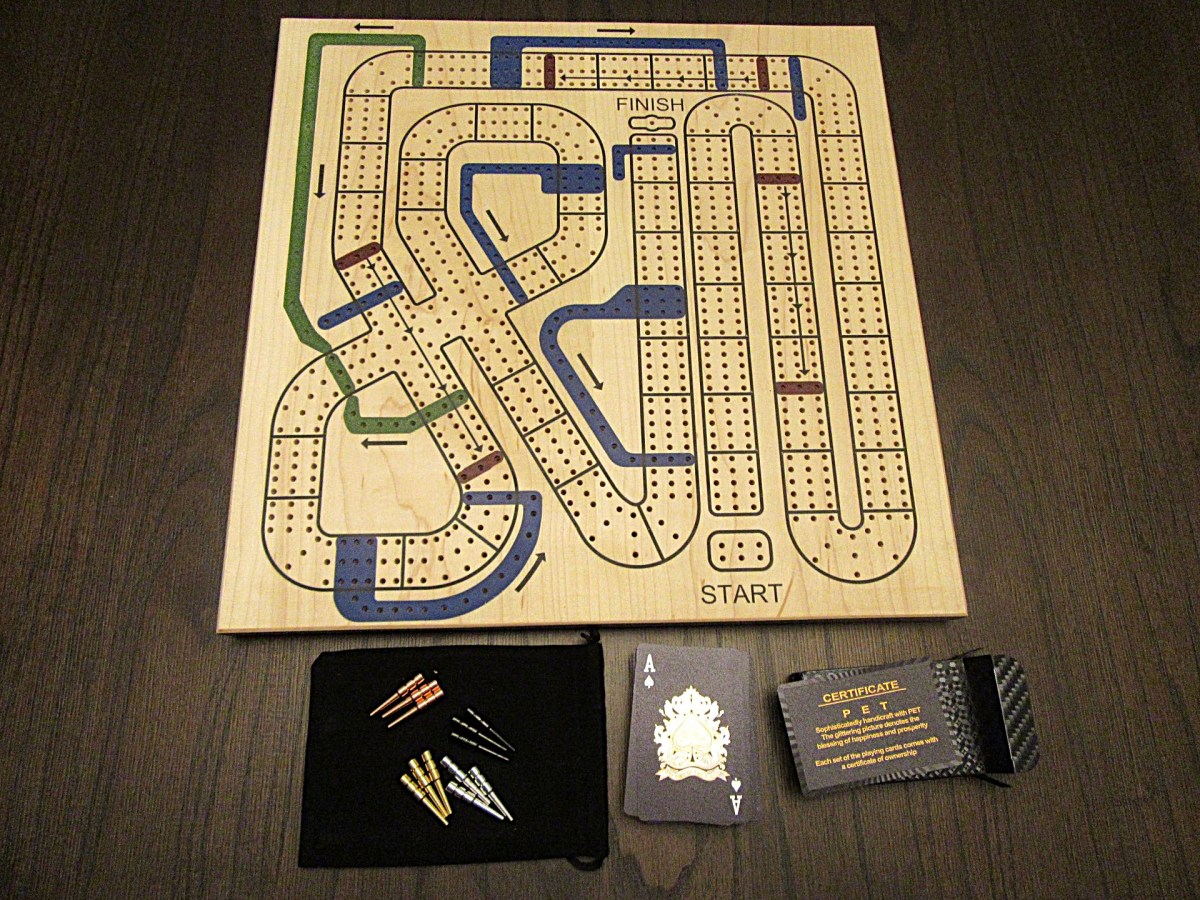
In Crib Wars, pegging backwards is a penalty associated with specific locations on a specialized, longer game board (363 holes instead of 121). The rules are a variation of the game “Snakes and Ladders”.
- Penalty Boxes (Blue): If a player lands exactly on a blue penalty box space via pegging or hand count, they are penalized. In a two-player game, the penalized player moves back 20 holes, and their opponent moves forward 20 holes.
- Time Traps (Blue Paths): Landing on a blue time trap space forces a player to follow a designated backward path on the board, losing many spaces. The peg literally moves backward along the blue path and then rejoins the main track further back than where it entered.
Wicked Cribbage Rules for Pegging Backwards
Wicked Cribbage uses a standard cribbage board and incorporates an extra deck of “Wicked” cards (Twinklers and Luggers) that introduce random, special abilities.
- Twinkler and Lugger Cards: Pegging backwards is one of many potential effects caused by drawing and playing a specific “Wicked” card. These cards are drawn when a player reaches exactly 15 or 31 during the play phase (Twinkler) or lands on a multiple of 5 during the show phase (Lugger). The effect (e.g., “cause someone to peg backwards”) is random and dictated by the specific card drawn.
In summary, Crib Wars uses a board-based mechanic where landing on specific physical spaces triggers a forced backward movement, while Wicked Cribbage uses a card-based mechanic where a drawn action card dictates a backward movement as an effect.”
December 17, 2017) Further AI specific to Wicked Cribbage and Crib Wars:
The backward pegging methods in the game variations Wicked Cribbage and Crib Wars are generally not consistent with official American Cribbage Congress (ACC) rules. These variations introduce specific “house rules” for backward movement as core mechanics, which are not standard in ACC tournament play.
The ACC rules mandate that all scoring is done by moving the back peg ahead of the front peg, always in a forward direction along the track. While ACC rules do contain specific penalties that involve moving a player’s peg backward (such as the 15-point penalty for a false claim of game), the general method of playing backwards as a standard scoring or movement option is unique to the game variations.
Key Differences
- Standard ACC Play: The only time a player’s peg moves backward is as a penalty for a serious infraction (e.g., false claim of game, where the pegs are moved back 15 holes from the out hole). The normal method of play is strictly forward movement.
- Wicked Cribbage/Crib Wars: These games are designed as distinct variations and introduce non-standard mechanics that involve regular backward movement or penalties to move forward/backward in specific zones (like “Muggers Alley” or “Penalty Boxes”). In some “reverse cribbage” variations, the explicit goal is to avoid scoring points and force your opponent to move forward, which is the opposite of the standard game.
In summary, the backward pegging methods as a general game mechanic are a feature of the specific game variations and are not an official part of the core ACC rules for traditional cribbage.
I’d say that’s enough.





 Go Retire Psychiatrist