The University of Iowa has the latest quick facts about the flu and how to protect yourself. Now you’re in the know!
Category: University of Iowa
Food for Thought
I’m giving a shout-out to a couple of child psychiatrists, one I know only from a blog, The Good Enough Psychiatrist. The other is an assistant professor in the University of Iowa Child Psychiatry Dept. I’ve never met her.
Since Jenna gives her name in the About Me section of her blog, I’m going to call her that because it’s easier. Jenna writes many thought-provoking posts, but I really admire the one titled “Amae.”
Dr. Ashmita Banerjee, MD wrote an essay titled “The Power of Reflection and Self-Awareness.” It’s published on line in the Mental Health at Iowa section of The University of Iowa web site.
As a relatively recently retired consultation-liaison psychiatrist who is also a writer, I feel a strong connection to them. In addition to being very glad that extremely talented persons are filling the ranks of a specialty which suffers from a serious manpower shortage, I get a big kick out of reading what really smart people write.
Here’s where a geezer retired psychiatrist starts kidding around. Jenna, a fellow blogger, is used to my habit of deploying humor, admittedly often as a defense. Dr. Banerjee doesn’t know me.
What is it about these essays that reminds me of the X-Files episode “Hungry”? It’s a Monster of the Week episode from the monster’s perspective. This monster looks like a human but sucks brains out of people’s skulls. He’s conflicted about it and even sees a therapist. But in the end his dying words were, as Agent Mulder shoots him down, “I can’t be something I’m not.”
If you read Dr. Banerjee’s essay and followed one of the links, you would have caught the clue that I actually read it because I consciously substituted the word “What” for “Why” in the previous paragraph. I could have as easily asked why instead of what—but it’s less helpful in gaining self-awareness.
And I haven’t sucked anybody’s brains out of their skulls in, what, over two weeks now! Upon reflection, I’m very aware of being incorrigible. Food for thought.
Jenna’s description of the Japanese concept of the word “amae” and Dr. Banerjee’s examination of the Japanese word “kintsukuroi” fascinated me. What made both writers consider human emotions using a language which captures the nuances so deftly?
I was a first-generation college student. There was a time in my life that a path to medical school seemed impossible. At times I probably thought I was trying to be something I’m not.
I’m just grateful for the new generation.
Dr. Igor Galynker and The Suicidal Crisis Syndrome
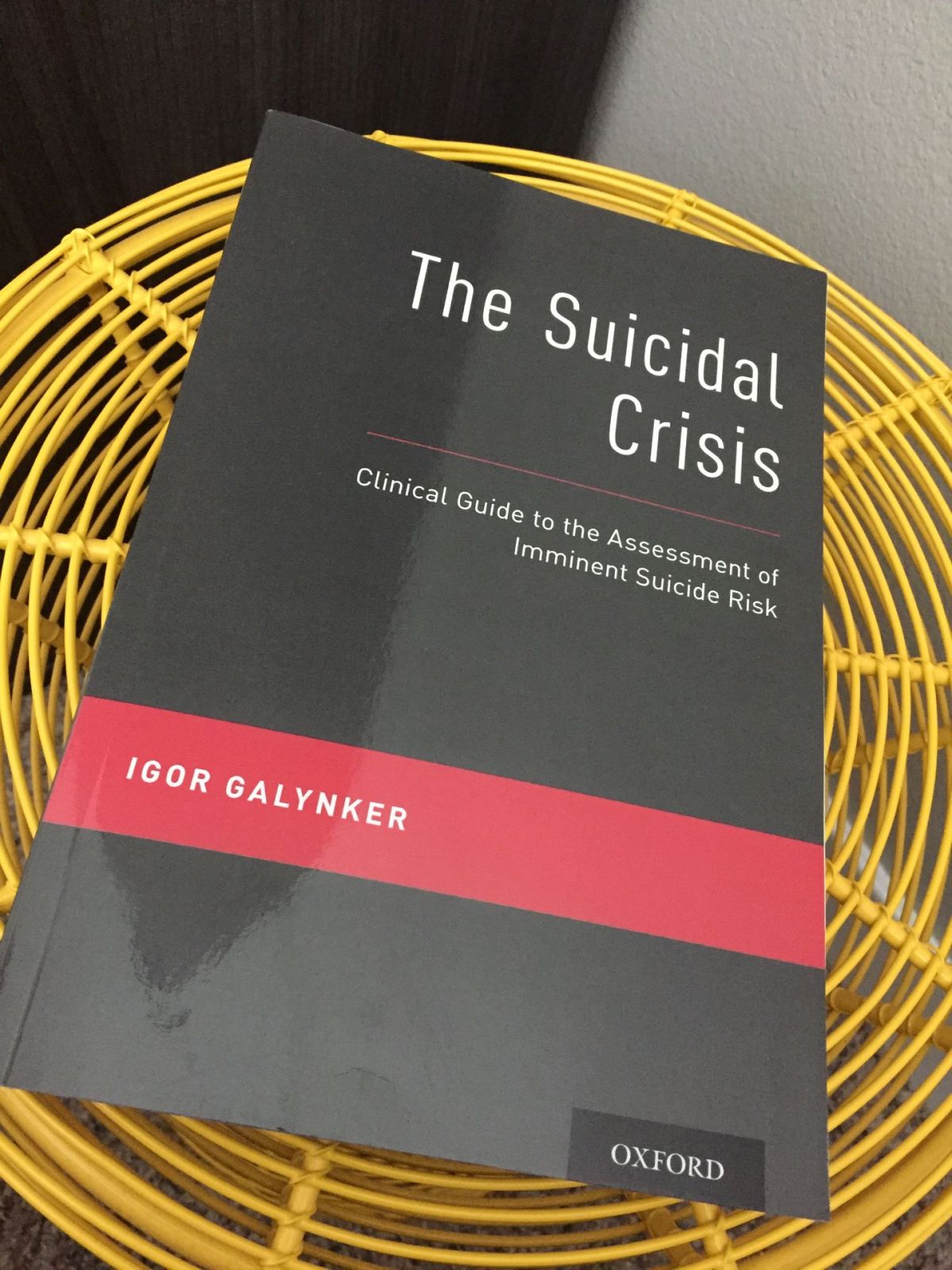
I was looking at my bookshelves and found the copy of the book, “The Suicidal Crisis: Clinical Guide to the Assessment of Imminent Suicide Risk.” It was written by Dr. Igor Galynker. It’s a fit topic for this month because September is National Suicide Prevention Month.
This brings back memories. I still have a gift from Dr. Galynker. It’s a stuffed animal called Bumpy the Bipolar Bear.

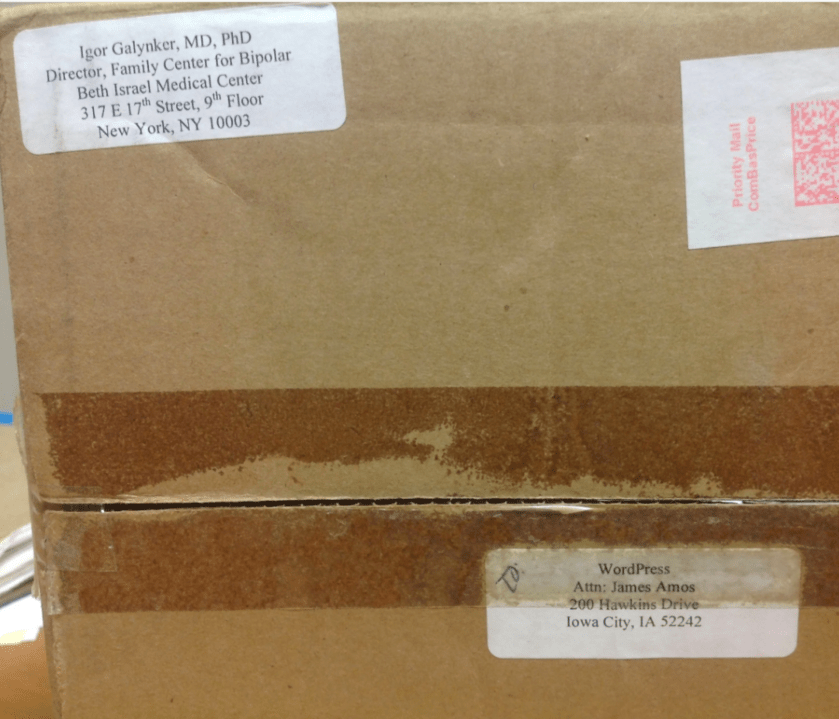
It arrived at my office at The University of Iowa Hospitals & Clinics in 2011. It was in a box addressed to:
WordPress
Attn: James Amos
200 Hawkins Drive
Iowa City, IA 52242

I’m still not entirely sure why he sent me Bumpy. There was no letter of explanation. I was writing a blog at the time called “The Practical Psychosomaticist” and I might have posted something about some research he published on suicide risk assessment.
I bought a copy of his book a few years ago. I barely had time to skim a few of the chapters because I was too busy conducting suicide risk assessments in the emergency room, the general hospital, and the clinics in my role as a psychiatric consultant. In fact, I think it’s an excellent resource.
I also found a YouTube video (posted about a month ago) in which he describes his suicide crisis syndrome assessment. You can find the actual set of questions for the assessment here and in a link posted in the description below the YouTube.
Should Doctors Be Funny?
I ran across an interesting Medscape article, “Should Doctors Be Funnier? These MDs Are Real Comedians.” I don’t know if they should be funny, but it probably wouldn’t hurt.
I think a sense of humor is a good thing for anyone to have and it’s probably not that hard to develop. There’s even a Wikihow article on how to develop a sense of humor.
I usually look for the funny edge in most things that happen to me. I was always very nervous about presenting Grand Rounds when I was on staff at the hospital. I would try to come up with a good case example illustrating both medical and psychiatric features. It was pretty challenging.
I often used humor to help me get through my stage fright. I didn’t tell jokes, but I did clown around a bit. One day, I arrived too early for the Psychiatry Dept. Grand Rounds and accidentally walked in on another scheduled event in the conference room that was obviously not for psychiatrists—only not immediately obvious to me. I got a few chuckles from the audience just from having to back out. Later, during the real Grand Rounds I clowned about my mistake as a sort of opener to my presentation.

Unfortunately, I then had to stumble through my PowerPoint slides (every presenter’s worst nightmare) because I evidently had not organized them correctly. I survived by joking about it. That resulted in a digital award from the residents for being “Improviser of the Year.”
Humor can get you through some pretty sticky situations.
Another Blast from the Past
Today is Labor Day, and I was looking at some of my old blog posts from my previous blog The Practical Psychosomaticist. I found one that I think I haven’t reposted on my current blog called “Going from Plan to Dirt.”
It’s a funny post, at least I think so. It draws a comparison between blue collar and white collar work, similar to what I did the other day (“Why Can’t I Wear Blue After Labor Day?”).

I wrote it in 2011, when I was on a hospital committee to improve detection and prevention of delirium in the general hospital.
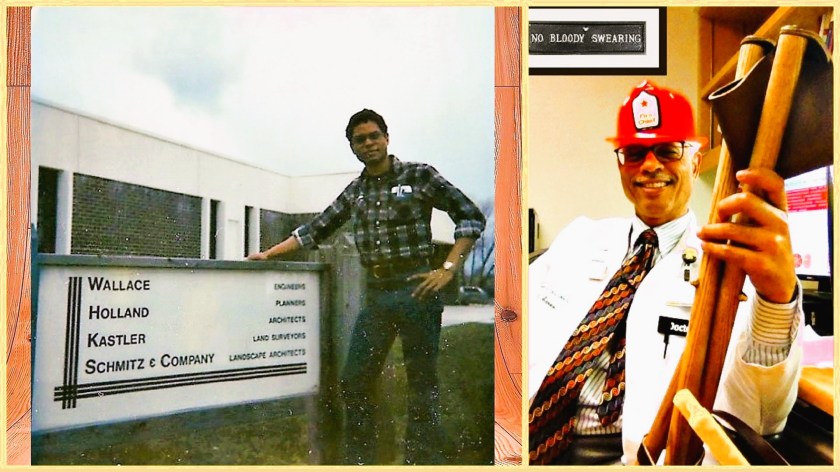
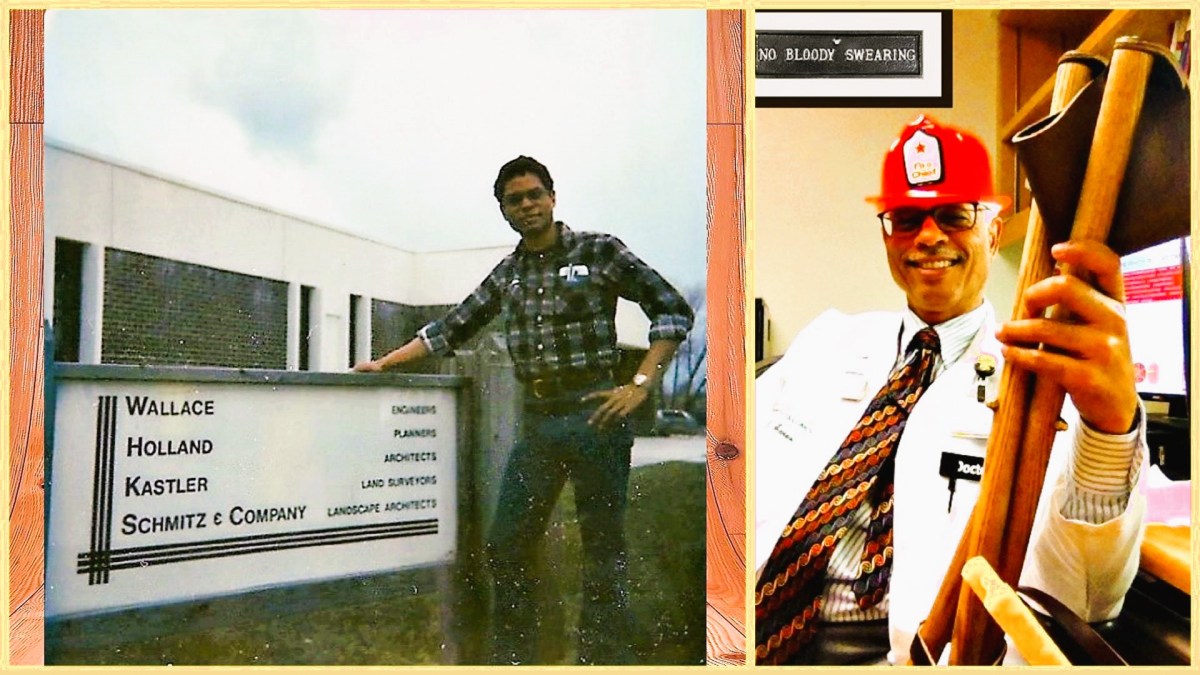
“Our work on the Delirium Early Detection and Prevention Project reminds me of my early formative experiences working as a draftsman and land survey technician starting in 1971 with an engineering company, Wallace Holland Kastler Schmitz & Co. (WHKS & Co.) in Mason City, Iowa. I remember being amazed at how a drawing on paper could be turned into a city street, highway, bridge, or airport runway. They have a website now. I can now find written there what was modeled for me then:
“WHKS & Co. is committed to the continuous improvement of the quality of service provided to our clients.”
Then and now WHKS & Co. worked hard to create the infrastructure that we depend on and then put it into the world in a “safe, functional, and sustainable” way. Out in the field we sometimes joked about how a designer’s drawing was flawed if we couldn’t go from plan to dirt.
It’s common to believe that engineers and land surveyors deal with complex mathematical formulas, structural materials, things instead of people—an applied science in which the emotions and motivations of people play a small role. Nothing could be further from the truth.
I was 16 years old when WHKS & Co. hired me. I had no idea what engineers and land surveyors did, had no experience, and I was at a crossroads in my life. They didn’t hire me because I had any talent or asset they needed. They hired me because they were as committed to the people in the community, not just to things.
And if you think land surveying doesn’t have anything to do with people’s emotions, consider property line disputes. The survey crew I was attached to had been sent out to find the property corners of two neighbors. This involves locating iron pins that mark the corners of the lots that houses sit on. Little maps or “plats” are used as guides and let me tell you, often enough we found the map is not the territory.
Anyway, while we were out there in the back yard of one of the neighbors, they both came outside. One of them was a diminutive elderly lady and the other was a tall, big-boned elderly man. They started arguing about the boundaries of their lots and it got pretty heated. Pretty soon they were yelling in each other’s faces and the lady reached down in the garden in which we were all standing. She picked up the biggest, juiciest rotten tomato she could find and it was clear to us what she planned to do with it. They were both pretty old and neither one of them could move very fast. My crew chief, sensing that something violent was about to happen, moved in between them (a decision I still can’t fathom to this day).
What followed seemed to happen in slow motion, in part because the combatants were so old. The man could see the lady was about to hurl the rotten tomato at him. Ducking must have been beyond his power, probably because of a stiff back. He bent his knees and leaned forward. She cocked the tomato as far back as she could and let fly, screeching, “You’re nothing but an old Norwegian!” My crew chief probably caught a seed or two. Amazingly, the tomato only grazed the top of the man’s head.
I think the altercation took a lot of both of them. They both went back in their houses after that.
It’s not hard for me to see the connection between my past and the present. WHKS & Co. was and still is committed to continuous improvement. And they were and still are all about finding a practical way to do it. If we’re going to improve the quality of care we provide patients and we propose to do it by preventing delirium, we’re going to have to use the same principles that my first employer used. And we’re going to have to be just as practical about how to go from plan to dirt.
We’re still trying to refine the charter for our delirium detection and prevention project, which is a kind of map, really. And even though the map is not the territory, it’s still a necessary guide to remind us of the goal.”
Why Can’t I Wear Blue After Labor Day?
I have a few thoughts on the upcoming Labor Day weekend. It occurs to me that Labor Day often evokes images of blue-collar workers. On the other hand, I think in a broader view of the holiday, most of us can think of ourselves as working toward improving our society no matter whether our jobs are in the white-collar or blue-collar sector.
Many eons ago, I was a blue-collar worker. I was a surveyor’s assistant and drafter for a consulting engineers’ company in Mason City, Wallace Holland Kastler Schmitz & Co. (WHKS & Co.). I got attached to my job because it was the first real job I ever had.
I was proud of what I did, even though I didn’t make much money. I had to travel around the state a lot. I lived at the YMCA and ate all my meals in cafes because I was often out of town on jobs and when I was not, there was no kitchen in my tiny sleeping room at the Y.
I wore blue jeans and tee shirts, flannel shirts when I wasn’t out in the hot sun. I liked being outside except when the ragweed was out in the late summer. I had bad hay fever. I tried desensitization shots, but all they did was make my arm swell up. Winters were cold, especially if I had to stand in one place for a long time, either holding up the rod or running the gun.
I was mostly a rear chain man and rod man early on, but moved up to “running the gun” which meant operating the level and theodolite, the former for measuring elevations and the latter for measuring angles. I was proud of my job.
It took me a while to transition from blue-collar to white-collar mindset. In college, I often returned to work for WHKS during the summer breaks. That was where I formed my identity.
Some aspects of the job were simple. You hammered a stake, an iron property marker, or a frost pin if the ground was frozen. Measuring distances, angles, and elevations were often repetitive tasks, yet satisfying because they marked progress toward a concrete goal, like building an airport runway, establishing the outline of a tract of farmland, or raising a bridge. As one of my bosses on the survey crew put it, the work helped you see “the lay of the land.”
Land surveying, mapping, and drawing up plans set my perspective on life when I was a young man. At one time, that perspective made me think I wanted to be an engineer. I respected engineers because they built the subdivisions, highways, dams, and other real things from ideas.
I respected my teachers at WHKS, but couldn’t do the math. And they respected my change of heart.
I eventually became a doctor, after a short stint as a medical technologist in clinical laboratory medicine. You’d think, given my hands-on background, I would have become a surgeon, but I wasn’t made for that either.
I learned basic things at WHKS like being steady, reliable, and focused. I had to learn other things to be a doctor, especially a psychiatrist. On the other hand, in this white-collar environment, especially in a research-oriented academic medical center, I often looked and acted more like a blue-collar worker.
One of the Family Medicine residents who rotated on the psychiatry consultation-liaison service left me a gift of a fireman’s helmet. It fit my head and my approach to psychiatry in the general hospital. What I did mostly was put out the fires, metaphorically speaking, of behavioral eruptions related to delirium which were caused by medical problems. Often, I had to apply blue-collar approaches in a white-collar world. So, can I wear blue after Labor Day?
Happy Labor Day.
The Thing About Identity
I was searching on the web for something about my co-editor, Robert G. Robinson, MD, for our book Psychosomatic Medicine: An Introduction to Consultation-Liaison Psychiatry, published in 2010.
The reason I was searching for something about him was that I’ve had difficulties finding anything on the web lately about doctors I had worked with years ago and admired—and the search revealed they had died. It has been a little jarring and got me thinking about my own mortality.
My search didn’t turn up any obituary about Dr. Robinson, but I found a couple of interesting items. One of them is, of all things, a WordPress blog item, the About section. It’s dated April 2012. I’ve seen it before. It’s supposedly about a person named Dr. Robert G. Robinson, MD and the only thing on it is his name and affiliation with The University of Iowa Carver College of Medicine. Every WordPress blog has an About section. I have one and I’ve been blogging since 2010.
There’s no entry in the About section for him on WordPress. However, there was another item on the web that looked like it was a blog (It’s another blogging site called About.me), and it was labeled as an About section. It was a biographical summary of his academic and scientific career. Of course, it was impressive. At first, it looked like he was planning to write a blog, which could have been very educational because he’s an extremely accomplished psychiatrist with a very long bibliography of published articles about psychiatric research, a lot of it about post-stroke syndromes.
But when I looked at the social media links on the WordPress page, it led to a picture of someone who is definitely not the Robinson I know. This person was a “Certified Rolfer.” Remember Rolfing? It’s a form of deep tissue massage developed in the 1970s. The Dr. Robinson I know was never involved in Rolfing.
I’m not sure what happened with the WordPress and other blog items, but it looked the WordPress section was a case of mistaken identity. The most recent genuine item on the web about him is a 2017 University of Iowa article about his receiving the Distinguished Mentor Award.
I hope somebody doesn’t get confused by that WordPress mistake.
Then, I happened to come across an article that, at first, I didn’t recognize. The link on the search page listed Dr. Robinson’s name. It’s on the Arnold P. Gold Foundation website for humanism in medicine. The title is “Are doctors rude? An Insider’s View.” It didn’t have my byline under it. It took me a minute, but I soon recognized that I wrote it in 2013. At the bottom of the page, I was identified as the author.
At first, I thought it was a mistake; there was a place for an icon that at one time had probably contained a photo of me, but it was missing. It’s my reflection about a Johns Hopkins study finding that medical interns were not doing basic things like introducing themselves to patients and sitting down with them.
This was not a case of mistaken identity. But I got a little worried about my memory for a few seconds.
Anyway, I was reminded of my tendency to have trainees find a chair for me so I could sit down with patients in their hospital rooms. I later got a camp stool as a gift from one of my colleagues on the Palliative Care consult service. It was handy, but one of my legs always got numb if I sat too long on it. It broke once and I landed flat on my fundament one time in front of a patient, family, and my trainees. The patient was mute and we had been asked to evaluate for a neuropsychiatric syndrome called catatonia. The evidence against it was the clear grin on the patient’s face after my comical pratfall—and because of the laughter that we could see but not hear.
One of the points of this anecdote is that it’s prudent to be skeptical about what you see on the internet. The other point is that parts of your identity can hang around on the web for a really long time, so it’s prudent to be skeptical about how permanent your current identity is.
Remembrance of Dr. William R. Yates MD
I was thinking about the Clinical Problems in Consultation Psychiatry (CPCP) learning sessions which was introduced to me by one of my first teachers in the University of Iowa Dept of Psychiatry, Dr. William R. (Bill) Yates.
I had originally been thinking of posting one of my own CPCPs that I presented in 2015. It was about the psychosocial adjustment of patients to ostomy.
I searched widely and in vain on the web for any recent information about what Dr. Yates was doing now. I was surprised and saddened to discover his obituary. He died on January 19, 2023 in Tulsa, Oklahoma.
As the obituary says:
He served on the faculty at the University of Iowa for Psychiatry and Family Medicine before becoming Professor and Chair of Psychiatry at the University of Oklahoma College of Medicine in Tulsa. After retiring, he continued to dedicate his time as a volunteer research psychiatrist at OU and the Laureate Institute for Brain Research where he also served on the board of directors. He authored over 100 scientific manuscripts that were published in peer-reviewed journals.
He was an energetic, a great teacher, had a great sense of humor, and was easy to get along with. He published in many scientific journals and taught many trainees. He was an avid bird watcher and his blog Brain Posts highlighting neuroscience research findings is still visible on the web.
He published the paper along with a chief resident on problem-based learning used on the psychiatry consult-liaison service in 1996, the year I graduated psychiatry residency and joined the faculty at The University of Iowa Hospitals & Clinics (Yates, W. R. and T. T. Gerdes (1996). “Problem-based learning in consultation psychiatry.” Gen Hosp Psychiatry 18(3): 139-144.) You can read the abstract for it along with a description of the CPCP at the link above which takes you to my April 19, 2019 blog post “Clinical Problems in Consultation Psychiatry.”
When he was the leader of the psychiatry consult service, we were still using paper charts and his staffing comments were always very brief and encapsulated the assessment and plan succinctly without wasted verbiage—contrasting with my long-winded note.
His remarks about his role at Laureate Institute for Brain Research is still accessible:
“I work part-time as a research psychiatrist for the assessment team at the Laureate Institute for Brain Research. We do research diagnostic assessments for a variety of imaging, genetic and biomarkers studies in mood, anxiety and other brain disorders. I also provide review and analysis of neuroscience research on my blog Brain Posts that can be found at www.brainposts.blogspot.com. You can follow me on Twitter @WRY999. I also use my blog and Twitter feed to share my bird photography images.”
I respected and admired Dr. Yates, as I’m sure many learners did. I will always remember Bill as a gifted scientist and teacher.
I think a fitting tribute would be to go ahead and post my CPCP on the psychosocial adjustment of patients with ostomy. One of the most interesting articles in the bibliography is how the mindfulness meditation approach to that adjustment can be very helpful. The website United Ostomy Association of America website is also informative.
The presentation is also limited to a dozen slides. I often encouraged learners to keep the number of slides to a managed number so the presentations wouldn’t run too long. I called my slide sets the Dirty Dozens.
Many thanks to Dr. William R. Yates and my condolences to his family.