The upcoming meeting on the MMVR and Covid-19 vaccines will include voting on the MMVR and Covid-19 vaccines. Usually, the committee posts the actual voting questions, which so far I have not seen on the meeting agenda. I’ll be looking for them in the next couple of days.
Here is the linkto the Center for Infectious Disease and Policy (CIDRAP) at the University of Minnesota article which bears directly on the meeting topics.
I just noticed that the CDC ACIP draft agenda for upcoming meeting on September 18th and 19th has been posted. There will be votes on the MMRV, Hepatitis B, and Covid-19 vaccines.
Sena pointed out a swallowtail butterfly fluttering around the lantana in our backyard garden yesterday. The lantana is great for attracting butterflies and hummingbirds because it has bright flowers and sweet nectar.
At first, I didn’t think it was unusual but I got video anyway. When I looked at it, I eventually noticed that the butterfly (which admittedly might be a different species) was lacking either one or both of the tips on its hindwings. For comparison, I checked a video clip of a swallowtail Sena shot when we were out on the Terry Trueblood walking trail a couple of weeks ago. The videos are obviously not the same quality. I shot the one yesterday through a window.
Sure enough, that swallowtail on the Terry Trueblood trail had impressive hindwing tips. I wondered what was so different about the tips on the one we saw yesterday. Not all swallowtails have tips and maybe the tips are smaller or only faintly visible on some species.
It turns out that the wing tips are probably a piece of butterfly anatomy that can be easily sacrificed when bird predators try to eat the butterflies. This is similar to some lizards whose tails can be sacrificed to predators for the same reason. Maybe the wing tips distract birds from attacking the central body parts. Anyway, I found an article about it on the web.
The article cites a study published in the May 2022 issue of the Proceedings of the Royal Society B that seemed to back up the idea that the tips might be an escape tactic. In the article, you can even see a video of bird preferentially targeting the sacrificial tips.
In our video, you can just barely make out either a transparent vestige of one of the tips or maybe there are two barely visible tips on the swallowtail in our garden. I saw a Facebook entry photo showing that females tend to be larger and have more prominent bluish coloring and males tend to be smaller and have more yellowish markings (interestingly, the male in that photo seems to be missing the right hindwing tip). Maybe we’re seeing a female in the video from 2 weeks ago and a male in yesterday’s video, only the male in that picture seems to have obvious hindwing tips, though they are smaller. I don’t know if anyone could help us sort this out.
How about some good news? This just in, University of Iowa Physician-Scientist, Dr. Michael Welsh, wins the 2025 Lasker Award for his research on cystic fibrosis.
His work and the work of two other researchers with whom he’ll share the award set the stage for the development of new drugs which saves the lives of those who suffer from cystic fibrosis.
I learned from the article that the cystic fibrosis gene was discovered in 1989; I was a second-year medical student then. Since then, the development of new treatments has meant that many people who died in early adulthood now can live into their 80s.
Join Dr. Clancy, Dr. Appenheimer & Dr. Barker as they discuss prevention, diagnosis and treatment of various tick-borne illnesses. CME Credit Available: https://uiowa.cloud-cme.com/course/courseoverview?eid=82296 Host: Gerard Clancy, MD Senior Associate Dean for External Affairs Professor of Psychiatry and Emergency Medicine University of Iowa Carver College of Medicine Guests: Ben Appenheimer, MD Clinical Associate Professor of Internal Medicine-Infectious Diseases Assistant Director, Infectious Diseases Fellowship Program Associate Clinical Director, Infectious Diseases Co-Medical Director, TelePrEP, University of Iowa Health Care University of Iowa Carver College of Medicine Jason Barker, MD Associate Professor of Internal Medicine-Infectious Diseases University of Iowa Carver College of Medicine Financial Disclosures: Dr. Gerard Clancy, his guests, and Rounding@IOWA planning committee members have disclosed no relevant financial relationships. Nurse: The University of Iowa Roy J. and Lucille A. Carver College of Medicine designates this activity for a maximum of 1.0 ANCC contact hour. Pharmacist and Pharmacy Tech: The University of Iowa Roy J. and Lucille A. Carver College of Medicine designates this knowledge-based activity for a maximum of 1.0 ACPE contact hours. Credit will be uploaded to the NABP CPE Monitor within 60 days after the activity completion. Pharmacists must provide their NABP ID and DOB (MMDD) to receive credit. JA0000310-0000-26-038-H01 Physician: The University of Iowa Roy J. and Lucille A. Carver College of Medicine designates this enduring material for a maximum of 1.0 AMA PRA Category 1 CreditTM. Physicians should claim only the credit commensurate with the extent of their participation in the activity. Other Health Care Providers: A certificate of completion will be available after successful completion of the course. (It is the responsibility of licensees to determine if this continuing education activity meets the requirements of their professional licensure board.)
This is a fascinating topic and the discussion ran for close to an hour, which is longer than usual because there’s a lot to say about it. The substances include a lot of chemicals that are not illegal and, in some cases, easily available in convenience stores and gas stations. In fact, the name for one of them is gas station heroin, which is tianeptine, approved in other countries as an antidepressant.
The discussion also included substantial information (or maybe better said, lack of enough information) about bath salts (usually cathinones), kratom, and something I’ve never even heard of: diamond shruumz (chocolate bars which can contain various substances not limited to psilocin). Remember that guy who chewed the face off of somebody in Miami in 2012? That was attributed to intoxication with bath salts.
This is way beyond the 1970s stuff like window pane or blotter (LSD) and pot. Many people end up in emergency rooms for evaluation of what looks like poisoning from multiple drugs. The stickler is the possibility that they got poisoned from something bought at a convenience store. Often it’s difficult to tell what the person ingested.
One of the takeaways from this podcast is that, whenever possible, try to get a history from the patient. They might just tell you what you need to know.
Sena went over to ForeverGreen, a popular landscaping and garden center locally, to see the butterfly house. She got pictures and video clips which showed the monarch butterfly management operation they have. They have quite a conservation program, including a large monarch butterfly house enclosure along with demos of life cycle stages. The butterfly house is just part of the deal and it’s open to the public. It opened in June of this year and runs until September 14th. The schedule shows there’ll be a big release then and possibly even tagging prior to that. You might want to call ahead and check to see if they’re still going to tag the monarchs.
I think this is also a good way to rehabilitate Bigfoot’s image because they could be sort of like ranch hands tending to the monarch as they go through their life cycle. The monarchs migrate to Mexico every fall. You can learn more about the monarch watch program and why many people believe the monarchs are at risk of extinction.
As I announced yesterday, we put together a short YouTube video on the tagged monarch butterfly we saw yesterday at Terry Trueblood Recreation Area, with the help of another guy who pointed it out to us. This was a lot of fun because we didn’t know anything about the monarch tagging project.
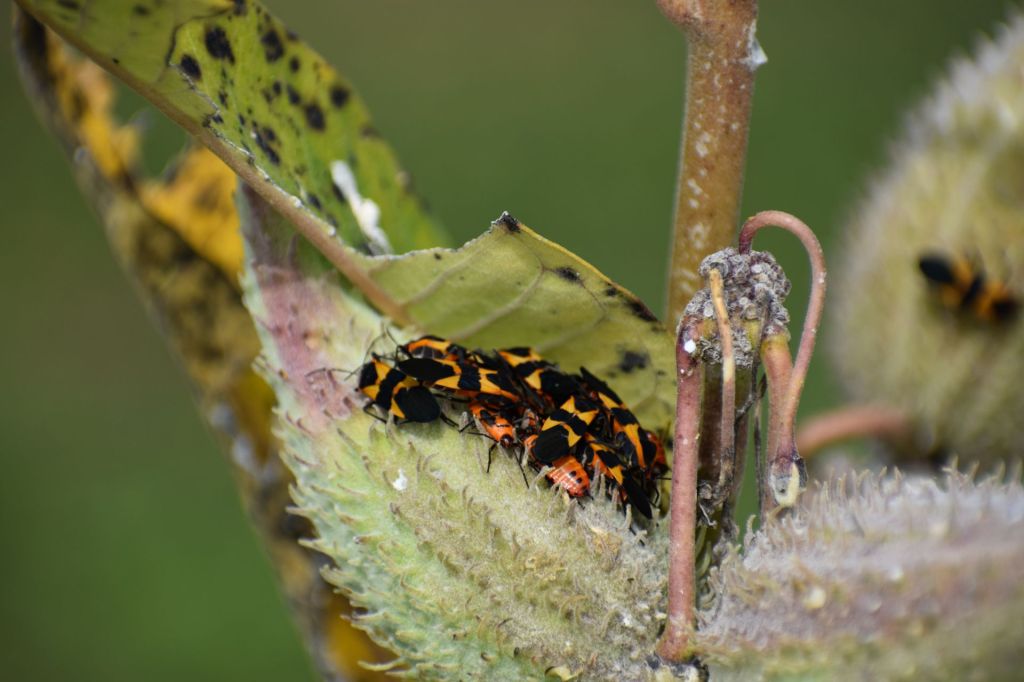
The tagging project is just one part of a comprehensive educational and research program. One interesting section on bugs that feed on milkweed talks about milkweed beetles, but I didn’t find anything about milkweed bugs until I checked another site. It sounds like splitting hairs, but they’re not the same insect although they both feed on the milkweed, which the monarch larvae eat.
I got a photo of the milkweed bugs. Although the pile of them on the milkweed look like two different insects, the smaller ones are just younger versions of the same bug. I don’t think there were milkweed beetles on the milkweed plant I saw.
The other interesting thing is how to tell male from female monarchs. I’m not confident I can do that, although there is a video I posted yesterday (made by the Monarch Watch team) which tells you how to distinguish them.
We think the tagged monarch we saw might be a male, but I wouldn’t bet on it. We saw another monarch (which is featured in the video) which could be a female.
There is a fall open house at Kansas University West Campus in Lawrence, Kansas on Saturday, September 13, 2025.
We’re both pretty excited today because we found a tagged monarch butterfly with a guy’s help out on the Terry Trueblood Trail. We saw quite a few monarch butterflies around the flowers and saw a man spending a lot of time getting a video of one of them with his smartphone. Sena remarked about how nice all the flowers were and he pointed to the butterfly and said it was tagged.
We had no idea what he meant until after we filmed the butterfly and saw this tag with numbers and letters printed on its wing. Sena got a really good shot of it and we were able to read the code.
Then we discovered the website for tracking monarch butterflies.
You can actually report the tagged butterfly to MonarchWatch.Org. We had never heard of the Monarch Watch Tagging Program, which got started in 1992 to track the monarch’s migration pattern.
We’re not certain of the sex of the monarch we saw today (which is part of the reporting process), but that’s OK. We can just enter “Unknown.” On the other hand, you can find instructions on line. We plan to make a video of our walk tomorrow with the monarch as the star, but I wanted to give you a heads up about the most exciting part of it today.
I’ve been checking the Centers for Advisory Committee schedule on their website for weeks and the only way I found out there is an upcoming meeting is on the Federal Register schedule. Sena found it in a news outlet story. As of this morning around 9 a.m., there was no announcement on the CDC website yet. That may change later today.
According to the Federal Register, the CDC ACIP will hold a meeting on September 18, 2025, from 10 a.m. to 5 p.m., EDT, and September 19, 2025, from 8 a.m. to 4 p.m., EDT.
Under Supplementary Information:
“The agenda will include discussions on COVID-19 vaccines; Hepatitis B vaccine; measles, mumps, rubella, varicella (MMRV) vaccine; and Respiratory Syncytial Virus (RSV). The agenda will include updates on ACIP Workgroups. Recommendation votes may be scheduled for COVID-19 vaccines, Hepatitis B vaccine, MMRV vaccine, and RSV. Vaccines for Children (VFC) may be scheduled for COVID-19 vaccines, Hepatitis B vaccine, MMRV vaccine, and RSV. Agenda items are subject to change as priorities dictate. For more information on the meeting agenda, visit https://www.cdc.gov/acip/meetings/index.html.”
However, I also noticed a news article posted by the Center for Infectious Disease Research and Policy (CIDRAP) indicating that the meeting might be postponed because of the recent upheaval around vaccine policy and personnel.
This meeting’s actual timing and schedule items could be moving targets.

The Svengoolie show last night was the 1957 Hammer production “The Curse of Frankenstein” starring the 3 stooges. Actually, this film was no laughing matter and this was my first time (and last time) seeing it.
That’s not saying it’s a “bad” movie. It’s just tough to come up with anything comical to say about a gothic horror flick that was inspired by Mary Shelley’s novel, “Frankenstein; or, The Modern Prometheus.”
I’ve not read Mary Shelley’s novel and I only skimmed the Encyclopedia Britannica entry. That’s good enough for an old guy pretending to be a movie reviewer.
What hooked me, though, early on the film was a short dialogue between Paul Krempe (Robert Urquhart) and Elizabeth Lavensa (Hazel Court). Paul describes Victor Frankenstein (Peter Cushing) in contemptible and scary terms, to which Elizabeth reacts by saying that Victor is either “wicked or insane.” Paul answers that Victor is neither—which struck me as odd.
I would have no trouble saying Victor is evil, but what do I know? On the other hand, I ran across a couple of web articles that mentioned “psychopath” as a suitable label for someone who thinks nothing of pushing an old man like the scientific scholar Professor Bernstein (Paul Hardtmuth) over a banister to kill him in order to dig his brain out of his skull to insert into a do-it-yourself hodgepodge of spare body parts in an experiment to create a living being.
Victor, from the time he first meets Paul, presents as an insufferable, entitled brat lacking a conscience and by the time he reaches adulthood he’s the perfect example of someone with the most creepily severe case of antisocial personality disorder (ASPD) imaginable.
He gets the housekeeper Justine (Valerie Gaunt) pregnant, tricks her into entering the laboratory where the monster (Christopher Lee) kills her, marries Elizabeth and then abandons her on their wedding night in order to cheat in a cribbage game with the monster.
He pretends to bury the monster in the woods after Paul kills it by shooting it in the eye with an AK-47—then sneaks back to dig it up, carry it back to the lab and reanimates the wreck. He proudly shows it off to Paul, who throws up on him. This makes no difference to Victor who is always smeared with dirt anyway because he hangs out in morgues, graveyards, and golf courses (“as he approaches this critical putt, somebody leaps out and cuts off his feet”), filching eyes, hands, Adams apples and what have you to assemble and repair the monster.
There are big differences between Shelley’s monster and Hammer’s creature—the latter doesn’t speak at all while the former is eloquent. Hammer’s creature can barely stand up or sit down on command while Shelley’s monster can do triple axels skating across the Arctic ice as Victor pursues him.
During the movie, my mind often wandered off to memories of Mel Brooks’ “Young Frankenstein.”