I saw a couple of web resources about staying healthy and fit that seem to make sense to me. One of them was actually a YouTube video by a personal trainer advising people to stop doing certain kinds of workouts that could be unhealthy. He recommended avoiding certain kinds of weight lifting exercises, especially for those over 40. I’m way over 40 and I agreed with him.
The video was posted about 2 months ago and there are so far 725,000 view and well over 2,000 comments, both for and against the trainer’s advice. Many of the older commenters disagreed with slowing down after the age of 40.
I’m 70 and I’m a minimalist when it comes to exercising. I’ve slowed down from daily exercise, but I still enjoy juggling, riding an exercise bicycle, limited use of dumbbells, body weight squats, a step platform routine, planks, stretching and wrestling grizzly bears. I occasionally go for walks when the weather permits.
I remember trying to lift really old barbells in the free weight room at the YMCA when I was a kid. I dropped them once and the director directed me out of the room. After they got a weight machine, a guy bet me and a friend a dollar that he could jump over a broom handle (in another variant of this stunt you try to jump over a dollar bill, I think) while bent over and grasping his toes. He did it but we couldn’t. We didn’t pay him any money. I still can’t do that trick. Nobody recommends doing this as a regular fitness exercise.
On the other hand, patient YMCA teachers taught me how to swim and helped me get over my severe headaches related to my initial fear of the water.
The other web source is an article that actually recommends we stop focusing on working out. In fact, the title is “Stop focusing on working out”—a professor says you should follow these five science-backed steps to improve your wellness instead.”
There are so far no comments on it. The authors have five suggestions:
Make movement fun
Be socially active
Use mindfulness as a stress buster
Be kind to yourself and others
Prioritize quality sleep
The last one usually is difficult for me. Ever since kindergarten, when the teacher wanted the class to take a nap, I’ve had trouble sleeping. The teacher never understood that. I also tend to be shy. I like playing cribbage, though my wife is my only partner. I still practice mindfulness meditation. Juggling is a fun movement activity and it’s also beneficial exercise.
I think it might be a little safer to try to jump over a dollar bill while squatting and grabbing your toes than squatting with barbells if you’re 70. You’re welcome. That’ll be one dollar, please.
I’ve been reading about artificial intelligence (AI) in general and its healthcare applications. I tried searching the web in general about it and got the message: “An AI Overview is not available for this search.”
I’m ambivalent about that message. There are a couple of web articles, one of which I read twice in its entirety, “Are we living in a golden age of stupidity?” The other, “AI, Health, and Health Care Today and Tomorrow: The JAMA Summit Report on Artificial Intelligence”was so long and diffuse I got impatient and tried to skip to the bottom line—but the article was a bottomless pit. The conflict-of-interest disclosures section was overwhelmingly massive. Was that part of the reason I felt like I had fallen down the rabbit hole?
I recently signed an addendum to my book contract for my consult psychiatry handbook (published in 2010, for heaven’s sake) which I hope will ultimately protect the work from AI plagiarism. I have no idea whether it can. I delayed signing it for months, probably because I didn’t want to have anything to do with AI at all. I couldn’t discuss the contract addendum with my co-editor Dr. Robert G. Robinson MD about the contract addendum because he died on December 25, 2024.
I found out today the book is old enough to find on the Internet Archive as of a couple of years ago. One notice about it says “Borrow Unavailable” and another notice says “Book available to patrons with print disabilities.”
All I know is that an “archivist” uploaded it. The introduction and first chapter “The consultation process” is available for free on line in pdf format. I didn’t know that until today either.
Way back in 2010 we didn’t use anything you could call AI when we wrote the chapters for the book. I didn’t even dictate my chapters because the only thing available to use would have been a voice dictation software called Dragon Naturally Speaking. It was notorious for transcribing my dictations for clinic notes and inserting so many errors in them that some clinicians added an addendum warning the reader that notes were transcribed using voice dictation software—implying the author was less than fully responsible for the contents. That was because the mistakes often appeared after we signed off on them as finished, which sent them to the patient’s medical record.
Sometimes I think that was the forerunner of the confabulations of modern-day AI, which are often called hallucinations.
Now AI is creating the clinic notes. It cuts down on the pajama time contributing to clinician burnout although it’s not always clear who’s ultimately responsible for quality control. Who’s in charge of regulatory oversight of AI? What are we talking about?
We watched the Svengoolie show 1958 movie “The Fly” last night and Sena says she’s seen it before. I can’t remember seeing the full movie, but for some reason the final scenes when the tiny creature in a tiny voice keeps screaming “Help me!” sounds familiar. I don’t know why I would “remember” only that scene.
That brings up something Sena alerted me to and which I’ve mentioned before in an oblique reference to the non-review I did of the Svengoolie movie, “Young Frankenstein” a week ago. It’s the Mandela Effect.
Some trivia about “The Fly” included the Mandela Effect about whether it was made in black and white—which didn’t happen. It was made in color. But many believe it was made in black and white.
Anyway, as a guy who writes parodic reviews, I can say that I have a couple of issues about this film directed by Kurt Neumann and starting Vincent Price (Francois Delambre), David Hedison (Andre Delambre), Patricia Owens (Helene Delambre), Charles Herbert (Phillipe Delambre), Herbert Marshall (Inspector Charas) and a white-headed fly as himself.
Andre is a dedicated scientist who develops the early version of the Star Trek transporter for which he gets no credit and his brother, Francois, who secretly loves his brother’s wife, Helene, eventually tricks her by lying about having the white headed fly locked in his desk drawer next to his shaving kit, convincing her to tell him the whole story about how and why Andre can apparently see just fine to use a typewriter, write on a black board and operate all the knobs and dials in his lab despite wearing a black beach towel draped over his head, which essentially makes this movie a very long flashback about the original theft of the x-ray vision technique from Superman, who already had a patent on it for about 20 years.
That’s one thing I don’t get about this film. Flies have compound eyes, but they don’t see in the dark any better than humans do, partly because they’re not related to bats who use sonar to guide them in dark caves where they zero in on your hair because you’re fool enough to blunder into the Bat Cave in order to find out just how Alfred keeps Bruce Wayne’s suits so nicely pressed.
Another thing that “bugs” me (Har! See what I did there?) is why do I not remember seeing Andre ever talking to his son, Phillipe. Is that some other variant of the Mandela Effect, only, of course, if my experience is similar to that of anyone else who has seen this movie? I know I didn’t fall asleep during the movie and miss the scenes of heartfelt interactions between father and son. Phillipe and his mother get along just fine and discuss the finer points of capturing white headed flies with Zagnut bars, which Beetlejuice described in the materials and methods section of his article published in the Lancet some time ago.
Svengoolie mentioned something pretty funny about the only scene which I seem to remember, which is the white-headed fly (which is you know who!) incessantly screaming “Help me deepen my voice so that Herbert Marshall and Vincent Price won’t bust out laughing at me!”
I think this movie is OK, and I give it a shrilling chicken rating of 4/5.
Svengoolie Intro: “Calling all stations! Clear the air lanes! Clear all air lanes for the big broadcast!”
We got the 1958 classic bug flick “The Fly” with Vincent Price coming up this Saturday and boy can I wait…no, sorry, I mean I can’t wait. I’ve never seen this particular film, but I did see the one made in 1986 in which Jeff Goldblum played the fly and developed superhuman strength, busting a man’s arm in a wrist wrestling match.
Until now, the insects we’ve seen on the Svengoolie show have been atomic bomb testing created giant insects like spiders and ants. Now we get to see a dead guy who survived the black plague, went to Harvard Business School and Julliard, and saw the Exorcist 167 times trick a giant fly by tempting it with a Zagnut bar, and drag it into his dining room where he has built the well-known transporter room with only limited help from chief engineer Scotty and also they’ve modified it to rearrange the atoms of creatures including humans and extraterrestrial giraffes, enabling them to prevail in stomping combat with the army of the planet of the apes who are just looking for a decent banana split for crying out loud and…well, that’s probably not how this movie goes, but I’m not in charge here.
The title of this post might sound familiar to those who have seen the movie Men in Black way too many times, like me. There’s a trailer poster from the 1997 MIB movie showing Agents J and K holding huge space guns and the title is “Protecting the Earth from the Scum of the Universe.”
There are reasons to invert the title; all you have to do is read the news headlines. And one of them is on a story posted in the Guardian entitled ‘Bored aliens’: has intelligent life stopped bothering trying to contact Earth?
Whoa! When exactly did they start?
In a nutshell, the author is citing an astrophysicist’s notion that we should consider embracing a novel idea called “radical mundanity” which in this context says that maybe extraterrestrials are not much smarter than earthlings. That could be one explanation why nobody has seen what the majority of humans would call clear and convincing evidence that advanced civilizations exist out in the galaxy.
I guess “clear and convincing evidence” means ETs should be walking up to us and asking for directions to the nearest good rib joint.
I guess terms like “radical mundanity” and “radical empathy” are in vogue because radical rationalization is an old earthling habit that fathered both.
In fact, common sense suggests that something like radical practicality might explain one pretty funny quote from MIB. It’s the one in which Agent K is demonstrating the universal translator to the soon to be Agent J and confides that earthlings are not supposed to have it, and then goes on to explain why:
“Human thought is so primitive it’s looked upon as an infectious disease in some of the better galaxies. That kind of makes you proud, doesn’t it?”
Interesting why Agent K says that the low opinion some ETs have of humans is something to be proud of. Maybe that because of radical admiration, which is what we often have for slick villains clever enough to steal something like the universal translator—since radical criminality is so rampant everywhere on earth.
That would pretty much be the end of this line of thought (if I had any sense). But if you reason that most ETs would be leery of earthlings, why would so many of them travel to this planet? Part of the answer (of course) is in MIB. It’s Agent K’s explanation for why so many of them do.
Agent K: “Back in the mid-1950s the government started a little, underfunded agency with the simple and laughable purpose of establishing contact with a race not of this planet… They were a group of intergalactic refugees wanting to use the earth as an apolitical zone for…creatures without a planet. Did you ever see the movie Casablanca?”
“Today there are approximately 1500 aliens living and working Manhattan and most of them are decent enough; they’re just trying to make a living.”
OK, that’s only part of the story, maybe mostly the radical empathy part. Getting back to radical mundanity, which is how we got started on this crooked tale, where does this put earthlings and ETs? Maybe we’re headed toward realizing that every bright dot in the sky is not evidence for visitors from somewhere out in the galaxy or beyond. Maybe trying to get to Mars is not such a hot idea. Maybe we can try to get along with each other on earth without waiting for ETs to stop us from slaughtering each other. I don’t know as much about this approach as I should, but I think it’s called radical acceptance.
OK, so because I didn’t want to miss the Iowa vs Wisconsin football game (Hawkeyes won 37-0!), I watched the hit science fiction movie, “Them!” on the Internet Archive.
This is a 1954 film directed by Gordon Douglas and which won an Oscar for best special effects! At the time, creature effects must have been considered pretty special.
I thought this film was great! I thought I would be bored, but there were a lot of reasons to enjoy it. We recognized a few actors who later became big stars. I’m not going to openly spill the beans, but I can give you a few hints. One of them is now immortalized as part of an exhibit called the Voyage Home Museum in Riverside, Iowa, which is a short drive from Iowa City. Another later became known as king of the wild frontier. Yet a third couldn’t stop telling certain persons to “Get outta Dodge!”
I guess I have to tell you that the third guy was James Arness, who played FBI agent Robert Graham. He has a pretty important role which consists of his not knowing what to do about the invasion of someplace in New Mexico by giant ants resulting from the atomic blast test in White Sands in 1945. He also never gets to first base with Dr. Edmund Gwenn’s daughter (Joan Weldon), see below.
There were other film heavies including Edmund Gwenn as Santa Claus, tasked with giving Christmas presents to the giant ants in order to coax them into the post office where drunken postal workers would immobilize them with brown wrapping paper and tape, stamping labels marked Santa Not Available Right Now; Please Leave a Message. No wait, that was a different movie. Actually, Gwenn played the scientist Dr. Harold Medford who was in charge of designing a huge ant farm to keep the insects away from picnics. His devotion to ants probably kept him from adapting to normal life. He was as resistant to learning how to use the helicopter military radio headset in this movie as Brooks Hatlen (James Whitmore) was resistant to living outside of prison in The Shawshank Redemption.
Speaking of James Whitmore, he played a cop named Sgt. Ben Peterson who partnered with FBI Agent Graham to teach the giant ants how to play cribbage just well enough to lose most of the time whenever Peterson or Graham played them in penny a point games.
After a big meeting to plan the strategy for conquering the ants in which everybody smoked cigarettes producing a big haze that made it hard to get visible closeups, there was a flurry of hilarious comic relief scenes about an hour into the film which had us laughing ourselves silly.
I was pretty impressed with the amount of information about ants, which was pretty convincing and likely accurate about how strong, ruthless, and persistent ants are as a species. If they ever did grow gigantic, humans would be extinct in no time—a message Dr. Gwenn seemed to enjoy giving every 10 minutes or so.
There are some dad jokes in this “review” but there are no spoilers because I highly recommend seeing this film. I give it a 5/5 Shrilling Chicken Rating.
Svengoolie Intro: “Calling all stations! Clear the air lanes! Clear all air lanes for the big broadcast!”
This big broadcast is about the upcoming Svengoolie show movie, “Them!” on October 11, 2025 at 7:00 p.m. One problem I have with this schedule is that the Iowa Hawkeye vs. Wisconsin Badgers football game starts at 6:00 p.m. on the same day. This happened previously with another Svengoolie movie last month, “The Bad Seed,” and I got around it by watching the movie on the Internet Archive. I may have to do that again.
Anyway, “Them!” is a 1954 classic atomic bomb testing leading to giant creatures film (in this case ants) terrorizing the desert southwest countryside. James Arness (who plays FBI agent Robert Graham although Arness starred as Marshal Matt Dillon in Gunsmoke a year later) who has run afoul with then FBI director J. Edgar Hoover and heads to a New Mexico field office because he wanted to investigate the Mafia but Hoover didn’t think that gang existed, leading to Dillon’s famous quote heard around the world in many languages, “I gotta get outta Dodge!” As happens repeatedly in the 1950s, radiation-exposed insects grow to gigantic size, in this case ants who beat the living daylights out of grasshoppers running a protection racket on them for food (so much for Hoover’s dismissal of organized crime!) and in their headlong search for Insectopia, where the streets are lined with picnic baskets, trample on a tiny guy in a weird suit who is incredibly strong who charges the once oppressed lower class ants huge sums of money to defend them against the superior race of ants who have larger mandibles and shake down the lower class ants (leading agent Graham to write a letter to J. Edgar Hoover saying “That is why you fail!” which is yet another famous quote parroted by middle schoolers everywhere).
OK, so that’s not exactly how the movie goes, but I’ve never seen it so how should I know?
I watched the Svengoolie show movie “Tarantula” last night, although I fell asleep for what turns out to have been about 20 minutes or so during the second half hour of this 1955 film about radioactive nutrient producing a giant tarantula. I had to catch up on what I missed on the Internet Archive.
Don’t get me wrong, the movie didn’t put me to sleep; in fact, there were various segments that reminded me of various tangents I’m about to go off on.
Anyway, the film was directed by Jack Arnold and starred John Agar (Dr. Mass Hastings), Mara Corday (Stephanie ‘Steve’ Clayton), and Leo G. Carroll (Prof Gerald Deemer, who I guess was in a lot of Hitchcock films including North by Northwest, which Sena has seen). Raymond Bailey (Townsend, Arizona dept of agriculture scientist) had an interesting line I’ll mention later. Bailey also played the banker Milburn Drysdale in the Beverly Hillbillies TV show in the early ‘60s-early ‘70s.
The short summary of this film is that it’s one of several related to the fear of radioactivity-linked science gone bad leading to the creation of really big bugs running amok in tiny towns in the desert southwest. The main angle here is Prof Deemer’s scientific work on preventing world starvation from overpopulation by creating a nutrient that would, if mixed with the evil radioactive isotope, cause hungry tarantulas to grow to enormous size, in turn leading to cattle mutilations that would prevent long wait times for motorists waiting for cows to cross Route 66, consequently unblocking the path to McDonald’s restaurants, although the food chain interruption from the beef shortage caused by tarantula predation would eventually result in the loss of big macs leading to cannibalism, thereby cancelling world hunger by population reduction.
Scientists never think this one through.
But there are other things to talk about with respect to this movie. One of them is the word “acromegalia.” I know about acromegaly, but the term “acromegalia” was a new one to me, although it turns out to be an old term. Acromegaly is the usual name for the medical condition. Why the writers chose this word is a mystery. Both mean a rare pituitary gland problem which produces too much growth hormone leading to gigantism in which the hands, feet, and face grow bigger.
Another fascinating thing about the film is that I think I can hear Dr. Deemer call the radioisotope a specific name, something that sounds sort of like “ammoniac.” In the internet archive version, see if you can hear it at about 27:47.
Sena can hear it too. But I can’t find any reviewers who mention it and even AI denies that the radioisotope is given a name in the movie. Also, if it was made just for the movie, it doesn’t make sense because most isotopes’ names end in “-ium,” so no made-up word for it should sound like “ammoniac” which makes you think of ammonia, something somebody would wave under your nose to smell if you fainted from the sight of the giant tarantula.
Another interesting thing is the dialogue between Dr. Hastings and an Arizona Agricultural Institute scientist, Dr. Townsend (played by Raymond Bailey). The gist of the interaction is that Dr. Hastings brought a specimen of giant tarantula venom for Dr. Townsend to analyze, but when he says he found giant pools of it, Townsend is incredulous and accuses Hastings of either having a nightmare or being the biggest liar since Baron Munchausen. On the internet archive this exchange happens at about 59:07.
This is priceless. I know about Baron Munchausen because, as a consulting psychiatrist for many years I saw patients who had the syndrome which used to be called Munchausen’s Syndrome (now called Factitious Disorder) which is essentially a mental disorder in which patients claim to have diseases which they don’t actually have but fake them and lie to doctors about it. I gave lectures about the syndrome. There’s a fascinating literature about it and, the odd thing is that the real Baron von Munchhausen was a famous adventurer and raconteur—but he was not a liar.
What many people don’t know is that it was actually a fellow named Rudolf Erich Raspe, a German scientist and scholar who wrote a book about the baron which was mostly made up. Raspe was the liar, not Baron Munchhausen.
A person with Factitious Disorder was hospitalized at University of Iowa Health Care back in the 1950s and a long case report about it was published in the Journal of the American Medical Association (JAMA). Further, a physician named William Bennett Bean, MD in the Department of Medicine at the University of Iowa wrote a very long poem about this which you can access. There was also a fascinating case report published in 1980 in the New England Journal of Medicine (NEJM) by medicine residents claiming they had seen a patient who lied about having Factitious Disorder (Factitious Munchausen’s Syndrome). The residents later admitted that they made up the story. I summarized most of this in a blog post a few years ago.
Finally, there is a line by Dr. Hastings at about 1:04:45 which reminded me of a Verizon commercial years ago: “Can you hear me now?”
I think that’s more than enough about this movie, which I would give a rating of 4/5 mainly because it evoked so much from the deep recesses of my memory.
Shrilling Chicken Rating 4/5
Addendum: I couldn’t shake an urge to comment on a gesture of earlobe tugging that Dr. Matt Hastings engaged in while asking Prof Deemer about how quickly Jacobs developed his physical malformations. You can find this on the Internet Archive at time 28:36. Deemer dismisses it as acromegalia and nothing more but finally suggests Hastings could see that an autopsy be performed on Jacobs. I suspect Hasting’s earlobe tug might be dismissed as simple overacting, but there could be other interpretations.
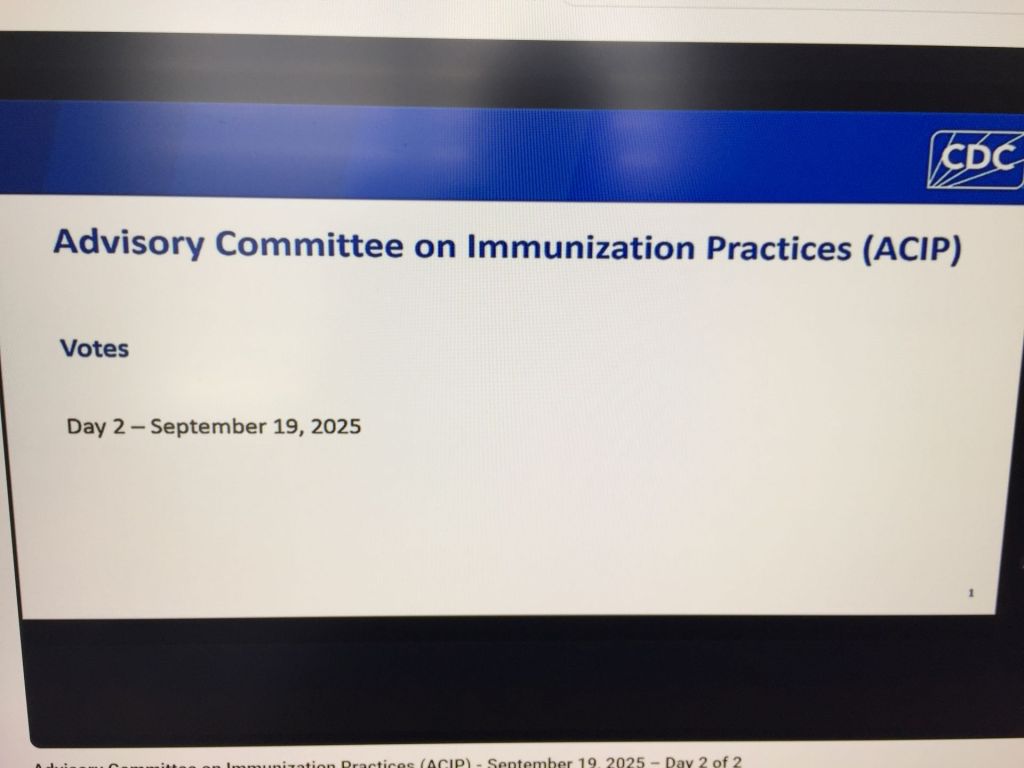
There was a lot to digest in today’s CDC ACIP meeting on Covid-19 vaccines. I missed the morning sessions but managed to see a few of the afternoon presentations.
The presentation by Dr. Retsef Levi, PhD, MIT, ACIP Work Group Chair, the Covid -19 Vaccine Discussion Framing Work Group (WG) was basically pretty critical of the Covid-19 vaccines in general.
The opposing reply to this (favorable to vaccines) was put together by University of Iowa’s Dr. Stanley Perlman, Dr. H. Bernstein, and Dr. M. Miglis, Additional Workgroup Considerations in Covid-19 Vaccination Policy and Practice.
For a change, I listened to the Public Comment section. I usually have not paid attention to them because most of the speakers were opposed to vaccines. Today was different. All of them were strongly supportive of vaccines.
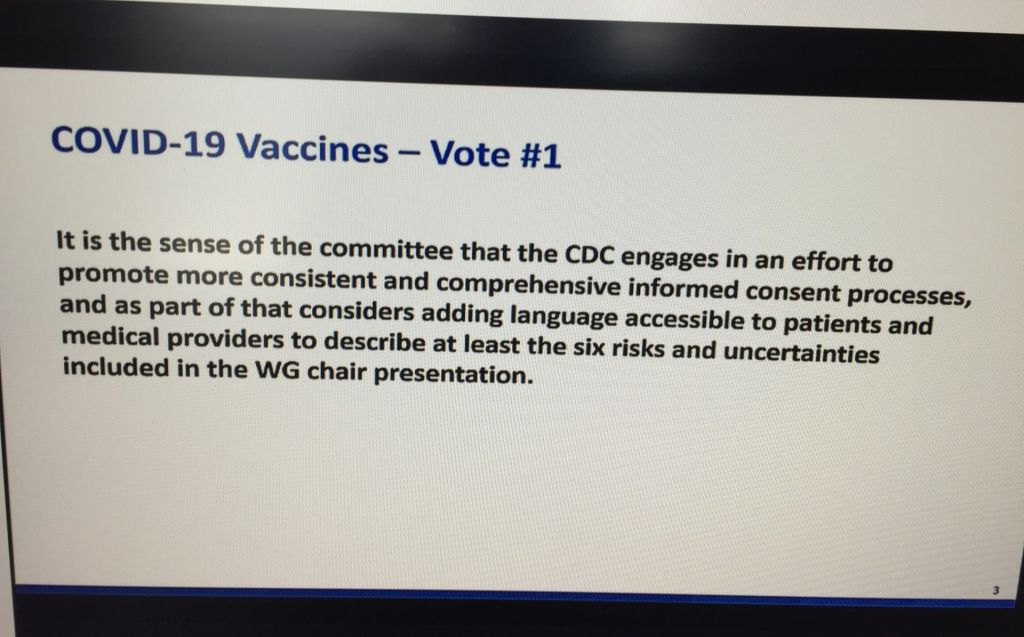
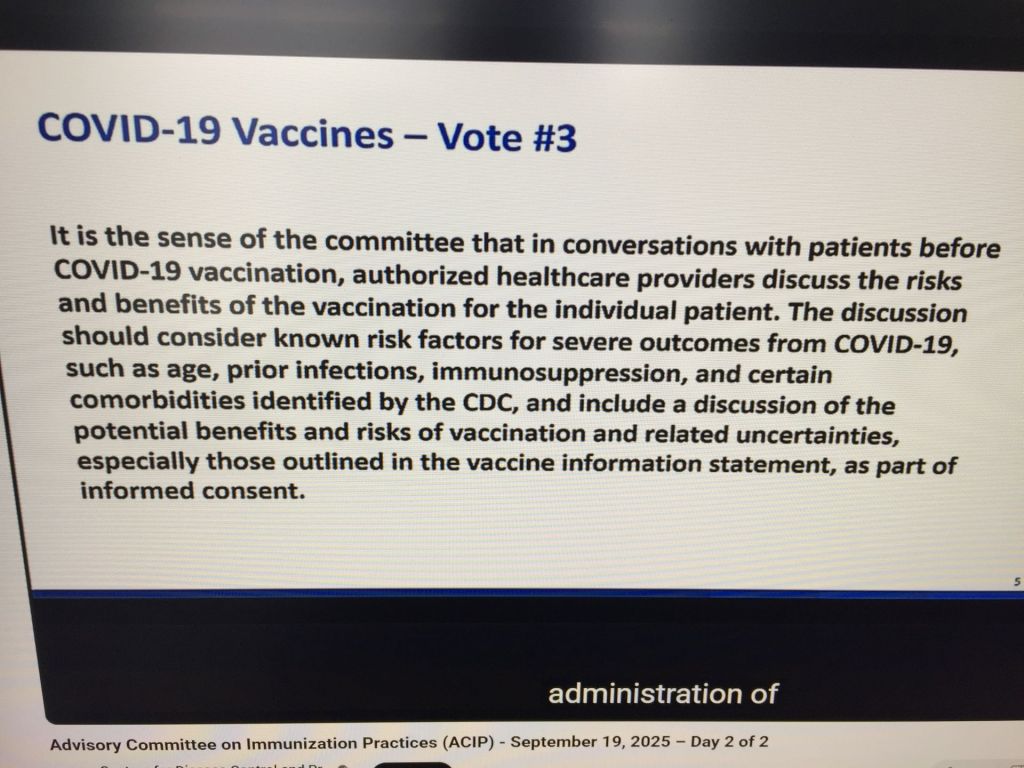
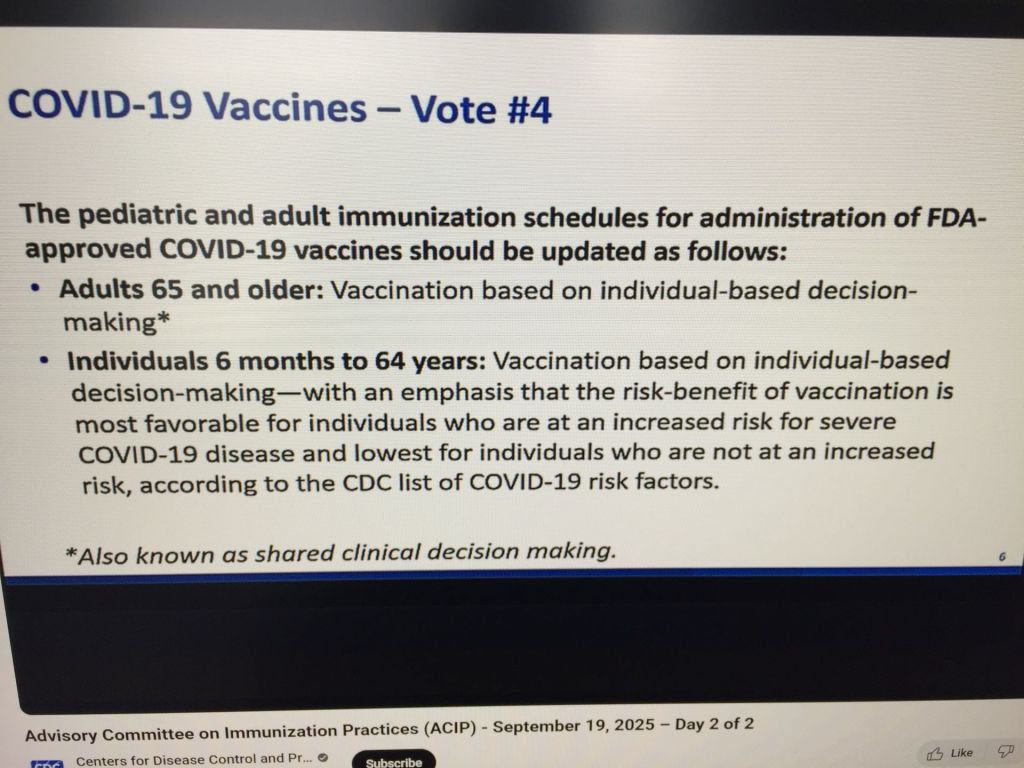
There is a bottom line to this. I watched the voting session, which was very interesting. There were 4 voting questions. I had to take pictures of them because they were not included in the on-line schedule. It was easily the most interesting session of the afternoon, at least for me.
Voting question 1: all but one member voted “yes,” the committee chair Kulldorff voted “no.”
Voting question 2: one member suggested striking this one, but they voted anyway. What’s worrisome is that it was split between the yes and no votes; only the chair, Kulldorff, could break it and he voted “no.” Looks like common sense won; otherwise it would have made access very difficult.
Voting question 3: The video lost audio for a long time, but eventually it turned out that the votes were “yes” unanimously on the assumption that pharmacists counted as “health care providers.”
Voting question 4: The votes were all “yes,” mainly because they decided that pharmacists could make this work. One member questioned the wording which suggested that you needed to talk to your doctor about getting the vaccine because of the wording “shared clinical decision-making.” They glossed over it.
It looks like access to the Covid-19 vaccine will remain mostly open for now.











 Go Retire Psychiatrist