


The FDA Vaccines and Related Biological Products Advisory Committee (VRBPAC) will meet on May 16, 2024 to make recommendations on Covid-19 strain selections for the fall vaccine of 2024-2025.
Category: science
The Good and the Not So Good About Mental Health Treatment

Sometimes I write “depressing” blog posts. On the other hand, I have both good and bad news today.
I found out that, according to the Treatment Advocacy Center, Iowa’s state psychiatric hospital bed availability is dismal according to 2023 figures. That’s actually not new. Although we rate last in the nation for this, we still get a Grade B overall. I’ll have more to say later about it. You can check your own state’s grade on the web site’s map graphic.
And a recently published article about antidepressant prescribing for young people is sort of depressing, there are ways to address the likelihood that adolescent females are being prescribed antidepressants more often than adolescent males.
I tend to agree with the author of another article on adopting a more nuanced perspective on what is often called “depression” in young people. Not everybody who is distressed is depressed.
Even if we are depressed, there are healthy activities we can engage in to heal. We don’t all necessarily need antidepressants. That’s the point of a recent systematic review and meta-analysis on the role of exercise for managing depression. Exercise is effective either by itself or in addition to psychotherapy and antidepressant.
Iowa actually seems to be putting a lot of hard work in mental health outreach, such as Your Life Iowa. It’s funded by the Iowa Dept of Health and Human Services under the Division of Behavioral Health.
I’d say that’s pretty positive, overall.
Thoughts on a Study of Sitting with Your Patients

I saw this interesting article on a study about the effect of chair placement on physicians’ behavior when in a patient’s room, specifically whether it altered the length of time a doctor spends with a patient or the level of satisfaction patients had with the interaction. In this study, it didn’t lengthen the time, but seemed to strengthen patient satisfaction with interaction with the physician. It’s a concept I recognize because I took this one level up—I carried my chair with me on hospital rounds in my role as a consultation-liaison psychiatrist.
I got a gift of a 3-legged camp stool from a colleague who ran the palliative care service at University of Iowa hospital. Other members of the palliative team had been using them as well.
Patients got a big kick out of a doctor who carried his chair around with him and actually sat down to talk with them. The way the camp stool folds up apparently made it look like nunchucks to some patients, so I got jokes about that occasionally. It really helped build rapport.
The only drawback with the camp stool was that my one of my legs would go numb the longer I sat on it, and could lead to a challenge getting up from it gracefully because it was partly a balancing act. Even so, I often spent much more than 10-15 minutes with patients.
Once, the stool actually broke and I dropped unceremoniously on my butt while evaluating a patient for catatonia—who proved not to be catatonic by the apparent facial expression of mirth as I fell on the floor. In that sense, the chair actually became a part of the evaluation—accidentally.
Thomas Hackett knew all about this. He was a famous consultation-liaison psychiatrist and a past president of the Academy of Consultation-Liaison Psychiatry (ACLP). One of his quotes from an early edition of the Massachusetts General Hospital Handbook of General Hospital Psychiatry fits perfectly in this context:
“As a matter of courtesy, I sit down when interviewing or visiting patients. Long accustomed to the ritual of making rounds, many physicians remain standing as a matter of course. Standing, physicians remind me of missiles about to be launched, poised to depart. Even if that is not necessarily true, they look the part. Patients sense this and it limits conversation. In addition, when standing, the physician necessarily looks down on the patient. This disparity in height is apt to encourage the attribution of arrogance. Looking down at a patient who is prone emphasizes the dependency of the position. Sitting at the bedside equalizes station. Sitting with a patient need not take longer than standing with him.”— Hackett, T. P., MD (1978). Beginnings: liaison psychiatry in a general hospital. Massachusetts General Hospital: Handbook of general hospital psychiatry. T. P. Hackett, MD and N. H. Cassem, MD. St. Louis, Missouri, The C.V. Mosby Company: 1-14.
Reference: Effect of chair placement on physicians’ behavior and patients’ satisfaction: randomized deception trial BMJ 2023; 383 doi: https://doi.org/10.1136/bmj-2023-076309 (Published 15 December 2023)
CDC ACIP Meeting on the RSV Vaccine and Some Dad Jokes
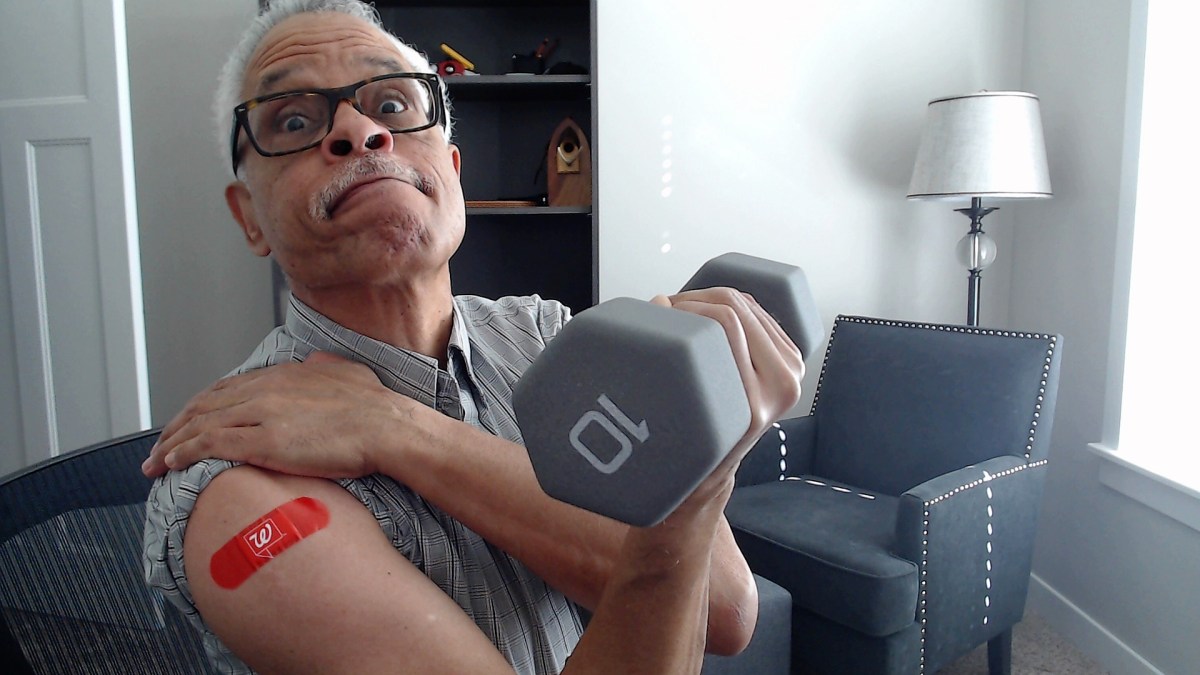
We watched the section of the CDC ACIP meeting about RSV vaccines on February 29, 2024. There was a lot of discussion on the safety of the vaccine. It looks like it will still have a requirement that you have a shared clinical decision-making meeting with your physician. I think that still implies you’d need a prescription. However, there are only a handful of states which would require a prescription from your doctor. Iowa is one of them.
That made the comment by one of the committee participants thought provoking. I believe she got the RSV vaccine from a pharmacist, who asked no questions. There was no shared clinical decision-making discussion with that pharmacist.
But there was a discussion during the meeting with a pharmacist who was in the room. She made it clear that pharmacists had plenty of training (“20 hours” along with additional learning) and could handle the shared clinical decision-making piece with patients.
Sena and I have had all of our vaccines including the Covid-19 shots administered by pharmacy techs. I hardly know what the pharmacists look like because they are a blur, managing the drive-up window and all other customers. It’s clear that a large proportion of vaccines are available at most pharmacies and the techs give the shots. They are pleasant and happy to apply the Band-Aid.
You can’t even telephone the pharmacy and talk to a live person. Sometimes you’ll get a recording which replies to most of your questions with “Sorry, I didn’t get that. Did you say you want a vaccine or a cheeseburger with fries?” Scheduling vaccine appointments are generally done on line. Scheduling a visit with the pharmacist is probably not easier than scheduling one with your doctor, who might confuse you with “the colonoscopy” in room 5.
I’ve looked at the health care professional section on the CDC website pertaining to the age and medical conditions necessary to qualify for getting the RSV vaccine. I’m pretty sure I’m in the right age category, although I stopped keeping track after the evolution of asparagus. I don’t have any chronic medical conditions, unless you count dad jokes. I exercise, juggle, take only a multivitamin a day, meditate, and regularly leap tall buildings in a single bound. I’m pretty sure I don’t need the RSV vaccine, but what do I know? I’m a retired psychiatrist.
It looks like the risk of getting Guillain-Barre Syndrome (pronounced “GBS”) is not zero and may or may not be associated with the RSV vaccine. It’s pretty clear that 2 of the 3 major manufacturers of the vaccine who attended the meeting were pretty sensitive to any hints their product might have anything to do with GBS and might challenge you to a no holds barred thumb wrestling match if you say otherwise.
We think there’s a long way to go before everybody’s clear on who gets the RSV vaccine and when, and also where. But you can’t get it at the pharmacy drive up window.
CDC ACIP Meeting on Covid 19 Vaccine Additional Dose

The CDC ACIP meeting on February 28, 2024 on the proposal of a Spring booster of the Covid 19 vaccine was interesting and confusing. Initially right after the morning presentations, we were a little confused about whether the committee was targeting only those who got the vaccine booster last fall or everybody. That didn’t make much sense given the concern about low overall uptake of the vaccine.
The presenters also mentioned that getting the Spring Covid booster would be part of a shared clinical decision-making discussion with your doctor, similar to that recommended for the RSV vaccine. That was bewildering because we think that’s part of the reason some people might skip the RSV vaccine, given the news reports last year pointing out you had to have a prescription from a medical provider in some states to get it.
I was pretty interested in learning more about T-cell immunity given the concern about waning which of immunity from vaccines over a few months, which I think was based on neutralizing antibodies from B cells. I thought the CDC web site link to an article about the T-cell immune response suggested that cell mediated immune responses might mean that our immunity might not be waning that quickly. However, one of the presentations, “Evidence to Recommendation” showed a slide indicating that your T-cell immunity gets weaker with age (ref. de Candia P, Prattichizzo F, Garavelli S, Matarese G. T Cells: Warriors of SARS-CoV-2 Infection. Trends Immunol. 2021 Jan;42(1):18-30. doi: 10.1016/j.it.2020.11.002. Epub 2020 Nov 13. PMID: 33277181; PMCID: PMC7664351.)
I’ve read other articles, one of them on the CDC website, which says you may have more durable immunity provided by T-cells, but if I read it carefully, the authors hedge and say that T-cell adaptive immunity may not be as strong when you’re older. (Moss, P. The T cell immune response against SARS-CoV-2. Nat Immunol 23, 186–193 (2022). https://doi.org/10.1038/s41590-021-01122-w).
Later in the afternoon, the committee voted that those who are 65 years old and older should get the spring dose. There was no further discussion of limiting it to only those who got the Covid vaccine in the fall of 2023. There was also no discussion of the shared clinical decision-making detail. The committee upvoted the resolution with a majority.
And yet, the voting question did say: ACIP recommends that persons greater than or equal to 65 years of age “should” (which was changed from “may”) receive an additional dose of 2023-2024 Formula COVID-19 vaccine. The “additional dose” means in addition to the vaccine (monovalent XBB.1.5) given last fall. That’s a relatively select group, when you take the subset of those who are 65 and older.
However, the slides in the “Evidence to Recommendation” had recommended there should be shared clinical decision-making, meaning that you should discuss getting the vaccine with your doctor. However, according to the STAT NEWS article summary of this meeting, substituting the word “should” for “may” would make the conversation with a doctor unnecessary.
Finally, there was no discussion at all of changing the 5-day isolation precaution for those testing positive for Covid-19. If the committee were planning to drop that, as many news agencies recently reported, I would think they’d have discussed it at length at the meeting.
The CDC Director will have to sign off on the additional Covid-19 shot before it’s official.
2/29/2024 Update: CDC Director endorsed the additional dose yesterday.
Hot Mic in the NASA Control Room

By now, everybody probably knows about the Intuitive Machine lunar landing of the Odysseus space craft recently, broadcast from NASA. I happened to have a direct audio hookup to the control room during the hot mic episode which somehow didn’t get broadcast last week.
Sam: OK, how’s Odysseus doing?
Doug: Uh, we slightly overshot the planned landing.
Sam: What? How did that happen?
Doug: Not sure, but I heard a crunching noise.
Sam: Crunching? There’s no crunching allowed on this mission!
Doug: It’s OK, we can hit the gas and put it down in a different spot a little further away.
Sam: How far?
Doug: Not much, about 1,000 miles give or take. Almost there; applying disc brakes—now.
Sam: What is Odysseus’ position now?
Doug: Well, it looks like it sort of fell over on its side. But it’s transmitting images.
Sam: Great! What’s coming across?
Doug: Kind of fuzzy. Wait a sec, just need to adjust the rabbit ears here. What’s that?
Sam: Hard to make it out.
Doug: OK, there. It’s yellow, whatever it is. Stand by. Wait, are those wheels?
Sam: Adjust the focus.
Doug: Whatever this yellow thing or vehicle whatever on wheels is—it’s coming closer. Hey, there’s somebody inside!
Sam: Oh my god; a life form! On the moon! Quick, what’s it doing?
Doug: Wow. It just gave me the finger. Since when are taxicabs on the moon?
Sam: Dammit! Are you telling me that Odysseus didn’t even leave Earth?
Doug: No sir! But that moon rock sort of looks like a manhole cover.
Sam: You’re fired, Doug.
Doug: Does that mean the Odysseus Landing Gala and Orgy is off? I don’t think I can return the Counting Kites THC Magnum Cocktails.
Sam: I guess now we’ll have to refund the 118 million dollars from NASA—minus the cocktail charge.
Thoughts on Upcoming CDC ACIP Meeting
Sena and I are talking about the upcoming CDC meeting on February 28th-29th next week. The agenda looks like they’ll be talking about an “additional dose” of the Covid-19 vaccine.
Given the extent of vaccine fatigue going on, I tried to find a layperson-friendly article on the web about vaccine immunity with details about how long it lasts.
There’s review article from 2022 that helps a little bit. The author says that boosting every few months may not be practical as a long-term strategy. It leads to vaccine fatigue in the population. We all know how low the Covid-19 vaccine uptake has been. The author says that boosters should be offered annually or even less often. There is more to immunity than neutralizing antibodies.
The suggestion of some experts is to offer Covid-19 boosters to whoever wants it. I feel like I’m getting mixed and circular messages when I read that my immunity is “waning,” and I need another one. We’ve gotten every Covid-19 shot since the vaccine campaign began. Experts even differ on whether to call Covid-19 a “seasonal” respiratory virus. That would suggest you could get one shot annually during the respiratory virus season-like the flu shot. Obviously, it’s not that simple if the CDC recommends another Covid-19 vaccine this spring.
And the CDC respiratory virus channel snapshot from February 16, 2024 is a little concerning. A couple of days ago there was a news report that schools in Forest City, Iowa would have to move to remote learning because of outbreaks of influenza, strep throat, and even stomach flu. According to the CDC, respiratory virus activity levels are high all over Iowa, which surprised me this late in the season.
New Large Covid-19 Vaccine Study Shows Association with Rare Side Effects Which Other Smaller Studies Have Found
I’ve seen a couple of news stories about the CDC supported large study across many countries which essentially shows that Covid-19 vaccines can be associated with rare side effects. The stories might tend to raise anxiety about the vaccines’ overall safety, which has been repeatedly proven in other studies.
The study is published in the journal Vaccine and the conclusions are consistent with smaller studies showing the Covid-19 vaccines safety although they do have rare side effects.
One of the news stories contacted an expert, Dr. Marc Siegel, clinical professor of medicine at NYU Langone Medical Center, who confirmed that.
Unfortunately, there are over 1200 comments (and counting) containing alarmist and misleading information about the vaccines.
 Go Retire Psychiatrist