My Old Elevator Pitches on Delirium

I thought it would be fun to take a look back at my chronicle as expressed in my old blog posts. As the featured image shows, I used to have a blog I called The Practical Psychosomaticist, which I started back in 2010. It was mostly about how to diagnose, manage, and prevent delirium. One of them was about developing elevator pitches promoting delirium awareness. My blog post Elevator Pitch for a Delirium Prevention Project is below:

“Sir Winston Churchill: Be clear, be brief, be seated.

I have been told that I could improve my chances of selling my product of delirium prevention to various stakeholders by developing a good elevator pitch. An elevator pitch is a short summary used to quickly and simply define a product or service and sell it. The idea is that you should be able to deliver the pitch in the time it takes to ride an elevator or about thirty seconds to two minutes.

I’m a doctor, not a salesman. But I’ll give it a shot.

Pitch to a staff nurse: I’m Dr. JA and I teach nurses how to assess, treat, and prevent delirium in hospitalized patients. Delirium is an acute confusional episode that mimics mental illness but is actually a medical emergency. Delirium worsens concentration, can lead to hallucinations, withdrawal, changes in appetite, reduced mobility, and sleep disturbance. When nurses have the skills and tools to prevent delirium, they ultimately do less work yet provide safer and more effective care for their patients, thereby promoting healing. Delirium leads to increased death rates, longer lengths of hospital stay, and persisting cognitive impairment. Nurses work harder to take care of them because confusion makes patients less cooperative, emotionally volatile, harder to communicate with, and sometimes even violent. Nurses want and need to know how to prevent delirium and I can help them do that.

Pitch to a potential funding source: I’m Dr. JA and I teach doctors and nurses how to assess, treat, and prevent delirium, an acute confusional disorder caused by multiple medical problems that mimics mental illness but is actually a medical emergency. They may be slow to respond, withdrawn, have attitude changes, and have mood symptoms. Because the risk for delirium is higher in the elderly, physicians and nurses in hospitals actually have to work harder to treat delirious patients with serious medical disorders. That’s because the patients are too cognitively impaired to cooperate with treatment, too disorganized to consent for them, and too agitated and restless to sit still for necessary tests. Doctors and nurses want and need to learn how to use assessment skills and tools to prevent delirium. This vital educational resource allows them to provide the best health care for older patients.

Pitch to Patient and Carers: I’m Dr. JA and I help doctors and nurses care for patients who may be at high risk for or who are in fact suffering from delirium. Delirium is an abrupt change in your mental state that represents a distinct change from your usual self and is often alarming to you and your loved ones. You can be disoriented, restless, hallucinate, have delusions and personality changes, or be very sleepy and seem depressed. Delirium is often temporary but can cause longer hospital stays, or the need for long-term care and raises the risk for falls and bed sores. Those at risk are over age 65, already have memory problems or dementia, have a broken hip, or several serious medical illnesses. We’ll assess regularly for changes in your emotions, behavior, or thinking and if they occur, we’ll use a special test to spot delirium early. We’ll work to prevent delirium by providing high-quality medical care. Occasionally, distress and behavioral changes could make patients a risk to themselves and if non-medication methods don’t reduce these, then a short course of medication called Haldol may be used.”

Well, all of the elevator pitches are way too long. But the message is still important.

Pegging Around Wisconsin

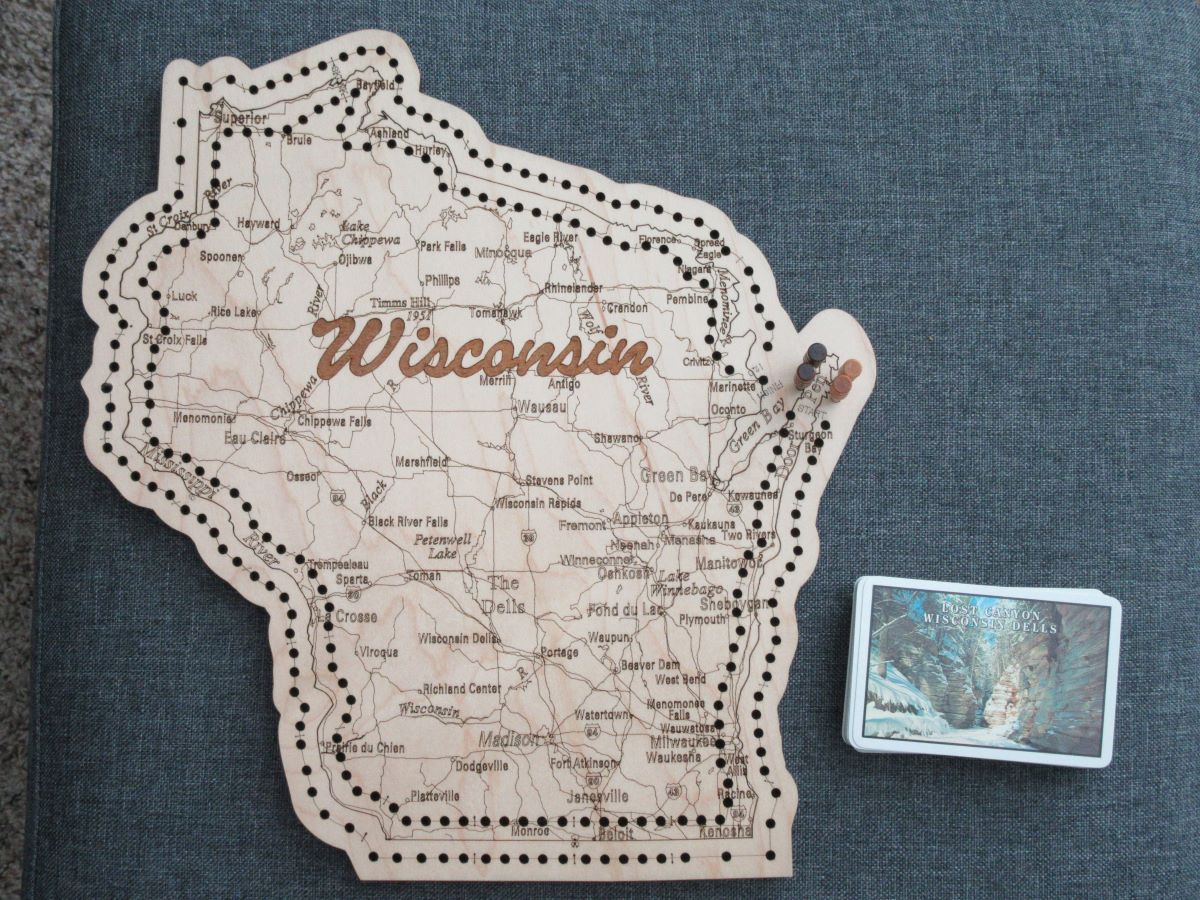
We played a game on our new Wisconsin cribbage board. We made some miscounts I’m sure, but it was because we had so much fun talking. We lived in Madison for a short time many years ago and managed to see quite a few sights in the south-central region of the state. And even after we moved back to Iowa, we made return trips to visit Wisconsin because there’s a lot to do there.

Madison itself is the capital of Wisconsin. One of my first impressions is that a number of fascinating people live there. I remember we were walking west on State Street, and I saw a guy walking in the middle of the street wearing a live rattlesnake coiled on his head. Sena missed that for some reason. He was moving carefully and slowly, probably to avoid rattling his headgear.

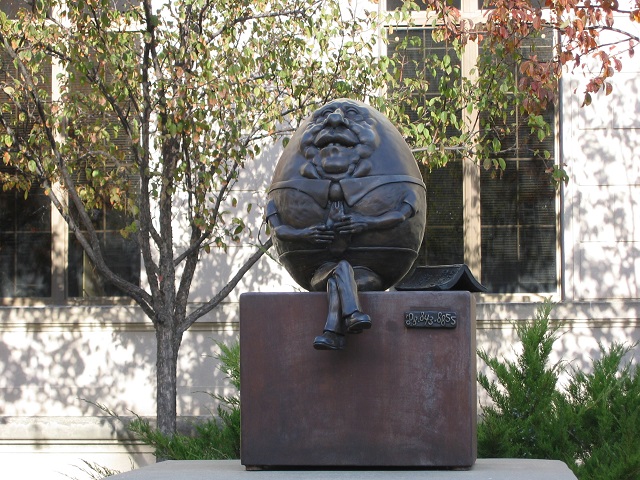
I don’t think the sculpture of Harry Dumpty is still standing in Madison, but for several years it was a distinctive bronze sculpture in front of the Madison Municipal Building just south of the intersection of Martin Luther King Jr. Boulevard and East Doty Street. I can’t see it on Google Maps nowadays.

I never knew the sculpture was Harry Dumpty. It sat above a large concrete wall with an inscription on it which I just assumed was connected to the sculpture and probably still sits there although we couldn’t find it in 2012 when we returned for a visit:

“David James Schaefer, 1955-2004
was a phenomenal phenomenon. Though plagued by the progressive debilities of cerebral palsy, “Schaefer” was an uncomplaining and generous friend to many. Disability Rights Specialist for the City of Madison in three different settings, his death of a heart attack in September 2004 made a hole in our community which cannot ever be filled.
Erected by the Friends of Schaefer at private expense.”

It turns out Harry Dumpty has no connection to David James Schaefer. In fact, Harry is one of several similar sculptures created by artist Brent George, who made him in 1997, saying he’s Humpty’s brother. If you look closely at the book sitting open next to Harry, it’s entitled “Harry Dumpty.” Brent George’s name is below it. Brent’s phone number is on the front of the wall. Evidently somebody called him and asked about the sculpture. Brent says there’s no connection between the sculpture and the inscription.

On the subject of art, the Madison Museum of Contemporary Art (on State Street) is a place to see. Although the art works are free to view on the web, they’re copyrighted and you can’t reproduce them without permission of the artists. However, at the time we were there in 2012 we saw Typewriter Eraser by Claes Oldenburg. I think it’s OK to share our picture of the giant one we saw in Washington, D.C. In 2015.

Typewriter Eraser in Washington, D.C.

One of the more relaxing times we had was having pizza for lunch at Paisan’s in Madison. We were outside and had that breathtaking view of Lake Monona, the breeze was coming off the water, cooling and refreshing—like the Moose Drool brown ale, which is not a Wisconsin brew; it’s made in Montana.

Wisconsin is known for its beer, among many other virtues. New Glarus Brewing Company is famous. I tried a few of the brews. One of them was Stone Soup. It had oil of clove in it and my lips got numb.

We took a dinner train ride at the Mid-Continent Railway Museum in North Freedom. It was great food and great company.

One of the more interesting stories about Monroe, Wisconsin is The Great Limburger Cheese War, which I mangled during the heat of the game. I first heard about it on a TV show; it seemed to me it was on Mysteries at the Museum, but when I googled it, I couldn’t find it.

We had a great time in Wisconsin. Maybe someday we’ll go back for a visit.

Wisconsin Memories

We’re just reminiscing on our time in Wisconsin years ago. We’re hoping this will be a prologue to making a video soon of us playing cribbage on our new Wisconsin board. Until then, you can check out the mini travelogue, including hanging out with the Fonz in Milwaukee. The big mansion in the video is Black Point Estate and Gardens in Lake Geneva.

It was during a July 2012 visit to Madison that I found, at Browzers Bookstore, an old medical book my class used in my first year, Robbins’ Pathologic Basis of Disease. My class used the nearly 7-pound red 3rd edition containing 1,467 pages. 

Also on that trip, we rented a couple of bicycles from Machinery Row Bicycles. We can’t imagine paying $7,500 for a bicycle, much less what looked like $25,000 for a double tandem.

We rode all the way out to Olbrich Botanical Gardens on a sweltering summer day. The Thai Pavilion shown in the video was a gift to the University of Wisconsin from the Thai government.

We never ran into a Bigfoot in Wisconsin, but there have reportedly been over 70 squatch sightings in the heavily wooded areas. Don’t tell the Appalachian Investigators of Mysterious Sightings (AIMS). Wild Bill would just cuss a blue streak and shout, “Hell, that ain’t no Appalachia!”

Wisconsin Cribbage Board Arrives

We got the Wisconsin state map cribbage board yesterday and there’s a little story behind it, right off the bat. It was delivered by the United States Postal Service (USPS) and I remember the slap as it hit our porch from the USPS worker just tossing the package.

When we opened the package, it turned out to be not the board we ordered. It was not as thick as the Iowa cribbage board and it didn’t have a storage space on the back for pegs. The packing material for the Wisconsin board was not as interesting as that used for the Iowa board, which was packed using a local newspaper with a sermon on one of the pages, “In times like these we turn with trust to God.”

In contrast, the Wisconsin board was shipped from the same place in Minnesota, but this time in a plain white USPS envelope, conventionally secured with eBay tape, bubble wrap, and a plain brown shopping bag. No sermons.

Wisconsin cribbage board packing

Sena arranged to return it for a refund (which was the only choice other than having the exact same item reshipped from the seller), carefully rewrapped it and drove out to a couple of the UPS stores—both of which happened to be closed yesterday. She was late by just a couple of minutes.

This morning we noticed that the seller sent an email apologizing about shipping us the wrong board and offered us the choice of shipping it back for the full refund or keeping it at 70% off the price. We took the latter.

We’re now brushing up on our memories of Wisconsin, chuckling at our snapshots, and considering using the deck of cards we got at Lost Canyon gift shop at Wisconsin Dells, where we took the horse-drawn wagon tour 13 years ago.

Lost Canyon wagon tour in Wisconsin Dells

Musing on Coincidences

We’re waiting for another state road map cribbage board, this one is Wisconsin. If you’ve seen the cribbage game video we made, “Pegging Around Iowa,” you get the idea.

We’ve been to Wisconsin, briefly. It’s a complicated story. It was roughly 13 years ago. We moved to Madison so I could make another stab at private practice psychiatry.

During the lunch break between interviews, I read The Onion for the first time. It was set up as a college newspaper in which none of the stories were factually accurate—and wildly satirical. I thought it was really funny. It started back in 1988 in Madison, Wisconsin. It’s now based in Chicago. They published a large paperback book entitled The Onion Book of Known Knowledge: A Definitive Encyclopaedia of Existing Information.

I’m pretty sure none of the information was true. I owned a copy, but the print was so small, I couldn’t read it without a magnifying glass. It either got lost in one of our moves or I got rid of it.

Scott Dikkers was one of the originators. Coincidentally, in 1993 he was interviewed by a columnist for The Daily Iowan, the University of Iowa college newspaper. Scott also wrote a cartoon called Jim’s Journal. This is another coincidence because I kept a sort of diary in between blogs for a while a few years ago. I called it Jim’s Journal. Back in 1993 I wasn’t paying attention then to The Onion or much of anything else except surviving my first year of residency in psychiatry at Iowa.

The Onion was one of my favorite reminders of Madison. We loved living there, but unfortunately, I disliked private practice. We moved back to Iowa, but not before doing a lot of fun things in Madison and places nearby.

Another coincidence that is admittedly minor is that, several years ago I accidentally walked into an auditorium ready to present my Grand Rounds lecture to a crowd. The only hitch was that it was the wrong crowd. I had arrived early and the previous group was still in the auditorium. That was embarrassing. When it was time for my performance, I sort of ad libbed a series of jokes about my blunder. This got me an award from the residents—Improvisor of the Year.

I think I also blogged about the experience and used a feature image of myself with the caption, “And now for the juggling of produce,” a reminder of my clownish performance at the Grand Rounds. If you look closely, you can see one of the produce items is—you guessed it, an onion.

Years later, I happened to find a video of older people being interviewed on their 100th birthday. They were in Madison. I left a comment saying I thought it was a gas. I still do. Coincidentally, I worked at St. Mary’s Hospital, albeit briefly. I left that comment in 2012, about 3 years after I returned to Iowa.

And, coincidentally I found another video that sends pretty much the same message, pertinent to our times. It was taken for a January 2021 news story about a lady named Mary Gerber who was celebrating her 100th birthday who had volunteered for 33 years at St. Mary’s Hospital and got her first Covid-19 vaccine. 

These coincidences happen only occasionally, but continue to reverberate in our lives, even to this day. I think of the 2002 alien invasion film, Signs. In it, the lead character is Graham Hess, a local pastor who has given up being a minister because he’s lost his faith related to his wife dying in a car accident. He and his brother Merrill are discussing the many lights in the sky (UFOs) that have been seen recently. I think of what he says,

People break down into two groups. When they experience something lucky, group number one sees it as more than luck, more than coincidence. They see it as a sign, as evidence, that there is someone up there, watching out for them. Group number two sees it as just pure luck. Just a happy turn of chance. I’m sure the people in group number two are looking at those fourteen lights in a very suspicious way. For them, the situation is a fifty-fifty. Could be bad, could be good. But deep down, they feel that whatever happens, they’re on their own. And that fills them fear. Yeah, there are those people. But there’s a whole lot of people in group number one. When they see those fourteen lights, they’re looking at a miracle. And deep down, they feel that whatever’s going to happen, there will be someone there to help them. And that fills them with hope. See what you have to ask yourself is what kind of person are you? Are you the kind that sees signs, that sees miracles? Or do you believe that people just get lucky? Or, look at the question this way: Is it possible that there are no coincidences?

Merrill answers “I’m a miracle man.”

I’m not sure yet what group I fall into. Things happen sometimes that make me hope there are miracles.

Calpurnia’s Lesson

I finished To Kill a Mockingbird by Harper Lee a couple of days ago. Calpurnia’s line toward the end of Chapter 12:

It’s not necessary to tell all you know. It’s not ladylike—in the second place, folks don’t like to have somebody around knowin’ more than they do. It aggravates ‘em. You’re not gonna change any of them by talkin’ right, they’ve got to want to learn themselves, and when they don’t want to learn there’s nothing you can do but keep your mouth shut or talk their language.

That stuck in my head until the end of the book. It reminds me of my time at an HBCU, Huston-Tillotson University (then Huston-Tillotson College) in Austin, Texas. I was the only black child in my classes in grade school while I was growing up in Iowa. Nobody noticed how I talked because I sounded like everybody else.

But I didn’t have a Texas twang at H-TC. I also tended to talk too much. Finally, one student asked me, “Why do you talk so hard?” Those were her exact words. I don’t remember my reply, or if I even had one. I hope I just shut up.

That doesn’t mean that black students all had a drawl or were terse. One of them I remember called himself Malachi. He didn’t have a drawl or twang. He pronounced it Ma-Lah-Chee, emphasis on the second syllable.  He had an ordinary English name. One of the English professors tried to tell him that, if he was trying to model himself after the Hebrew prophet in the Bible, he should pronounce it Ma-Luh-Kai. He didn’t buy it.

And there was the guy I had to debate in philosophy and logic class. He talked way too much—which is a big part of the reason I lost the debate. I couldn’t get a word in edgewise. My professor hinted that being too polite by not interrupting was unlikely to help me in debates with bombastic opponents.

I have sometimes found myself either staying clammed up or talking too much, often at the wrong times with the wrong people.

I think there must be a happy medium somewhere. If I can’t talk the talk, is there a way to walk the talk? If I respect others, and believe we should all show respect for one another, I don’t have to drone on forever about it. I can hold the door open for them.

Para-Debunking on Debunking Day

Today, in honor of Debunking Day, which is held on March 11 annually (starting in 2005) I thought I’d introduce a new word. It’s Para-Debunking and you won’t find it in the dictionary, at least not in our brand-new hardcover Merriam-Webster’s Collegiate Dictionary, Eleventh Edition. It was just delivered yesterday. We needed at least one physical dictionary for when we play Scrabble. We’re also waiting for an official Scrabble Dictionary, also on order. The heft of a real dictionary feels really good, by the way.

Anyway, the definition of “debunk” is “to expose the sham or falseness of” something.

Before I give you my definition of para-debunking, I should say that it’s a spinoff of the word “paranormal.” I know it doesn’t really make sense, but hang on, I’m getting to that.

You’ll never guess how I even found out it was Debunking Day today. Sena found out yesterday that a radio DJ was planning to observe the holiday by looking up something on MythBusters, another TV show we used to watch a lot.

That led to Sena finding a couple of X-Files episodes (a big-time paranormal TV show in the not-so-distant past): Sunshine Days and The Rain King.

If you can pick any topic to find debunkers always ranting about, the paranormal would be one of them. I’m not out to actually debunk it, so you can put your guns down. But the two X-Files episodes made me think of maybe something more important than just garden variety debunking.

Sunshine Days, an episode in the 9th season, originally aired in 2002, with Agents Doggett, Reyes, and Scully investigating two murders at a house that is off and on tricked out as the Brady Bunch house. This is the accidental result of the staggering psychokinetic powers of the homeowner, Anthony, whose psychic talents were studied when he was a child by a parapsychologist, Dr. Rietz. Anthony developed an attachment to Dr. Rietz and created doubles of the Brady Bunch (gaaahhhh!) because his family life was bad.

The agents take Anthony to FBI headquarters in Washington, D.C. and convince Assistant Director Skinner and a scientist that Anthony’s powers could change the world. But as Anthony demonstrates his powers by levitating things, including Skinner, the strain of it makes him deathly sick. Skinner is no lightweight.

As he lay dying in the hospital, Dr. Rietz realizes that Anthony loves him like a father and that relationship is more important than using him for his paranormal powers to change the world since it would kill him. Paranormal power is not debunked, but the real power is the power of love. That’s para-debunking, which doesn’t have a holiday but should.

The other X-Files episode is The Rain King, which aired in the 6th season in 1999 and features Agents Mulder and Scully investigating a guy named Daryl in Kansas, who claims he can make it rain whenever he wants, thereby controlling the awful drought that has plagued the area for months. I think it’s important that this is set in Kansas. As usual, Mulder believes that somebody is making it rain, but maybe not Daryl. Scully is skeptical as usual and tries to debunk the whole thing.

It turns out that the local weatherman, Holman, is responsible for the crazy weather because he’s been in love for decades with Sheila (who had been engaged to Daryl but he was not down with the plan). But Holman just can’t work up the nerve to tell her. He even creates a tornado that tosses a cow through Mulder’s hotel room ceiling. Holman finally convinces Sheila that he really loves her, which brings back the sunshine. The moral of the story is that we should be nice to each other because you never know when somebody will direct their paranormal ability at the skies and clobber us with flying cattle.

Just kidding. The idea is the same as it was for the Sunshine Days episode. It’s more important to feel our feelings and share them with others as long as that doesn’t involve hurling livestock at each other.

Get the idea? The paranormal is not debunked, but para-debunked in favor of focusing on the important stuff humans can achieve on earth without paranormal involvement. Maybe we can treasure what we already are capable of doing.

OK, let’s vote. Who wants to add Para-Debunking Day to our long list of holidays?

About Me Page Revisited

I’ve been looking at my About Me page and see that it needs revising. I’m way past the stage of being in phased retirement and I’m pretty sure I can’t do without this blog—or at least some way to keep writing. I notice I said that I was not sure how long I’d keep blogging.

I recently updated my YouTube trailer. It’s my first attempt at an elevator pitch in years. It’s a 48 second video, probably the shortest video I’ve ever done. According to some experts, it’s 3 seconds too long. If you want to read the long version, it’s on this blog, “Elevator Pitch for a Very Slow Elevator.”

Anyway, I’ve been retired from psychiatry since June 30, 2020 (there was a minor clerical glitch in the exact date). My wife, Sena and I have gotten all of our Covid-19 vaccines—until they come up with more. We have made Iowa City our home for over thirty years.

We play cribbage. One of the most fun cribbage games we played was the game on the Iowa state map board. That was a blast. The video of it was over 10 times longer than most YouTube videos I make. That’s because the main reason for the game was to talk up Iowa. You really ought to visit, maybe even move here. You can get used to snow. I keep reading articles on the web telling me I’ve got to stop shoveling at my age. I’ll think it over.

We also like going for walks. One of our favorite places to walk is on the Terry Trueblood Trail. Sometimes you can see Bald Eagles out there.

I have not yet mentioned Consultation-Liaison Psychiatry, even once. That’s a big difference from the old About Me page. It was the first thing I mentioned then, because it was just about the most important role I had in life.

It took a long time before I began to question that once I retired—about a year or so. It was a lot like being a firefighter. In fact, my pager was the bell, and I even had a firefighter’s helmet, a gift from a family medicine resident who rotated through the psychiatry consult service. I didn’t wear it when I interviewed patients. It would have alarmed them.

I also carried around a little camp stool. It was because there were never enough chairs in patient rooms to accommodate me, the trainees, and visiting family. Often, I sent a medical student to find me a chair from out in the hall—until I got the stool. I slung it over my shoulder and away I went. I was sort of like the guy on that old Have Gun—Will Travel (paladin) TV show (a 1950s-1960s relic with a gunslinger called Paladin). Have Stool—Will Travel. A surgeon, who also doubled as a palliative care medicine consultant, gave me the little chair as a gift. I passed it on to a resident who took it with good grace.

I miss work a lot less now than I did when I left. I think I must have loved my work. Maybe I loved it too much, because leaving it was hard. There are different kinds of love. I love writing. I love long walks and watching the birds. And most of all I love Sena.

Love

I’m gradually replacing work with something else I love, which is writing. Mindfulness meditation and exercise also help. And let’s not forget, I change electrical outlets. I think I’ve changed just about every outlet (and many toggle switches) in the house. They ought to do away with those bargain bin plugs. Just because they’re cheap doesn’t mean they’re any good.

I’m not sure yet how I’ll edit the About Me page. Maybe I’ll just call the first one Chapter One and this one Chapter Two.

Elevator Pitch for a Very Slow Elevator

This is a follow up to yesterday’s post about elevator pitches. I’m using one of the standard formats below. The first step is to find a really slow elevator.

Who am I?

I’m a retired consultation psychiatrist, slowly evolving beyond that backwards in time to something else I’ve always been. I’ve been a writer since I was a child. My favorite place was the public library. I walked there from my house. I stayed there as long as I could. It was place of tall windows where I could look out and see trees which swayed like peaceful giants. I borrowed as many books as I could carry in my skinny arms and walked all the way back home. Then I picked up a pencil. I wrote short stories which I bound in construction paper. I read them to my mother, who always praised them and called me gifted whether I deserved it or not. I lived inside my head. My inner world was my whole world.

What problem am I trying to solve?

The problem was that I forgot who I was as I got older. I forgot for a long time about being a writer. I evolved into the outer world, adopting other forms. I put down the pencil, but never for very long. I changed what I did and made, but I always lived in my head. People told me “Get out of your head.” I tried, but didn’t know how. I wrote less and less. When I did write, I realized that I was no genius, not gifted—but still driven to write. I was so busy in college, medical school, residency, and in the practice of consultation psychiatry, I didn’t write for a long time. But later I returned to it as the main way to teach students. I even co-edited and published a book, Psychosomatic Medicine: An Introduction to Consultation-Liaison Psychiatry, with my former department chair, Dr. Robert G. Robinson. On the Psychiatry Department web page, in the Books by Faculty section, the book is in the subsection “Classic.” Inside the cover of my personal copy is a loose page with the quote:

A classic is something that everybody wants to have read and nobody wants to read.

Mark Twain

I’m pretty sure I put it there. Part of the preface was my idea because of my admiration for Will Strunk, who I learned about in an essay by E.B. White (“Will Strunk,” Essays of E.B White, New York, Harper Row, 1977). We informally called the work The Little Book of Psychosomatic Psychiatry:

The name comes from Will Strunk’s book, The Elements of Style, which was, as White says, “Will Strunk’s parvum opus, his attempt to cut the vast tangle of English rhetoric down to size and write its rules and principles on the head of a pin. Will himself hung the title “little” on his book and referred to it sardonically and with secret pride as “the little book,” always giving the word “little” a special twist, as though he were putting a spin on a ball.”

I guess our little book was, in a way, my own parvum opus.

Obviously, I don’t write the way Strunk would have wanted. But it’s my way, and I’m finding my way back to it, back to the path I was on in the beginning of my life, back to who I am.

What solution do I propose?

Almost two years ago, my solution to the challenge of rediscovering who I am, I suppose, was interrupting my medical career, but that would be dishonest. I did it because of my chronological age or least that was what I told myself. Burnout was the other reason. That said, despite my love of teaching students, I missed something else. And I knew if I kept working as a firefighter, which is what a general hospital consultation psychiatrist really is, I might lose what I loved best, which was writing for its own sake and for sharing it with others. It sounds so simple when I say it. Why has this been so hard, then? Obviously, I’m not going to recommend to those who are writers at heart lock themselves in a garret and do nothing but write. We would starve.

I think this is where mindfulness helped me. I couldn’t ignore my love of writing. I was better off just accepting it. But until I learned mindfulness in 2014 as a part of a Mindfulness Based Stress Reduction (MBSR), which I took mainly because I was struggling with burnout, I would either just ruminate or act on autopilot. I still do those things, just less often. Mindfulness is not miraculous. It’s not for everyone. It can be a part of transitioning to a healthier life. I exercise too. I don’t rigidly always without fail adhere to my schedule. I miss some days. I accept that and just go back and try again.

What is the benefit of my solution?

I think the benefit of adopting mindfulness and other healthy practices, at least for me, is that sooner or later (in my case much later), I made a sort of uneven peace with the loss of my professional routines, my professional identity, my work, as the single most important way to live. I still have a lot to learn, including how to be more patient, how to listen to others, how to get out of my head for what I know will be only a short time. Most of all, I’ve reintegrated writing into my life and it brings me joy. If you’re going through anything like that, then maybe seeing my struggle, my wins and losses, will help you keep going. It gets better.

This elevator pitch is way longer than 45 seconds.

Featured image picture credit Pixydotorg.

Snow Day Reflections on Elevator Pitches

I got up early this morning, partly because I knew I wanted to shovel the snowdrifts from last night, and partly because I heard my neighbor’s snowblower, shortly after 5:00 a.m.

I don’t have a snowblower. I’d rather shovel. It was the wet, heavy stuff. It was still coming down when I charged outside without breakfast, not even coffee.

While I was slogging away at the snow, I kept thinking about how to update my YouTube trailer. It’s been about a couple of years since I made the last trailer. I’m evolving since my retirement from the hospital where I worked as a consulting psychiatrist. I guess it’s time to update my About page on this blog as well.

The further I get in time away from work, the more I wonder what I’m evolving into. Work is not my focus. Sena and I got a big kick out of doing the Iowa cribbage board video. It brought back memories of our travels in Iowa.

I noticed my YouTube trailer is long by usual standards. It’s about 2 minutes. I found instructions for making it on YouTube. It’s supposed to be no longer than 30-45 seconds. Technically it’s supposed to be sort of like an elevator pitch.

I tried to develop elevator pitches back when I was working. There’s all kind of guidance for them on the web.

The framework is designed for those who are job seekers and students and salesmen. I tried googling “elevator pitches for retirees” and didn’t get any real hits.

I’m not trying to sell anything. I’m not competing for a job. The basic format for an elevator pitch could include:

  • Who are you?
  • What problem are you trying to solve?
  • What’s your proposed solution?
  • What’s the benefit of your solution?

I guess the answer to the first one is that I’m a retired psychiatric consultant. I’m not sure who in his right mind would be interested in that. If I shorten it to just “retiree,” that doesn’t seem to gain much traction.

The second one is even harder. Frankly, the problem I’m trying to solve is deeply personal although arguably could be applied to any retiree. I’ve been trying to adjust to no longer having a professional identity. I know George Dawson, MD remarked that he had little trouble with the meaningfulness issues with which one could wrestle after retiring from one’s profession, some after several decades of work.

I’m actually still wrestling with it and I would say it’s normal, at least for me. The loss of my professional identity was a real struggle for at least a year after my last day of work on June 30, 2020. I often failed to cover it up with a sense of humor, although I never fully lost that trait.

I don’t have a solution, and therefore can’t propose one. I have discovered other interests, which have gradually overtaken the one which kept my mind on the hospital most of the time, even when I was not at the hospital. I know I never really seriously considered the solution of going back to work in my former role. Some of my colleagues did, though. I hope they were happier when they did.

Since I don’t have a solution to the problem of adapting to retirement, I can’t really talk about the benefit. On the other hand, I notice I’m changing very slowly from being the firefighter psychiatric consultant to whatever I am now.

I think mindfulness meditation has been helpful, which I started in 2014 mainly as a way to cope with burnout. I was in a class with several others who had various reasons for being in the Mindfulness Based Stress Reduction (MBSR) class at the hospital. The class is no longer given there, and my teacher, Bev Klug, retired. However, resources for it are available elsewhere on the University of Iowa campus.

Maybe I have the beginnings for an elevator pitch after all.