In light of March being Women in History Month (as well as Iowa History Month), I’d like to share some history stories about an African American librarian from Mason City, Iowa named Esther J. Walls. In 2020 during the Covid-19 pandemic, there was an essay about her, “Esther J. Walls: The Role of a Black Leader.” Her life story as a librarian, traveler, and educator is fascinating.
I looked through the list of women elected to the Iowa Women’s Hall of Fame and couldn’t find her name. However, I recognized Deborah Ann Turner’s name on the list. She was the first African American woman to be certified by the American Board of Obstetrics and Gynecology in gynecologic oncology. She was also from Mason City, Iowa. Her life story and list of accomplishments is also impressive.
I identify with both of them because they were born and raised in my hometown, Mason City, Iowa. Esther J. Walls was employed at the Mason City Public Library, my favorite haunt because my love of reading and writing began in early childhood.
An archived news item about Esther J. Walls entitled “A Mason City woman’s globe-trotting career” highlights her travels and her sense of humor.
A couple of days ago the temperature was in the mid-seventies, which is pretty balmy for February. We took the opportunity to get out for a walk on the Terry Trueblood Trail. It’s coincidental, but we did the same thing on the exact same date last February. It’s under the same condition for the most part—escaping from the bad news on the web. The difference was the temperature; it was only in the fifties last year.
The remarkable thing last February was that another trail walker claimed to have seen 16 bald eagles. I’ll have to say that we doubted it, at first. But shortly after that, we caught sight of half a dozen. There were also the quilted hearts we saw, connected to the “I Found a Quilted Heart” project, the goal of which is to make you happy.
This time, although we didn’t find any quilted hearts, we saw a young bald eagle in flight. It was a little hard to tell what it was at first. Bald eagles don’t look bald when they’re in the juvenile stage. I had to look it up. Juveniles look pretty mottled. I wondered if its parents were the bald eagle pair, which we saw at Trueblood in December of 2023. Probably not, given that nesting begins in January, incubation lasts over a month and the eaglets take their first flight over two months later, according to the Iowa Dept of Natural Resources. But it’s fun to think about.
This junior bald eagle looked a little clumsy, both in the air and near the water’s edge. It looked like it might have caught a little fish. It seemed like it was trying to learn how things work in the world and how it’s supposed to fit in.
Instinct takes care of most of that for a bald eagle. Humans have a lot of figuring out to do. We ran into somebody on the trail who told us a great deal about local history. Over time, a lot of things have changed in Iowa City. That goes for the world, too. Much of the time, the changes don’t always seem to make life better, at least according to older people who talk about them.
But the seasons come and go. Bald eagles lay eggs. Eaglets fledge. They don’t gaze up at the moon. Humans do look up at the moon, and occasionally fly there. It’s hard to know why.
There are plenty of earthly mysteries. We saw small black handprints on the Trueblood sidewalk, not far from the shelter. I can’t figure out why they would be there, and what’s more, I can’t find out anything on the internet that explains it. So much for the internet. I supposed I could take a chance and ask Artificial Intelligence (AI) about it, but I’m not confident it wouldn’t just make something up.
We also found a little badge on the ground. It was labeled National Museum USAF Junior Flight Crew. This time, when I checked the internet, I found out there is a lot of information about it on the internet—but none of it helped me understand why it would be on the ground along the Terry Trueblood Trail. You can find a very long article on the internet about how items from the National Museum USAF might not have been handled the way they should have been. You can buy one for about $20 or so on eBay, if you’re interested.
I think it’s more interesting to see how the junior bald eagles learn their way around the world. They earn their wings the old-fashioned way.
This is an update on a couple of Mason City, Iowa YWCA and YMCA renovation posts I wrote in May of 2022 (May 12 and May 25). I’m also going to compare the information about those with recent news about the building which is home to Pagliai’s Pizza.
Recall that the YMCA in Mason City was placed on the National Register of Historic Places in 2002. It was built in 1926. It was also converted into an affordable apartment housing resource. When I was a young man, I used to live in the dormitory. And if you must know, that was in the days of the Pony Express.
And the YWCA in Mason City was built in 1918, well before the YMCA. Yet it is still not on the historic register, which is puzzling. It sat empty for many years before a couple of artists (2 Artists) bought it in 2021. They are trying to renovate the building with some assistance from the city, and their own fund-raising campaign which includes a GoFundMe and other efforts. They plan to use it as a resource for artists, eventually to include studios, apartments, and art shows. The city has received a grant to convert part of the building into apartments.
The State Historical Society of Iowa told me that the YWCA has been deemed eligible twice for nomination (in 1991 and in 2003, which was a year after the YMCA was added to the list). Yet the YWCA has never been nominated. I ended up calling this a mystery in history. It’s true it was neglected for years and renovation is expensive. The nomination process is long and very involved.
A recent, brief local newspaper article indicates that the renovations are still underway, but there is still no mention of trying to get it added to the historic register.
How does that connect to the current news about the building that houses Pagliai’s Pizza? The owner wants to sell the building. However, the building has been there since the 1870s and the Iowa City Historic Preservation Commission has decided along with many others that it belongs on the city’s list of historic landmarks.
The building used to house a dance hall, a grocery store, and a bohemian restaurant. It has been home for Pagliai’s Pizza since 1957. It’s a local favorite; Sena and I have enjoyed pizza there on several occasions.
The owner has misgivings about designating the building a historic landmark as it might hurt its marketability. Nevertheless, the Iowa City Historic Preservation Commission legally decided to recommend it for landmarking. It will be voted on by the Iowa City Planning and Zoning Commission, although it’s not clear exactly when. The owner of the building is not the same person who runs the pizza place—he signed a lease through 2030 and beyond if possible.
My question is if Iowa City can insist on adding a building to the historic register (in a way overriding the owner), why has it never been done for the Mason City YWCA? There is at least as much culturally significant history linked to it as there is with the Iowa City property.
I’m not savvy enough about the intricacies of city planning to figure this one out. So, it remains a mystery in history to me.
Sena and I got to talking about Central Park in Mason City, Iowa. I remember my brother, mother and I taking a walk there occasionally. One time we saw a man who lost his legs and who got around using a small platform on wheels. Later in life, I wondered if he was a disabled war veteran.
That reminded us of the 1884 Memorial Civil War Statue in the center of the park. We looked it up and found it has a complicated history. In the late 1990s it was under repair for about 3 years in Cincinnati, Ohio. When it was finally returned, it was noticed that it had not been repaired correctly. The city decided to keep it anyway, partly because some people, including a Civil War re-enactment supporter, thought the flaws were relatively minor.
Anyway, there are relief busts of famous persons on the statue. We could identify Abraham Lincoln, Ulysses S. Grant, and a Civil War soldier. After a brief web search, we confirmed that the 4th relief bust was that of George Washington.
There are a couple of topics of interest here. One of them is the George Washington relief bust and the other is Civil War re-enactments.
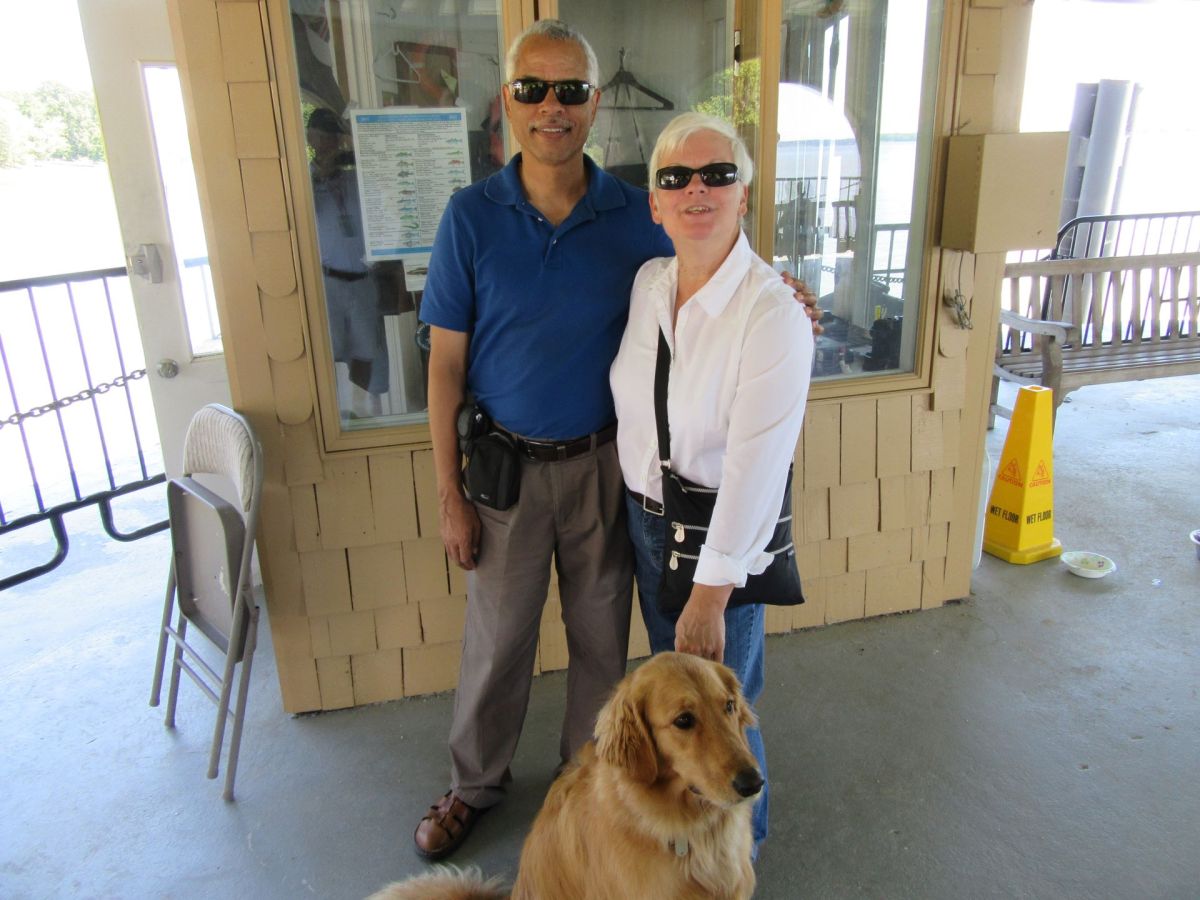
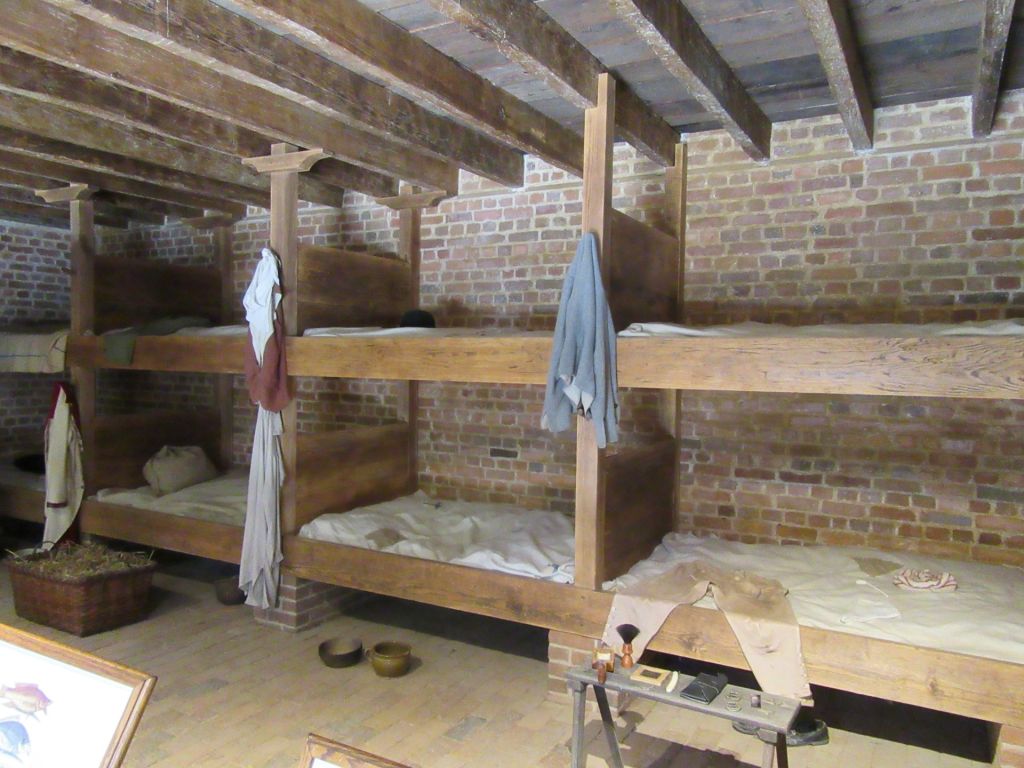
The connection of the Civil War to George Washington is a little puzzling because he owned slaves. We’re aware he freed them upon his death. On the other hand, when we visited Washington D.C. in 2015, we took a tour of Mt. Vernon. It was a scenic boat trip out there. We took a picture at the dock with the dog of the guy who helped people on and off the boat. We also took pictures of the slave quarters. There were no re-enactment persons and we were told we were on our own when viewing those exhibits.
This also reminds me of the news item about a bill recently (on February 9, 2024)) introduced in the West Virginia legislature to remove the statue of former Senator Robert C. Byrd from the West Virginia State Capitol and replace it with 4 other statues: Abraham Lincoln, James Madison, Arthur I. Boreman, and George Washington. Nothing is mentioned in that news story about Senator Robert C. Byrd having been a leader in the Ku Klux Klan in the past, and filibustered against the Civil Rights Act of 1964. This is from a news story posted on the web in 2020 under a link titled “time to remove monuments to senator byrd.”
Again, I struggle a bit with suggesting that a statue of George Washington, a former slave owner, would be an appropriate substitute for that of Senator Byrd. And James Madison, despite saying that slavery was incompatible with Revolutionary principle, owned slaves and made profits on their sale. Arthur I. Boreman is described as not being an abolitionist but a unionist. However, in 1865 he signed a legislative act banning slavery in the state of West Virginia.
Maybe a nice set of abstract sculptures for the corners of the rotunda of the West Virginia State Capitol?
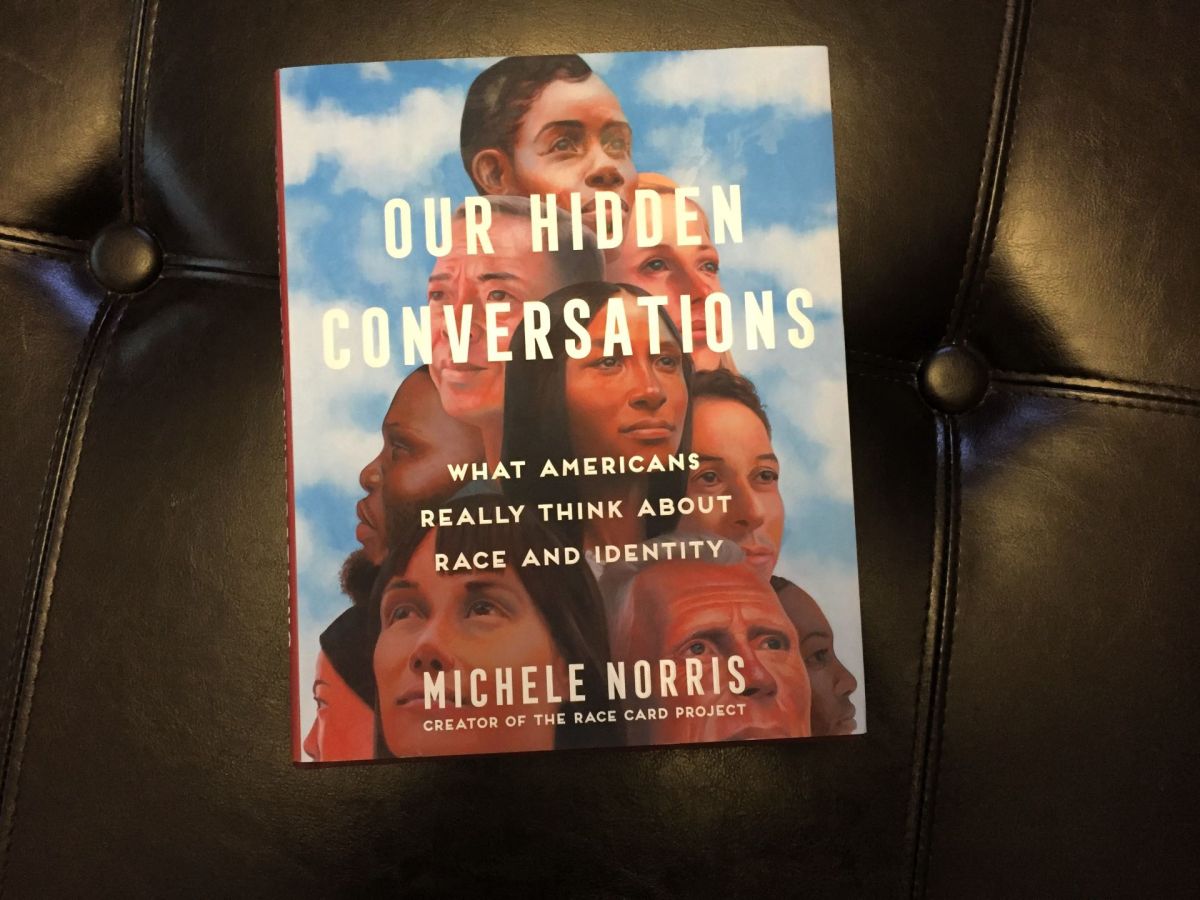
Turning to Civil War re-enactments, I’m ambivalent about them. I remember reading a couple of anecdotes about re-enactments in the book “Our Hidden Conversations” by Michele Norris.
One of them was about black woman re-enactor who played the role of a house slave. This was in Chapter 4, “Coins in the Couch.” The six-word Race Card (p.160) said “Why Do You “Play” A Slave?” Nicole is a slave interpreter. She makes sure that visitors to former plantation sites portray slavery accurately to tourists. She’s a public historian by training who works at the National Center for Civil and Human Rights in Atlanta. She teaches tourists about the reality of chattel slavery, including the sale of relatives to other plantations and the ingenuity of enslaved men in improving farm implements.
The next anecdote about re-enactment in the book is in Chapter 10, “So, You Want to Talk About Lynching?” The six-word Race Card (p. 386) said “Confederate re-enactor chose intimidation as spoils.” A black man and his biracial but white looking friend were at a barbecue in Texas. Two big white guys dressed in Confederate-era uniforms were passing by and one of them placed his rifle on his knee and tried to stare down the black man. The black man stared back and this went on long enough for his friend to get nervous enough to suggest they just leave. Finally, the other re-enactor pulled the sleeve of the intimidator and they were the ones who finally left. Despite this episode, the black guy “…made a choice to accept people as I receive them.”
Apparently, there are regular Civil War re-enactments in Mason City. It looks like the most recent was from Sept 8, 2023-Sept 10, 2023. It was The Battle of Chickamauga, TN. It was held in East Park, where I used to play as a kid. Iowa soldiers in the Civil War fought on the Union side. However, I found out the battle of Chickamauga was won by the Confederates, and it had the second highest number of casualties after the Battle of Gettysburg. There was a battle demonstration and the camps were open all weekend to talk to the re-enactors. And there were food vendors.
There is a newer Mason City Veterans Monument in Central Park. It was built in 2004. It has 12 handsome black granite stones with room for the names of 4,600 veterans. We have seen pictures of it on the web. There are no relief busts.
Sena found a great essay on leaving a legacy. It’s titled “Forget Me Not” written by Jonathan Clements and posted on the website HumbleDollar on February 17, 2024. I think it’s worth sharing.
The comments are still coming in. One commenter (Newsboy) wrote the one below:
“The late great author, Steven (sic) Covey, once suggested: “To live. To love. To learn. To leave a legacy – That’s what we all want.”
How appropriate it seems that a willingness to embrace the first three items on his list (live / love / learn) typically results in the “dearly departed” achieving some meaningful degree of the last one (leave a legacy).”
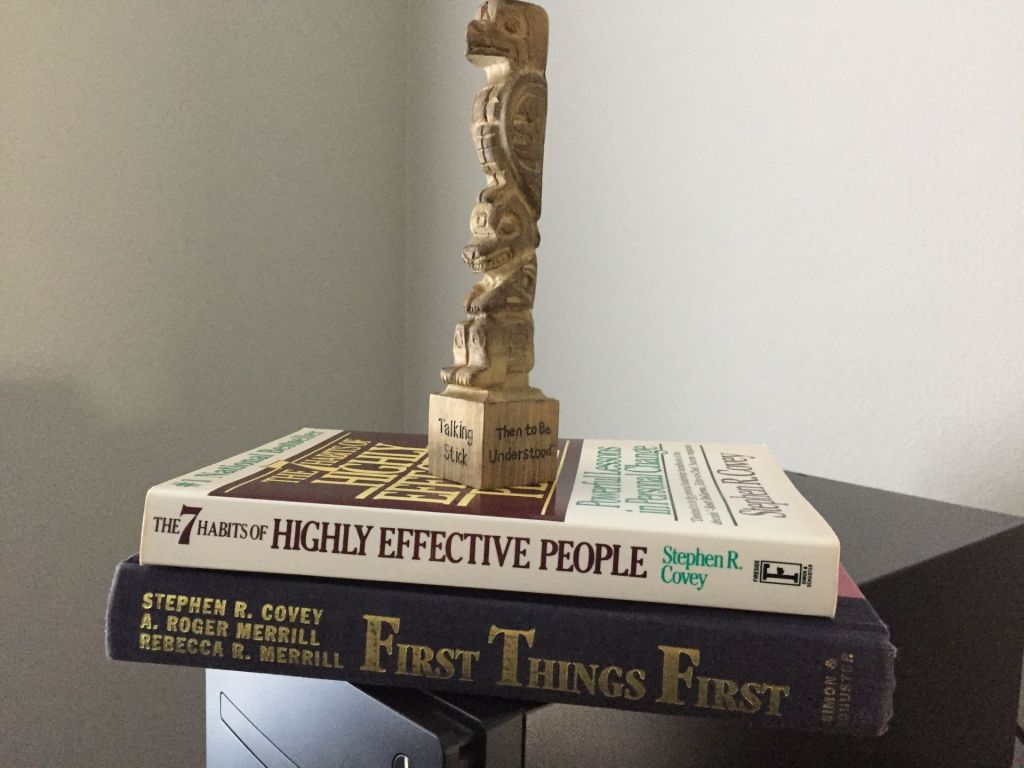
This reminded me that I shared Stephen Covey’s concepts with junior residents when I was the chief resident in psychiatry. He wrote many books, including The 7 Habits of Highly Effective People.
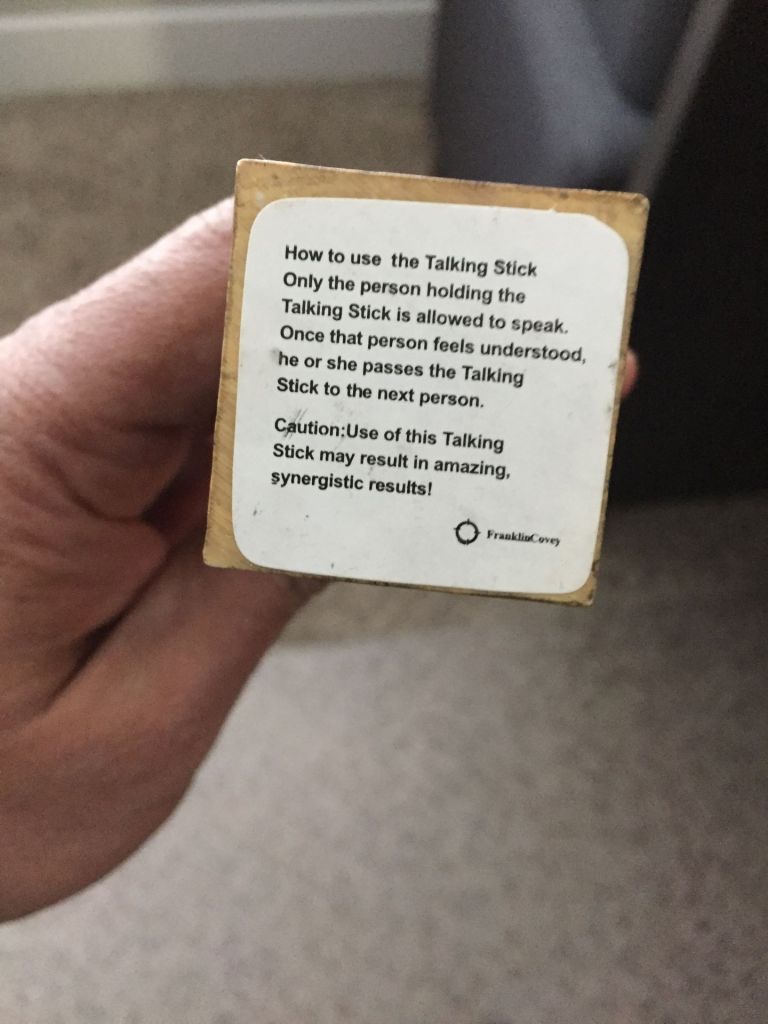
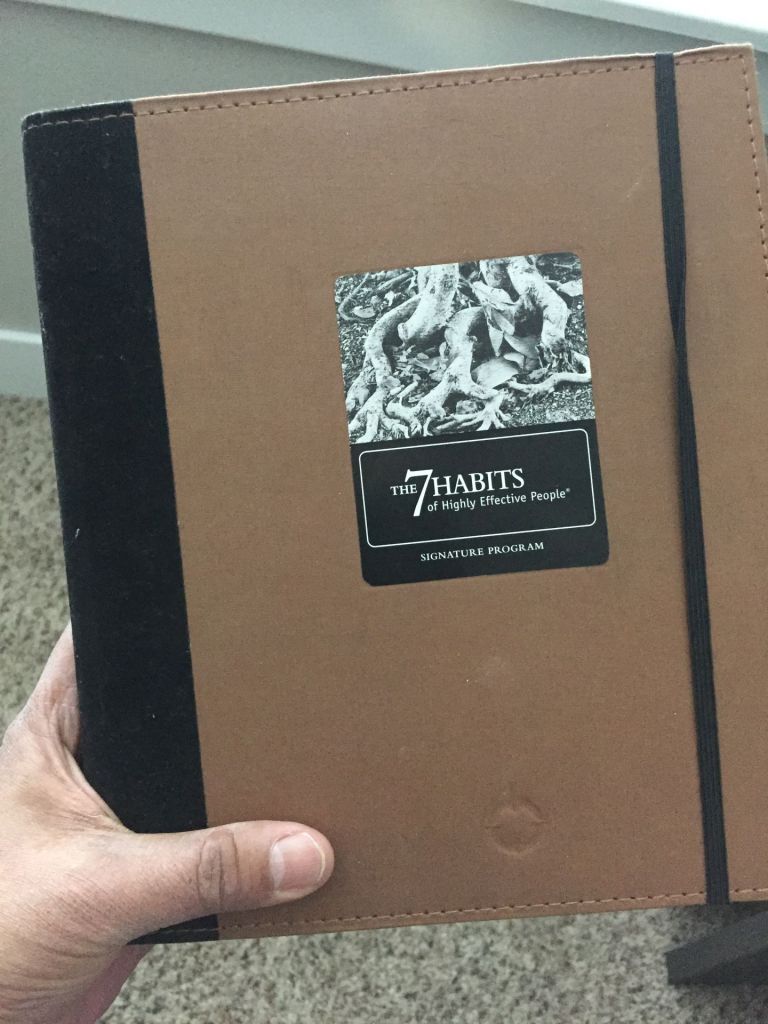
I took the 7 Habits of Highly Effective People Signature Program many years ago. All of us who attended got the course book and the Talking Stick. Back then Covey called it the Indian Talking Stick; I guess nowadays you’d call it the Indigenous People Talking Stick. The idea was to pass the stick around and you’d have to respect the person holding it and listen carefully while they have their say until they feel understood. Only then could the stick be passed on to someone else, once again to allow them to say their piece until they are understood. There could be no interruptions.
I wonder if the Talking Stick really works. I’ve never tried it. I guess that’s the problem.
I think Covey left a legacy. I doubt that was his main goal.
This is a short post about my initial impressions about the book, “Our Hidden Conversation” by Michele Norris.
I’m not finished with the book yet, but I thought I would let you know that the first chapter, “Bread Crumbs” was tough to read. I had to put it down and come back to it a few times because it brought back memories.
The chapter title “Bread Crumbs” means the clues that parents, grandparents, etc. might leave for subsequent generations to find which might shed light on one’s background, explain troubling circumstances, and so on.
I have some bread crumbs left to me by my family. Some are in the form of photos, although there is no family photo of all of us together.
I remember the hair combing routine my mom had with me and my brother every Sunday morning before church when we were kids. Our father was black and my mother was white. Dad was out of the home and we lived with mom. We were the only black kids in the church. In fact, all the members were white.
Mom used a prodigious amount of hair oil while vigorously combing our curly hair back. It took many strokes and the pulling pinched a bit. The ritual took a little while. When I look back on it, I guess the goal was to straighten our hair as much as possible.
Everyone in the church always treated us kindly and I was baptized there.
If you decide to read “Our Hidden Conversations,” give yourself a break whenever you feel like you need it.
Sena bought a pretty big tomato at the grocery store the other day. When she picked it up, she said to a store employee that she was going to make a huge “vegetable hamburger” with it.
Evidently, the guy didn’t know what to make of the name “vegetable hamburger” because he asked her why she wasn’t going to use any meat.
This was the same situation when she tried to order a “vegetable hamburger” at Wendy’s over a year and a half ago. Nowadays everybody seems to think that means “meatless.”
I checked the internet again and I still can’t find a definition of a “vegetable hamburger” that corresponds to what Sena and I grew up with. Everybody seems to think that lettuce, tomato, etc. are no longer parts of a vegetable hamburger.
I think we need to bring this concept back-because I doubt Sena is going to change what she calls it.
I was thinking about my time as a student at Huston-Tillotson University in the 1970s (then Huston-Tillotson College) and remembered somebody who was a student there. His name is James Spaights. In honor of his stature in music as it connects to the Black History Month theme of African Americans and the Arts, I just want to make special mention that Mr. Spaights is a concert pianist. I have not found his obituary (you know already about my habit of checking the obituaries) so I’m not going to talk about him in the past tense.
When I met him, Mr. Spaights was straightforward about his life goal, which was to be a concert pianist. Little did I know that he had already achieved that by the time I met him at H-TU.
He gave a fantastic performance for the faculty and students. I’m pretty sure we gave him a standing ovation.
I found some news clippings and other items about his career (unfortunately I couldn’t find recordings of his performances), which deserves to be better known. He was a member of the Alpha Phi Alpha Fraternity and a fraternity news letter shows his photo and bio in the 1977 issue of the SPHINX:
“Brother James Spaights, pianist, whom New York critics acclaimed “a virtuoso pianist and technician of the first rank” after his New York debut at Town Hall in 1965, was presented in concert on March 20, 1977 in Carnegie Hall, New York City, by the Behre Piano Associates of New York. Spaights is a former student of Madam Edwine Behre in New York City, also Freda Rosenblatt, Bronx, N.Y. and Emma Slutsky, Brooklyn, N.Y.
For three years Spaights served as Ambassador of Goodwill for the United States’ State Department as a concert pianist touring throughout Europe, parts of Canada, and the United States.
On his most recent United States tour, Spaights was presented by the Music Department at Morgan State College in Baltimore, Maryland, and Goddard College in Montpellian, Vermont.
Spaights holds his B.A. Degree in Music from Howard University and a Master of Arts Degree in Music from Columbia University. He is a member of the Lechetisky Association of America, The Behre Piano Association of New York, and a member of Gamma Eta Lambda Chapter of Alpha Phi Alpha Fraternity in Austin, Texas.
He is presently serving a post in the Music Department of Huston-Tillotson College of Austin, Texas.” (The SPHINX, Fall 1977, Volume 63, Number 3 197706303).
I guess I misunderstood what Mr. Spaights was doing at H-TU when I was an undergraduate there. I thought he was a student! He never mentioned his career or accomplishments (at least to me) and he had a great sense of humor. I was in the presence of a music luminary and never knew it.
Ref: The SPHINX Volume 63, Number 3, October 1977.
We enjoyed the Dr. Martin Luther King, Jr. Distinguished Education (originally given on January 17, 2023) by Dr. Russell Ledet. He’s definitely a mover and a shaker and this is another recorded presentation that I wish was available for the general public.
His bio is knockdown impressive. And even more interesting to me is that he’s presently in residency toward boarding in adult psychiatry and child psychiatry as well as pediatrics.
That’s right—triple boarding.
His talk was a fascinating oral autobiography from his upbringing in poverty to his military career, to his undergraduate and graduate college career, and his achievement in organizing a very successful nonprofit, The 15 White Coats. This helps get underrepresented minority students into medicine by giving them inspiration and financial support.
His life story by itself is inspiring. It’s also exhausting. The person introducing him wondered aloud if he ever slept!
He began with a well-known quote by Dr. Martin Luther King, Jr:
“It’s all right to tell a man to lift himself by his own bootstraps, but it is a cruel jest to say to a bootless man that he ought to lift himself by his own bootstraps.”
Dr. Ledet’s story of his path from bootlessness to crowning success is compelling. You really have to hear it from him to get a clear idea of how difficult it was. It’s hard to imagine that a star like him once rummaged through dumpsters for food for the family while his mother was on the lookout to make sure he didn’t get caught.
I think a big part of what kept him going was his wife and kids. In fact, his wife, Mallory Alise, insisted that he take the path because of her fear he would die if he continued a dangerous assignment in the military.
A member of the audience who had a career similar to Dr. Ledet asked a question about what more should he do to make sure young people of color would get the kind of opportunities to succeed. Dr. Ledet had a very good answer, but that was not the most interesting part of the interaction. Firstly, the questioner didn’t sound (I know this is going to sound crass) black. He sounded more like someone who had grown up in the Northern United States—like me. But during the course of the conversation, it was clear that he was black. He just didn’t sound like Dr. Ledet. He also mentioned, almost in passing, that some people of color who succeed may develop imposter syndrome.
This sounded strange at first, but I quickly realized that I sometimes had felt like an imposter. This cuts two ways with me. One was the obvious context in which I came out of an impoverished background to finish college and medical school, and had a career as a consultation-liaison psychiatrist at a university medical center where I published and taught for many years. At times I felt like a phony.
The other situation in which imposter syndrome arose was when I went to Huston-Tillotson University (an HBCU formerly called Huston-Tillotson College) in Austin, Texas back in the 1970s. Most of the students were from the region. I had a Northerner’s accent and somebody once remarked on it, asking me “Why do you talk so hard?” I was easily identified simply because of how I spoke. I didn’t always feel comfortable, despite for the first time being not the only black guy in school. Ironically, I didn’t feel like I fit in, even in an HBCU. Even among those who looked like me, I sometimes felt like a phony. But that was not an enduring affliction.
And I think Dr. Ledet has a great deal of confidence and energy. More power to him.
February is Black History Month and in 2024 the theme is African Americans and the Arts.
This reminds me of a blues artist I heard on KCCK on the Big Mo Blues Show last Friday. His name is Toronzo Cannon and his career as a blues guitarist and songwriter is skyrocketing. I heard his song “The Preacher, the Politician, and the Pimp.”
The lyrics reminded me of a character (or maybe more properly a non-character) called Rinehart in Ralph Ellison’s book, Invisible Man. I’m by no means an Ellison scholar but in chapter 23 the main narrator gets mistaken for a black guy named Rinehart who has many faces in the black community. He’s a preacher, a numbers runner, a pimp, and is also related to a political movement in the novel. Rinehart is all of them and none of them, moving between the “rind and heart” of who black people are in America. The implication is that the identity of black people is multifaceted and the similarity of the theme in Toronzo Cannon’s song is striking.
Cannon is also multifaceted. He’s a Blues guitar star and song writer and is also still a bus driver for the Chicago Transit Authority. How does he find time to do all that?
I wonder if Cannon got the idea for the song from Ellison’s novel. I guess I’ll never know.
This reminds me of an encounter I had with a black writer at Huston-Tillotson University (then Huston-Tillotson College, located in Austin, Texas) in the 1970s when I was an undergraduate in college. I’ve described this episode before in another post (“Black Psychiatrists in Iowa” 2019). The excerpt below includes a reference to a book review I wrote that was published in The American Journal of Psychiatry over 20 years ago:
“This reminds me of a book review I wrote for the American Journal of Psychiatry almost 20 years ago (Amos, J. (2000). Being Black in America Today: A multi perspective review of the problem. Am J Psychiatry, 157(5), 845-846.).”
The book was written by Norman Q Brill, M.D. It reminded me of my experience at Huston-Tillotson College (now Huston-Tillotson University, a private school, historically with largely Black enrollment) in Austin, Texas back in the 1970s. I wrote:
“Dr. Brill’s appraisal of many black leaders in chapters such as “Black Leaders in the Black Movement” and “Black Anti-Semitism” may be refreshingly frank in the opinion of some. He tailors his prose so as not to denounce openly those whom many would describe as demagogues. At the same time, it is apparent that his underlying message is that a substantial number of them are not only out of touch with mainstream black America but may even mislead black people into adopting ideological positions that impede rather than foster progress. Dr. Brill’s description of the issue reminded me of my own experience with this phenomenon as a freshman in the mid-1970s at a college of predominantly black enrollment in the southern United States. A guest lecturer (who, as I recall, had also written a book about being black in America) told us that the white man would never allow a black man to be a man in America. He had only three choices: he could be a clown, an athlete, or a noble savage. These corresponded to the prominent and often stereotyped roles that blacks typically held in entertainment, sports, and black churches.”
I was taken aback by the speaker’s judgment and asked him what my choice should then be. He was equally taken aback, I suspect. He advised me to be a clown.
The lyrics of Cannon’s song “The Preacher, The Politician, and the Pimp,” Ellison’s Rinehart, and another writer’s characterization of the roles allowed in American society for black men all resonate together. What drives the similarity of this perception across different artistic platforms?
When I reflect on how I’ve negotiated my life’s path over they years, I guess I would have to admit that I’ve often played the clown. Anyone can see that in the way my sense of humor comes across. Is it the healthiest way to respond to racism in this country? In terms of the psychological defense mechanisms, I think it’s a relatively mature strategy. You could argue with that by asking, “But where’s the maturity in dad jokes?”













 Go Retire Psychiatrist