I just noticed something about one of my YouTube videos that I made sort of as a combination gag and educational piece about pseudobulbar affect. It needed a couple of updates—one of which is minor and which I should have noticed 10 years ago when I made it.
It’s a pseudo-rap performance (badly done, I have to agree although it was fun to make), but it’s one of my most watched productions; it has 18,000 views.
One minor update is about the word “Dex” in the so-called lyrics of this raggedy rap song (see the description by clicking on the Watch on YouTube banner in the lower left-hand corner). It stands for dextromethorphan, one of the ingredients along with quinidine in Nuedexta, the medication for pseudobulbar affect. Dextromethorphan has been known to cause dissociation when it’s abused (for example, in cough syrup).
The most important update is about Dr. Robert G. Robinson, who I joked about in the piece. He passed away December 25, 2024. He was the chair of The University of Iowa Dept. of Psychiatry from 1999-2011. He was a great teacher, mentor, and researcher. He published hundreds of research papers and books on neuropsychiatric diseases like post-stroke depression and pseudobulbar affect. He lectured around the world and was widely regarded as a brilliant leader in his field.
Early in my career in the department, I left twice to try my hand in private practice psychiatry. Both times Dr. Robinson welcomed me back—warmly. He was my co-editor of our book, Psychosomatic Medicine: An Introduction to Consultation-Liaison Psychiatry, published in 2010.
All who worked with Dr. Robinson will never forget him.
I read Dr. Ron Pies, MD’s essay today, “What Long COVID Can Teach Psychiatry—and Its Critics.” As usual, he made thought- provoking points about the disease concept in psychiatry. What I also found interesting was the connection he made with Long Covid, a debilitating illness. He cited someone else I know who was involved with a group assigned to create a working definition for it—Dr. E. Wes Ely, an intensive care unit physician at Vanderbilt University in Nashville, Tennessee.
I remember when I first encountered Dr. Ely, way back in 2011 when I was a consulting psychiatrist in the University of Iowa Health Care general hospital. I was blogging back then and mentioned a book he and Valerie Page and written, Delirium in Critical Care. Back then I sometimes read parts of it to trainees because I thought they were amusing:
“…there is a clearly expressed opinion about the role of psychiatrists. It’s in a section titled “Psychiatrists and delirium” in Chapter 9 and begins with the sentence, “Should we, or should we not, call the psychiatrist?” The authors ask the question “Can we replace them with a screening tool, and then use haloperidol freely?” The context for the following remarks is that Chapter 9 is about drug treatment of the symptoms and behaviors commonly associated with delirium.”
I would point out that the authors say, while acknowledging that the opinions of psychiatrists and intensivists might differ, “…we would advocate that a psychiatrist should be consulted for patients already under the care of a psychiatrist or on antipsychotic medications”. Usually, in most medical centers in the U.S.A. a general hospital consultation-liaison psychiatrist sees the delirious inpatient rather than the patient’s outpatient psychiatrist. And many delirious patients don’t have a previous formal history of psychiatric illness and so would not have been seeing an outpatient psychiatrist in the first place.” (Page, V. and E.W. Ely, Delirium in Critical Care: Core Critical Care. Core Critical Care, ed. A. Vuylsteke 2011, New York: Cambridge University Press).
I’m pretty sure I got an email from Wes shortly after I posted that, with his suggestion that I write more about the delirium research he was doing. He sent me several references. I met him in person at a meeting of the American Delirium Society later on and attended an internal medicine grand rounds he presented at UIHC in 2019, “A New Frontier in Critical Care Medicine: Saving the Injured Brain.” He’s also written a great book, “Every Deep-Drawn Breath.”
Anyway, Dr. Ely and others were tasked by the Administration for Strategic Preparedness and Response and the Office of the Assistant Secretary of Health in the Department of Health and Human Services tasked the National Academies of Sciences, Engineering, and Medicine (NASEM) with developing an improved definition for long Covid.
At first, I was puzzled by the creation of criteria that essentially defined Long Covid as a disease state which didn’t even necessitate a positive test for Covid in the history of patients who developed Long Covid. I then read the full essay by Family Medicine physician, Dr. Kirsti Malterud, MD, PhD, “Diagnosis—A Tool for Rational Action? A Critical View from Family Medicine.”
I was hung up on the dichotomy between physical illness and somatization and thought the Long Covid definition posed a dilemma because it purposely omits any need for an “objective” test to verify previous Covid infection, making the Long Covid diagnosis based completely on clinical grounds. The section on persistent oppositions (dichotomies) was helpful, especially the 2nd point on the dichotomy of the question of whether an illness is physical or psychological (p.28).
The point on how to transcend the dichotomy was well made. I guess it’s easy to forget how the body and mind are related when a consultation-liaison psychiatrist is called to evaluate somebody for “somatization.” Often that was the default question before I ever got to see the patient.
Still, the person suffering from Long Covid often doesn’t seem to have a consistently effective treatment and may stay unwell or even disabled for months or years. Social Security criteria for disability look well-established.
I can imagine that many persons with Long Covid might object to have their care transferred to psychiatric services alone. I can see why there are Long Covid clinics in several states. It’s difficult to tell how many and which ones have psychiatrists on staff. The University of Iowa calls its service the Post Covid Clinic and can refer to mental health and neuropsychology services. On the other hand, a recent study of how many Long Covid clinics are available and what they do for people showed it was difficult to ascertain what services they actually offered, concluding:
“We find that services offered at long COVID clinics at top hospitals in the US often include meeting with a team member and referrals to a wide range of specialists. The diversity in long COVID services offered parallels the diversity in long COVID symptoms, suggesting a need for better consensus in developing and delivering treatment.” (Haslam A, Prasad V. Long COVID clinics and services offered by top US hospitals: an empirical analysis of clinical options as of May 2023. BMC Health Serv Res. 2024 May 30;24(1):684. doi: 10.1186/s12913-024-11071-3. PMID: 38816726; PMCID: PMC11138016.)
I’m interested in seeing how and whether the new Long Covid definition will be widely adopted.
I got a big kick out of the Big Mo Blues Show last night. And the Big Mo Pod Show this morning was another great teaching session by John Heim aka Big Mo.
It’s also another peek into the lives of blues and rock musicians which would appeal to the headshrinkers in the listening audience, including me. Coincidentally, on the shout-outs part of the show, Big Mo announced somebody he called “Dr. Jim, the shrink.” There are probably a lot of guys who could fit that moniker, not just me.
Anyway, one of the artists listed on the pod show included James Booker who played a piano piece entitled “Junco Partner.” It turns out Booker was in and out of jail and struggled with substance use disorder. He eked out a living from tips playing piano in bars.
The highlight of the pod show was Big Mo’s history of Howlin’ Wolf (Chester Burnett) who is well known for his song “Smokestack Lightnin.” As I usually like to do, I glanced at the web articles on sites with biographical information about Burnett, although I’m unable to curate them for accuracy. So, I checked the Britannica website entry. There are different versions of the story about what “Smokestack Lightnin” means. As near as a I can tell, I think Big Mo’s explanation is probably as accurate as you can get. There are web articles that claim Burnett said it was about train engine sparks blowing out of the stack.
Interestingly, Burnett formed a group that included another artist on the pod show, Little Junior Parker, whom I knew nothing about and as it turns out, neither did Big Mo. The question posed by Producer Noah was about how he got his name. Did “Little” mean there was a senior Parker? The African American Registry entry doesn’t shed any light on it. But both Burnett and Parker were inducted into the blues hall of fame. Burnett was also inducted into the rock and roll hall of fame.
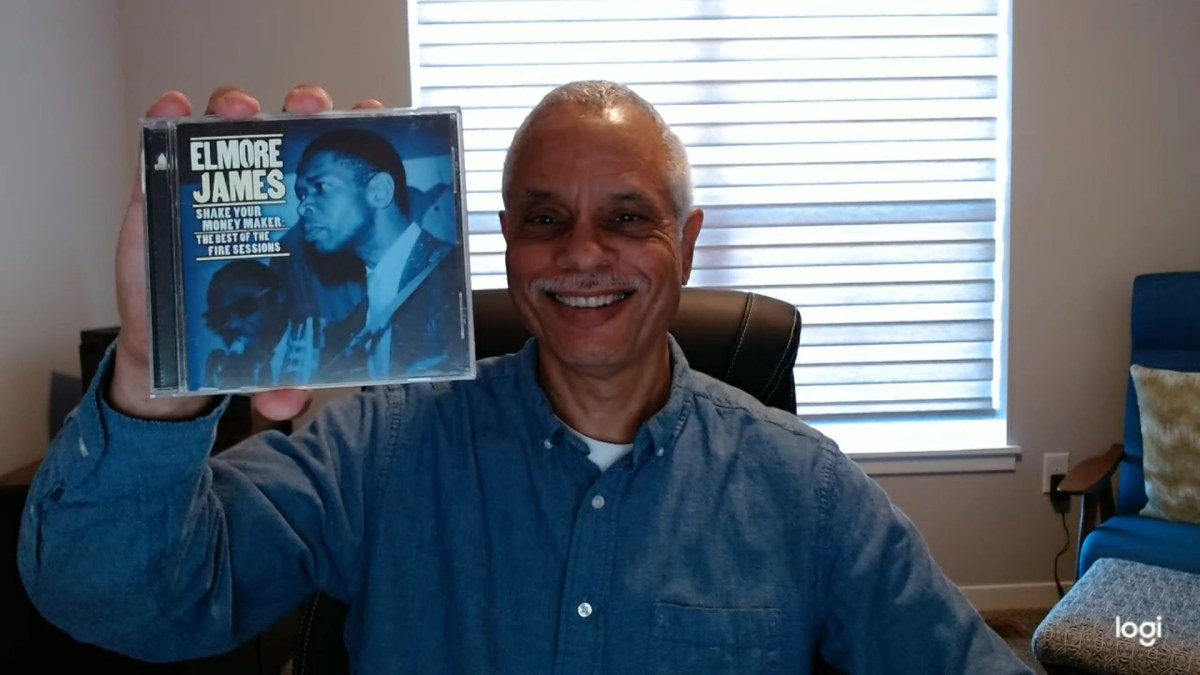
Just a smidgeon of trivia on Little Junior Parker’s song “Look on Yonders Wall.” I know that other artists have recorded this song. Elmore James is one of them and I happen to still have a copy of the CD, Elmore James, Shake Your Money Maker, Best of the Fire Sessions, released in 1960 (I didn’t buy it in 1960). It’s just an odd thing that you can find on the web a YouTube version of that, the title of which has an odd note, “Wrong Lyrics.” It has the lyric “look on yonders wall, hand me down my precious cane” instead of “walkin’ cane.” I’m unsure if it’s legit. And the words of the title are “Look on Yonder Wall” instead of “Look on Yonders Wall” although I think I can hear Elmore James sing “yonders.”
Now, one of the most interesting parts of the blues show last night was not something on the pod show today. I think it was during the last half hour of the blues show. I heard a rock and roll song I’d never heard of and I don’t know how I missed it because it was during my wasted youth when I was listening to similar songs at the time. It was released in 1975. It was the song “Green Grass and High Tides” by The Outlaws. I was absolutely open-mouthed thunderstruck by the guitar licks. One bit of trivia is that the song title is very similar to the title of an album released in 1966 by the Rolling Stones, “High Tide and Green Grass.” There’s no song with that title ever done by the Rolling Stones, it’s just the name of their album.
I always find Dr. Moffic’s articles in Psychiatric Times thought-provoking and his latest essay, “Enhancement Psychiatry” is fascinating, especially the part about Artificial Intelligence (AI). I liked the link to the video of Dr. John Luo’s take on AI in psychiatry. That was fascinating.
I have my own concerns about AI and dabbled with “talking” to it a couple of times. I still try to avoid it when I’m searching the web but it seems to creep in no matter how hard I try. I can’t unsee it now.
I think of AI enhancing psychiatry in terms of whether it can cut down on hassles like “pajama time” like taking our work home with us to finish clinic notes and the like. When AI is packaged as a scribe only, I’m a little more comfortable with that although I would get nervous if it listened to a conversation between me and a patient.
That’s because AI gets a lot of things wrong as a scribe. In that sense, it’s a lot like other software I’ve used as an aid to creating clinic notes. I made fun of it a couple of years ago in a blog post “The Dragon Breathes Fire Again.”
I get even more nervous when I read the news stories about AI making delusions and blithely blurting misinformation. It can lie, cheat, and hustle you although a lot of it is discovered in digital experimental environments called “sandboxes” which we hope can keep the mayhem contained.
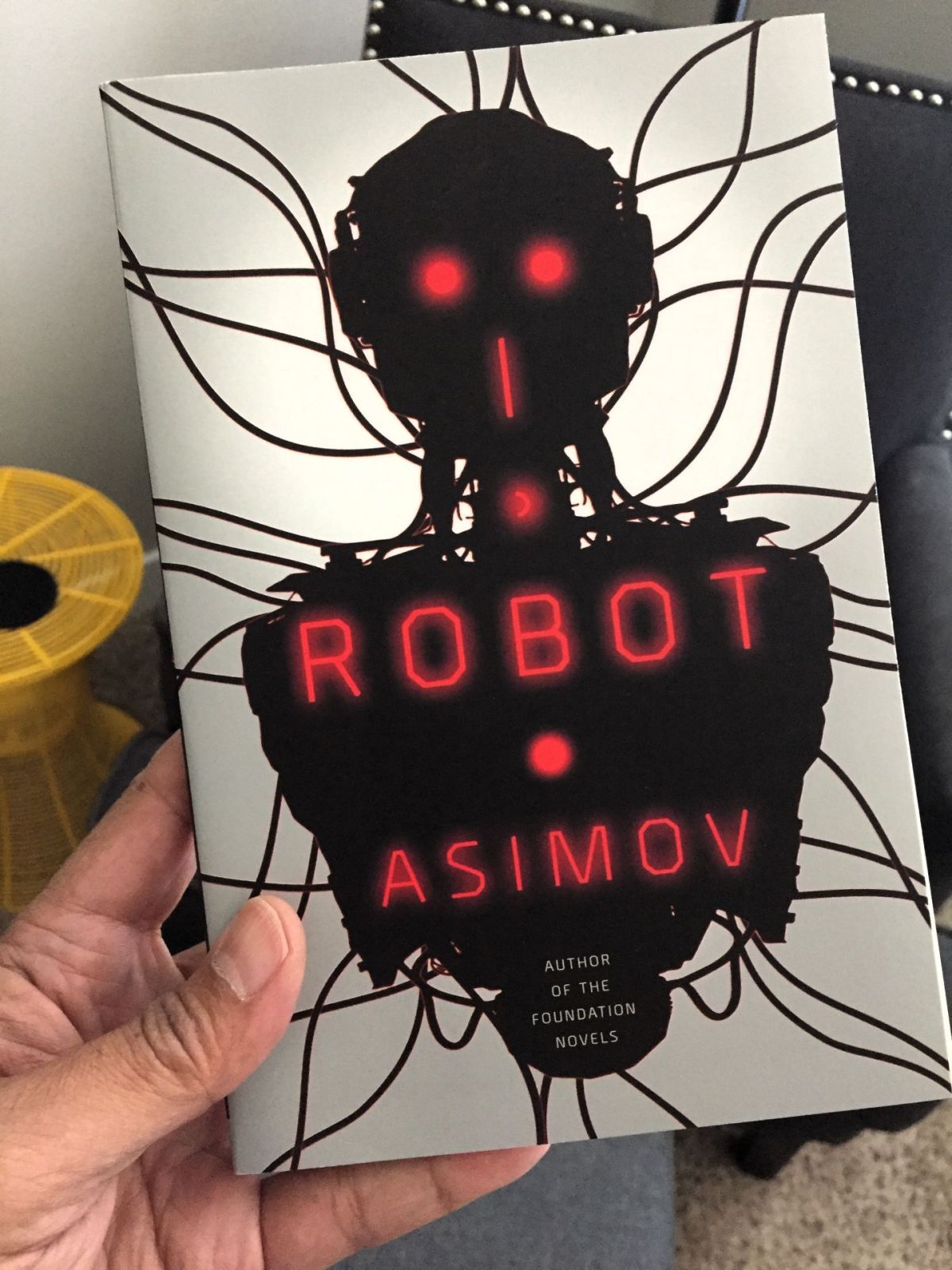
That made me very eager to learn a little more about Yoshua Bengio’s LawZero and his plan to create the AI Scientist to counter what seems to be a developing career criminal type of AI in the wild west of computer wizardry. The LawZero thing was an idea by Isaac Asimov who wrote the book, “I, Robot,” which inspired the film of the same title in 2004.
However, as I read it, I had an emotional reaction akin to suspicion. Bengio sounds almost too good to be true. A broader web search turned up a 2009 essay by a guy I’ve never heard of named Peter W. Singer. It’s titled “Isaac Asimov’s Laws of Robotics Are Wrong.” I tried to pin down who he is by searching the web and the AI helper was noticeably absent. I couldn’t find out much about him that explained the level of energy in what he wrote.
Singer’s essay was published on the Brookings Institution website and I couldn’t really tell what political side of the fence that organization is on—not that I’m planning to take sides. His aim was to debunk the Laws of Robotics and I got about the same feeling from his essay as I got from Bengio’s.
Maybe I need a little more education about this whole AI enhancement issue. I wonder whether Bengio and Singer could hold a public debate about it? Maybe they would need a kind of sandbox for the event?
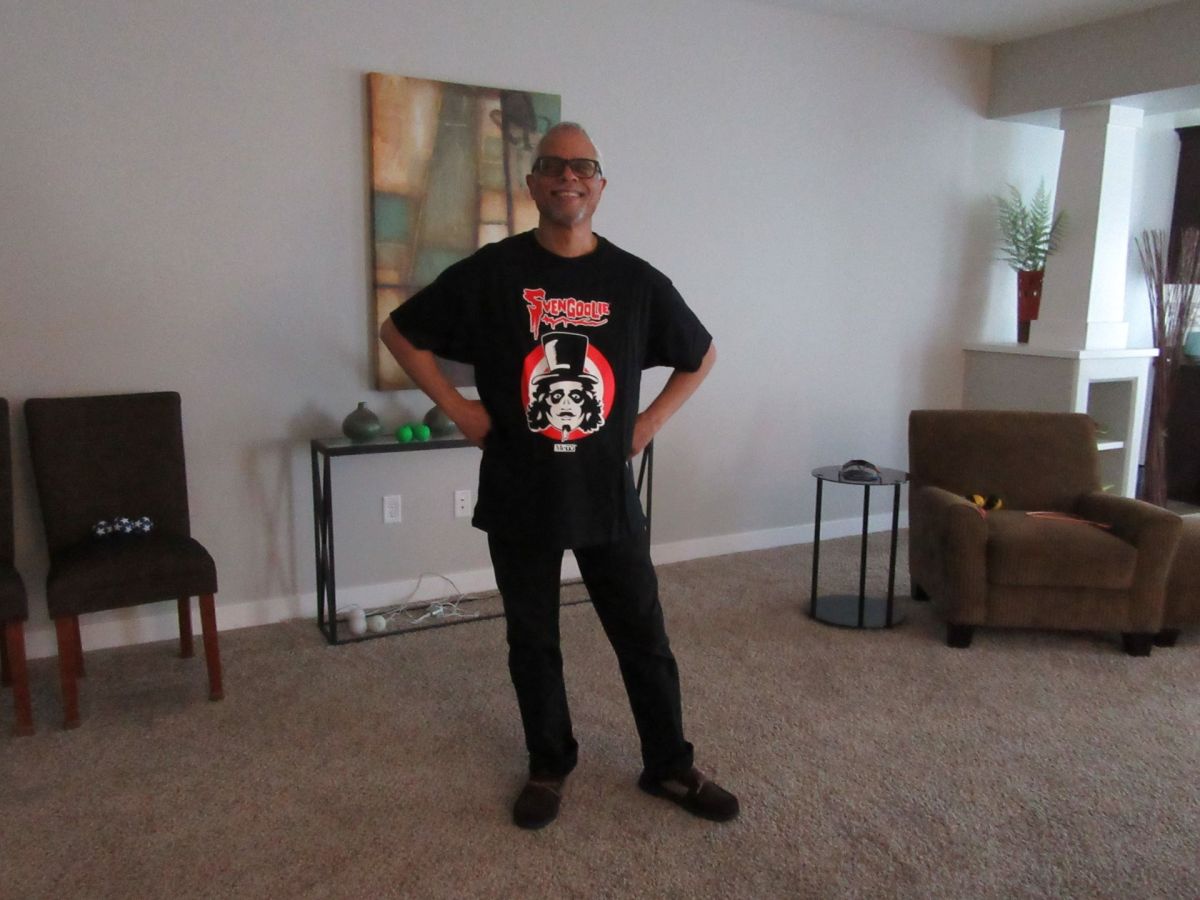
Last night I watched the Svengoolie Show movie, “The Haunted Strangler” (1958), starring Boris Karloff as Dr. Rankin, which had psychiatric overtones, along with hints at demonic possession. This was evidently a rerun of a previous Svengoolie episode.
Without spoilers, I can point to a time setting goof you can see in two copies of the film on the internet Archive. It involves a line by the character Dr. Kenneth McColl (played by Tim Turner, in which he attempts to explain Dr. Rankin’s behavior using the term “projective identification.” The problem is that as far as the time setting of the film’s story (from 1860 to the early 1880s), this psychoanalytic term for a defense mechanism was not invented until the mid-1940s by psychoanalyst Melanie Klein.
The point in one of the Internet Archive copies of the movie “The Haunted Strangler” where “projective identification” is mentioned by Dr. Kenneth McColl (played by Tim Turner) as a way to explain Rankin’s behavior is at 1:03:28, added on 09/02/2019 by Amalgamated. It’s also at 1:28:44 on the Internet Archive copy “Creature Feature: The Haunted Strangler” which is actually a Svengoolie episode, added by “Uh? Want Entertainment” on 02/22/2022.
Another interesting feature pointed out on the Svengoolie show includes the lack of complicated makeup for the transformation of Dr. Rankin into a homicidal monster. Karloff just removed his dentures and grimaced. I’m pretty sure it saved money on production costs.
The other psychiatric connection of “The Haunted Strangler” to psychoanalysis is dissociation both as a mental disorder and a defense mechanism. It’s also connected to dissociative identity disorder. In fact, the character Dr. Kenneth McColl mentions “dual personality” in the movie “The Haunted Strangler.”
There’s an echo also to “The Strange Case of Dr. Jekyll and Mr. Hyde” which was a novella published in the mid-1880s by Robert Louis Stevenson, which was adapted from Freud’s concepts of the id, the ego, and the superego. And we got the 1920 film “Dr. Jekyll and Mr. Hyde” (which I’ve never seen) arising from the dual personality idea. I think Svengoolie showed “Abbott and Costello Meet Dr. Jekyll and Mr. Hyde,” which I’ve also not seen.
There were several warnings (more than I usually have seen) to viewers about the possibility some scenes in the movie might be too intense for younger or sensitive viewers.
As the month of May Mental Health Awareness draws to a close, I reflect a little on the Make It OK calendar items that are salient for me: 3 things I’ve done that I’m most proud of and 3 reasons I’m hopeful for the future. I’ll keep it short.
One thing I’m most proud of is being the first one in my family to go to college. The biggest accomplishment was going to medical school at The University of Iowa in 1988. That was also the year Michael Jackson’s pop hit “Man in the Mirror” was released. That’s sort of how I felt about what I was doing that year—making a big change.
The more I reflect on this the more I realize the other thing I’m most proud of was getting a degree from Iowa State University in 1985. That paved the way for the path to becoming a doctor.
This process seems to work backwards because probably the first thing I’m proudest of is making a change even earlier in my life to land a job with a Mason City, Iowa consulting engineer firm, Wallace Holland, Kastler Schmitz & Co. That came before college and they’re all like stepping stones on the path of achievement. I think I started at the minimum wage back then, which was about $2.00/hr. I was an emancipated minor and couldn’t afford an apartment so I lived at the YMCA. It was a cramped sleeping room with no kitchen, a communal bathroom/shower, and a snack vending machine from which I got a worm infested candy bar. There were strict rules about what you could keep in your room—which somehow didn’t prevent one guy from building a motorcycle in his. Now this is getting too long.
In order to move on expeditiously with the mental health awareness calendar items, I’m going to cheat on the 3 reasons I’m hopeful for the future because they involve what is most important to a teacher. That’s what I was. I was so proud of the many medical students and residents I had the honor to teach. There were a lot more than 3 reasons to be hopeful for the future. I used to take group pictures of them and me at the end of each rotation through the consultation psychiatry service. We got a kick out of that because the only way I could do it was by using my old iPad that had a fun remote way to trigger the snapshot. I leaned the iPad up against something on a table. We all gathered as a group at the other end of the room. We posed, I raised my hand and counted to three, then closed my hand into a fist. That was our cue to smile. The shutter clicked.
Every time we did that, I was proud. Wherever they are, I hope they know how proud I am of them.
I just read Dr. George Dawson’s excellent blog post on supportive psychotherapy (“Supportive Psychotherapy—The Clinical Language of Psychiatry.” If you’re looking for an erudite and humanistic explanation of supportive psychotherapy, I think you’re unlikely to find anything superior to Dr. Dawson’s essay.
Now, about my take on “supportive” psychotherapy—there’s a reason why the word supportive is wrapped in quotes. It’s because I have a sort of tongue in cheek anecdote about it based on my experience with a staff neurologist in the hospital. It was long enough ago that I’m not sure what level of training I was in exactly. I was either a senior medical student or a resident doing a rotation on an inpatient neurology unit.
Dr. X was staffing the neurology inpatient service and I happened to overhear a brief conversation he had with the psychiatry consultants about what approach to adopt with a patient who he believed had a gait problem due to a psychological conflict. He wanted a psychological approach, preferring something on the psychodynamic side. I remember the psychiatric consultant said flatly, “We’re pretty biological.” I can’t remember what their recommendation was, but he disagreed. Later in the day, Dr. X gathered all of the trainees and we rounded on the patient in his hospital room.
We all crowded into the room with the patient, who had a severe problem walking due to what seemed to be unexplained hemiparesis. This is where the “supportive” element of Dr. X’s approach to psychological treatment came in.
Whether due to a deformity or past injury (I can’t recall which), Dr. X walked with a pronounced limp. He asked the patient if he would be willing to try walking vigorously with him across his room. Dr. X promised to assist him up and made it very clear that, despite his own limp, he was going to walk with the patient as normally as possible, together using both their legs.
The patient was very hesitant. Dr. X offered a lot of reassurance and encouragement—and then hoisted him up out of bed and marched with him across the room, ensuring that the only way this could happen was if he used both legs. The scene was comical, Dr. X limping but strongly moving in one direction while hauling the patient along with him.
The patient did it—twice and with increasing speed while obviously using both legs, never collapsing to the floor while Dr. X effusively praised him. He looked embarrassed and also seemed genuinely grateful for this miraculous cure. I was impressed.
I’m calling this a form of supportive psychotherapy partly in jest, but also to make a point about what support can mean, both literally and figuratively speaking, under certain circumstances according to how differently trained health care professionals might define psychiatric help.
Later in my career as a psychiatric consultant in the general hospital, I often found that many medical generalists and specialists preferred patients with these kinds of afflictions be transferred to psychiatric wards.
I don’t recall Dr. X ever suggesting that.
The personal identities of both doctor and patient were de-identified.
I learned a new slang word from Houston White, the guy who makes that specialty coffee in Minneapolis I blogged about yesterday: Brown Sugar Banana (I’m not a fan, but I admire him just the same). The word is “dope.” That used to be an insult or an illicit drug when I was growing up. Now it means “very good.”
I guess writing, at least for me, is dope.
The further I get in time away from the day I retired from practicing consultation psychiatry, the more I reflect about how I became a psychiatrist. I’m a first-generation doctor in my family, so what follows is one way to write about it.
What has helped me get through life was this writing habit along with a sense of humor. When I was little, I wrote short stories for my mother. I was the “number one son” in the words of my father, which meant only that I was the first born. My younger brother came second only in order of birth. He was the track star. I was the paperboy. Our parents separated early on. Sena and I have been married for 47 years.
I have been writing my whole life. I used a very old typewriter. I wrote poetry for a while, eons ago. Like many aspiring writers, I tried to sell them to publishers. The only publisher I remember ever responding sent me a hand-scrawled note on a small sheet of paper. He told this really short, nearly incoherent story about his son, who had apparently died shortly before. His son had a “tough road.” It wasn’t clear exactly how he died, but I remember wondering whether it was suicide. It was very sad.
In the 1970s, while I was a student at one of the Historically Black Colleges and Universities (Huston-Tillotson College, now a university) in Austin, Texas, I submitted a poem to the school’s annual contest and for entry into the college’s collection, called Habari Gabani (which means “what’s going on” in Swahili). It was rejected. Years later, I finally was able to track down a digital copy of Habari Gani.
Habari Gani from Huston-Tillotson College
Eventually, thank goodness for everyone’s sake, I gave up writing poetry. It was as bad as Vogon poetry. You’ll have to read Douglas Adam’s book “A Hitchhiker’s Guide to the Galaxy,” for background on that. The Vogons were extraterrestrials who destroyed Earth in order to build an intergalactic bypass for a hyperspace expressway. Vogon poetry is frightfully bad; it’s the waterboarding torture of literature.
I wrote a short Halloween story for my hometown newspaper contest once. It got honorable mention, but I can’t recall what it was about, thank goodness.
I wrote a feature story in a journalism class taught by a nice old guy who made a long speech to the class about the unfortunate tendency for young writers to use flowery, polysyllabic words in their prose. He made it clear that journalists shouldn’t write like that. Although I didn’t consciously do the opposite to annoy him, I did it anyway. I even tossed the word “Brobdingnagian” in it, which might have referred to some high bluffs somewhere in Iowa. Despite being infested with Vogonisms, my teacher tolerated it, sparing my feelings. I must have passed the course although how I did it remains a mystery.
I wrote and co-edited a book with the chairman of the University of Iowa Healthcare Dept of Psychiatry, Dr. Robert G. Robinson, MD. It was “Psychosomatic Medicine: An Introduction to Consultation-Liaison Psychiatry”. There were several contributors. Many of them were my colleagues. It was published in 2010, and prior to that, I’d written an unpublished manual that I wrote for the residents.
Handbooks of CL PsychiatryHandbook of Psychosomatic Medicine
There wasn’t any humor in either book, because they were supposed to be evidence of scholarly productivity from a clinical track academic psychiatrist. But I used humor and non-scientific verbiage in my lectures, albeit sparingly. I remember one visiting scientist remarked after one of my Grand Rounds presentations, “You are so—poetic” and I detected a faint disparaging note in his tone…probably a reaction to a latent Vogonism. It’s not impossible to monkey-wrench those into a PowerPoint slide or two.
I used to write a former blog called The Practical Psychosomaticist, later changed to The Practical CL Psychiatrist when The Academy of Psychosomatic Medicine changed their name back to The Academy of Consult-Liaison Psychiatry back in 2017. I wrote The Practical CL Psychiatrist for a little over 7 years. I stopped, but then missed blogging so much I went back to it in 2019 after only 8 months. I guess I was in withdrawal from writing.
Today is designated Earth Day although there is such a thing as Earth Month. Among the several trees Sena planted in our back yard trees are a few that we hope exemplify the Earth Day theme, which is Our Power, Our Planet.
One of them is a dogwood, which we’re hoping will bloom soon. Dogwoods represent joy and rebirth. There are a couple of crab apple trees, a red jewel and a perfect purple. Crab apple trees represent love and all are very special to Sena and me.
Love, joy, and rebirth. They can all be linked to power, which can be the power of will. The will to respect the planet also implies respecting each other. Practicing humility can be a kind of power.
The power to be still and listen to each other can make us more open to change.
On that note, because I can’t go for long without joking around, I should retell the story about me and the walking dead meditation. About 13 years ago, I had an even more serious case of not listening to others than I do now, if you can believe that. It eventually led to my choosing to take the Mindfulness Based Stress Reduction (MBSR) class ( see this current University of Iowa mindfulness essay). I wrote an essay for the Gold Foundation and it’s still available (I updated the links):
How I left the walking dead for the walking dead meditation (August 13, 2014)
About a year or so later, I bought Jon Kabat-Zinn’s book on Mindfulness-Based Stress Reduction (MBSR), Full Catastrophe Living, because I was dimly aware of the burden of stress weighing on me as a consulting psychiatrist in an academic medical center. I didn’t get much out of Kabat-Zinn’s book on my first read. But then in 2012 I started getting feedback from colleagues and trainees indicating they noticed I was edgy, even angry, and it was time for a change.
Until then, I’d barely noticed the problem. Like most physicians, I had driven on autopilot from medical school onward. I had called myself “passionate” and “direct.” I had argued there were plenty of problems with the “system” that would frustrate any doctor. I had thought to myself that something had to change, but I never thought it was me.
After reflecting on the feedback from my colleagues and students, I enrolled in our university’s 8 week group MBSRprogram. Our teacher debunked myths about mindfulness, one of which is that it involves tuning out stress by relaxing. In reality, mindfulness actually entails tuning in to what hurts as well as what soothes. I was glad to learn that mindfulness is not about passivity.
But I kept thinking of Kabat-Zinn’s book, in which he described a form of meditation called “crazy walking.” It involved class members all walking very quickly, sometimes with their eyes closed, even backwards, and crashing into each other like billiard balls. I hoped our instructor would not make me “crazy walk” because it sounded so—crazy. I dreaded crazy walking so intensely that I considered not attending the 6-hour retreat where it might occur.
We didn’t do crazy walking. Instead, we did what’s called the “walking meditation.” Imagine a very slow and deliberate gait, paying minute attention to each footfall—so much so that we were often off balance, close to crashing into each other like billiard balls.
I prefer to call this exercise the “walking dead meditation” because it bore a strong resemblance to the way zombies move. One member of the class mentioned it when we were finally permitted to speak (except for the last 20 minutes or so, the retreat had to be conducted in utter silence). It turned out we had all noticed the same thing!
Before MBSR, I was like the walking dead. I was on autopilot — going through the motions, resisting inevitable frustrations, avoiding unstoppable feelings, always lost in the story of injustices perpetrated by others and the health care system.
In practicing mindfulness, I began noticing when my brow and my gut were knotted, and why. Just paying attention helped me change from simply reacting to pressures to responding more skillfully, including the systems challenges which contribute to burnout. About halfway through the program, I noticed that the metaphor connecting flexibility in floor yoga to flexibility in solving real life problems worked.
Others noticed the change in me. My professional and personal relationships became less strained. My students learned from my un-mindfulness as well as my mindfulness, a contrast that would not have existed without MBSR.
As my instructor had forewarned, it was easy for me to say I didn’t have time to practice meditation. I had to make the time for it, and I value the practice so much that I’ll keep on making the time. I will probably never again do the walking dead meditation.
Today we gather to reward a sort of irony. We reward this quality of humanism by giving special recognition to those who might wonder why we make this special effort. Those we honor in this fashion are often abashed and puzzled. They often don’t appear to be making any special effort at being compassionate, respectful, honest, and empathic. And rewards in society are frequently reserved for those who appear to be intensely competitive, even driven.
There is an irony inherent in giving special recognition to those who are not seeking self-aggrandizement. For these, altruism is its own reward. This is often learned only after many years—but our honorees are young. They learned the reward of giving, of service, of sacrifice. The irony is that after one has given up the self in order to give back to others (family, patients, society), after all the ultimate reward—some duty for one to accept thanks in a tangible way remains.
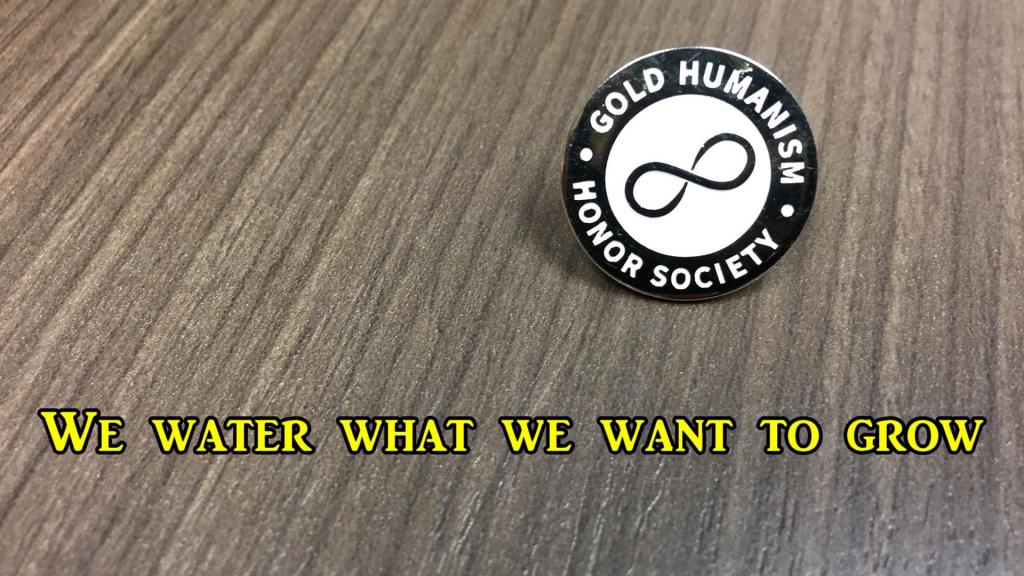
One may ask, why do this? One answer might be that we water what we want to grow. We say to the honorees that we know that what we cherish and respect here today—was not natural for you. You are always giving up something to gain and regain this measure of equanimity, altruism, trust. You mourn the loss privately and no one can deny that to grieve is to suffer.
But what others see is how well you choose.
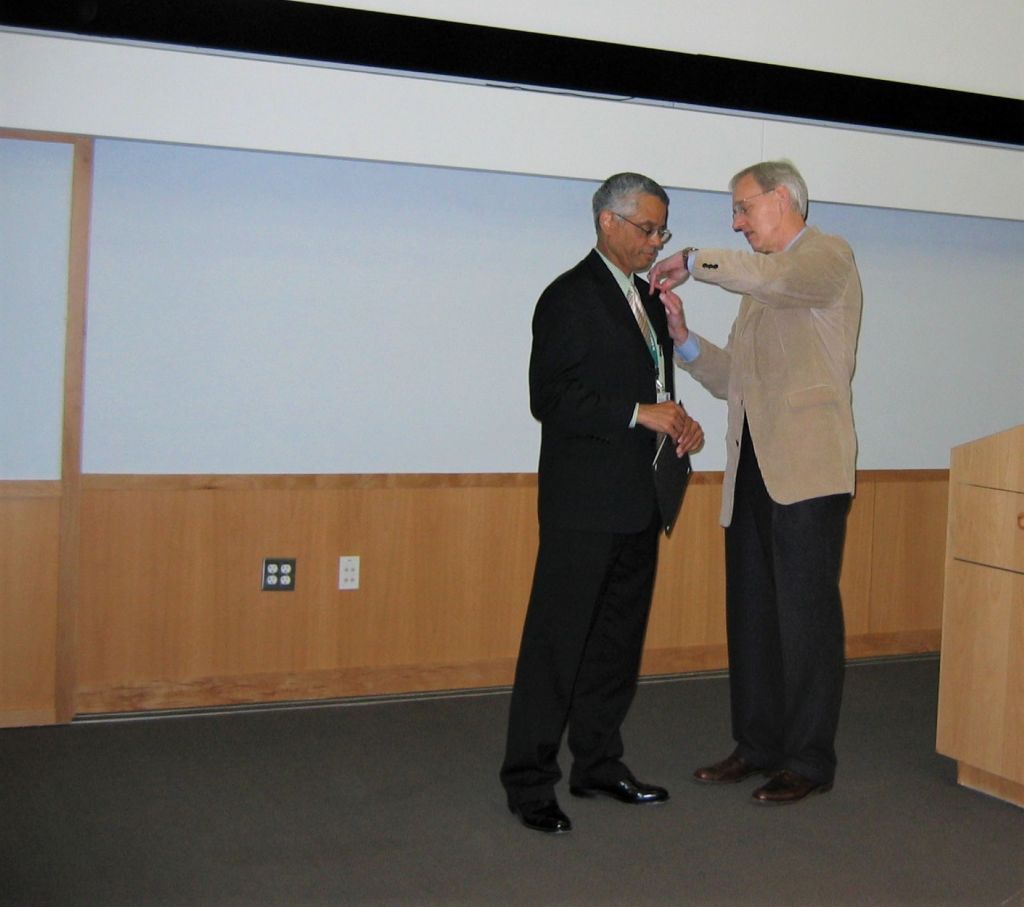
Leonard Tow awardGetting the pinOn my lapel; in my heart
I’m still practicing mindfulness-more or less. Nobody’s perfect. We hope the dogwood tree blooms soon.
I’ve been looking over some of the web articles on the Goldwater Rule, which is the APA Ethics Committee guideline enjoining any psychiatrist from making public psychiatric armchair diagnoses of public or political figures without a formal evaluation or permission to conduct one. It was originally made in 1973, years after Fact Magazine in 1964 sent out a questionnaire to psychiatrists asking for their public opinions about the mental stability of then candidate Barry Goldwater who was running for President against Lyndon B. Johnson. Many thought he was psychotic, although there was no evidence for that. Goldwater won a lawsuit against Fact Magazine, which led to the publisher going out of business. It was a big embarrassment for psychiatrists, which contributed to the creation of the Goldwater Rule.
Over the last few years and currently, many psychiatrists question whether the Goldwater Rule should be revised and abolished, making it permissible for psychiatrists who believe they have a duty to warn the public about political leaders they think might be a threat to national security, specifically President Donald Trump.
I’ve found a few articles on the web which helped me think about my own position about this. McLoughlin says the Goldwater Rule should change, but doesn’t tell us how. Glass calls the Goldwater Rule a “gag rule” and tells us why it should change. He resigned from the APA in protest. Ghaemi and others don’t agree on whether the Goldwater Rule should change, and one discussant says the rule only applies if you’re a member of the APA. Blotcky et al tell us how it could change, using sample conversations between reporters and psychiatrists.
I lean toward Blotcky et al. In fact, the final paragraph gives psychiatrists another way to express their opinions to the public. They can give them as private citizens without calling them professional judgments—which is their right.
On the other hand, if you want to know about my psychiatric interview of President Trump, you can see it below.
Mr. President, you have signed an affidavit allowing me to conduct a thorough psychiatric assessment today.
Yes, Dr. Amos, that’s correct.
Can you tell me why an Autopen was used to sign it?
I decline to answer that question on the grounds it may incriminate me.
Have you ever undergone a psychiatric assessment before?
Yes, but I had to fire her when she started asking questions about tariffs.
Very well, then. Can you tell me a little about your childhood?
It was perfect—as long as the other kids paid their tariffs.
Oh. Was there ever a time in your life marked by any problems with having access to the basic necessities of life?
Well, there was one thing. Water pressure was sometimes low, which is why I just wrote an Executive Order ensuring that low water pressure in faucets and showerheads will never again in my lifetime or yours be a problem. Make American Faucets Gush Again (MAFGA).
Thanks, I’m sure. Tell me, how would you typically go about solving an interpersonal conflict between you and others?
Raise tariffs by 300%.
I see. How about talking to people with whom you disagree?
I would say, “You’re fired.”
Would you try anything else first?
I would try tariffs.
Well, I think we’re done here. Thank you for your time, Mr. President.
Of course, this was satire.
References:
McLoughlin A. The Goldwater Rule: a bastion of a bygone era? Hist Psychiatry. 2022 Mar;33(1):87-94. doi: 10.1177/0957154X211062513. Epub 2021 Dec 20. PMID: 34930051; PMCID: PMC8886301.
Nassir Ghaemi, MD MPH.The Goldwater Rule and Presidential Mental Health: Pros and Cons – Medscape – Jun 07, 2017.
Glass, Leonard A. The Goldwater rule is broken. Here’s how to fix it. Stat News. June 28, 2018.
Blotcky, Alan D., PhD; Ronald W. Pies, MD; Moffic, H. Steven, MD. The Goldwater Rule Is Fine, if Refined. Here’s How to Do it. Psychiatric Times. January 6, 2022. Vol. 39, Issue 1













 Go Retire Psychiatrist