Rearranging My Books

The other day, I finally rearranged my bookshelf. I’ve put it off for a long time. While I was doing it, I remembered where I spend the most time in my thoughts. I don’t have a very broad library, which probably illustrates where my mind wanders. It has changed very little over the years. Retirement affected it some, but not a great deal. After I rearranged the books, it was not just better organized. It made me think about the past, the present, and the future.

I have a lot of books by Malcolm Gladwell for some reason. The Tipping Point was published around the time when all of my immediate family members died for one reason for another. They died within a few years of each other. It was a difficult time. I remember hoping I would just get through it. I did.

I’m still a fan of Stephen Covey. The 7 Habits Manual for the Signature Program marks a time when I was contemplating leaving my position at The University for a position in private practice. It didn’t work out, and it’s just as well.

Of course, there are many books about consultation psychiatry, including the one I wrote with my former Dept. of Psychiatry Chair, Robert Robinson. Every once in a while, I search the web to find out what former colleagues and trainees are doing now. I can’t find a few, which makes me wonder. A couple have died. I’m a little less eager to look around each time I find out about those. Finding obituaries is a sad thing—and it makes me a little nervous about my own mortality. One or two have apparently simply dropped off the face of the earth.

I read some books for fun. I’m a fan of humorists, which is no surprise. The most recent is The Little Prince. That book and others like it inspire me.

I like books that make me laugh and give me hope. It’s difficult to sustain hope in humanity, if you read much of the news, which I tend to avoid.

I feel better when we go out for walks. Recently we did that about a week ago when there were a couple of warm days. On one day, we saw a couple of bald eagles and northern shovelers (the latter of which we’ve never seen before), at Terry Trueblood Recreation Area.

On another warm day we saw a couple Harvest Preserve staff members preparing to hang a big Christmas wreath on the side of a barn on the property that faces Scott Boulevard. They’d got some evergreen branches from an “overgrown Christmas tree farm.” It had a big red bow. They were going to decorate it further and hang it. We hoped it would be finished by the time we returned that day, but it wasn’t done.

When we returned a day later, it was very cold but the wreath was on the barn wall and it was festooned with gorgeous decorative balls. It was worth waiting for.

Video music credit:

Canon and Variation by Twin Musicom is licensed under a Creative Commons Attribution 4.0 license. https://creativecommons.org/licenses/by/4.0/

Artist: http://www.twinmusicom.org/
A Study Shows Mindfulness Is Non-Inferior to SSRI for Anxiety Disorders And What the Heck Does That Mean?

I ran across this study showing Mindfulness Based Stress Reduction (MBSR) is “noninferior” to escitalopram in the treatment of adults with anxiety disorders.

I passed my Biostatistics course in medical school—barely. I have been practicing MBSR daily (for the most part) since 2014 when I really needed to address my struggle with burnout. I’m probably a worrier but I doubt I have a clinically significant anxiety disorder. I’m admittedly biased in favor of MBSR. Otherwise, I wouldn’t still be practicing it after about 10 years.

On the other hand, I don’t have a great handle on the statistical concept of noninferiority in clinical studies. I found a little YouTube presentation on it and I think I’m a little more comfortable with it now. I said “a little bit.” I’m not taking questions.

Reference:

Hoge EA, Bui E, Mete M, Dutton MA, Baker AW, Simon NM. Mindfulness-Based Stress Reduction vs Escitalopram for the Treatment of Adults With Anxiety Disorders: A Randomized Clinical Trial. JAMA Psychiatry. 2023;80(1):13–21. doi:10.1001/jamapsychiatry.2022.3679

When Should Psychiatrists Retire?

In answer to the question in the title, I’ll confess right away I don’t know the answer. The impetus for my writing this post is the Medscape article about an 84-year-old physician who was forced to take a cognitive test required by her employer as a way of gauging her ability to continue working as a doctor. She’s suing her employer on the grounds that requiring the cognitive test violated the American with Disabilities Act (ADA), the Age Discrimination in Employment Act, and two other laws in her state.

I didn’t retire based on any cognitive test. I recall my blog post “Gauging My Readiness for Retirement,” which I posted in 2019 prior to my actual retirement. In it I say:

I spent 4 years in medical school, 4 years in residency, and have worked for more than 23 years as a psychiatrist, mostly as a general hospital consultant. Nothing used to jazz me as much as running around the hospital, seeing patients in nearly all specialties, evaluating and helping treat many fascinating neuropsychiatric syndromes, teaching medical students and residents, and I even wrote a book.

On the other hand, I don’t want to hang on too long. When people ask me why I’m retiring so early (“You’re so young!”), I just tell them most physicians retire at my age, around 65. I also say that I want to leave at the top of my game—and not nudged out because I’m faltering.

In it, I mention a blog post written by a physician blogger, Dr. James Allen. The title is “When Physicians Reach Their ‘Use By Date.’ At the time I didn’t make a link to his post because the web site was not listed as secure.

Since that time, the web site has become secure, and you can read the post here. Dr. Allen lists anecdotes about physicians who ran close to or past their “use by” date.

Dr. Allen’s point is that we often don’t realize when we are past our “use by” date. That applies to a lot of professions, not just medicine.

There’s been a shortage of psychiatrists for a long time and it’s not getting better, the last I heard. All in all, I’m OK with the timing of my retirement.

I note for the record that I have not seen any mention in the news that the Rolling Stones have ever been required to take a cognitive test to continue working. I also want to point out that they are around 80 years old and their 2024 tour is sponsored by the AARP, the organization formerly known as the American Association of Retired Persons. I heard that the Rolling Stones new song, “Angry” is up for a Grammy.

I doubt anyone is angry about the obvious fact they’re not even thinking about retiring.

On Retiring from Psychiatry

I found this very uplifting and thought-provoking article on retiring from psychiatry by Juan C. Corvalan.

He sounds like he’s successfully navigating his retirement. On the few occasions I’ve felt compelled to make a remark about my own retirement, I typically say something like “It’s a mixed blessing.”

My retirement is a process, unfolding as time passes. It was difficult in the beginning, which was only a little over 3 years ago. It’s not what I would call easy even now.

What gave me joy since I retired were getting messages from the learners I was privileged to teach. Some of them I’d not heard from in many years. Someone from my department said, “We miss you.” I answered that, in some ways, I never left.

Time itself feels different. The days go by so quickly that I want time to slow down.

I like Corvalan’s way of expressing himself. He’s a writer and likes to talk about words and their meaning. He talked about the definition of the Spanish word for retirement, which is jubilacion, which reminds me of the English word “jubilation.”

Retirement has been, at times (perhaps often), anything but cause for jubilation.

On the other hand, I can think of several things I will never miss about being a psychiatrist. I don’t write about them, as a rule. In fact, I tend to write about anything but psychiatry: cribbage, juggling, making wisecracks about extraterrestrials.

I really appreciate colleagues like George Dawson, MD (who writes the blog Real Psychiatry), H. Steven Moffic, MD (who writes the articles “Psychiatric Views on the Daily News”), Ronald Pies, MD, Editor in Chief Emeritus of Psychiatric Times, and Jenna, the psychiatry resident who writes the blog “The Good Enough Psychiatrist,” who is very far from retirement, unlike me and the other writers just mentioned.

And I appreciate Dr. Corvalan’s excellent essay on retirement from psychiatry.

Reference:

Corvalan JC. A Retired Psychiatrist on Retirement: Rejoicing Jubilatio. Mo Med. 2022 Sep-Oct;119(5):408-410. PMID: 36338006; PMCID: PMC9616447.

Food for Thought

I’m giving a shout-out to a couple of child psychiatrists, one I know only from a blog, The Good Enough Psychiatrist. The other is an assistant professor in the University of Iowa Child Psychiatry Dept. I’ve never met her.

Since Jenna gives her name in the About Me section of her blog, I’m going to call her that because it’s easier. Jenna writes many thought-provoking posts, but I really admire the one titled “Amae.”

Dr. Ashmita Banerjee, MD wrote an essay titled “The Power of Reflection and Self-Awareness.” It’s published on line in the Mental Health at Iowa section of The University of Iowa web site.

As a relatively recently retired consultation-liaison psychiatrist who is also a writer, I feel a strong connection to them. In addition to being very glad that extremely talented persons are filling the ranks of a specialty which suffers from a serious manpower shortage, I get a big kick out of reading what really smart people write.

Here’s where a geezer retired psychiatrist starts kidding around. Jenna, a fellow blogger, is used to my habit of deploying humor, admittedly often as a defense. Dr. Banerjee doesn’t know me.

What is it about these essays that reminds me of the X-Files episode “Hungry”? It’s a Monster of the Week episode from the monster’s perspective. This monster looks like a human but sucks brains out of people’s skulls. He’s conflicted about it and even sees a therapist. But in the end his dying words were, as Agent Mulder shoots him down, “I can’t be something I’m not.”

If you read Dr. Banerjee’s essay and followed one of the links, you would have caught the clue that I actually read it because I consciously substituted the word “What” for “Why” in the previous paragraph. I could have as easily asked why instead of what—but it’s less helpful in gaining self-awareness.

And I haven’t sucked anybody’s brains out of their skulls in, what, over two weeks now! Upon reflection, I’m very aware of being incorrigible. Food for thought.

Jenna’s description of the Japanese concept of the word “amae” and Dr. Banerjee’s examination of the Japanese word “kintsukuroi” fascinated me. What made both writers consider human emotions using a language which captures the nuances so deftly?

I was a first-generation college student. There was a time in my life that a path to medical school seemed impossible. At times I probably thought I was trying to be something I’m not.

I’m just grateful for the new generation.

Dr. Igor Galynker and The Suicidal Crisis Syndrome

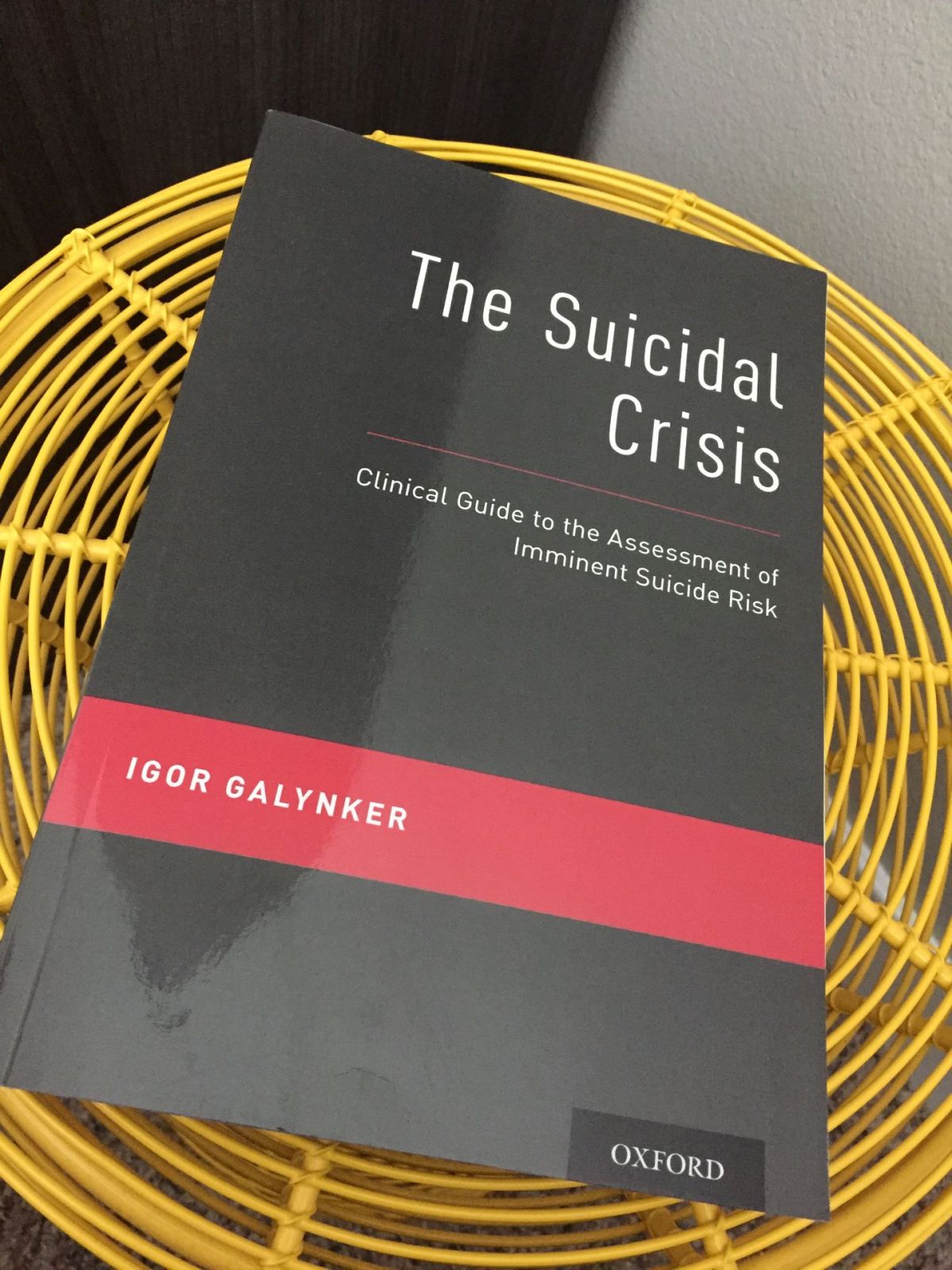
I was looking at my bookshelves and found the copy of the book, “The Suicidal Crisis: Clinical Guide to the Assessment of Imminent Suicide Risk.” It was written by Dr. Igor Galynker. It’s a fit topic for this month because September is National Suicide Prevention Month.

This brings back memories. I still have a gift from Dr. Galynker. It’s a stuffed animal called Bumpy the Bipolar Bear.

It arrived at my office at The University of Iowa Hospitals & Clinics in 2011. It was in a box addressed to:

WordPress

Attn: James Amos

200 Hawkins Drive

Iowa City, IA 52242

 I’m still not entirely sure why he sent me Bumpy. There was no letter of explanation. I was writing a blog at the time called “The Practical Psychosomaticist” and I might have posted something about some research he published on suicide risk assessment.

I bought a copy of his book a few years ago. I barely had time to skim a few of the chapters because I was too busy conducting suicide risk assessments in the emergency room, the general hospital, and the clinics in my role as a psychiatric consultant. In fact, I think it’s an excellent resource.

I also found a YouTube video (posted about a month ago) in which he describes his suicide crisis syndrome assessment. You can find the actual set of questions for the assessment here and in a link posted in the description below the YouTube.

September is National Suicide Prevention Month

September is National Suicide Prevention Month. The 988lifeline website has many resources for getting the word out about the importance of not missing any opportunities to help prevent suicide.

In fact, there is a recently published article entitled “Multiple Missed Opportunities for Suicide Risk Assessment in Emergency and Primary Care Settings.” A few of the important take home points:

  • “Screening for suicide risk, while a critical step in potentially preventing death or injury by suicide, is fraught with additional challenges centering around the poor sensitivity and specificity of many of the screening tools. The widely used PHQ-9 question about suicide has poor sensitivity and specificity. A much better screening tool we recommend is the Columbia-Suicide Severity Rating Scale Screener which can be administered by both clinicians and non-clinician individuals who have been trained in its use.
  • So called “no harm contracts” are best avoided and, instead, replaced with approaches that emphasize joint planning that more respectfully builds upon patients’ innate resiliency to self-soothe, build upon one’s protective factors and reduce those risk factors that are modifiable, and problem-solve ways to create a series of “what-if” scenarios of what to do if suicidal feelings start to intensify
  • Firearms are the leading means of fatal suicides in the U.S. Effort to ensure patients at risk for suicide do not have access is critical
  • There is a bidirectional and undoubtedly complicated relationship between substance use and suicide.”

Stop Me If You Heard This One Before

I saw one of my favorite X-Files episodes the other night. It’s titled “Monday.” Mulder goes through the day repetitively doing the same things, including fumbling his chance to thwart a bank robber who blows up the bank and everyone in it, including Mulder. See the Wikipedia for a full spoiler alert but I’m going to spill the beans here anyway.

A lot of people think the idea was stolen from the movie “Groundhog Day,” which I’ve never seen. Actually, it was stolen from a Twilight Zone episode called “Shadow Play,” which I have seen.

“Monday” got good reviews overall, which is saying a lot. I never got the part about how a bank robber (Bernard) who can only land a job mopping floors would be smart enough to build a bomb jacket.

That said, the scenes are mostly everybody going through the day doing the same things over and over. Mulder and Scully both meet Bernard and his girlfriend Pam, who was always waiting outside in the getaway car and is the only one who remembers what has happened each and every time, which is about 50. Pam thinks Mulder is the key to disrupting the endless cycle. She has been trying to get Mulder to change what he does every time he walks in the bank just to cash a check and interrupts Bernard in the process of robbing the bank.

Mulder never gets it right away, but does wonder aloud that he’s getting a sense of déjà vu. Déjà vu is the sense that an experience is something you had before but could not have. The medial temporal cortex triggers the false memory and, normally, the frontal lobe says, “No, this is not a memory.”

Eventually, Mulder gets the idea of repeating to himself over and over that Bernard has a bomb and changes his approach by giving his gun to Bernard and telling him he knows he has a bomb. This approach is based on the assumption Bernard will walk out without setting off the bomb because Mulder will let him go without trying to arrest him.

Then, Scully brings Pam into the bank, and Bernard almost surrenders to Mulder, until he hears police sirens—and tries to shoot Mulder but instead kills Pam because she steps into the path of the bullet. He gives up and doesn’t set off the bomb. Pam changed the ending and notices just before she dies that it never happened in any of the previous enactments.

There’s the brain-based definition of déjà vu and then there’s a more mundane definition, both of which are in the Merriam-Webster dictionary on the web. The mundane definition is “something overly or unpleasantly familiar,” mainly about situations that happen repeatedly (“here we go again”).

We all recognize the second definition. We sometimes say or do something which we would not if we just recognized that it’ll trigger a pattern of events we would like to avoid. Something has to change in order to interrupt the pattern.

Psychiatrists and psychotherapists are usually experts in helping people change repetitive, maladaptive patterns of thought and behavior.

Medications can be helpful, for example in the repetitious thoughts and behaviors of obsessive-compulsive disorder (OCD). Some cases of that may respond better to a combination of psychotherapy and medication.

One of the challenges is that there are not enough helpers to help those who need it. Another challenge is that the ones who need help often don’t recognize they need it. That’s called lack of insight.

The cycle of lack of insight and unpleasantly familiar, repetitive patterns sometimes resulting in explosive consequences is ubiquitous in our society.

Can somebody please bring Pam into the consulting room?

This is National Suicide Prevention Week

Thanks to Dr. H. Steven Moffic for his Psychiatric Times article, “A Psychological Autopsy on My Only Patient Who Died by Suicide.” In it he describes his own experience with a patient who committed suicide. He also reminded us that this is National Suicide Prevention Week. It’s also National Suicide Prevention Month.

The quote I’m familiar with about psychiatrists and patients who die by suicide Moffit is by forensic psychiatrist, Robert Simon:

“There are two kinds of psychiatrists—those who have had a patient die by suicide and those who will.”

I have been through that experience. It led me to focus on my role as an educator to psychiatry residents and other trainees to learn as much as I could about the process of suicide risk assessment.

On the other hand, my first experience with someone who died by suicide happened long before I became a psychiatrist. It was in the early 1970s and I was working for a consulting engineer company. I was just a kid, learning on the job to be a drafter and surveyor’s assistant.

One of my teachers was a man I would come to respect a great deal. Lyle was a land survey crew chief and part time photographer. He was gruff, but kind and had a great sense of humor. We all liked him.

He was so tough that, while perched high in a tree and trimming a large branch to enable a line of sight for the instrument man running a theodolite (used to measure vertical and horizontal angles)—he accidentally cut a significant gash in his hand. We on the ground were aghast because blood was dripping from his hand.

He just laughed and said, “I don’t sweat the small stuff.”

One day, he told me and another survey crew member that his girlfriend left him, saying she was tired of picking up after him. He was crying. We felt sorry for him and didn’t know what to say. We never saw him cry before. This image was strikingly different from the tough guy persona he usually had.

As I look back on it, I wondered why he didn’t think the breakup was just more “small stuff.”

The next day, one of the leaders of the company made a short announcement, saying that Lyle had “passed away,” the night before, by suicide. A little later, the rest of the story gradually emerged. Lyle had shot himself in the chest. One of the guys said that it took a long time for him to die, that somebody found him early the next morning, and all Lyle could say was “It hurts.” At first, I thought he meant physical pain. Later, I wondered if he meant physical and emotional pain.

About a week later, one of the survey crew members was planning to pick me up and drive us to Lyle’s funeral. He never showed up.

Of course, I could not have foreseen Lyle’s suicide based on his being so upset about a breakup with his girlfriend. I was just a kid.

When I became a psychiatrist, I saw this quite a lot. I learned, a few times the hard way, how to make the best judgments I could about what might happen to a patient describing physical and emotional pain.

Should Doctors Be Funny?

I ran across an interesting Medscape article, “Should Doctors Be Funnier? These MDs Are Real Comedians.” I don’t know if they should be funny, but it probably wouldn’t hurt.

I think a sense of humor is a good thing for anyone to have and it’s probably not that hard to develop. There’s even a Wikihow article on how to develop a sense of humor.

I usually look for the funny edge in most things that happen to me. I was always very nervous about presenting Grand Rounds when I was on staff at the hospital. I would try to come up with a good case example illustrating both medical and psychiatric features. It was pretty challenging.

I often used humor to help me get through my stage fright. I didn’t tell jokes, but I did clown around a bit. One day, I arrived too early for the Psychiatry Dept. Grand Rounds and accidentally walked in on another scheduled event in the conference room that was obviously not for psychiatrists—only not immediately obvious to me. I got a few chuckles from the audience just from having to back out. Later, during the real Grand Rounds I clowned about my mistake as a sort of opener to my presentation.

Unfortunately, I then had to stumble through my PowerPoint slides (every presenter’s worst nightmare) because I evidently had not organized them correctly. I survived by joking about it. That resulted in a digital award from the residents for being “Improviser of the Year.”

Humor can get you through some pretty sticky situations.