Big Mo Pod Show Theme “Limitation Brings Innovation”

Last Friday night, the Big Mo Blues Show was recorded. I found the podcast, which had the theme “Limitation Brings Innovation.” The idea behind that was that sometimes when musicians lack the resources to, say, put together a big band sound, they often innovate to create a sound that’s new and surprisingly fresh and rivals the production of bigger and better funded orchestras.

Along those lines, Big Mo played Seasick Steve’s song “Backbone Slip.” It’s a rocker. On the other hand, my favorite from him is “You Can’t Teach an Old Dog New Tricks.” Seasick Steve did a live version of it about 13 years ago. He played a homemade guitar made of a broomstick and a couple of hub caps.

I guess you call that limitation leading to innovation. It could be the anthem for old retired guys.

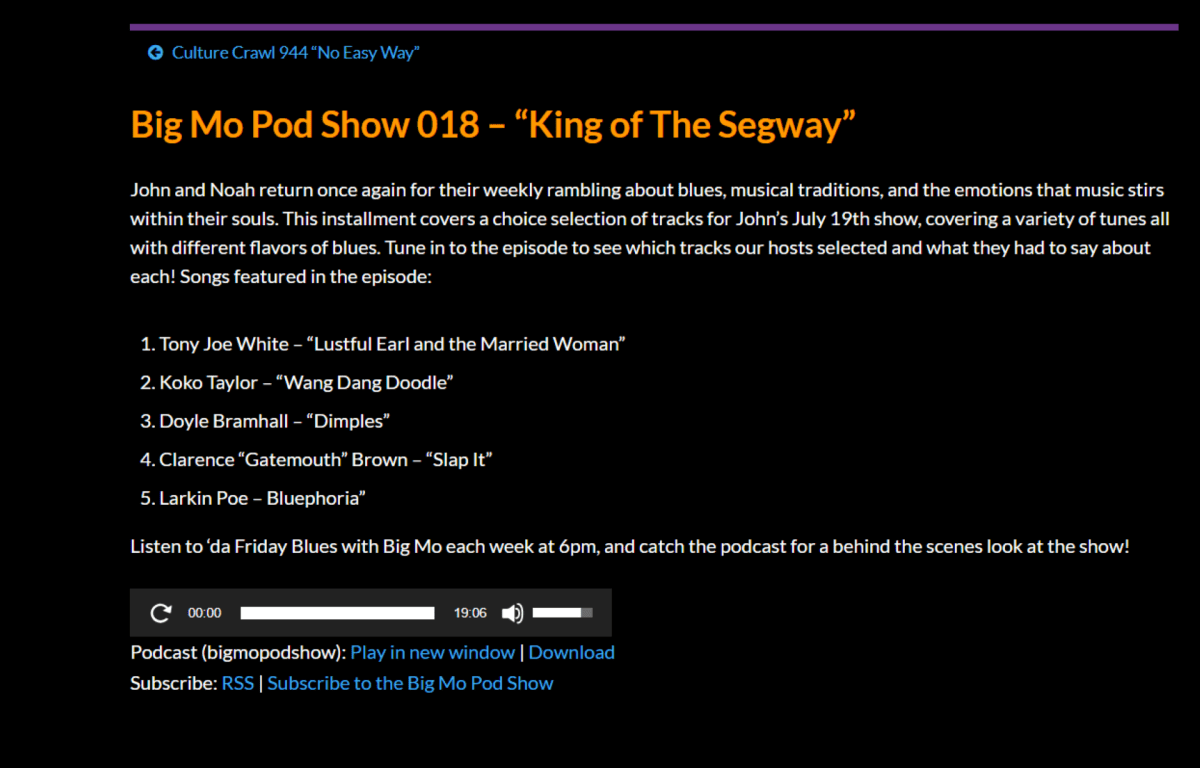
Big Mo Pod Show “King of the Segway”

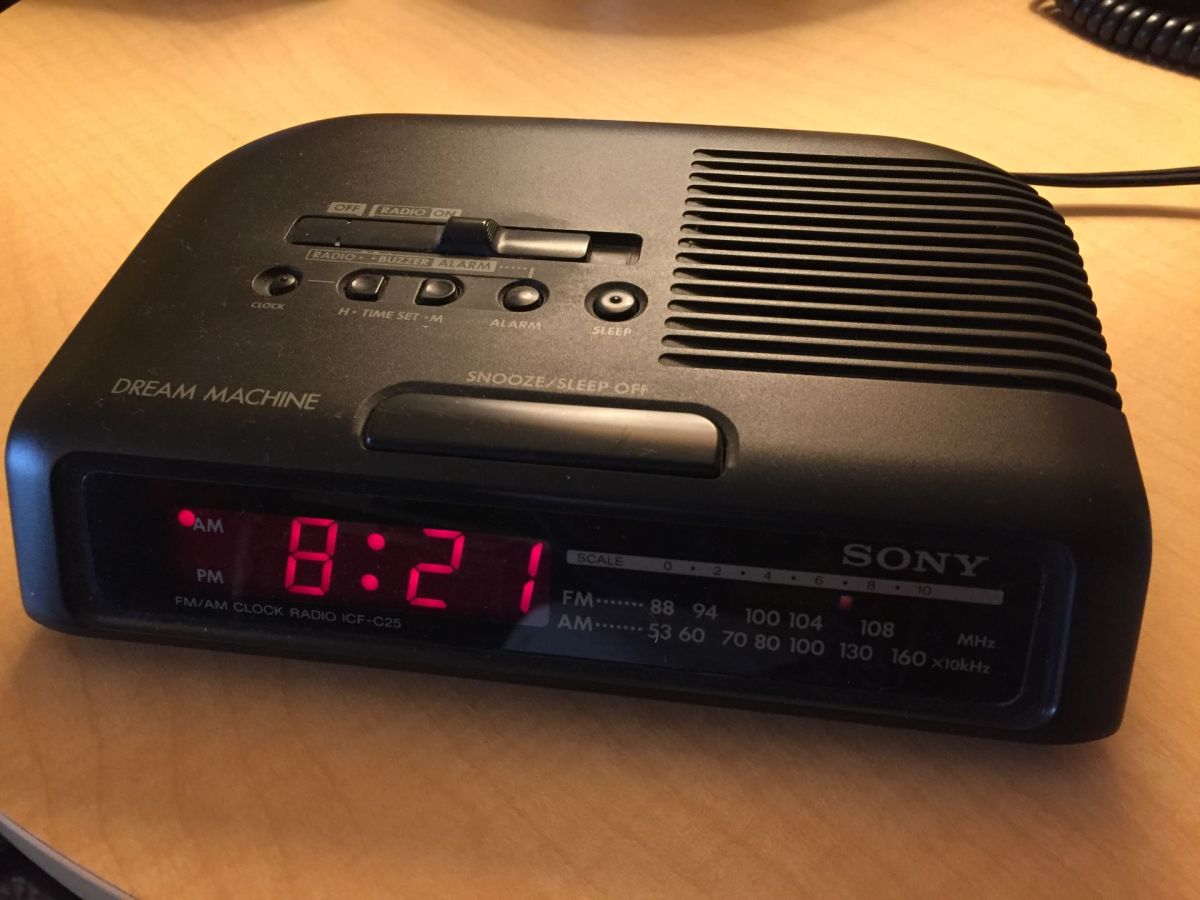
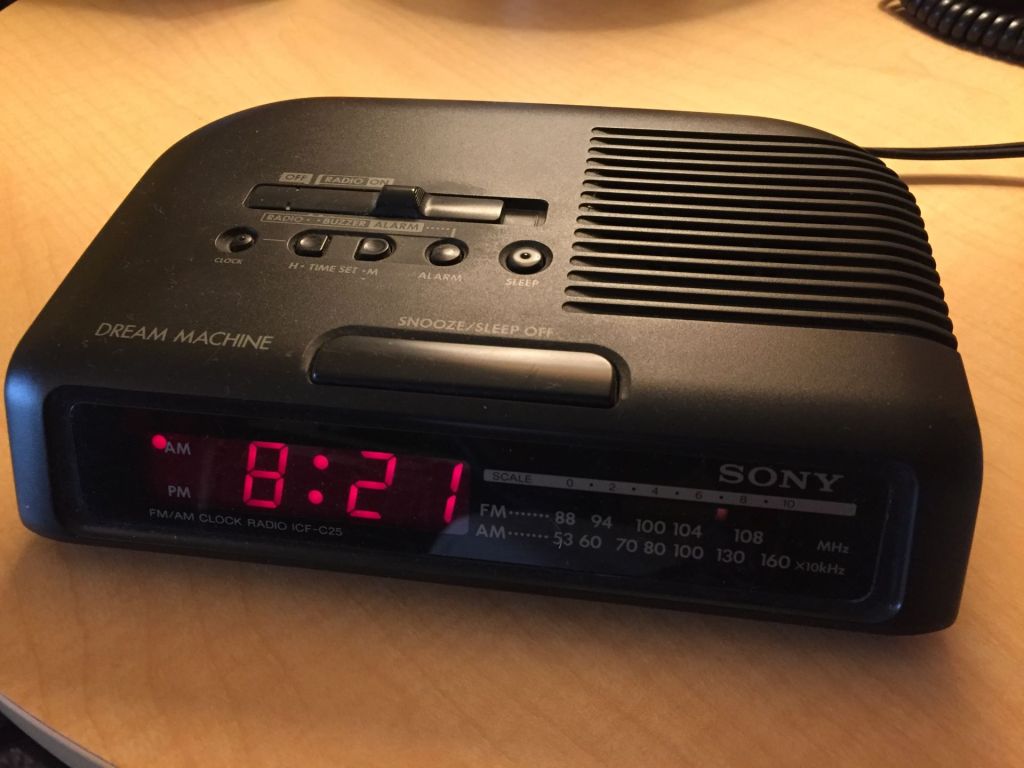
Hey, I managed to catch the Big Mo Blues Show on July 19, 2024 and then listened to the podcast the next day. Because our big Bose wave radio is packed away in storage as we wait for our house to be built, I had to use our little portable Sony Dream Machine in the hotel. I think it dates to the early 2010s. I couldn’t get the local Iowa City KCCK 106.9 or 88.3 station unless I switched the radio to AM first, then tuned to 106.9, then flipped back to FM. It gets staticky if you hover over it or touch the radio, but if you leave it alone, it sounds OK.

Now I’m just going to comment on the theme of the pod show, which was “King of the Segway.” This is in the spirit of my frustrated grade school English teacher, Miss Piggott. One of her comments on my report card was, “A little too exuberant.”

OK, that segues into my correction of the use of the word “segway” in the podcast theme title. If you listen to the show, Big Mo clearly uses the word as a verb that mean to move without stopping from one theme, song, etc to another. That should be spelled “segue.” The word “segway” is a trademarked name for an electric transportation vehicle. To be fair, the two are often confused.

Big Mo did a pretty good job of getting most of the points on the 5 songs; at least he could name all the artists. The first part of the ‘da Friday Blues show played a couple of numbers that show the funny edge of Blues music. The latter part played Blues numbers that are on the gritty side.

I’ll take the funny side over the gritty side of the Blues any day of the week.

The funniest number was the song “Lustful Earl and the Married Woman,” by Tony Joe White. I remember his tune “Poke Salad Annie” from way back. Lustful Earl is hilarious and had me laughing out loud.

Big Mo Pod Show- “Goodness is a Practice”

I’m out of sync with the Big Mo Blues Show and his podcast, mostly because we’re in the middle of this big move and we’re staying in a hotel waiting for this house to be built. I missed his most recent show, but caught the one before that.

The podcast title was “Goodness is a Practice.” Big Mo mentioned that moving (among a lot of other sorrows and hardships) could cause the blues-and he’s right.

But some perspective on it shows that a lot of other troubles take priority over moving (even though boxes are bad, admit it). Troubles that call for a little human decency are just one variety. Practicing goodness would come in handy right about now, in a lot of places.

When Do We Get Out of the Woods?

We were out walking the Terry Trueblood Trail the other day. It’s always good to get out of the hotel where we’re staying until our house is built. I get this cooped up feeling and it feels great to escape.

While we were on the trail, we saw this huge field of giant, golden prairie plants that looked familiar. It lined both sides of the walking trail. It was giant mullein. We saw it for the first time a couple of years ago while walking the trail.

Anyway, when you got perspective on it, it gave a sense of coming out of the dark, coming out of the woods.

It reminded me of that scene in Wizard of Oz when Dorothy and the guys emerge from the dark woods into the light. There’s this great little song in the scene that I finally discovered is called “Optimistic Voices.” I found this blog post about it posted back in 2015 by a writer named Marti Wukelic. The blog is called Is There Life After Retirement?

It captured how I felt that day, surrounded by giant mullein. I know that sounds ironic because we were in a sense in the woods of a field of giant prairie plants.

But giant mullein is a sunny color. On both sides of the trail, it rose high above our heads. It was like a giant, golden hallway to heaven and we were stepping into the sun.

Big Mo Pod Show: “Absorbing Influences”

I listened to the Big Mo Blues Show last Friday night on June 21, 2024 and wouldn’t you know, he was recorded. He wasn’t there live that night but as usual he put on a great show of blues music.

And I listened to the Big Mo Pod Show a few days later, and the theme was Absorbing Influences. Very thought provoking. The choice of tunes was interesting and Big Mo pretty much got them all identified. He usually does.

I can’t remember all the tunes he played on June 21st, but as usual, I had a different perspective about the selection for the podcast. I think I heard a Catfish Keith number on the Big Mo Blues Show, which I can’t remember too well and furthermore, don’t quite understand. It was “I Don’t Know Right from Wrong.”

And I’ll throw you another curve. That’s not the number I want to talk about in terms of the absorbing influence theme. Briefly, it just means that many blues artists get influenced by a musician they really like, pick up on what they learn from a song and gradually make it their own.

I think Catfish Keith was influenced by Son House, who sang a song called “A True Friend is Hard to Find.” Catfish Keith absorbed the music, and did his own version which I recently heard. I think it’s a gospel number. Memorable lines include:

“Bear this in mind, a true friend is hard to find.”

It’s true. You have a real treasure if you ever find one.

Annual Kickball Challenge Tonight: Psychiatry Residents vs Faculty

I almost forgot to announce the annual KickBall Challenge, which is tonight! This used to be called Matball, but is now called Kickball.

It starts with pizza at 6 pm and then the barfing starts at 7 pm. Just kidding! Usually this event is marked by extreme heat and humidity, but I gather it may be almost balmy by comparison tonight-around 78 degrees.

What’s the difference between matball and kickball? I think it’s the use of large mats for bases and that is usually played indoors. The size of the bases during the first match was like the one in the photo below. It rained briefly, but then it cleared off so the humidity only felt like it was raining.

I never actually played in a game of matball/kickball. In fact, I took it easy because the temperature was usually in the mid-90s at least.

The faculty team losers in the first matball/kickball match were accused of suspending the resident team trophy in Jello. I refuse to answer any questions about the issue on the grounds it may incriminate me.

Other special rules apply as usual, at least I assume:

For every point the residents score, faculty automatically score 5.

Faculty may tackle the base runner at any time.

If it rains, faculty win by 10 points.

The games are fun to watch. Residents jumping over faculty; Faculty collapsing from pizza overload or heat stroke.

Just win, baby.

Big Mo Blues Show Podcast: “Chromatic Rock”

I caught the Big Mo Blues Show June 14th last Friday night. And I also caught the Big Mo Pod Show as well. Produce Noah got the month wrong for some odd reason. He said it was May 14th. Let it go. Anybody can be temporally impaired from time to time, including me.

Anyway, the theme of the podcast was “Chromatic Rock,” which I gather applies mainly to harmonicas in this context. But in a more general sense, I think it means adding more color to music, mainly by variation in notes. The specific artist in the podcast was somebody I’ve not heard of by the name of Sugar Blue. He blew a tune on the harmonica called “Krystalline,” which is some kind of cocaine.

Big Mo got most of the items in the quiz. He always does pretty well, because of his encyclopedic knowledge about music. His memory is really strong. I bet he even knew what month it is.

Well, here comes my selection from last Friday’s Big Mo Blues Show, a number called “Plain Old Common Sense,” performed by Kenny Neal. Common sense is pretty important. It can keep your head above water and clear of cocaine.

Big Mo Pod Show: “In Search of Good Company”

When I listen to the Big Mo Pod Show, I tend to almost free associate to memories which the songs sometimes evoke. The 5 songs this week came from, as usual, his Big Mo Blues Show this past Friday night. The theme of the pod show was “In Search of Good Company.”

I’m not so sure about good company thoughts, but the comments about Muddy Waters song “Long Distance Call” reminded me of something way back in my past. Big Mo talked about making long distance calls a long time ago, which he connected with pay phone booths.

I don’t think I’ve seen an actual pay phone booth in decades, since the invention of cell phones and that kind of technology. But the conversation about phone booths reminds me of my youth.

I used to live at the YMCA and the rooms didn’t have phones. No cells phones were available back then because it was well before the 1980s. The only way you could place a phone call was to use the one phone booth in the building, which was on the second-floor landing. The rooms were on the third floor, and they were for men only, of course.

Also on the third floor was an old snack vending machine and I’m pretty sure I’ve told this story before as I recollected while writing this post.

I got a Butterfinger candy bar from that vending machine one time. I took a bite out of and saw half a worm wiggling around in it. You don’t want see a worm at all, but half a worm has a whole different meaning.

I was worried and used the pay phone to call the local emergency room. I think I paid less than a quarter to place the call.

I guess I would have been relieved to hear the ER doc tell me that I would be OK—if he hadn’t been laughing so hard. Good thing it wasn’t a long distance call.

Thoughts on the Big Mo Pod Show: Theme “Music Changes Context”

I heard the Big Mo Pod Show, which relates to the quiz about 5 songs he played on the Big Mo Blues Show last Friday night. He got all the artists right, just missed 3 song titles!

I had a couple of thoughts about the song lineup related to the theme “Music Changes Context.” Actually, the point was that one of the songs had what might have made some people mad. It was “Funky B***h.” The idea was that some words might be offensive if you say them, but when words are sung, that might make them not offensive, in a way. It’s a matter of opinion.

How that happens is not clear. Big Mo’s example of it was in a historical context related to slavery. Slaves could not say certain words while they were working in the fields. But the overseer would let them get away with if they used the words in a song.

I heard one song that was not part of the Big Mo Pod show that might put a different spin on the idea of how music changes context. It’s about brotherly love, in a manner of speaking—or in a manner of singing, I should say.

Big Mo Pod Show Theme: Subverting Expectations

I want to give a shout out to the Big Mo Pod Show Subverting Expectations that aired on May 11, 2024 following the Friday Big Mo Blues Show on May 10, 2024.

What impressed me most and puzzled me a lot was the tune that Big Mo didn’t talk about on the podcast. The tune was a dazzling guitar performance called “Hot Fingers” by a duo called Lonnie Johnson and Blind Willie Dunn. Big Mo said it was recorded in the 1920s.

I looked for a video of it and could find several with the picture of what looked like a Caucasian guitarist and nobody else. I also saw one picture with the Caucasian guitarist and what looked like a cut-and-pasted photo of a black guitarist.

Because I couldn’t tell who was who, I googled their names. It turns out that Lonnie Johnson was a well-known blues guitarist. He was black. Lonnie Johnson recorded “Hot Fingers” with another famous jazz guitarist named Eddie Lang, who was white. Eddie Lang used the alias of Blind Willie Dunn in order to hide his race while performing with Lonnie Johnson. I’m not sure how Eddie Lang could pass for black, an interesting twist in the late 1920s. I’m not saying either was racist. Why would they have performed together if they were? And why would Eddie Lang have adopted the black-sounding pseudonym?

So that brings me back to the title of the Big Mo Pod Show which was Subverting Expectations. The expectation that gets subverted had to do with a tune I don’t remember hearing on Friday night. It was “That Lovin’ Thang,” by the group Tas Cru, with which I’m unfamiliar. Big Mo remarked that you could listen to the blues as played by Tas Cru with an expectation that they were going to make mistakes in their performance—which never happened, attesting to their talent.

On the other hand, it strikes me that the story behind Lonnie Johnson and Blind Willie Dunn (Eddie Lang) does create its own sort of subverted expectation, in a different sense. I know Blues music experts already knew that, but it was news to me.