I caught the Big Mo Pod Show last night and listened to the podcast this afternoon. That’s later than I usually do because we were running around today learning how to use our new smartphones. You know, the makers don’t send the phones with even basic instructions. I guess they just expect you to guess right.
It’s like passing the torch (the title of the pod show) with the burning end towards your face. The phones are really slippery because they wash them with triple muddifying brahma bull body wash and add a 3-inch charging cable.
Anyway, I think the passing the torch title really comes from the Morganfield family. One of Muddy Water’s sons named Mud did a number called “She’s Getting her Groove On.” Mckinley is another son of Muddy and he’s also a blues musician.
Big Mo called one of the numbers on the blues show last night a novelty song: “Willie Dixon’s Gone,” by Tom Hambridge. Producer Noah asked him point blank, “What makes a song a novelty song?” to which Big Mo replies, “Ohhh, that is so hard!” He named a few like “Alley Oop.” And in general, his answer was that novelty songs are “overdone” and “over-shticked.” So, the novelty songs are comical.
But for comical, I don’t think you can beat one of my favorite songs that Big Mo played last night but didn’t make today’s list: “Can’t Even Do Wrong Right,” by Elvin Bishop. He grew up on a farm in Iowa. He even did a song titled “Calling All Cows.” I’ll let you look that one up.
I watched the Svengoolie show movie “Tarantula” last night, although I fell asleep for what turns out to have been about 20 minutes or so during the second half hour of this 1955 film about radioactive nutrient producing a giant tarantula. I had to catch up on what I missed on the Internet Archive.
Don’t get me wrong, the movie didn’t put me to sleep; in fact, there were various segments that reminded me of various tangents I’m about to go off on.
Anyway, the film was directed by Jack Arnold and starred John Agar (Dr. Mass Hastings), Mara Corday (Stephanie ‘Steve’ Clayton), and Leo G. Carroll (Prof Gerald Deemer, who I guess was in a lot of Hitchcock films including North by Northwest, which Sena has seen). Raymond Bailey (Townsend, Arizona dept of agriculture scientist) had an interesting line I’ll mention later. Bailey also played the banker Milburn Drysdale in the Beverly Hillbillies TV show in the early ‘60s-early ‘70s.
The short summary of this film is that it’s one of several related to the fear of radioactivity-linked science gone bad leading to the creation of really big bugs running amok in tiny towns in the desert southwest. The main angle here is Prof Deemer’s scientific work on preventing world starvation from overpopulation by creating a nutrient that would, if mixed with the evil radioactive isotope, cause hungry tarantulas to grow to enormous size, in turn leading to cattle mutilations that would prevent long wait times for motorists waiting for cows to cross Route 66, consequently unblocking the path to McDonald’s restaurants, although the food chain interruption from the beef shortage caused by tarantula predation would eventually result in the loss of big macs leading to cannibalism, thereby cancelling world hunger by population reduction.
Scientists never think this one through.
But there are other things to talk about with respect to this movie. One of them is the word “acromegalia.” I know about acromegaly, but the term “acromegalia” was a new one to me, although it turns out to be an old term. Acromegaly is the usual name for the medical condition. Why the writers chose this word is a mystery. Both mean a rare pituitary gland problem which produces too much growth hormone leading to gigantism in which the hands, feet, and face grow bigger.
Another fascinating thing about the film is that I think I can hear Dr. Deemer call the radioisotope a specific name, something that sounds sort of like “ammoniac.” In the internet archive version, see if you can hear it at about 27:47.
Sena can hear it too. But I can’t find any reviewers who mention it and even AI denies that the radioisotope is given a name in the movie. Also, if it was made just for the movie, it doesn’t make sense because most isotopes’ names end in “-ium,” so no made-up word for it should sound like “ammoniac” which makes you think of ammonia, something somebody would wave under your nose to smell if you fainted from the sight of the giant tarantula.
Another interesting thing is the dialogue between Dr. Hastings and an Arizona Agricultural Institute scientist, Dr. Townsend (played by Raymond Bailey). The gist of the interaction is that Dr. Hastings brought a specimen of giant tarantula venom for Dr. Townsend to analyze, but when he says he found giant pools of it, Townsend is incredulous and accuses Hastings of either having a nightmare or being the biggest liar since Baron Munchausen. On the internet archive this exchange happens at about 59:07.
This is priceless. I know about Baron Munchausen because, as a consulting psychiatrist for many years I saw patients who had the syndrome which used to be called Munchausen’s Syndrome (now called Factitious Disorder) which is essentially a mental disorder in which patients claim to have diseases which they don’t actually have but fake them and lie to doctors about it. I gave lectures about the syndrome. There’s a fascinating literature about it and, the odd thing is that the real Baron von Munchhausen was a famous adventurer and raconteur—but he was not a liar.
What many people don’t know is that it was actually a fellow named Rudolf Erich Raspe, a German scientist and scholar who wrote a book about the baron which was mostly made up. Raspe was the liar, not Baron Munchhausen.
A person with Factitious Disorder was hospitalized at University of Iowa Health Care back in the 1950s and a long case report about it was published in the Journal of the American Medical Association (JAMA). Further, a physician named William Bennett Bean, MD in the Department of Medicine at the University of Iowa wrote a very long poem about this which you can access. There was also a fascinating case report published in 1980 in the New England Journal of Medicine (NEJM) by medicine residents claiming they had seen a patient who lied about having Factitious Disorder (Factitious Munchausen’s Syndrome). The residents later admitted that they made up the story. I summarized most of this in a blog post a few years ago.
Finally, there is a line by Dr. Hastings at about 1:04:45 which reminded me of a Verizon commercial years ago: “Can you hear me now?”
I think that’s more than enough about this movie, which I would give a rating of 4/5 mainly because it evoked so much from the deep recesses of my memory.
Shrilling Chicken Rating 4/5
Addendum: I couldn’t shake an urge to comment on a gesture of earlobe tugging that Dr. Matt Hastings engaged in while asking Prof Deemer about how quickly Jacobs developed his physical malformations. You can find this on the Internet Archive at time 28:36. Deemer dismisses it as acromegalia and nothing more but finally suggests Hastings could see that an autopsy be performed on Jacobs. I suspect Hasting’s earlobe tug might be dismissed as simple overacting, but there could be other interpretations.
There was a lot to digest in today’s CDC ACIP meeting on Covid-19 vaccines. I missed the morning sessions but managed to see a few of the afternoon presentations.
The presentation by Dr. Retsef Levi, PhD, MIT, ACIP Work Group Chair, the Covid -19 Vaccine Discussion Framing Work Group (WG) was basically pretty critical of the Covid-19 vaccines in general.
The opposing reply to this (favorable to vaccines) was put together by University of Iowa’s Dr. Stanley Perlman, Dr. H. Bernstein, and Dr. M. Miglis, Additional Workgroup Considerations in Covid-19 Vaccination Policy and Practice.
For a change, I listened to the Public Comment section. I usually have not paid attention to them because most of the speakers were opposed to vaccines. Today was different. All of them were strongly supportive of vaccines.
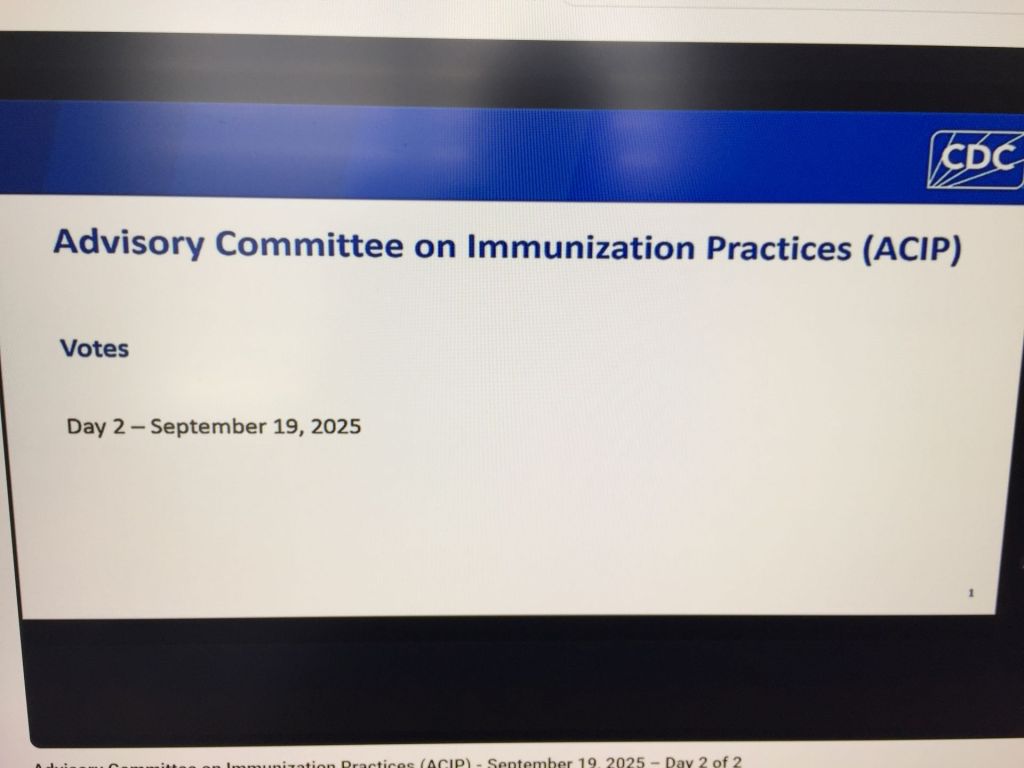
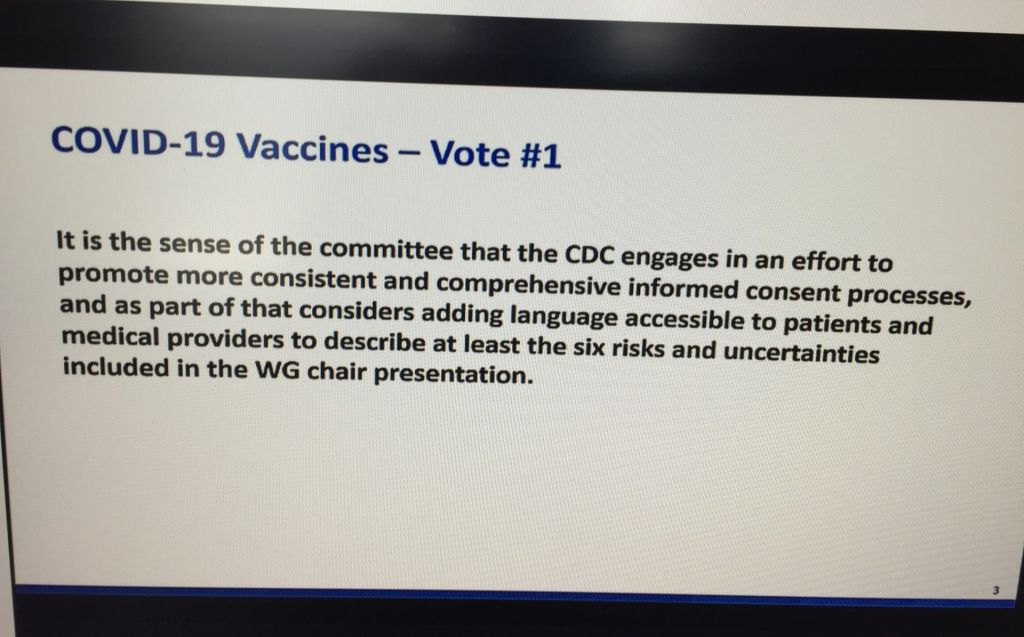
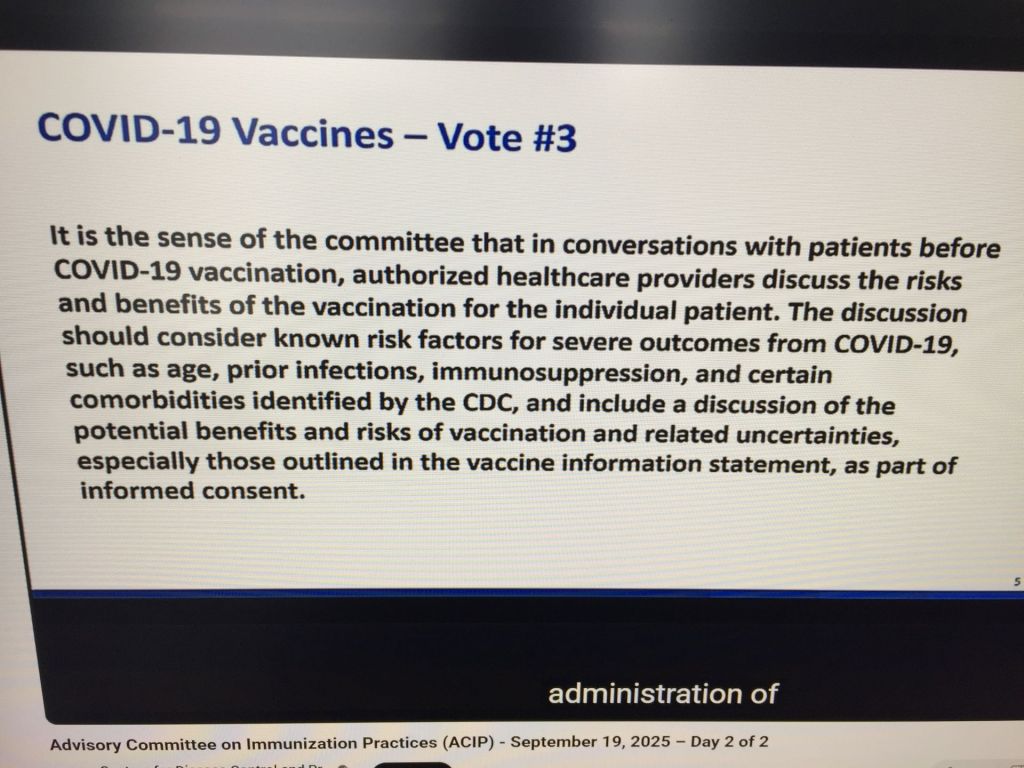
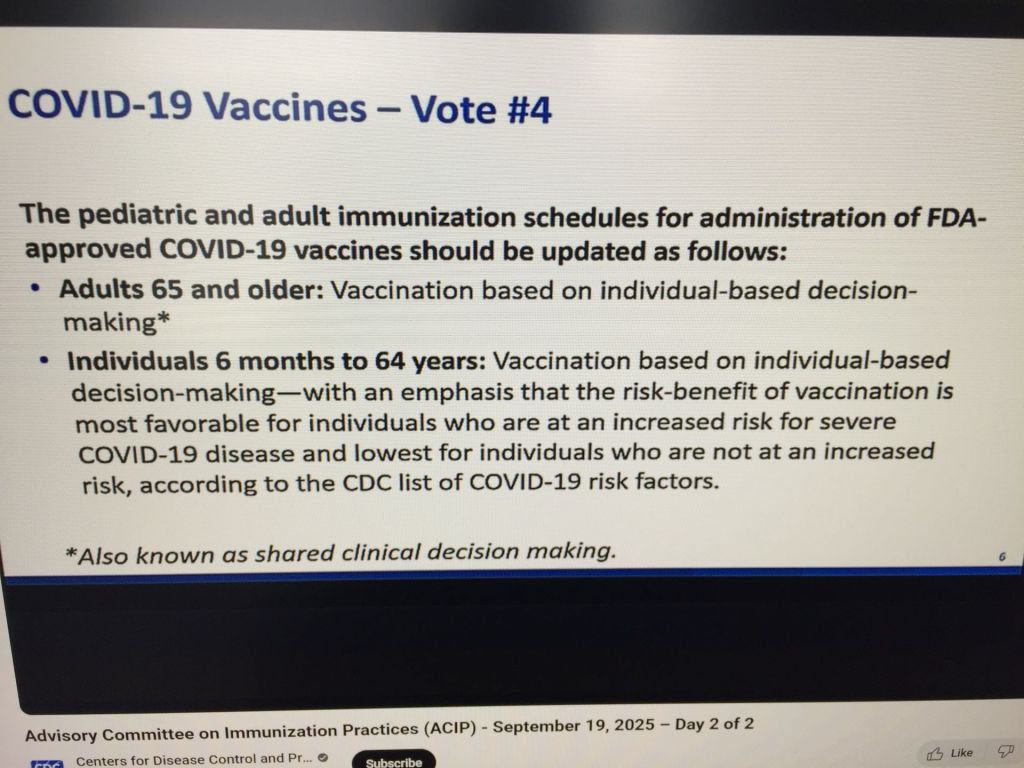
There is a bottom line to this. I watched the voting session, which was very interesting. There were 4 voting questions. I had to take pictures of them because they were not included in the on-line schedule. It was easily the most interesting session of the afternoon, at least for me.
Voting question 1: all but one member voted “yes,” the committee chair Kulldorff voted “no.”
Voting question 2: one member suggested striking this one, but they voted anyway. What’s worrisome is that it was split between the yes and no votes; only the chair, Kulldorff, could break it and he voted “no.” Looks like common sense won; otherwise it would have made access very difficult.
Voting question 3: The video lost audio for a long time, but eventually it turned out that the votes were “yes” unanimously on the assumption that pharmacists counted as “health care providers.”
Voting question 4: The votes were all “yes,” mainly because they decided that pharmacists could make this work. One member questioned the wording which suggested that you needed to talk to your doctor about getting the vaccine because of the wording “shared clinical decision-making.” They glossed over it.
It looks like access to the Covid-19 vaccine will remain mostly open for now.
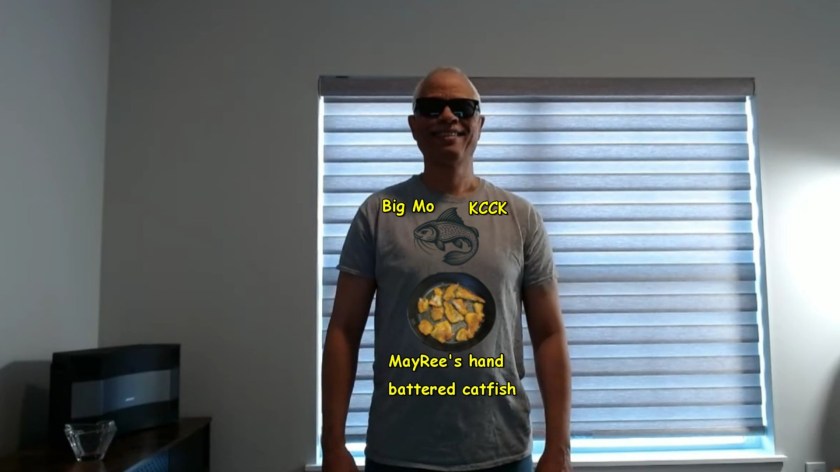
The Big Mo Pod Show title is about planting seeds in a metaphorical way. One of the seeds Big Mo sows is his comedy bit on MayRee’s hand-battered catfish. It’s just one of his hilarious faux sponsor routines that he frequently tweaks, and the subtle changes are difficult to catch if you don’t listen to his show every Friday night. It evolves, kind of like a shaggy dog story joke. My lame imitation from my crippled memory is below:
You see, MayRee’s hand-battered catfish is better because it’s battered, cooked to perfection with manic delight, packed with nitrates at her shack which you can find at the corner of Highway 6 and Snowflake Drive, and if you tip her and give her a wink, she’ll set you up with a mason jar of her famous kickin’ mule’ not sure if it’s all the way legal, but it comes in 3 flavors, Classic Clear, Golden Grabass, and just right for the holidays, Pumpkin Spice, that’s Mayree’s hand-battered catfish; it’s better because it’s battered.
You get the idea. I’m still trying to sell him on my design for a MayRee’s hand-battered catfish tee shirt. Don’t know why he’s not biting that hook. The catfish could be a fire truck red color, just sayin’.
So, the pod show title is “Planting Seeds” and that’s related to the idea of fundamental, historically important basic elements of blues music, specifically in the case of Jessie Mae Hemphill’s song “Jump, Baby, Jump.” Both Big Mo and Producer Noah agree that this example of North Mississippi hill country folk trance or hypnotic griot music (or grio, pronounced Gree-oh; a kind of West African traditional oral folklorist) which serves as the seed or basis for building on other layers (instrumental or otherwise). That’s just what I picked up from the internet.
Big Mo distinguishes this from “production” style music you hear a lot of nowadays on the radio and I get his disparaging tone about it.
Anyway, that’s the rich music history part of the pod show, which you can get by listening to KCCK on your radio dial at 88.3 or click on the Listen Now to hear by internet.
Now, what is also great about the show is Big Mo’s own historical perspective on music. That’s what you get by growing older. And that’s why my favorite song from last night from the Big Mo Blues Show was Curtis Salgado’s “The Longer That I Live.” I can identify with the lyrics.
Sena pointed out a swallowtail butterfly fluttering around the lantana in our backyard garden yesterday. The lantana is great for attracting butterflies and hummingbirds because it has bright flowers and sweet nectar.
At first, I didn’t think it was unusual but I got video anyway. When I looked at it, I eventually noticed that the butterfly (which admittedly might be a different species) was lacking either one or both of the tips on its hindwings. For comparison, I checked a video clip of a swallowtail Sena shot when we were out on the Terry Trueblood walking trail a couple of weeks ago. The videos are obviously not the same quality. I shot the one yesterday through a window.
Sure enough, that swallowtail on the Terry Trueblood trail had impressive hindwing tips. I wondered what was so different about the tips on the one we saw yesterday. Not all swallowtails have tips and maybe the tips are smaller or only faintly visible on some species.
It turns out that the wing tips are probably a piece of butterfly anatomy that can be easily sacrificed when bird predators try to eat the butterflies. This is similar to some lizards whose tails can be sacrificed to predators for the same reason. Maybe the wing tips distract birds from attacking the central body parts. Anyway, I found an article about it on the web.
The article cites a study published in the May 2022 issue of the Proceedings of the Royal Society B that seemed to back up the idea that the tips might be an escape tactic. In the article, you can even see a video of bird preferentially targeting the sacrificial tips.
In our video, you can just barely make out either a transparent vestige of one of the tips or maybe there are two barely visible tips on the swallowtail in our garden. I saw a Facebook entry photo showing that females tend to be larger and have more prominent bluish coloring and males tend to be smaller and have more yellowish markings (interestingly, the male in that photo seems to be missing the right hindwing tip). Maybe we’re seeing a female in the video from 2 weeks ago and a male in yesterday’s video, only the male in that picture seems to have obvious hindwing tips, though they are smaller. I don’t know if anyone could help us sort this out.
How about some good news? This just in, University of Iowa Physician-Scientist, Dr. Michael Welsh, wins the 2025 Lasker Award for his research on cystic fibrosis.
His work and the work of two other researchers with whom he’ll share the award set the stage for the development of new drugs which saves the lives of those who suffer from cystic fibrosis.
I learned from the article that the cystic fibrosis gene was discovered in 1989; I was a second-year medical student then. Since then, the development of new treatments has meant that many people who died in early adulthood now can live into their 80s.
There’s a new podcast in town from The University of Iowa Health Care and the title is “When to Suspect Atypical Recreational Substances.”
This is a fascinating topic and the discussion ran for close to an hour, which is longer than usual because there’s a lot to say about it. The substances include a lot of chemicals that are not illegal and, in some cases, easily available in convenience stores and gas stations. In fact, the name for one of them is gas station heroin, which is tianeptine, approved in other countries as an antidepressant.
The discussion also included substantial information (or maybe better said, lack of enough information) about bath salts (usually cathinones), kratom, and something I’ve never even heard of: diamond shruumz (chocolate bars which can contain various substances not limited to psilocin). Remember that guy who chewed the face off of somebody in Miami in 2012? That was attributed to intoxication with bath salts.
This is way beyond the 1970s stuff like window pane or blotter (LSD) and pot. Many people end up in emergency rooms for evaluation of what looks like poisoning from multiple drugs. The stickler is the possibility that they got poisoned from something bought at a convenience store. Often it’s difficult to tell what the person ingested.
One of the takeaways from this podcast is that, whenever possible, try to get a history from the patient. They might just tell you what you need to know.
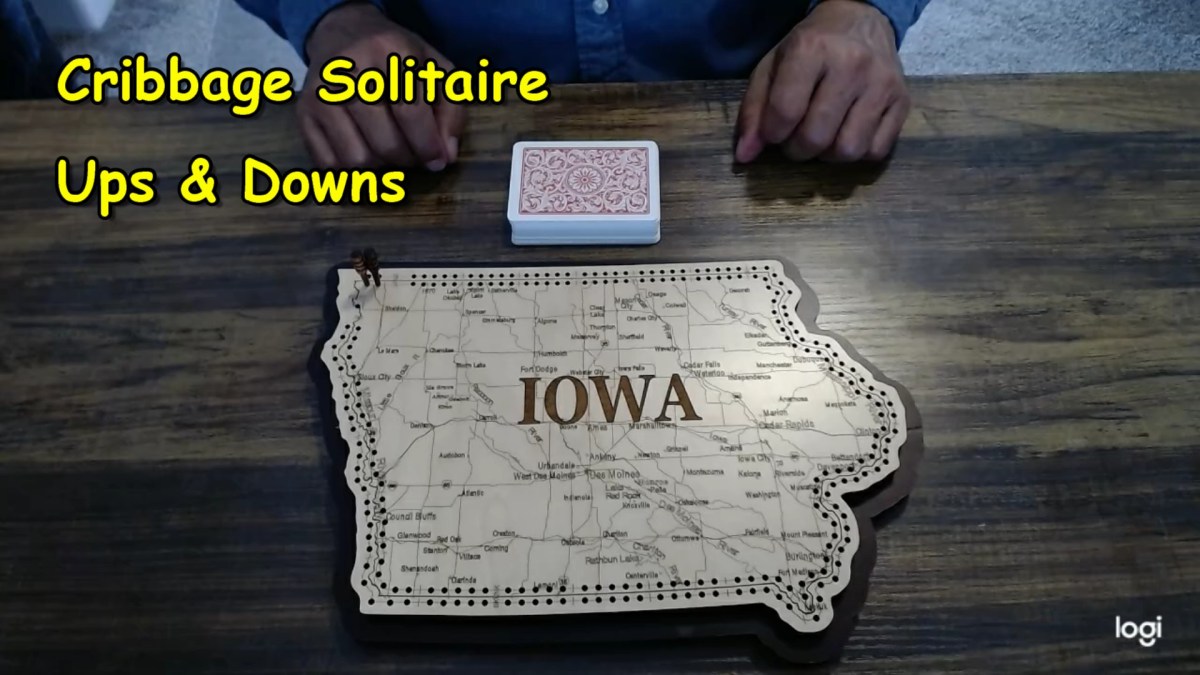
I made this YouTube video of a full six deal game of cribbage solitaire—and missed a 3-card run which would have won the game!
What the heck, I probably made other mistakes too that others will notice.
The rules:
Cribbage solitaire has six hands and six cribs and you peg your six hands.
Start by dealing two cards down to form part of your hand, then one down to form part of the crib. Deal two more to your hand, one more to the crib, and finally two more to your hand (which now has six cards and the crib has two.
Discard two of the six cards to form a four-card crib. Then flip the top card of the deck for the starter card.
Then peg your hand for maximum count, which would not always be the way you’d peg in a game with an opponent. Colbert’s example paraphrased: if you hold 5-10-10-jack. Play the 5 first, then a 10 for “15-2,” then the other 10 for “25, a pair for two and a go.” The remaining jack also scores a “go” for one point. Your peg is six points total.
After scoring the peg, count your hand, then your crib.
Then start the second deal by using the first-hand starter card, which becomes one of the first six cards for your hand. Again, deal the crib two cards. Repeat this process until you complete the game with the sixth deal (the deck will have four cards after six deals). (Colvert, 2015)
Reference
Colvert, D. (2015). Play Winning Cribbage 5th ed. Missoula, Montana: Starr Studios.
I’m thinking about the upcoming commemoration of the 24th Anniversary of the 9/11/2001 attack on America. There will be the annual event in New York City.
In Muscatine, Iowa, there will be the annual Patriot Day ceremonies sponsored by the City of Muscatine and the Muscatine Fire Department. After the morning ceremony, the Memorial Stair Climb will begin at 8:52 a.m. at the Muscatine High School football stadium bleachers.
The KCRG news reported on August 7, 2025 that 3 more World Trade Center victims were identified last month by DNA testing. The New York medical examiner’s office continues testing the remains recovered from the wreckage.
Like many people, I remember where I was and what I was doing when the attack happened in 2001. I was the general hospital psychiatric consultant on duty at the hospital at the time. I was hustling up the stairs back to my office after responding to a consultation request.
I happened to glance at the big television screen on the wall of the main floor lobby in the south part of the hospital. I watched in horror as a newscast showed the fire and smoke coming from one of the towers, which I later learned came from the plane crashing into the building. The rest of the day was full of reports of the attack.
When we visited New York City in 2017, we saw the Memorial & Museum Plaza as well as the Survivor Tree, the Callery Pear. It was discovered at Ground Zero, scarred and scorched but alive and replanted at the Memorial in 2010 after being nursed back to health at the city nursery. It is still alive and well today. It remains a symbol of strength, hope, and a reminder of our connection to each other.
Sena and I got our latest updated seasonal Covid-19 and flu vaccines today. Manpower was low at Walgreens so we ended up sitting for about an hour, but otherwise this was a routine trip. We’re thankful.
We noticed there were a few people waiting—mostly our age. No word up yet on the CDC ACIP site about the Sept. 18-19 meeting as far as an agenda, speakers, or slides.











 Go Retire Psychiatrist