MLK Week Redux for the New University of Iowa Psychiatry Fellows

I discovered the University of Iowa Dept of Psychiatry had a very successful match, filling key residency slots in Child Psychiatry, Addiction Medicine, and Consultation-Liaison fellowships. Congratulations! That’s a big reason to celebrate.

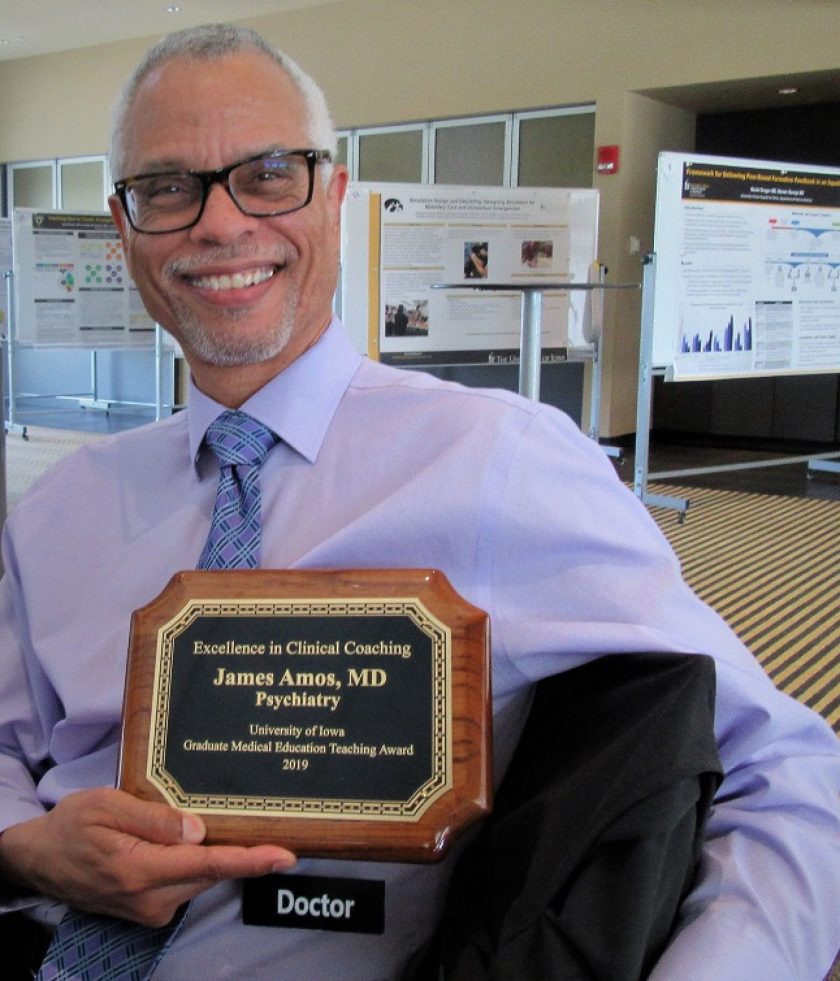
This reminds me of my role as a teacher. I retired from the department two and a half years ago. But I’ll always remember how hard the residents and fellows worked.

And that’s why I’m reposting my blog “Remembering My Calling.”:

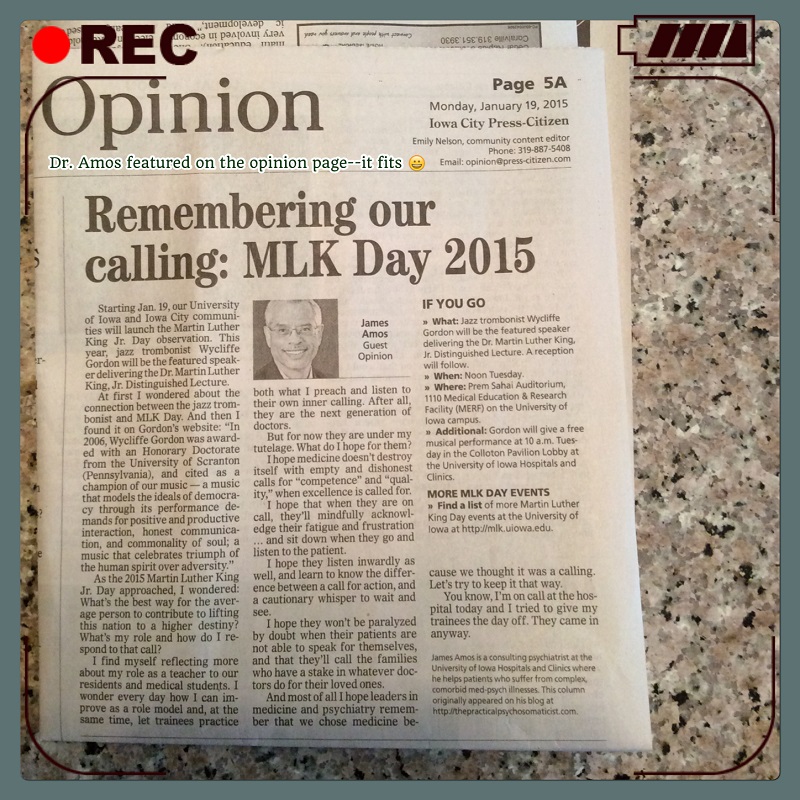
Back when I had the blog The Practical C-L Psychiatrist, I wrote a post about the Martin Luther King Jr. Day observation in 2015. It was published in the Iowa City Press-Citizen on January 19, 2015 under the title “Remembering our calling: MLK Day 2015.”  I have a small legacy as a teacher. As I approach retirement next year, I reflect on that. When I entered medical school, I had no idea what I was in for. I struggled, lost faith–almost quit. I’m glad I didn’t because I’ve been privileged to learn from the next generation of doctors.

Faith is taking the first step, even when you don’t see the whole staircase.”

Martin Luther King, Jr.

As the 2015 Martin Luther King Jr. Day approached, I wondered: What’s the best way for the average person to contribute to lifting this nation to a higher destiny? What’s my role and how do I respond to that call?

I find myself reflecting more about my role as a teacher to our residents and medical students. I wonder every day how I can improve as a role model and, at the same time, let trainees practice both what I preach and listen to their own inner calling. After all, they are the next generation of doctors.

But for now they are under my tutelage. What do I hope for them?

I hope medicine doesn’t destroy itself with empty and dishonest calls for “competence” and “quality,” when excellence is called for.

I hope that when they are on call, they’ll mindfully acknowledge their fatigue and frustration…and sit down when they go and listen to the patient.

I hope they listen inwardly as well, and learn to know the difference between a call for action, and a cautionary whisper to wait and see.

I hope they won’t be paralyzed by doubt when their patients are not able to speak for themselves, and that they’ll call the families who have a stake in whatever doctors do for their loved ones.

And most of all I hope leaders in medicine and psychiatry remember that we chose medicine because we thought it was a calling. Let’s try to keep it that way.

You know, I’m on call at the hospital today and I tried to give my trainees the day off. They came in anyway.

Bivalent Covid-19 Booster Protects Us

University of Iowa Health Care participated in research which demonstrates that people over age 65 who got the updated bivalent Covid-19 vaccine booster:

  • “84% less likely to be hospitalized with COVID-19 compared with unvaccinated people 
  • 73% less likely to be hospitalized with COVID-19 compared with people who received monovalent mRNA vaccination alone but had not received the bivalent booster dose.”

Amaryllis and Zygocactus Repotting

Remember that gorgeous Christmas Amaryllis flower? After it leaned over so far, we had to retire it, so to speak. We didn’t throw it out, but Sena kept it and performed some kind of miracle.

Apparently, she resurrected it by giving it a little water. A couple of new leaves grew a few inches overnight.

She knows that gardeners tell you to bury the Amaryllis bulb outside after the flowers die. I guess in the following winter you dig it up, put it in a new pot and a new set of blossoms should grow. She wanted to transfer it to a different pot instead, one with holes that will let the excess water leak out.

She was very industrious. She also repotted the Zygocactus. That’s the holiday cactus, another houseplant she got for the Christmas holidays.

And the most important question: how are extraterrestrials involved in this urge to repot? ? By the way, I was not involved in the repotting project because I’m allergic to gardening. I did make a YouTube video of her working on it, though.

An Old Post on Breaking Bad News

I’m reposting a piece about a sense of humor and breaking bad news to patients I first wrote for my old blog, The Practical Psychosomaticist about a dozen years ago. I still believe it’s relevant today. The excerpt from Mark Twain is priceless. Because it was published before 1923 (See Mark Twain’s Sketches, published in 1906, on google books) it’s also in the public domain, according to the Mark Twain Project.

Blog: A Sense of Humor is a Wonderful Thing

Most of my colleagues in medicine and psychiatry have a great sense of humor and Psychosomaticists particularly so. I’ll admit I’m biased, but so what? Take issues of breaking bad news, for example. Doctors frequently have to give their patients bad news. Some of do it well and others not so well. As a psychiatric consultant, I’ve occasionally found myself in the awkward position of seeing a cancer patient who has a poor prognosis—and who apparently doesn’t know that because the oncologist has declined to inform her about it. This may come as a shock to some. We’re used to thinking of that sort of paternalism as being a relic of bygone days because we’re so much more enlightened about informed consent, patient centered care, consumer focus with full truth disclosure, the right of patients to know and participate in their care and all that. I can tell you that paternalism is not a relic of bygone days.

Anyway, Mark Twain has a great little story about this called “Breaking It Gently”. A character named Higgins, (much like some doctors I’ve known) is charged with breaking the bad news of old Judge Bagley’s death to his widow. She’s completely unaware that her husband broke his neck and died after falling down the court-house stairs.  After the judge’s body is loaded into Higgins’ wagon, Higgins is reminded to give Mrs. Bagley the sad news gently, to be “very guarded and discreet” and to do it “gradually and gently”. What follows is the exchange between Higgins and the now- widowed Mrs. Bagley after he shouts to her from his wagon[1]:

“Does the widder Bagley live here?”

“The widow Bagley? No, Sir!”

“I’ll bet she does. But have it your own way. Well, does Judge Bagley live here?”

“Yes, Judge Bagley lives here”.

“I’ll bet he don’t. But never mind—it ain’t for me to contradict. Is the Judge in?”

“No, not at present.”

“I jest expected as much. Because, you know—take hold o’suthin, mum, for I’m a-going to make a little communication, and I reckon maybe it’ll jar you some. There’s been an accident, mum. I’ve got the old Judge curled up out here in the wagon—and when you see him you’ll acknowledge, yourself, that an inquest is about the only thing that could be a comfort to him!”

That’s an example of the wrong way to break bad news, and something similar or worse still goes on in medicine even today. One of the better models is the SPIKES protocol[2]. Briefly, it goes like this:

Set up the interview, preferably so that both the physician and the patient are seated and allowing for time to connect with each other.

Perception assessment, meaning actively listening for what the patient already knows or thinks she knows.

Invite the patient to request more information about their illness and be ready to sensitively provide it.

Knowledge provided by the doctor in small, manageable chunks, who will avoid cold medical jargon.

Emotions should be acknowledged with empathic responses.

Summarize and set a strategy for future visits with the patient, emphasizing that the doctor will be there for the patient.

Gauging a sense of humor is one element among many of a thorough assessment by any psychiatrist. How does one teach that to interns, residents, and medical students? There’s no simple answer. It helps if there were good role models by a clinician-educator’s own teachers. One of mine was not even a physician.  In the early 1970s when I was an undergraduate at Huston Tillotson University (when it was still Huston-Tillotson College), the faculty would occasionally put on an outrageous little talent show for the students in the King Seabrook Chapel. The star, in everyone’s opinion, was Dr. Jenny Lind Porter, who taught English. The normally staid and dignified Dr. Porter did a drop-dead strip tease while reciting classical poetry and some of her own ingenious inventions. Yes, in the chapel. Yes, the niece of author O. Henry; the Poet Laureate of Texas appointed in 1964 by then Texas Governor John Connally; the only woman to receive the Distinguished Diploma of Honor from Pepperdine University in 1979; yes, the Dr. Porter in the Texas Women’s Hall of Fame—almost wearing a very little glittering gold something or other.

It helps to be able to laugh at yourself.

1.       Twain, M., et al., Mark Twain’s helpful hints for good living: a handbook for the damned human race. 2004, Berkeley: University of California Press. xiv, 207 p.

2.       Baile, W.F., et al., SPIKES-A six-step protocol for delivering bad news: application to the patient with cancer. Oncologist, 2000. 5(4): p. 302-11.

Giving Credit Where Credit is Due

Here’s another vintage post from around a decade ago after my former Psychiatry Dept chairperson, Dr. Robert G. Robinson and I published our book, Psychosomatic Medicine: An Introduction to Consultation-Liaison Psychiatry” in 2010.

Blog: Who Gets The Credit?

When I think about peak moments, I remember this guy back in junior high school who decided to try to break the Guinness Book of World Records for skipping rope. I don’t remember his name but the school principal and his teachers all agreed to let him do it during class hours. They marked out a little space for him in our home room. He was at it all day. And he was never alone because there was always a class in the room throughout the day. We didn’t get much work done because we couldn’t keep our eyes off him. It was mesmerizing. The longer he jumped, the more we hoped. We were very careful about how we encouraged him. We didn’t want to distract him and make him miss a jump. And so, we watched him with hope in our hearts. It was palpable.  As he neared the goal, we were all crowded around him, teachers and students cheering. He was exhausted and could barely swing the rope over his head and lift his knees. When he made the time mark, we lifted him high above our heads and you could have heard us yelling our fool heads off for miles. Time stood still. He was a hero and we were his adoring fans. It didn’t occur to us to be jealous. His achievement belonged to all of us.

Another peak moment occurred more recently, when my colleagues and I published a book this summer. It’s my first book. It’s a handbook about consultation-liaison psychiatry which my department chairman and I edited, and the link is available on this page. This time, the effort was collaborative with over 40 contributors. The work took over 2 years and often, being an editor felt like herding cats. But we worked on it together. Many of the contributors were trainees working with seasoned psychiatrists who had much weightier research and writing projects on their minds, I’m sure. Like any first book, it was a labor of love. The goal was to teach fundamental concepts and pass along a few pearls about psychosomatic medicine to medical student, residents, and fellows. The book grew slowly, chapter by chapter. And when it was finally complete, this time the achievement was ours and again it belonged to all of us.

I made a lot of long-distance friends on the book project and occasionally get encouragement to do something else we could work together on. I suppose one thing everyone could do is to propose some kind of delirium early detection and prevention project at their own hospitals and chronicle that in a blog to raise awareness about delirium—sort of like what I’ve been trying to do here. We could share peak moments like:

  1. Getting the Sharepoint intranet site up and going so that group members can talk to each other about in discussion groups about how to hammer out a proposal, which delirium rating scale to use, or which management guidelines to use—and avoid the email storms.
  2. Being invited to give a talk about delirium at a grand rounds conference or regional meeting.
  3. Talking with someone who is interested in funding your delirium project (always a big hit).

That way if one of us falters, we always know that someone else is in there pitching. Copyrighting ideas and tools are fine. Hey, everybody has a right to protect their creative property. I’m mainly talking about sharing the idea of a movement to teach health care professionals, and patients about delirium, to help us all understand what causes it, what it is and what it is not, and how to prevent it from stealing our loved ones and our resources.

“It is amazing what you can accomplish if you do not care who gets the credit”-Harry Truman, Kansas Legislature member John Solbach, Ronald Reagan, Charles E. Montague, Benjamin Jowett, a Jesuit Father, a wise man, Edward T. Cook, Edward Everett Hale, a Jesuit Priest named Father Strickland.

Take a Hike, You Diphthong!

Yesterday we were listening to the Mike Waters morning radio program on one of Iowa’s great radio stations, KOKZ. It’s called the Waters Wake-Up Call. He always has something funny to ask listeners about and encourages them to call in with an opinion.

We heard him say he wanted listener feedback on the word “diphthong.” I wasn’t sure whether he wanted legitimate comments on maybe the definition of the word or suggestions on how to use the word differently.

Sena thought she heard Mike say he is a former schoolteacher, and that would make sense for his mentioning the word “diphthong.” She might be right, although I can’t find anything on the KOKZ website which verifies or even mentions that.

We switched stations before we heard anything more from listeners about diphthongs.

But it made me curious about the whole diphthong thing, so I googled the definition. I knew it had something to do with two vowel sounds in words. I don’t remember Mike saying what the definition is. Anyway, Merriam-Webster and other sources on the web define it as the sound formed by the combination of two vowels in a single syllable. The best example is the word “toy.” The vowel combination of “oy” makes you say o which glides into e. There are several diphthongs in English, but other languages have them as well, such as Spanish.

You can read about the conventional definition if you want. After checking out the web for something maybe more humorous or weird about diphthongs, I discovered that it’s sometimes used as an insult, “Get lost, you diphthong!”

There’s this web site called Language Log that I’ve linked to on my blog a while ago about another word, “splooting,” which refers to an animal (like a squirrel) lying flat on the ground with its limbs splayed out in order to cool off on hot days.

It turns out Language Log also has a lot of comments about “diphthong.” It’s a word that does sound like an insult. One guy wrote a column on the web about it, entitled “Oy, You Diphthong!

The Urban Dictionary defines it as a vowel combination combining a weak vowel with a strong one, and also says, “It is more commonly used as an insult, seeing as it is a legitimately funny word.”

I wonder if that was what Mike Waters was fishing for?

It does sound funny. If you substitute it for certain lyrics in a song, like, for example, “You Are My Sunshine,” you get,

“You are my diphthong, my only diphthong…You’ll never know, dear, how much I love you, please don’t take my diphthong away.”

Or maybe “Camptown Races,”

“Gwine to run all night, gwine to run all day, I bet my money on a diphthong nag, somebody bet on the bay.”

The Grinch song?

“You’re a diphthong, Mr. Grinch.”

The expletive possibilities are probably endless:

“Are you diphthonging me?”

“Get diphthonged!”

“I don’t give a diphthong what you say!”

Have we done enough diphthonging language skills discussion for today?

You’re welcome.

Dr. Donald Warne, MD, MPH to Deliver MLK Jr Distinguished Lecture January 18, 2023

The University of Iowa Hospitals & Clinics welcomes Donald Warne, MD, MPH, co-director of Johns Hopkins Center for Indigenous Health, on January 18, 2023 when he will deliver the Dr. Martin Luther King Jr Distinguished Lecture in the Prem Sahai Auditorium in Iowa City, Iowa.

Snowball Juggling!

Yesterday after we shoveled our sidewalks and driveway (again!) we went for a walk. Yes, we finally lost our minds. In fact, the temperature was a balmy 14 degrees. We almost put on shorts.

It was a little breezy. The city plows had not been out. It was their day off. Because of that, there were plenty of chunks of snow, a few of which were about the size of—yep, you guessed it—juggling balls.

We couldn’t get them formed exactly round, like they did in that TV commercial for cold medicine. That’s where I got the harebrained idea to try juggling snowballs in the first place.

You don’t want to try juggling snowballs barehanded. I can’t stop you from trying, just saying that my hands did smart when I tried it.

Next time, I’ll make sure the snowballs are round.