Svengoolie Intro: “Calling all stations, clear the air lanes, clear all air lanes for the big broadcast!”
This Saturday’s Svengoolie movie will be “Tarantula,” about a giant tarantula in the Arizona desert who developed a huge brain and invented a brand new barbecue-flavored meatballs dish made out of humans and marketed to extraterrestrials who are pretty hungry after traveling from a far-away galaxy and abducting thousands of people who are just looking for a fun new ride on a spaceship and the giant tarantulas have 8 arms and are trying to learn how to juggle 32 persons because it’s well known that people can learn how to juggle 8 items and they have only two hands and—OK, so that’s not quite the story line but fun to think about.
I watched the Svengoolie show movie, “The Baddest Seed on the Planet” yesterday on the Internet Archive because I wanted to see the Iowa Hawkeye vs UMass football game last night. Hey, the Iowa Hawkeyes and the Iowa State Cyclones both won yesterday!
Actually, I thought “The Bad Seed” was a pretty good movie, just to let the shrilling chicken out of the bag. It’s a good break from the rubber mask, stop motion animation, shlocky howlers. It does run long, a little over 2 hours and at times there’s a little too much lofty psychoanalytic dialogue. At times it seemed like a play.
It’s a 1956 Warner Bros. Pictures production. There was a Perry Mason regular on it; William Hopper played Col. Kenneth Penmark (father of Rhoda). Henry Jones played Leroy, the really creepy sociopath handyman who had a lot in common with Rhoda (played by Patty McCormack), the psychopathic 8-year-old daughter of Kenneth and Christine Penmark (played by Nancy Penmark). Eileen Heckart played the heck out of her role as the tipsy Hortense Daigle, mother of her unfortunate murdered child Claude—who is never seen.
The main underlying theme is the question of whether psychopaths are born bad or victims of bad environments.
How this gets treated in the film is fascinating. When Rhoda saws through a fawn with a dull straight razor while singing Elvis Presley’s “Don’t Be Cruel,” it really doesn’t leave much to the imagination.
Things start to go bad early when Claude wins a penmanship award instead of Rhoda who is thinking, “OK bud, over your dead body!” I’ve got to tell you; I got chills just looking at her after a while.
The handyman Leroy pegs Rhoda for a bad seed right away, mainly based on the idea that bad seeds think alike. He keeps telling her he’s got her number until he has a close encounter of the excelsior kind, and “excelsior” means ever upward only in the sense that burning wood shavings used for packing fragile items tend to be carried by the wind.
Just to gloss over the scientific psychiatric literature on psychopathy, the most recent paper I could find on the web suggests that structural and functional brain abnormalities of psychopathic persons contribute substantially to the observed behavioral patterns of callousness and poor adaptability to prosocial motivations beginning early in life and which tend to be resistant to change as one gets older. The younger the person, the more plastic the antisocial traits may be to change via behavioral modification, hopefully leading to greater empathy. (Anderson NE, Kiehl KA. Psychopathy: developmental perspectives and their implications for treatment. Restor Neurol Neurosci. 2014;32(1):103-17. doi: 10.3233/RNN-139001. PMID: 23542910; PMCID: PMC4321752.)
By far, Hortense Daigle has the most awkwardly comical role as she combines grief, inebriation and eerie suspicion of Rhoda in her own son’s death. Every time she shows up to the Penmark house, she’s roaring, dramatically staggering drunk. She helps herself to the booze in the house, even making it clear which bourbon she prefers (Never mind my grief! I said I wanted that martini in a dirty glass!).
Other than the movie being a bit too long, I thought it was very good. I could have done without the theater like credits with all the actors coming out to take a bow (or curtsy in Rhoda’s case), a slapstick bit between Christine and Rhoda, and the warning to the audience not to reveal the ending to anyone.
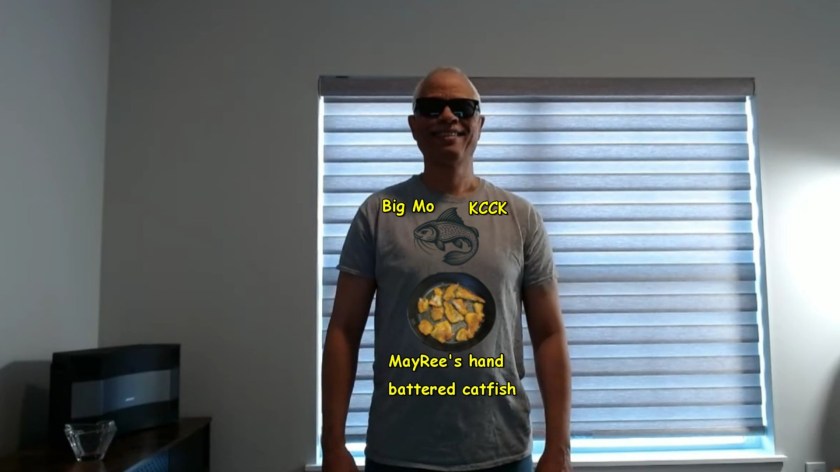
The Big Mo Pod Show title is about planting seeds in a metaphorical way. One of the seeds Big Mo sows is his comedy bit on MayRee’s hand-battered catfish. It’s just one of his hilarious faux sponsor routines that he frequently tweaks, and the subtle changes are difficult to catch if you don’t listen to his show every Friday night. It evolves, kind of like a shaggy dog story joke. My lame imitation from my crippled memory is below:
You see, MayRee’s hand-battered catfish is better because it’s battered, cooked to perfection with manic delight, packed with nitrates at her shack which you can find at the corner of Highway 6 and Snowflake Drive, and if you tip her and give her a wink, she’ll set you up with a mason jar of her famous kickin’ mule’ not sure if it’s all the way legal, but it comes in 3 flavors, Classic Clear, Golden Grabass, and just right for the holidays, Pumpkin Spice, that’s Mayree’s hand-battered catfish; it’s better because it’s battered.
You get the idea. I’m still trying to sell him on my design for a MayRee’s hand-battered catfish tee shirt. Don’t know why he’s not biting that hook. The catfish could be a fire truck red color, just sayin’.
So, the pod show title is “Planting Seeds” and that’s related to the idea of fundamental, historically important basic elements of blues music, specifically in the case of Jessie Mae Hemphill’s song “Jump, Baby, Jump.” Both Big Mo and Producer Noah agree that this example of North Mississippi hill country folk trance or hypnotic griot music (or grio, pronounced Gree-oh; a kind of West African traditional oral folklorist) which serves as the seed or basis for building on other layers (instrumental or otherwise). That’s just what I picked up from the internet.
Big Mo distinguishes this from “production” style music you hear a lot of nowadays on the radio and I get his disparaging tone about it.
Anyway, that’s the rich music history part of the pod show, which you can get by listening to KCCK on your radio dial at 88.3 or click on the Listen Now to hear by internet.
Now, what is also great about the show is Big Mo’s own historical perspective on music. That’s what you get by growing older. And that’s why my favorite song from last night from the Big Mo Blues Show was Curtis Salgado’s “The Longer That I Live.” I can identify with the lyrics.
I think I just found out why we have to tune in to the upcoming Svengoolie movie “The Bad Seed” an hour early this Saturday. It comes on at 6:00 p.m. because it’s two hours long!
There’s another crisis. The Iowa Hawkeye vs UMass college football game comes on at 6:40 p.m. tomorrow evening.
That means I’d have to choose between watching “The Bad Seed” or watching the football game. In order to see both I’d have to watch the movie on the Internet Archive.
That means I’d miss Svengoolie’s corny jokes. Hmmmm.
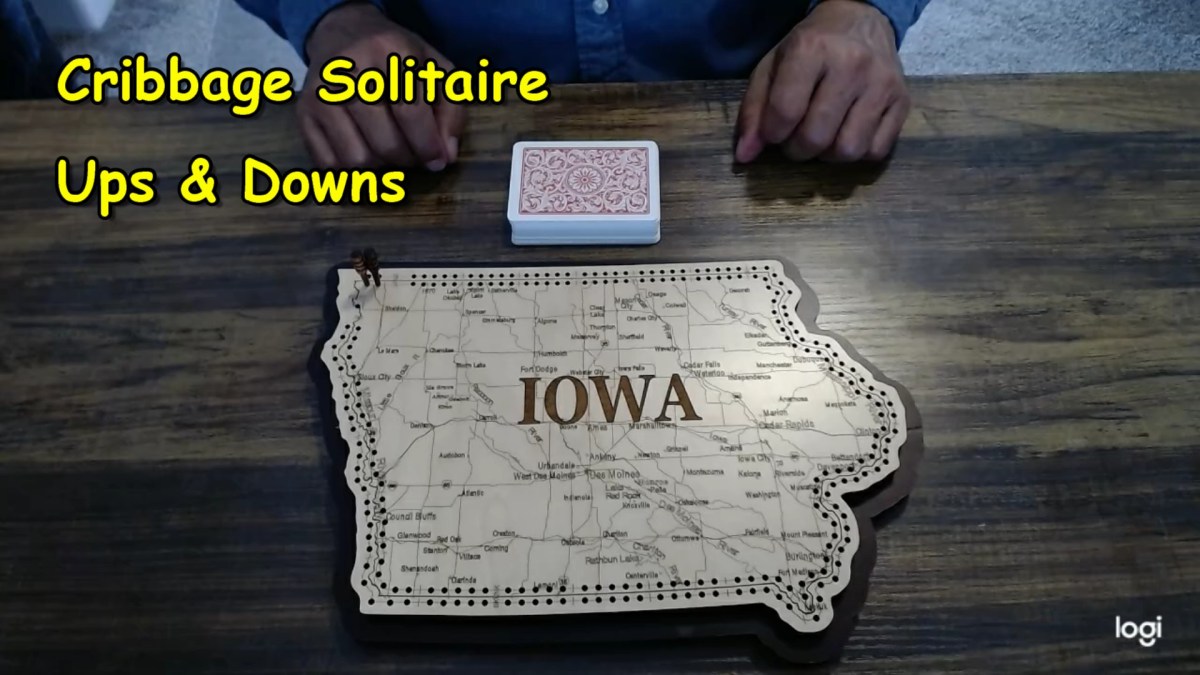
I made this YouTube video of a full six deal game of cribbage solitaire—and missed a 3-card run which would have won the game!
What the heck, I probably made other mistakes too that others will notice.
The rules:
Cribbage solitaire has six hands and six cribs and you peg your six hands.
Start by dealing two cards down to form part of your hand, then one down to form part of the crib. Deal two more to your hand, one more to the crib, and finally two more to your hand (which now has six cards and the crib has two.
Discard two of the six cards to form a four-card crib. Then flip the top card of the deck for the starter card.
Then peg your hand for maximum count, which would not always be the way you’d peg in a game with an opponent. Colbert’s example paraphrased: if you hold 5-10-10-jack. Play the 5 first, then a 10 for “15-2,” then the other 10 for “25, a pair for two and a go.” The remaining jack also scores a “go” for one point. Your peg is six points total.
After scoring the peg, count your hand, then your crib.
Then start the second deal by using the first-hand starter card, which becomes one of the first six cards for your hand. Again, deal the crib two cards. Repeat this process until you complete the game with the sixth deal (the deck will have four cards after six deals). (Colvert, 2015)
Reference
Colvert, D. (2015). Play Winning Cribbage 5th ed. Missoula, Montana: Starr Studios.
Svengoolie Show Intro: “Calling all stations, clear the air lanes, clear all air lanes for the big broadcast!”
This coming Saturday’s (September 13th) Svengoolie movie will be the 1956 Warner Bros. production of “The Bad Seed,” which is about a little psychopathic girl who dares another kid to knock a stick off her shoulder and when he does, he finds out with a shock it’s not a stick but a venomous snake which bites him on the nose, sending him to the hospital in an ambulance which careens off a bridge into a raging river full of giant piranha which—OK, so that’s not exactly how the movie goes and I’ve never seen it before.
The show is coming on at 6:00 p.m. central time instead of 7:00 p.m., just to let you know.
I watched the 1956 Universal-International Pictures production of “The Creature Walks Among Us” last night on the Svengoolie show. It’s a movie about chain-smoking scientists who capture the aquatic Gill-Man, transform it into an air-breather and blow smoke into its face to make it cough. This annoys it so much it starts breaking stuff.
The scientist who pushes the whole project is Dr. William Barton (Jeff Morrow) who at times can be seen smoking 10 cigarettes simultaneously which sets his hair on fire. He’s bald for the rest of the movie, which doesn’t endear him to his wife Marcia (Leigh Snowden) who copes with his pathological jealousy by playing several musical instruments throughout the movie.
The team of scientists includes a geneticist, Dr. Thomas Morgan (Rex Reason), a prince of a guy who spars with Dr. Barton about the pros and cons of contributing to the delinquency of a major monster by altering its biology, moving it closer to the “jungle or the stars.” Dr. Barton doesn’t buy this metaphor and is bent only on pursuing a maniacal plan to teach the creature how to shoplift cigarettes and bottles of Thunderbird wine.
Dr. Morgan is sweet on Marcia but so is the guide, Jed Grant (Gregg Palmer). Marcia plays various musical instruments to keep between her and Jed, starting with a piano, progressing to a guitar and, when he gets more insistent on messing up her hair, she hauls out a cello!
The group of scientists catch the creature out on the river. They’re all smoking when it suddenly leaps into the boat and when it picks up a gas can spilling the contents all over itself, all they have to do is flick their cigarettes at it on a pre-arranged signal (Dr. Barton farts). While the creature is wrapped in flames, the crew takes a little while to figure out which fire extinguisher they should use (what works on scales, foam or dry chemical?).
Apparently, the Creature evolves spontaneously once it’s out of the water and grows a feeble set of lungs. The scales fall off to be replaced by skin, and it develops fingers. Then it tries to steal Marcia’s banjo.
The scientists imprison the creature in a pen which has an electrified fence, which Dr. Barton forgets to re-activate after he dumps Jed (whom he has knocked out with Marcia’s clarinet) in there to distract it.
This doesn’t fool the creature but I wouldn’t want to spoil the ending for you. The moral of the story is that smoking is bad for your health.
Sena went over to ForeverGreen, a popular landscaping and garden center locally, to see the butterfly house. She got pictures and video clips which showed the monarch butterfly management operation they have. They have quite a conservation program, including a large monarch butterfly house enclosure along with demos of life cycle stages. The butterfly house is just part of the deal and it’s open to the public. It opened in June of this year and runs until September 14th. The schedule shows there’ll be a big release then and possibly even tagging prior to that. You might want to call ahead and check to see if they’re still going to tag the monarchs.
I think this is also a good way to rehabilitate Bigfoot’s image because they could be sort of like ranch hands tending to the monarch as they go through their life cycle. The monarchs migrate to Mexico every fall. You can learn more about the monarch watch program and why many people believe the monarchs are at risk of extinction.
Today, the Big Mo Pod Show was about how blues music can you help you “exorcise your demons” as Big Mo himself put it today. Isn’t that what it’s always about? And I can’t explain how that even works.
After a short break during the Thanksgiving holiday your hosts are back at it again with another episode! This week features the usual mix of blues eras you’ve come to expect along with a few Californian artists, tune in to see which ones! Songs featured in the episode: Solomon Hicks – “Further On Up The … Continue reading
But I don’t always understand how it works. I’m going to admit I’m not sure at all how one song last night by Toranzo Cannon would help anybody, and that’s “I Hate Love.” Of course, it’s contradictory and ironic. I’m not going to pretend I know what blues music is all about and how it can sometimes heal your inner soul pain.
But a lot of people believe that blues can help you get past the pain and it seems that it works paradoxically. I don’t always get it. But I’ve been listening to the Big Mo Blues Show for years.
That reminds me. We had a couple of guys install motorized window shades yesterday and one of them was a blues musician. He plays bass guitar and I gather he plays in local bands. He wore the best hat; it’s a fedora! Sena and I sort of ribbed him about it, but I had a fedora like that once, decades ago. It was gray with a narrow leather band. I don’t have it anymore.
I told him that I wore it while I was interviewing for residency. I wore it to dinner in a hotel in St. Louis, Missouri and a woman passing through the hotel restaurant looked at me and said with a grin, “Wear that hat!”
Sena reacted as if she’d never heard that story before. The fedora guy thought it was funny. Fedora man had that style to him that I think is fairly common in musicians. They look and may act in a way that makes you notice them. I don’t think you can always tell what somebody does just by the way he or she dresses. But when he told us he was a musician who liked the blues, that didn’t surprise us.
What did surprise us was that he didn’t recognize the name of a prominent blues musician in Iowa and a lot of other places—Kevin Burt. But he did have a sense of humor.
I think most blues musicians have a kind of slant sense of humor. It probably comes out in some of the music. I’m more drawn to blues music that makes me chuckle. On the other hand, I liked one song on the blues show last night they didn’t discuss today on the pod show. It’s not funny and I had a hard time finding the lyrics for it. It’s “I’ll Always Remember You” by the Robert Cray Band. I found a couple of sites I think got the lyrics below wrong and didn’t make sense. The way I heard the song the lines went like this:
“Old clothes and worn-out shoes Empty bottles and a book that’s way past due.”
The line I keep finding that I think is wrong is the second one, which is often written as “Empty bottles and I put this way past due.”
I think the line “a book that’s way past due” makes more sense because it conveys a sense of regret, waste and loss and promises not kept and opportunities lost and probably a half-dozen other ideas that you probably can’t easily encapsulate. It evokes sorrow that is only partly fixed by the letter’s promise— “I’ll always remember you.”
That may not completely heal you, but it’s a little like something I read about kintsugi. It’s about mending broken pottery with gold in a literal sense. In a metaphorical sense, it’s about repairing what might be broken emotionally broken in us and, despite not being the same as we were before we were broken, we’re somehow still functional and healed though not perfect. A psychiatry resident blogger wrote about that.
Sena played a couple of games of cribbage solitaire today and came within 8 points of making 121! And so that makes us both fans of this variation on cribbage.
There was a little project I set for myself given that DeLynn Colvert’s book, “Play Winning Cribbage” has a section called Cribbage World Publication, which is a monthly publication you can find on the American Cribbage Congress (ACC) website. Colvert was an editor of Cribbage World and included in his book copies of events and ads of interests to ACC members. Many items are odd and comical.
One of the interesting tidbits is an announcement that is historically important for cribbage in Iowa. However, none of the items including this one are dated. So, I had to hunt it down in the archives on the ACC website. The title is “Two 29’s Within 5 Minutes!” It refers to an event called the Hawkey Classic, which used to be the name for the annual cribbage tournament held in Des Moines, Iowa. Two 29 hands were scored within 5 minutes of each other during this tournament. This is remarkable because the odds of dealt a 29 hand are 1 in 216,580!
I had to dig through many pages of Cribbage World and Artificial Intelligence (AI) was no help at all (not that I asked it because AI intrudes itself on all my searches whether I want it’s help or not). In fact, it denied the existence of the Hawkeye Classic cribbage tournament.
Anyway, I had to make a guess about what issue of Cribbage World that announcement was published. I guessed that it was in the 1990s (for no particular reason) and I found it on page 3 in the June 1990 issue after striking out in the 1991-1993 issues (although I found one item related to cribbage solitaire which involved playing five hands instead of six).
It turns out that there’s been an annual cribbage tournament for over 40 years in Iowa and that tradition did start in Des Moines. It was called the Hawkeye Classic and was ACC sanctioned. However, my guess is that it gradually became absorbed into the Iowa State Fair schedule of events. It’s usually held on the last day of the fair. This year, I found out there were 252 entrants, which I think is probably not unusual.
Another interesting note about this issue of Cribbage World I noticed is that there isn’t a Hawkeye Classic cribbage tournament announcement listed in The Tournament Trail section. However, it does list the Grand National (National Awards Banquet) on September 20, 21, 23 in 1990 at the Hotel Fort Des Moines, Des Moines, Iowa. But I did find an announcement about the Hawkeye Classic in one of the earlier issues from 1991-1993.










 Go Retire Psychiatrist