150 Years of Coralville and Iowa River Flathead Catfish as Big as Your Leg!

We found out we missed the wheat paste murals posted on various buildings in Coralville this past summer. It’s the 150th anniversary of the city of Coralville in Iowa this year. You can find out more about it on the Coralville Public Library web site.

We drove around and found some of the murals were still up. They generally last about 2-3 months. There were murals on West Music and the Coralville Recreation Center, but they were gone.

In our YouTube, the murals we found are in order of appearance on the video:

The ice block mural is on Randy’s Flooring on 2nd Street. It’s a picture of the Jacob C. Hotz Ice Company Employees circa 1900s-1910s. They’re on the Iowa River. Workers were paid 10 cents an hour. Talk about your minimum wage.

The mural of 3 ladies who we don’t know anything about and the “Watch It Grow” image are on the Coralville Public Library in the 5th St. Plaza.

The long timeline mural is on the Coralville Community Food Pantry on 13th Avenue.

The Blue Top Motel mural is on Chong’s Supermarket on 2nd Street. According to the Coralville Public Library, the Blue Top motor court was built in the 1940s. No mention whether lodgers were abducted by extraterrestrials.

The mural of two fishermen with the two huge flathead catfish as big as a man’s leg they landed in the 1920s in the Iowa River is on the Iowa River Power Restaurant on 1st Avenue. This is my personal favorite. All I ever caught in my wasted childhood were bullhead as big as my fist.

You can see fishline and bobbers floating in the Iowa River. You can even see a handsome sculpture of a dragonfly sitting on a bobber on one side of the river. We saw one guy with at least three fishing poles rushing around to different spots next to the Iowa River Power Restaurant. I think he was hoping to land a big flathead—but all we saw him catch was a snag.

Happy 150th birthday, Coralville!

Thoughts on Jack Trice

I was outside doing yard work the day before yesterday and my neighbor across the street walked over to say hello. We got to talking about sports and football came up. His wife stopped watching football because it was so violent—but then switched to watching hockey. He wondered when the Iowa Hawkeye vs Penn State game was going to be on. No, I’m not going to discuss that any further.

Anyway, that led to my mentioning how brutal college football was back in 1923 when Jack Trice, Iowa State University’s first black athlete was killed on the field during a game with the University of Minnesota. My neighbor was incredulous. He’s in his 80’s and he’s never heard the story.

In fact, I had just learned about the whole Jack Trice story and commemoration event in his honor the day before that, only because Sena told me about it.

All this year long there has been a 100-year anniversary commemoration of Jack Trice, Iowa State University’s first African-American athlete. The program will culminate on October 8, 2023 with the closing ceremony.

Football was a rough game in that era—but rougher still because Trice was black. Many believe his injuries were deliberately and maliciously inflicted because of his race. It’s more than plausible. In 1997, the football stadium was renamed Jack Trice Stadium. It’s the only major college football stadium named for an African-American.

Sena and I moved to Ames in 1981 so that I could enroll in Iowa State University. I was so immersed in my studies that I never gave a thought to Jack Trice. I don’t remember the football field being named Jack Trice Field in 1984.

As I looked through the commemoration website, I wondered how it was possible for me to have ignored the story of Jack Trice while I was there.

I think it’s for the same reason I never knew anything about James Alan McPherson, the first African American to win the Pulitzer Prize for fiction and who was teaching at the Iowa Writers Workshop during the entire time I was in medical school, residency and a faculty member at The University of Iowa Hospitals & Clinics.

I was working hard. I finally found out about McPherson after reading a news item about a neighborhood park being named after him in 2021.

I should pay more attention. Anyway, Iowa State University did a tremendous job putting this commemoration event together.

22nd Anniversary Commemoration of 9/11 Attacks

The 22nd Anniversary Commemoration of the 9/11 attacks and the 1993 World Trade Center will be observed today.

I remember where I was on September 9, 2001. I was climbing the stairs at the hospital on my way back to my office. I was on duty on the psychiatry consultation service. I happened to glance at the television in the lobby from the landing. A news story was showing one of the Twin Towers on fire.

I couldn’t believe my eyes. The rest of the day there was talk of the attack on America.

We visited New York City in 2017 and viewed the Memorial & Museum Plaza. We saw the Survivor Tree, the Callery Pear.

It seems like there is almost nothing else to remember about the date except the disaster and the tragedy.

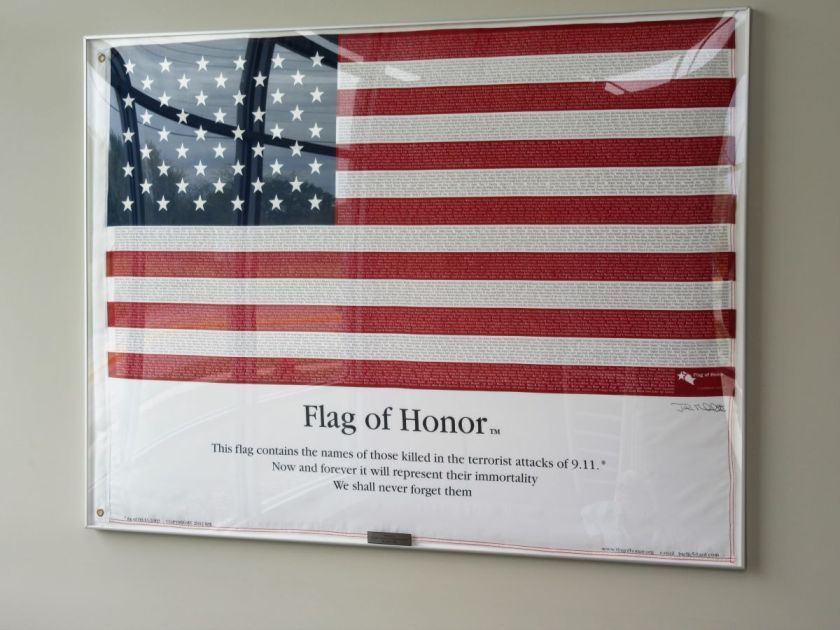
But one of the local fire stations not far from our house has a Flag of Honor on the wall. It honors those killed in the terrorist attacks on 9/11.

Even if we can’t go to the Memorial in New York City, we can remember it and honor the brave.

“I Have a Dream” Speech 60 Years Later

Today is the 60th anniversary of the Reverend Dr. Martin Luther King Jr’s “I Have a Dream” speech at the Lincoln Memorial in Washington D.C.

I was too young to remember it. However, I have a deep appreciation of the meaning it has not just for Black people, but for all of us. It’s not difficult to broaden the implication for all people.

My personal reflection about this started this morning with a look at one of my primary school class pictures. I’m the handsome guy 2nd from the left in the top row. The other kids of color in the photo are Latino.  

The photo shows not just a group of kids. It also illustrates, just by chance, pretty closely the percentage of black persons in the state of Iowa as of the 2021 U.S. census, about 4%. Historically though, in the county in which I was living at that time, the percentage of nonwhite persons was listed at 0.4%. This was a 28% drop from the previous decade. In 1980, the percentage of Black people in the state was only 1.8%. As near as I can tell from the web, the current percentage of Black people as of the most recent data is 3.74% (possibly as of 2021).

My father was black and my mother was white. In Iowa, the law against miscegenation (marriage between blacks and whites) was repealed in 1839. On the other hand, my parents got their marriage license in 1954 in Watertown, South Dakota—which was 3 years prior to when that state repealed its law against interracial marriage. Right below the license, though, is a certificate of marriage marked State of South Dakota in Codington County. It certifies that my parents were married in Mason City, Cerro Gordo County in the state of Iowa.

I’m not going to try to puzzle that one out. My mother kept a lot of old photos and legal records that anchor me in my personal history.

I have photos of my father with me and my brother, Randy. I also have photos of my mother with me and my brother.

What I don’t have are photos of all of us together. It’s understandable to ask why. I wonder if it has something to do with the culture and mindset of the time. Why was it not possible to find someone, black or white, to snap a family photo of us together?

We can pass legislation repealing anti-miscegenation laws as well as other laws to protect civil rights. That is a necessary (but perhaps insufficient) step toward non-exclusion of certain groups of people from basic human rights.

Ashley Sharpton, who is an activist with the National Action Network and daughter of Reverend Al Sharpton, said that Americans need to “turn demonstration into legislation.”

I agree with her. On the other hand, I also wonder what more has to happen in the minds of all of us to turn legislation into transformation—of our personal implicit biases, which are not in themselves always bad or inescapable.

And since we’re into rhyming, what about asking another question? Can we turn demonstration into legislation while encouraging transformation without bitter confrontation?

Hawaii Memories

The wildfires in Maui are so devastating. We wish everyone the best. We also had a wave of nostalgia back to 1997 when we visited the Hawaiian Islands on our first vacation in a long while after I finished my psychiatry residency in 1996.

The plane trip was very long and what I remember most about it, flying all the way from Iowa, was the terrible case of bilateral airplane ear which lasted for a couple of hours after we landed in Honolulu. After that, things got a lot better. It was a long time ago, so the memories are a little hazy.

We remember the bus from the airport stopped at the hotel where the tour guide got out to check the reservations for all of us. It was very hot because the bus driver didn’t want to let the vehicle run so as to allow the air conditioner to cool us off. We were probably the youngest members of the tour group. It was the oldest who complained the loudest, finally convincing the bus driver to start the bus to cool everybody off.

After we arrived at the hotel, it was also the oldest members who had the energy to go out and see Don Ho perform. When they got back, they said he got drunk, but he was able to sing “Tiny Bubbles.” We were too exhausted to go. The oldest group members were often the most energetic.

We went a great little restaurant in either Kauai or maybe it was in Hilo, Hawaii (the Big Island) and got plates of huge shrimp. They were shorthanded on servers and several members of the tour group (again the older ones) pitched in to help out.

We saw the Kodak Hula Show in Honolulu on the island of Oahu. I read a little about it and the show nearly closed in 1999, but it was taken over by the Hogan Family Foundation for three years at a cost of half-million dollars per year. The show closed in 2002 so that the money could be used to fund educational programs.

Of course. we also visited the USS Arizona Memorial at Pearl Harbor. One of our tour group members who was a veteran of that war wept as he read the names. We became friends with him and his wife and sent each other Christmas cards for a few years afterward.

We saw the Hawaii Tropical Botanical Gardens in Hilo, Hawaii. It’s huge. It was a tribute to the Japanese immigrants to The Big Island who helped build its agricultural history beginning in 1868.

We visited the Wailua River State Park Fern Grotto Area and the Waimea Canyon in Kauai. The latter is also known as The Grand Canyon of the Pacific. I think Kauai was where I first tried coffee-flavored ice cream—Kona coffee, I’m sure. It remains one of my favorites, next to plain vanilla.

We got a few photos of the Iao Needle in the Iao Valley on Maui. We went to a big luau, but I can’t remember exactly where it was. I remember I was coming down with a head cold and had a runny nose. We tried poi, and I’m afraid I didn’t find it very tasty—and it had nothing to do with cold.  Maui was the final island to see on our itinerary. I think we saw the huge Banyan Tree in Lahaina because we have a picture of a very large tree with Sena standing in front of it.

The 150-year-old Banyan Tree was charred in the fire, but it’s still standing.

What Kind of Census Does This Make?

We finished our Census Bureau survey and it seems like we just did this not long ago. It’s taken every 10 years but it seems like we got this form a few years ago.

They say it takes about 40 minutes to complete, but it sure felt like there were many more questions on it this time and the questions asked about a lot of things like income, taxes, etc. that we don’t remember from before.

Did anybody else get this feeling? I mean we really had to do things like get data from records and do math and sweat the details.

We asked ourselves what would happen if we just refused to do it. So, I looked it up. It turns out that there is a $5,000 penalty the bureau can impose if you refuse to do it or give false information.

On the other hand, Census Bureau officials have said nobody’s been prosecuted since 1970. I wonder what happened to that person? Is he still paying off the fine? Is he in jail because he couldn’t pay it? Was he abducted by extraterrestrials and is he still trying to get them to pay it?

There are other questions I had that led me to search the web. It looks like the best place to start might be the Census Bureau website itself. The section Census Bureau 101 for Students looks like a good place to start. The census has been around since 1790 and back then it was only a six-question survey:

What is your gender? (There are more choices nowadays)

What is your race? (It was not the 40-yard dash)

What is the name of the head of the household? (It’s always the wife!)

What is the relationship to the head of the household? (It’s always the husband!)

How many slaves do you own?

What is your occupation? (Tea party activists didn’t count)

There’s an interesting section on the web site PRB, entitled “Hard-to-Count Populations.”:

Decades of research have shown that the decennial census is very accurate, but (like population censuses in other countries) it is subject to both undercount and overcount errors that differ by age, sex, and race. The 2010 Census was no exception. Despite the best efforts and careful planning of Census Bureau staff, the direct, physical enumeration of the U.S. population is imperfect.

Part of the challenge in counting the population accurately is that some people are harder to count than others. People who lack a permanent address are less likely to complete a census form than people who have a permanent address. Similarly, language barriers, distrust of government, and frequent moves tend to make certain groups harder to count. On the other side of the spectrum, some people may be counted more than once. For example, those who own more than one home may submit a census form for each address, and children away at college may be counted at both their college and parental home.

If you decide not to complete the Census Bureau survey, they probably won’t fine you or throw you in jail. They could visit your house up to six times though. And if you manage to slip them every time, they could check with your neighbors to get the skinny on you.

You might as well do it.

Raccoon in the Mulberry Tree

I was not sure what exactly I saw this between 6:30 and 7:00 this morning shaking the mulberry tree branches in our backyard. It seemed too big to be a squirrel and I dismissed the thought, telling myself that it was most likely the usual squirrel getting its mulberry breakfast.

Just prior to this incident, I had seen and heard what I thought was a blue jay in the mulberry tree. It gave a series of short whistles while bobbing up and down on the branch. I had never heard a blue jay make whistle notes, just the usual screeches. I doubted what I saw and heard. I checked my bird book, “Birds of Iowa: Field Guide” by Stan Tekiela. It didn’t mention anything about blue jays making short whistling notes and bobbing up and down as they did so. I didn’t bother to get up and try to get a video of it. It would have been through the window of our sun room and the jay didn’t sit for more than a few seconds.

So, I looked it up on the web. It turns out blue jays make a variety of noises besides the jeer. They bob up and down as a part of a courtship ritual. They make what is termed a “pump handle call” and I found a video which duplicates what I saw and heard.

Anyhow, getting back to the critter in the mulberry tree, it turned out to be a large raccoon. It was eating mulberries and I tried to take video of it as it was climbing down the tree. This reminded me of an essay by E.B. White entitled “Coon Tree.” If you’ve ever read essays by E.B. White, you probably know already that this one is about a lot more than raccoons.

It’s basically about the conflict between nature and technology. The main essay was published in 1956 and a post script was added in 1962. The coon represents nature which White idealizes and contrasts with references to new inventions, including nuclear devices which represent the destructive side of technology.

I guess we can forget for the moment that raccoons can carry diseases like rabies and roundworm. I’m also reminded of an old TV commercial in the 1970s about margarine (an alternative to butter) in which an actor says angrily, “It’s not nice to fool Mother Nature!” The idea was that margarine (which was a new invention in the late 19th century) was healthier than the natural spread, butter—although the trans fat in it makes the comparison a bit more complicated.

White also says something interesting about unsanitary homes, claiming that children who live in them become more resistant to certain diseases like polio than the kids who grow up in clean homes. The polio scourge raised its ugly head recently in New York, which renewed the recommendation by the Centers for Disease Control recently that people who didn’t get vaccinated against polio should get vaccinated—regardless of how dirty your home was.

And then there is the artificial intelligence (AI) technology. I wonder what E.B. White would say about that? AI can improve detection of some diseases and assist in medical research. On the other hand, AI can still make mistakes and it needs human surveillance.

I read you can sometimes use loud noises to keep raccoons out of your yard. For example, you could try recordings of blue jays.

The Skinwalker Ranch Connection to Nikola Tesla

I watched one of the new episodes of The Secret of skinwalker Ranch the other night. The use of special imaging techniques led to finding what looked like little tunnels running underground in one area of the property.

That led to trotting out the little excavator and digging up the ground. They found some light-colored veins of dirt, which they analyzed. They contained elements, things like sodium, potassium and whatnot. I couldn’t understand why they didn’t compare that to the surrounding normal-looking dirt, because I think dirt everywhere has those elements in it.

I think one of the scientists/actors, Dr. Travis Taylor, mentioned that this kind of dirt might be able to transmit electricity. That got me thinking about Nikola Tesla and his fascinating experiments with electricity. I’m probably all mixed up about his theories but I think he tried to send electricity through the earth in an effort to show it could be transmitted without wires.

In fact, that led me on my usual wild goose chasing through the internet. I didn’t know Tesla almost died from cholera when he was much younger. I also found out he suffered from obsessive-compulsive disorder (OCD). That led me to a paper that was published in a neuroscience journal in 1999 showing that an intracellular form of cholera toxin was associated with OCD-like behaviors in mice.

Tesla also became friends with Mark Twain, one of my favorite humorists. Tesla used his “earthquake machine” to cure Twain’s constipation—by causing diarrhea.

You can learn a lot about science by watching the skinwalker ranch show. On the History Channel website, it’s subtitled as “science fiction.”

Campbell KM, de Lecea L, Severynse DM, Caron MG, McGrath MJ, Sparber SB, Sun LY, Burton FH. OCD-Like behaviors caused by a neuropotentiating transgene targeted to cortical and limbic D1+ neurons. J Neurosci. 1999 Jun 15;19(12):5044-53. doi: 10.1523/JNEUROSCI.19-12-05044.1999. PMID: 10366637; PMCID: PMC6782675.

We took the picture of the Nikola Tesla sculpture at Niagara Falls in 2015.

Thoughts on Gaming Disorder

I just read an interesting article in the latest print issue of Clinical Psychiatry News, Vol. 51, No. 5, May 2023: “Gaming Disorder: New insights into a growing problem.”

This is news to me. The Diagnostic and Statistical Manual lists it as an addiction associated with the internet primarily. It can cause social and occupational dysfunction, and was added to the DSM-5-TR in 2013 according to my search of the web. I’m not sure why I never heard of it. Or maybe I did and just failed to pay much attention to it.

There are studies about treatment of the disorder, although most of them are not founded in the concept of recovery. The research focus seems be on deficits. One commenter, David Greenfield, MD, founder and medical director of the Connecticut-based Center for Internet and Technology Addiction, said that thirty years ago, there was almost no research on the disorder. His remark about the lack of focus on recovery was simple but enlightening, “Recovery means meaningful life away from the screen.”

Amen to that.

That reminded me about the digital entertainment available thirty years ago. In 1993, the PC game Myst was released. Sena and I played it and were mesmerized by this simple, point and click adventure game with intricate puzzles.

Of course, that was prior to the gradual evolution of computer gaming into massive multiplayer online role-playing and first-person shooters and the like. It sounds like betting is a feature of some of these games, which tends to increase the addictive potential.

Sena plays an old time Scrabble game on her PC and other almost vintage age games. I have a cribbage game I could play on my PC, but I never do. I much prefer playing real cribbage with Sena on a board with pegs and a deck of cards. We also have a real Scrabble game and we enjoy it a lot. She wins most of the time.

This is in contrast to what I did many years ago. I had a PlayStation and spent a lot of time on it. But I lost interest in it after a while. I don’t play online games of any kind. I’m a little like Agent K on Men in Black II when Agent J was unsuccessfully trying to teach him how to navigate a space ship by using a thing which resembled a PlayStation controller:

Agent J: Didn’t your mother ever give you a Game Boy?

Agent K: WHAT is a Game Boy?

Nowadays, I get a big kick out of learning to juggle. You can’t do that on the web. I like to pick up the balls, clown around, and toss them high, which occasionally leads to knocking my eyeglasses off my head. I usually catch them.

Juggling is a lot more fun than playing Myst. I would prefer it to any massive multiplayer online game. I never had a Game Boy.